Best Hotel Deals with AI: Strategies Beyond \"Sort by Price\"
Total-value optimization, location savings, loyalty hacks, cancellation flexibility, and AI-powered timing — hotel deal strategies that go beyond sticker price.
The "cheapest" hotel costs $200 more than the hotel that was $30 per night pricier.
That is not a riddle. It is a common scenario that plays out every time a traveler sorts by price and books the lowest number without calculating total value. The $120-per-night hotel that requires $25 in daily transportation, charges $18 for breakfast, and sits in a neighborhood where taxis are the only safe option costs more than the $150-per-night hotel that is walkable to everything, includes breakfast, and sits in a neighborhood where you spend your evenings on foot.
Hotel deal strategy is not about finding the lowest nightly rate. It is about finding the lowest total cost for the highest total value. And that calculation is exactly what AI agents do well — evaluating multiple dimensions simultaneously rather than sorting by a single number.
Strategy 1: Total-value analysis
The concept: Evaluate the true daily cost of a hotel including transportation, meals, and time.
A $30-per-night location premium saves an average of $50 per day in transportation costs. The hotel in the center costs more per night but less per day when you factor in taxis, rideshare, and transit. This math is straightforward but rarely performed — travelers see the nightly rate and make a snap comparison.
AI agents calculate effective daily cost automatically. "Hotel A is $120 per night but 35 minutes from the conference center. Average daily transport cost: $45. Effective daily cost: $165. Hotel B is $155 per night but 8 minutes on foot from the conference center. Transport cost: $0. Effective daily cost: $155. Hotel B saves $10 per day and 50 minutes."
The analysis extends to included amenities. A hotel that includes breakfast saves $15 to $25 per morning. A hotel with a good fitness center saves gym drop-in fees. A hotel with reliable Wi-Fi and a business center saves co-working space costs for remote workers.
Strategy 2: Included amenity accounting
The concept: Value included amenities and subtract them from the effective rate.
Two hotels at $180 per night appear identical in price. Hotel A includes breakfast, airport shuttle, Wi-Fi, and gym access. Hotel B charges separately: breakfast ($22), airport transfer ($45), premium Wi-Fi ($12), and gym ($15). The amenity package at Hotel A is worth $94 per stay minimum. The effective rate difference is massive.
AI agents itemize the amenity value and present the comparison in total terms. "Hotel A appears $15 more expensive per night but includes amenities worth $45 per day. Adjusted value: Hotel A saves $30 per day."
Strategy 3: Loyalty point optimization
The concept: Earn points strategically and redeem them at maximum value.**
Loyalty programs represent real monetary value — when used optimally. The sweet spot for most hotel loyalty programs is 1.5 to 2 cents per point for premium redemptions. But the same points might be worth only 0.5 cents per point for a standard redemption.
AI agents track your loyalty balances and evaluate the earn-versus-burn decision for every booking. "You have 85,000 points. This hotel costs 30,000 points per night or $210 cash. Point value: 0.7 cents per point — poor. Recommend paying cash and saving points for your Tokyo trip where the same points are worth 1.8 cents each."
Plenty of travelers hold loyalty memberships they forget to use, or use poorly. An agent that knows your programmes can factor earning and redemption into the booking instead of leaving it to memory.
Strategy 4: Rate type selection
The concept: Choose between refundable and non-refundable rates based on actual plan certainty.
Refundable rates cost 10 to 20 percent more than non-refundable rates. For most travelers on most trips, the non-refundable rate is the better bet — you save the premium and your plans do not change.
But plans change 30 percent of the time. Illness, work conflicts, family emergencies, and simple changes of mind mean that the refundable rate saves money roughly one in three bookings. Over a year of travel, the math may favor refundable rates despite the per-booking premium.
AI agents evaluate your personal plan-change rate based on booking history. "Your last 10 hotel bookings: 3 were modified or canceled. At your change rate, the refundable rate is the better value. Booking refundable saves you an estimated $180 per year."
For trips with high certainty (business trips with confirmed meetings, events with non-refundable tickets), the agent recommends non-refundable. For tentative plans, refundable. The recommendation adapts to context rather than applying a blanket rule.
Strategy 5: Booking timing
The concept: Book at the optimal time for each market.
The optimal hotel booking window varies by market: 21 to 30 days ahead for most domestic hotel markets, further out for resort destinations, and closer-in for business hotels that receive late cancellations.
AI agents with market-specific pricing data identify the sweet spot for your specific destination and travel dates. "Hotel prices in Barcelona for your dates typically bottom out 25 to 30 days before arrival. You are currently 40 days out. Recommend waiting 10 days — historical data shows a 12 to 18 percent drop."
The agent monitors and alerts you when prices reach the target range, ensuring you capture the optimal timing without having to check daily.
Strategy 6: Package bundling
The concept: Book flight and hotel together for 20 to 35 percent savings.
Hotel package deals — flight plus hotel bundles — save 20 to 35 percent compared to booking each component separately. The savings are real and significant: on a 4-night trip with $300 flights and a $200-per-night hotel, a 25 percent package discount saves $275.
The reason packages are discounted is that hotels use bundling to fill inventory at lower rates without visibly cutting their public pricing. The discount is hidden inside the package rather than displayed on the hotel's rate page.
AI agents compare package rates against individual component rates and present whichever is cheaper. "Booking flights and hotel separately: $1,450. Package rate for the same components: $1,120. Package saves $330."
Strategy 7: Direct booking benefits versus OTA prices
The concept: Compare direct hotel booking benefits against OTA pricing advantages.
Chain hotels push direct booking through best-rate guarantees and exclusive benefits: upgrades, loyalty points, free cancellation, and member rates. These benefits have real value — a free upgrade to a suite is worth $100 or more per night.
But OTA pricing sometimes beats direct rates by 8 to 15 percent for the same property and dates. Rate disparity exists because OTAs negotiate bulk rates and occasionally sell below the hotel's public pricing.
AI agents compare both channels and factor in the value of direct booking benefits. "OTA rate: $175. Direct rate: $185 but includes 2x loyalty points (value: $8) and complimentary breakfast (value: $22). Adjusted direct rate: $155. Direct booking is better despite the higher sticker price."
Strategy 8: Cross-platform rate comparison
The concept: Check the same hotel across multiple booking platforms.
Rate disparity across platforms for the same property on the same dates averages 8 to 15 percent. This means that booking on the first platform you check costs you 8 to 15 percent more roughly half the time.
AI agents search across multiple platforms simultaneously and present the best available rate regardless of source. The traveler does not need to check five websites — the comparison happens automatically and the optimal rate surfaces.
Real scenario: $400 savings through AI strategy
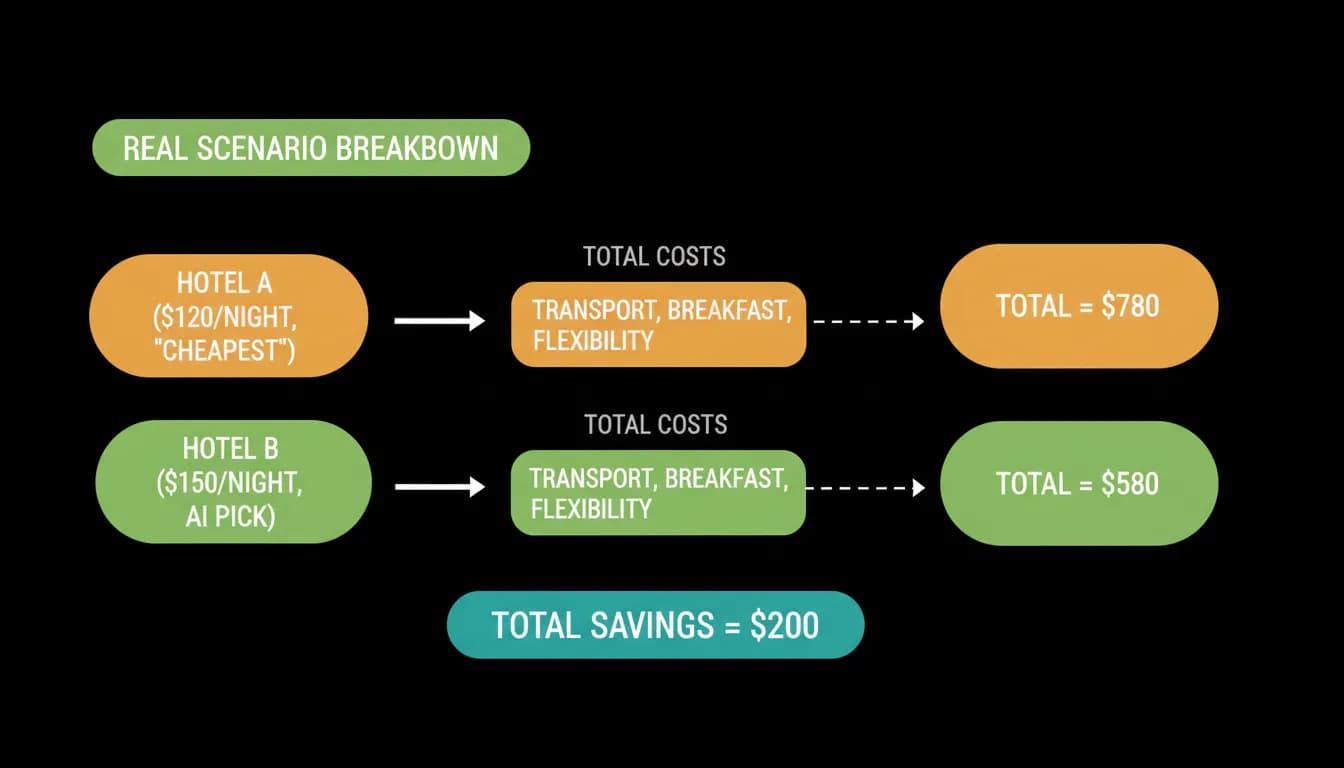
Consider a 4-night business trip to Chicago. The sort-by-cheapest approach selects a $120-per-night hotel 40 minutes from the convention center. Total cost:
Hotel: $480. Daily transport (rideshare): $180. Breakfast (not included): $80. Total: $740.
The AI-optimized approach selects a $155-per-night hotel 10 minutes walk from the convention center with included breakfast and a package rate. Total cost:
Hotel (package rate with flight): $520. Transport: $0 (walkable). Breakfast: $0 (included). Total: $520.
Same city, same dates, $220 savings. And the AI-recommended hotel is objectively better positioned, includes breakfast, and required no transportation logistics.
Multiply this by a year of travel — 6 to 10 hotel stays for a moderate traveler — and the AI strategy produces $1,500 to $3,000 in annual savings. Not from finding secret deals, but from evaluating total value rather than sticker price on every single booking.
Share your hotel priorities with your AI agent. Tell it what matters: location, breakfast, flexibility, loyalty, or pure price. Watch the recommendations change based on your priorities. The results will consistently beat sort-by-cheapest because value is always more nuanced than price.
Nowah is an AI travel agent that searches and books real flights and hotels through conversation — no filters, no thirty open tabs. Plan your next trip.