Building AI Trip Planning Tools: Currency, Tips, and More
Currency converter, tip calculator with local customs, bill splitter — travel utility tools that work standalone and through the AI chat agent.

Not every interaction with a travel app needs the AI agent. Sometimes you just need to know how much 500 yen is in dollars. Or whether you should tip in Japan (you should not). Or how to split a dinner bill four ways when one person only had a salad.
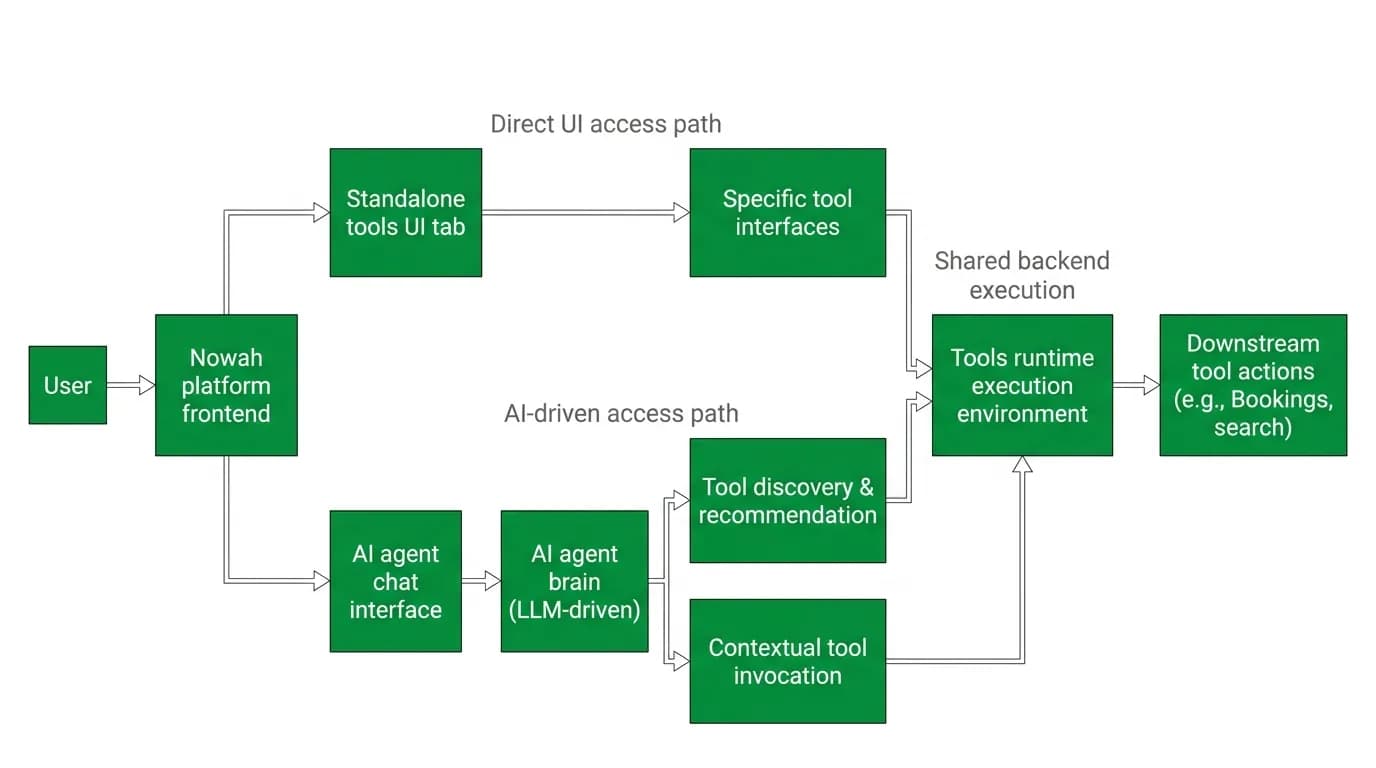
We built standalone travel tools for these moments: a currency converter, a tip calculator with local customs data, and a bill splitter. But here is what makes them interesting from an engineering perspective: they also work through the AI agent. Ask the agent "how much should I tip in France?" and it uses the same tool logic that powers the standalone UI.
Travel-specific tool design
Generic currency converters exist everywhere. Ours is different because it is built for travelers. When you select a currency pair, we also show you practical context: what a typical meal costs, what a taxi ride costs, and what the local tipping expectation is. If you are converting USD to Thai Baht, knowing that 1000 Baht is about $28 is less useful than knowing that 1000 Baht buys a nice dinner for two in Bangkok.
The tip calculator goes beyond percentage math. Tipping customs vary wildly by country and context. In the US, 20% at a restaurant is standard. In Japan, tipping is considered rude. In France, service is included but rounding up is polite. In Egypt, tipping (baksheesh) is expected for almost every service. Our tip calculator knows all of this and adjusts its defaults based on the country and context (restaurant, taxi, hotel porter, tour guide).
The bill splitter handles both equal and unequal splits. Equal splits are trivial math. Unequal splits, where each person had different items and you want to divide fairly, require a more thoughtful interface. We let users assign menu items to people and calculate each person's share including their proportional tax and tip.
The dual access pattern
Each tool is accessible two ways. You can open it from the tools tab in the app and use it with a full-screen UI. Or you can ask the AI agent in conversation and get the answer inline.
The engineering is organized so that the tool logic sits in a shared module. The standalone UI and the AI agent both call the same functions. When you ask the agent "convert 250 euros to dollars," the agent invokes the same currency conversion function that the standalone converter uses. The difference is that the standalone UI renders the result with a rich interactive display, while the agent renders it as a formatted message in the chat.
This dual access pattern has a nice side effect: any improvement to the tool logic benefits both access paths. When we add a new currency or update tipping data for a country, both the standalone tool and the agent get the update simultaneously.
Localization challenges
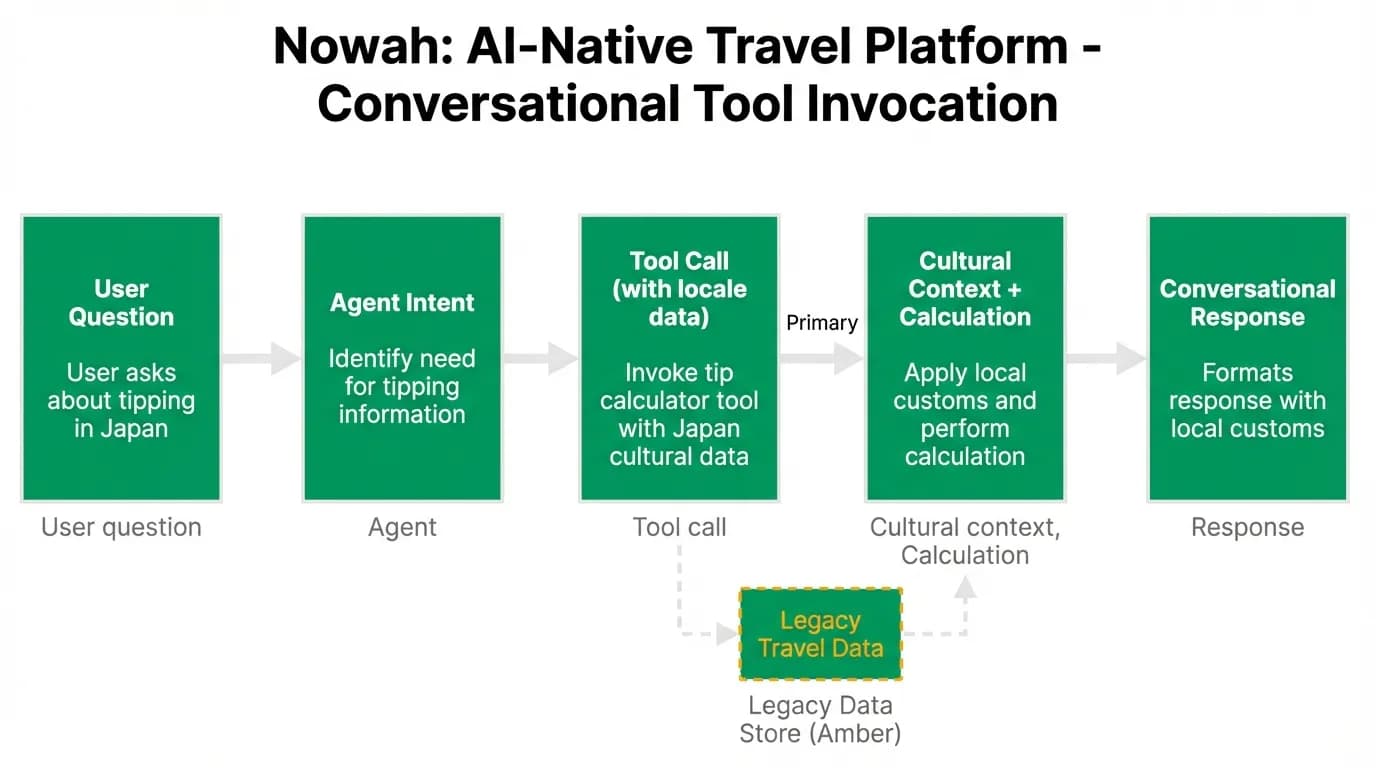
Currency and tipping tools are inherently multi-locale. We support multi-currency conversion with real-time exchange rates. But the harder localization challenge is the cultural knowledge encoded in the tip calculator.
Tipping customs are not just country-level data. They vary by context within a country. Restaurants, taxis, hotels, and tour guides often have different expectations. In some countries, the expectation varies by region or by the type of establishment. Fine dining vs. casual dining. Hotel bellhop vs. room service.
We maintain a structured dataset of tipping customs by country and context. This data comes from a combination of travel guides, local contributors, and government tourism resources. It is reviewed and updated regularly because customs do change. Several countries that traditionally did not expect tips have developed tipping cultures in tourist areas.
The formatting of currency values also varies by locale. Some currencies use commas for thousands separators and periods for decimals. Others use the opposite. Some currencies have no decimal places. The Japanese yen is whole numbers only. Getting this right matters because a misplaced decimal in a currency conversion is not just a UI issue; it could cause someone to drastically over-tip or under-tip.
Offline capability
International travelers frequently lose connectivity. Roaming data is expensive or unavailable. Airport WiFi is unreliable. The currency converter needs to work without a network connection because the moment you need to convert currency is often the moment you are arriving in a new country.
We cache the most recent exchange rates locally. When offline, the converter uses cached rates with a timestamp showing when they were last updated. For major currencies, rates cached within the past 24 hours are usually accurate enough for traveler purposes. The difference between a cached rate and the live rate is typically less than 1%, which matters for forex traders but not for someone estimating a dinner price.
The tip calculator works fully offline because tipping customs data is bundled with the app. The bill splitter is also fully offline since it is pure math with no external dependencies.
When connectivity returns, we refresh exchange rates in the background. The transition from cached to live data is seamless. There is no loading spinner or "updating rates" interruption.
Real-time data sources
For live exchange rates, we pull data from financial APIs that provide spot rates updated every few minutes. We normalize rates to a consistent format and cache them with short TTLs (15 minutes for popular currency pairs, 1 hour for less common ones).
We do not show the raw interbank rate because that is not what travelers get. Banks and ATMs apply a markup. We show the mid-market rate with a note that the actual rate at a bank or ATM will be slightly different. This sets realistic expectations without pretending we can predict each bank's markup.
For tipping data, we maintain our own dataset rather than relying on a third-party API. This gives us full control over accuracy and lets us add the contextual nuance (restaurant vs. taxi vs. hotel) that generic tipping APIs lack. We update the dataset manually based on research and user feedback, typically once per quarter.
These tools are small individually, but together they form a practical utility layer that travelers use throughout their trip. And because they share logic with the AI agent, they make the agent more capable without duplicating code.
Nowah is an AI travel agent that searches and books real flights and hotels through conversation — no filters, no thirty open tabs. Plan your next trip.