API Design Patterns for AI-Consumed Services
Dual-purpose APIs serving both human-driven UIs and AI agent tool calls. Here are the patterns that make endpoints work for both consumers.

Most API design advice assumes your consumers are human developers building UIs. That advice is incomplete when your API is also consumed by an AI agent making autonomous decisions about which endpoints to call, with what parameters, and how to interpret the results.
We design every API endpoint at Nowah to serve two consumers: the human-driven UI (our mobile and web apps) and the AI agent's tool calling system. These consumers have different needs, and the patterns that serve both well are not obvious until you have gotten them wrong a few times.
Dual-purpose API design
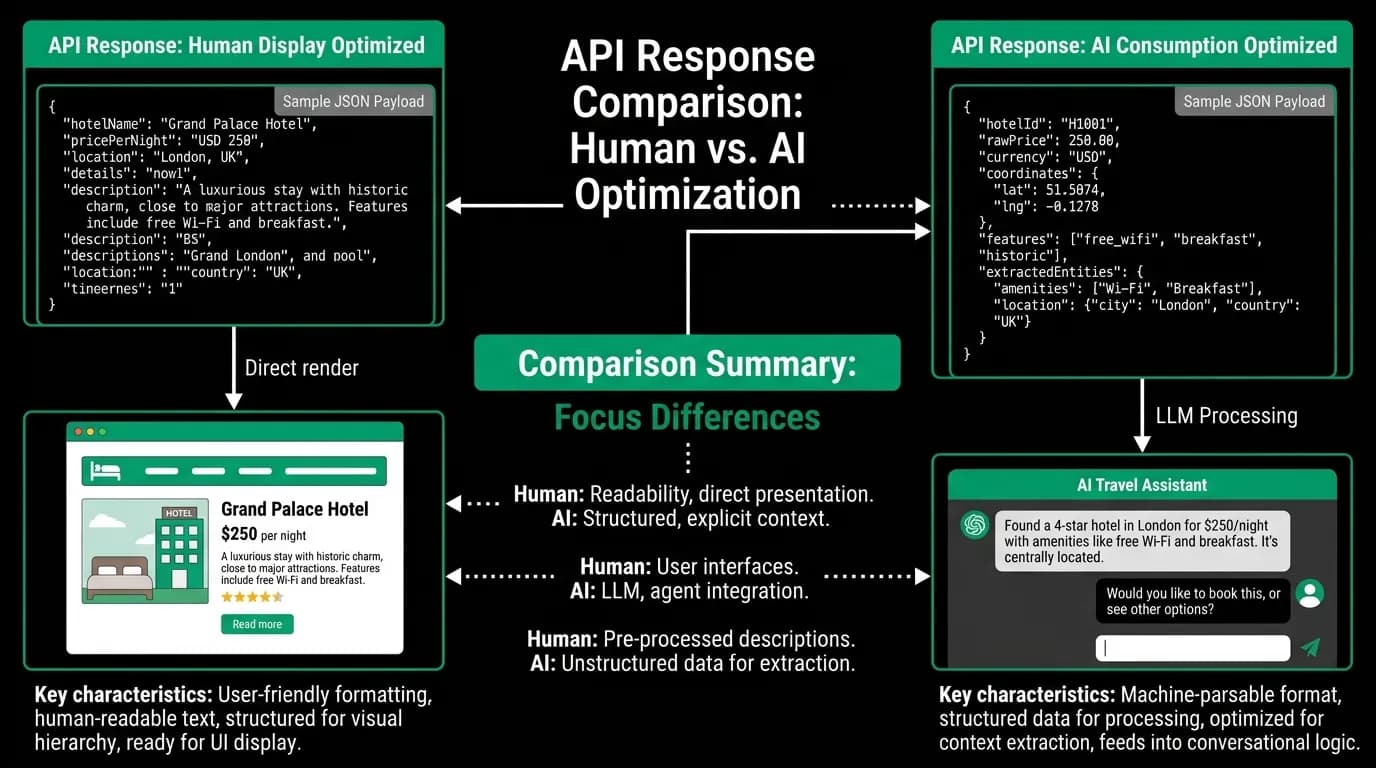
The same endpoint that the mobile app calls when a user taps "search flights" is the same endpoint the AI agent calls when it decides to search flights based on a conversation. Maintaining separate APIs for each consumer would be a maintenance nightmare, so we design every endpoint to work for both.
The key insight is that human UIs and AI agents differ in how they construct requests and how they consume responses, but the underlying data operation is the same. A flight search is a flight search regardless of who initiated it.
For request construction, the difference is in parameter flexibility. A UI form enforces structured input. The user picks dates from a calendar, selects an airport from a dropdown, chooses a cabin class from radio buttons. The parameters are always well-formed because the UI prevents malformed input.
An AI agent constructs parameters from natural language interpretation. The user said "sometime next week" and the agent translated that to a date range. The user said "somewhere warm" and the agent expanded that to a list of destination airports. The agent's parameters might include fields the UI never uses (like flexible date ranges or ranked destination preferences) and might omit fields the UI always includes (like exact dates when the user was vague).
Our API design handles this by making most parameters optional with sensible defaults, accepting ranges where the UI would send exact values, and validating flexibly rather than rigidly. An endpoint that rejects a request because the departure date is a range instead of a specific day is useless to an AI agent.
Response format design for AI consumption
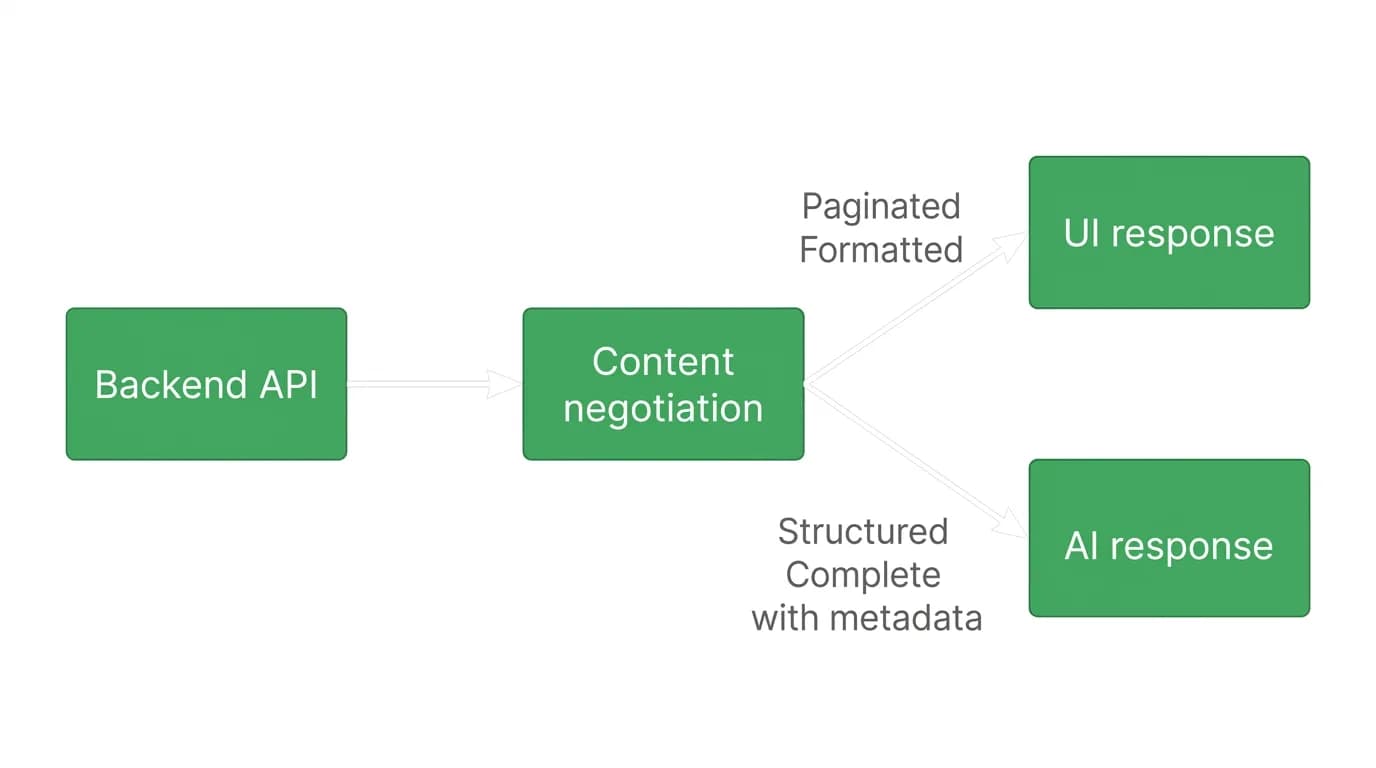
This is where the interesting trade-offs live. A human UI wants display-ready data. Formatted prices. Localized times. Truncated descriptions that fit the card layout. Paginated results.
An AI agent wants reasoning-ready data. Raw numeric prices it can compare. UTC timestamps it can calculate with. Complete descriptions it can evaluate against user preferences. All results in one response so it can rank them holistically.
We solve this with a response format that includes both. Every response contains raw data fields (numeric price, ISO timestamp, full text) alongside display fields (formatted price string, localized time, truncated summary). The UI reads the display fields. The AI agent reads the raw fields.
This doubles the response payload size. We accept that trade-off because the alternative, maintaining separate response formats for each consumer, is worse. It is worse because it means twice the serialization logic, twice the testing surface, and twice the chance of the two formats drifting out of sync.
We also include metadata in responses that the UI ignores but the AI agent needs. Provider reliability scores. Data freshness timestamps. Confidence levels for price estimates. This metadata helps the agent make better decisions without requiring separate API calls to retrieve it.
Error response design for AI interpretation
Error handling is where the dual-consumer pattern gets genuinely hard.
A human UI can show an error modal: "Something went wrong. Please try again." The user reads it, shrugs, and retries. An AI agent cannot shrug. It needs to understand what went wrong, why, and what to do about it.
Our error responses include three layers of information. A machine-readable error code that the agent can match against its decision logic ("PROVIDER_TIMEOUT", "INVALID_DATE_RANGE", "SOLD_OUT"). A human-readable message that the UI can display. And a structured context object that gives the agent enough information to decide its next action.
For example, if a flight search returns a SOLD_OUT error, the context object includes which flights were sold out, when they sold out (to indicate how stale the data was), and whether alternative dates or routes might have availability. The UI just shows "these flights are no longer available." The agent reads the context and decides whether to retry with different dates, suggest alternative routes, or ask the user for new preferences.
The error context object is the piece most API designers skip. It is the difference between an AI agent that retries blindly and one that adapts intelligently to failures.
Documentation that serves both consumers
API documentation has a new dual audience. Human developers need examples, explanations, and getting-started guides. AI agents need precise, machine-readable schema definitions that describe every parameter, every response field, and every error condition.
We write documentation in layers. The top layer is narrative documentation for human developers: what the endpoint does, why you would call it, common usage patterns. The middle layer is detailed parameter and response documentation with types, constraints, and examples. The bottom layer is a machine-readable schema that the AI agent's tool definition system consumes directly.
The machine-readable layer is the one that requires the most discipline. If a parameter description says "date of departure" but does not specify the format, a human developer will look at the example and figure out it is ISO 8601. An AI agent might not. We specify format, constraints, optionality, and defaults for every parameter in the schema because the agent has no fallback except to guess.
We have learned through painful experience that the tool definition the AI agent uses must match the API specification exactly. When they drift apart, the agent sends malformed requests, which look like AI bugs but are really documentation bugs.
Versioning strategies for AI-dependent APIs
Breaking changes affect AI agents differently than they affect human UIs. When we change a response format, the mobile app can be updated and redeployed. Users update their apps eventually. But the AI agent's tool definitions are part of its prompt, and changing them means changing agent behavior across the board, immediately.
We version our APIs with this asymmetry in mind. Response format changes are additive only. We add new fields but never remove or rename existing ones. When a field needs to change semantically, we add a new field with the new semantics and deprecate the old one with a timeline.
For the mobile app, this means backward compatibility windows measured in months (users do not update their apps on day one). For the AI agent, changes take effect as soon as we update the tool definition, which means we test exhaustively before updating.
Feature flags give us a middle ground. We can expose a new API behavior behind a flag, update the agent's tool definition to use the flag, and roll out gradually. If the new behavior causes problems, we flip the flag without touching the API code.
The practical lesson: treat your AI agent as the most fragile, least forgiving API consumer you have. It cannot adapt on the fly. It cannot read a changelog and adjust. It does exactly what its tool definition says, and if the definition is wrong or outdated, it breaks. Design your versioning strategy with that consumer in mind, and human consumers benefit too.
Nowah is an AI travel agent that searches and books real flights and hotels through conversation — no filters, no thirty open tabs. Plan your next trip.