From Chat to Booking: How AI Agents Navigate Multi-Step Flows
An AI travel agent goes from 'find me a flight to Paris' to a confirmed booking in 5+ API calls. Here is the full journey with decision points, errors, and user interactions.
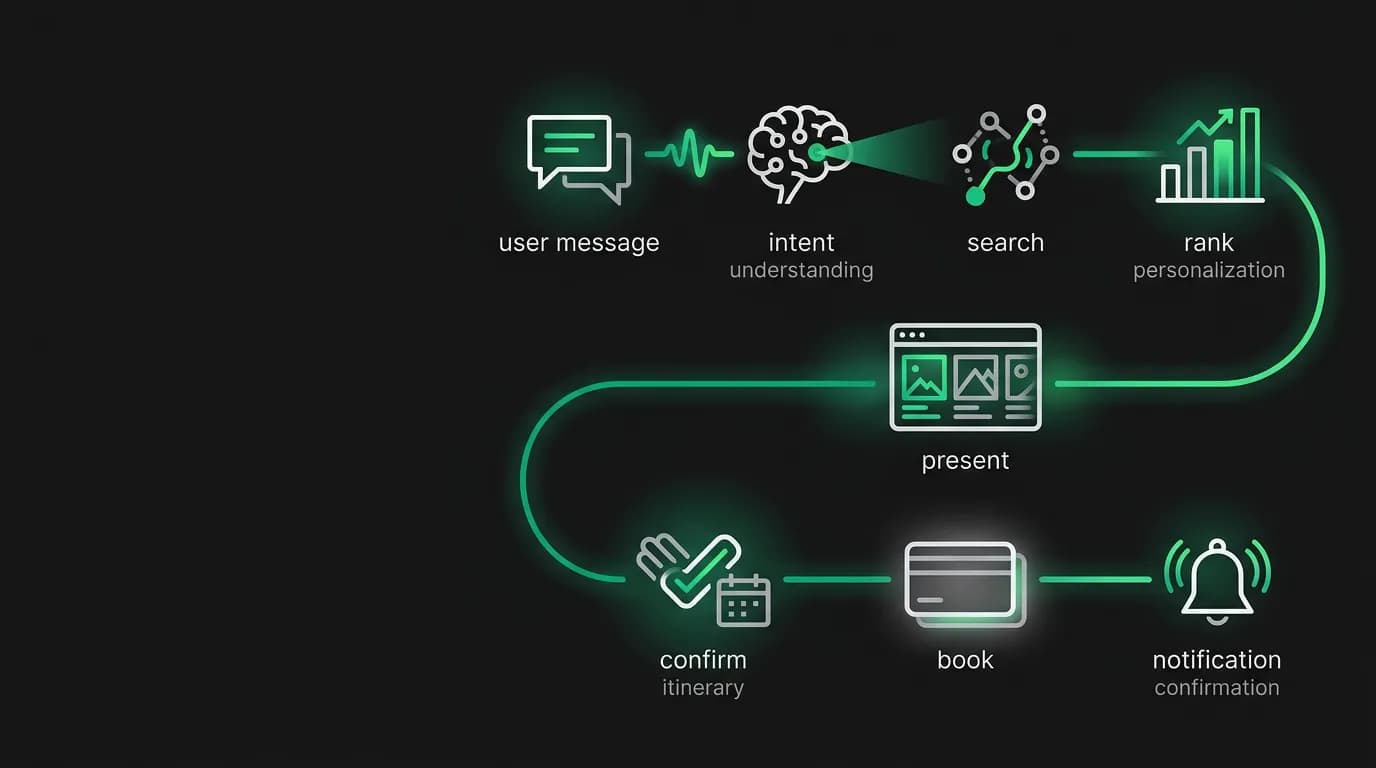
"Book me a flight to Paris next week."
Seven words. Behind them, the AI agent is about to execute a sequence of at least five distinct API calls across different modules, make a dozen decisions about ambiguous parameters, present ranked options to a human, handle their selection, process a payment, confirm with an airline, and send a notification. If anything goes wrong at any step, it needs to recover gracefully without losing the conversation context.
This is the journey from chat message to confirmed booking, and it is more complex than most developers expect when they first integrate a travel AI agent.
Intent extraction: turning language into parameters
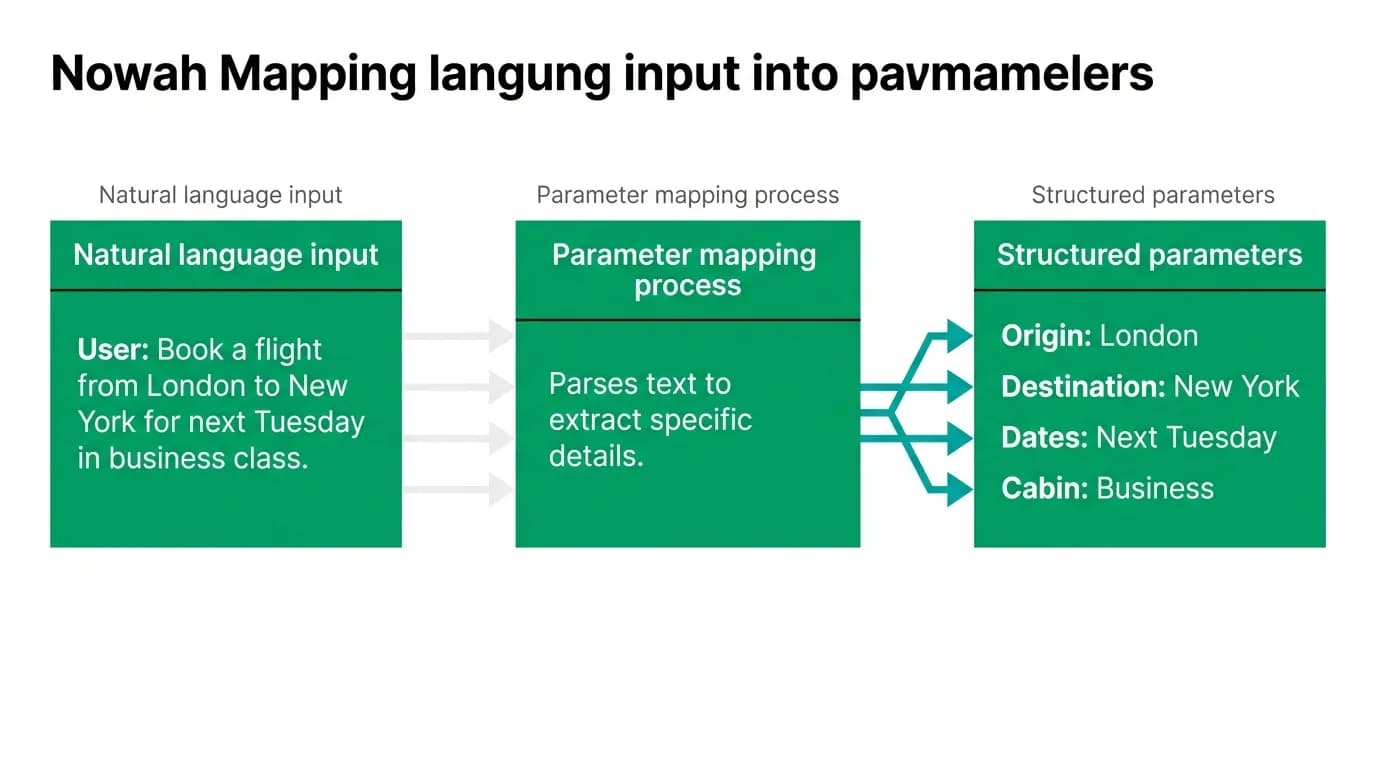
The first thing the agent does is parse natural language into structured search parameters. "Paris next week" needs to become a specific destination airport (or airports -- Paris has two major ones), a departure date range, and a return date if the user expects a round trip.
The intake module handles this. It is the first stage in a five-stage pipeline: intake, search, ranking, presentation, and booking. Each stage is a separate module with clear inputs and outputs.
Intent extraction is where the hard ambiguity lives. "Next week" is relative to today. "Paris" could be CDG or ORY. The user did not specify an origin, so the agent needs to either infer it from context (maybe a past conversation mentioned they live in New York) or ask. They did not mention cabin class, number of travelers, or whether they want a round trip.
The agent makes judgment calls here. If it has strong context from memory -- the user always flies economy, lives in San Francisco, and typically takes week-long trips -- it can fill in the gaps and confirm with the user. If context is thin, it asks targeted questions. Not a form's worth of fields, but one or two high-impact questions: "Flying from New York? And when would you like to come back?"
The output of intent extraction is a structured search request with explicit parameters and confidence scores. High confidence parameters get used directly. Low confidence ones get confirmed with the user before searching.
Search and ranking: finding the best options
With structured parameters in hand, the agent calls the flight search API. This is where fan-out happens. Depending on the query, the search might go to multiple airline data providers simultaneously to get comprehensive inventory. The agent handles this as a single operation, but underneath, multiple API calls are executing in parallel.
Results come back as a list of flight offers, sometimes dozens of them. This is where the ranking module takes over. Raw search results ranked purely by price are not very useful. A $50 cheaper flight that adds a 7-hour layover in a connecting airport with no lounges is not a good deal for most travelers.
The ranking module balances multiple signals. Price, obviously. But also total travel time. Layover quality and duration. Airline reliability data. Time of departure relative to user preferences. Whether the routing passes through airports the user has expressed opinions about. The result is a scored and ordered list where the top options genuinely represent the best choices for this specific user, not just the cheapest fares.
The agent does not just present the top three and move on. It explains its reasoning. "I ranked the direct flight first even though it is $80 more because you mentioned preferring to avoid connections when possible. The second option saves money but adds a 3-hour layover in London." This transparency builds trust and helps users make informed decisions.
Presentation and selection
This stage is where the agent shifts from autonomous processing to collaborative decision-making with the user. It presents the ranked options with enough detail for the user to choose but not so much that they are overwhelmed.
Each option shows departure and arrival times, total duration, number of stops, airline, price, and the key differentiators that explain the ranking. The agent highlights trade-offs between options: "Option A is the fastest. Option B is $120 cheaper but arrives 3 hours later. Option C has a lounge-accessible layover if you want to stretch the journey."
A single "book me a flight" request can trigger ten or more tool calls by this point. Search calls, ranking computations, preference lookups, airport detail fetches, and airline data retrieval all happen before the user sees the first option. The agent orchestrates all of this while maintaining a natural conversational flow.
The user selects an option, often with additional context: "Let's go with the direct flight, but can you check if there are window seats available?" The agent adapts, making additional API calls to retrieve seat maps and availability before confirming the selection.
Booking execution: the point of no money
Once the user confirms their choice, the booking module takes over. This is the most sensitive part of the flow because real money is involved and mistakes are expensive.
The booking flow is designed as a state machine with explicit steps. First, the agent creates a booking intent, which locks the selected offer's price for a limited window. This prevents the price from changing between the user's selection and the payment.
Next comes payment authorization. The agent initiates a payment flow, and the user confirms the charge. The agent never stores or directly handles payment credentials. It creates a payment intent through our infrastructure and lets the secure payment layer handle the sensitive parts.
After payment authorization, the agent submits the booking to the airline provider. This is the step that actually creates the reservation. The agent waits for confirmation, which can take anywhere from two seconds to thirty seconds depending on the airline's systems.
Finally, the confirmed booking generates a confirmation record with all the details: confirmation number, ticket details, baggage information, and cancellation policy. The agent presents this to the user and triggers post-booking actions.
Error recovery: when things go wrong
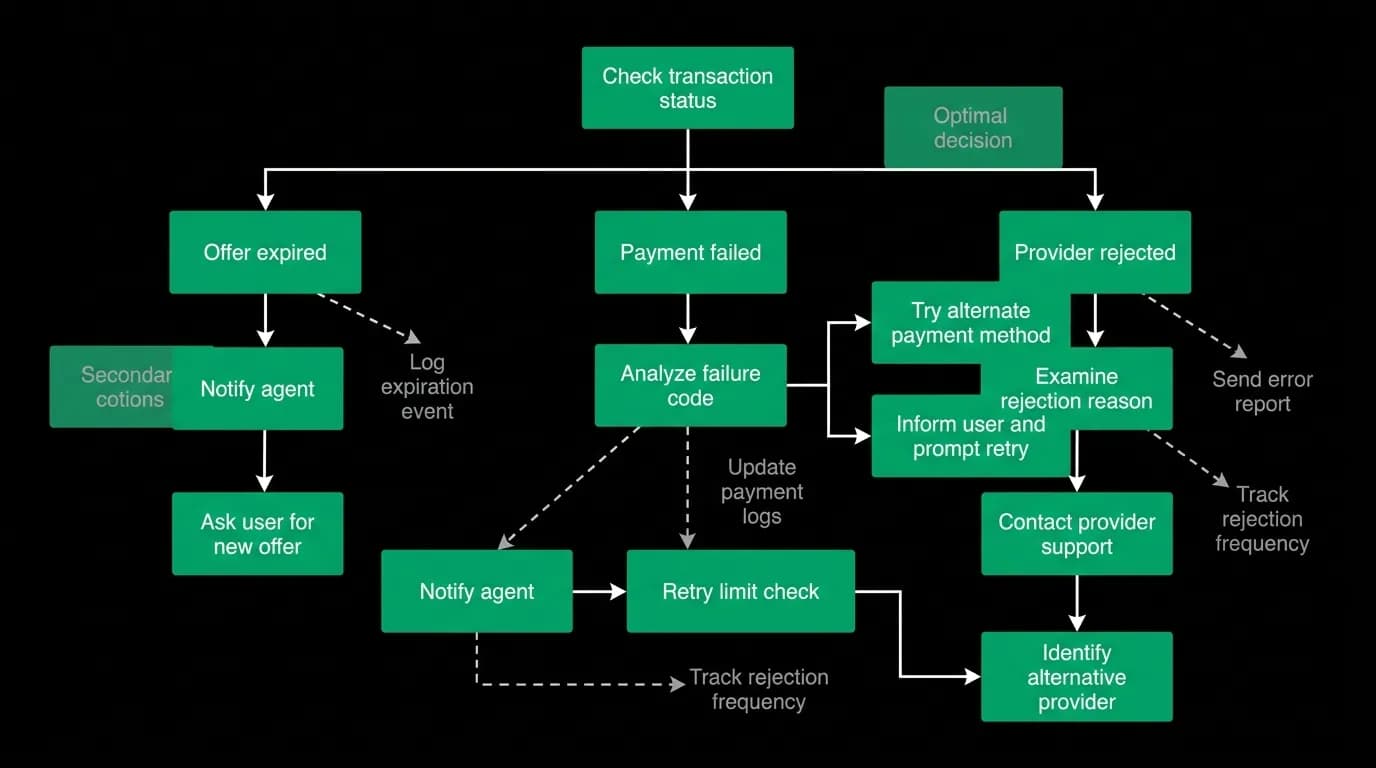
Every step in this flow can fail. What separates a good travel agent from a frustrating one is how it handles those failures.
Offer expired. The most common failure. The user takes a few minutes to decide, and the fare is no longer available. The agent detects the expiration, re-runs the search, and presents updated options. If the same flight is still available at a higher price, it tells the user: "That fare expired, but the same flight is available for $40 more. Want me to grab it, or should we look at other options?"
Payment declined. The agent does not know why a payment was declined, and it should not speculate. It tells the user the payment did not go through and asks them to try a different method or contact their bank. No panic, no detailed error codes shown to the user.
Provider rejection. Sometimes an airline's system accepts the booking request but rejects it during processing. Maybe the fare class sold out between search and booking. The agent catches this, explains what happened, and offers to search again. It does not retry the same failed booking.
Partial failure. In multi-segment bookings, one leg might confirm while another fails. The agent handles this carefully, clearly communicating which parts succeeded and which need rebooking, and offering to cancel the confirmed segment if the user wants to start over.
Each of these recovery paths is tested against our sandbox scenarios. We have pre-built test cases for every failure mode so agents can validate their recovery logic before going to production.
Post-booking: the journey continues
A confirmed booking is not the end of the agent's job. It sends a confirmation notification immediately. It delivers booking documents (e-tickets, confirmation PDFs) to the user's preferred channel. And it sets up monitoring for schedule changes.
If the airline changes the flight time or routing after booking, the agent detects the change and notifies the user proactively. If the change is significant, it can present rebooking options without the user having to do anything.
This post-booking monitoring is where the value of a persistent AI agent really shows. Traditional booking tools end their job at the confirmation screen. An AI agent that stays with you through the entire trip lifecycle, from "book me a flight" to "welcome home," is a fundamentally different product.
The entire pipeline -- intake, search, ranking, presentation, booking, and monitoring -- executes as a coordinated sequence of API calls orchestrated by the agent. Each module has clear boundaries and well-defined interfaces. This modularity makes it possible to improve each stage independently and to test them in isolation.
Building this kind of multi-step flow is hard. But when a user says "book me a flight to Paris next week" and has a confirmed ticket fifteen minutes later without opening a single browser tab, the complexity is worth it.
Nowah is an AI travel agent that searches and books real flights and hotels through conversation — no filters, no thirty open tabs. Plan your next trip.