Connection Pooling and Resource Management for AI Workloads
AI agents hold connections longer and consume more memory per request. Here is how we manage database connections and compute for AI-heavy traffic.
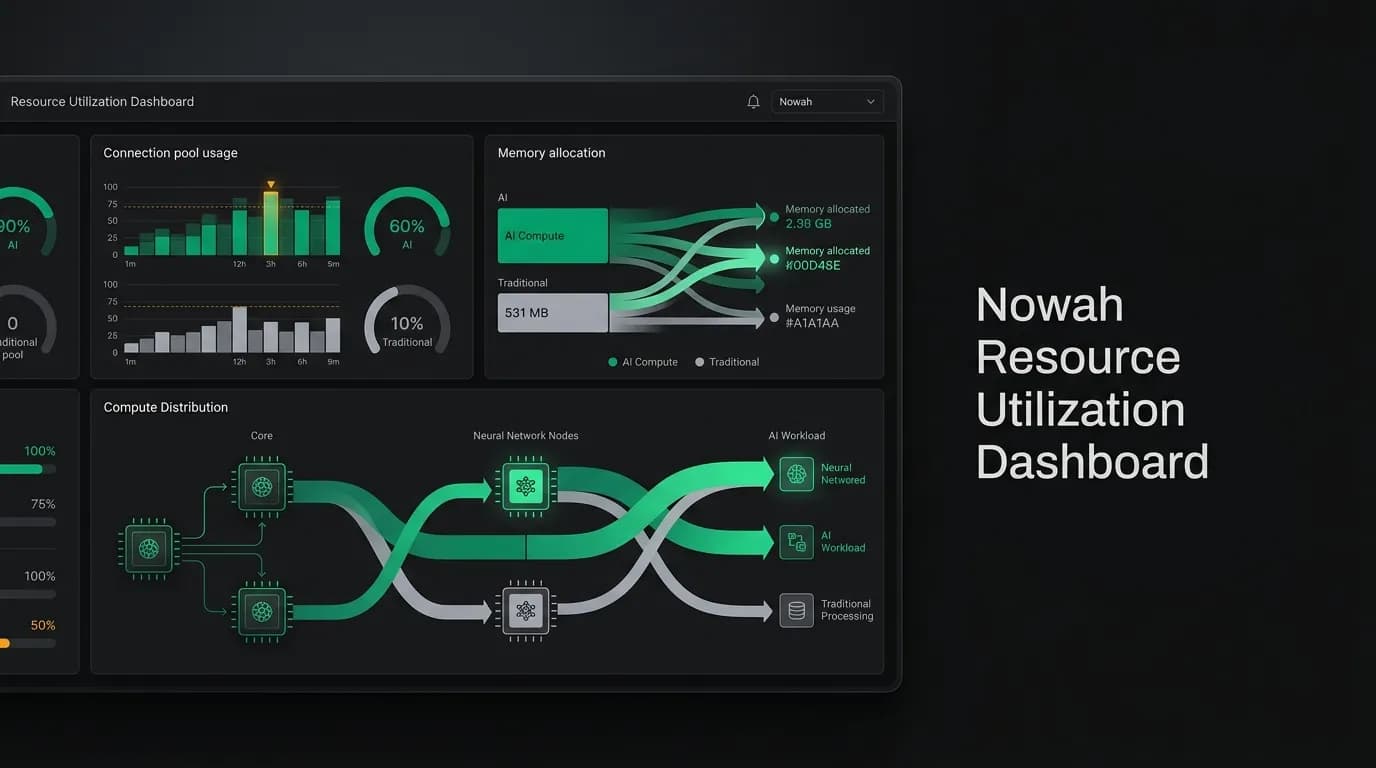
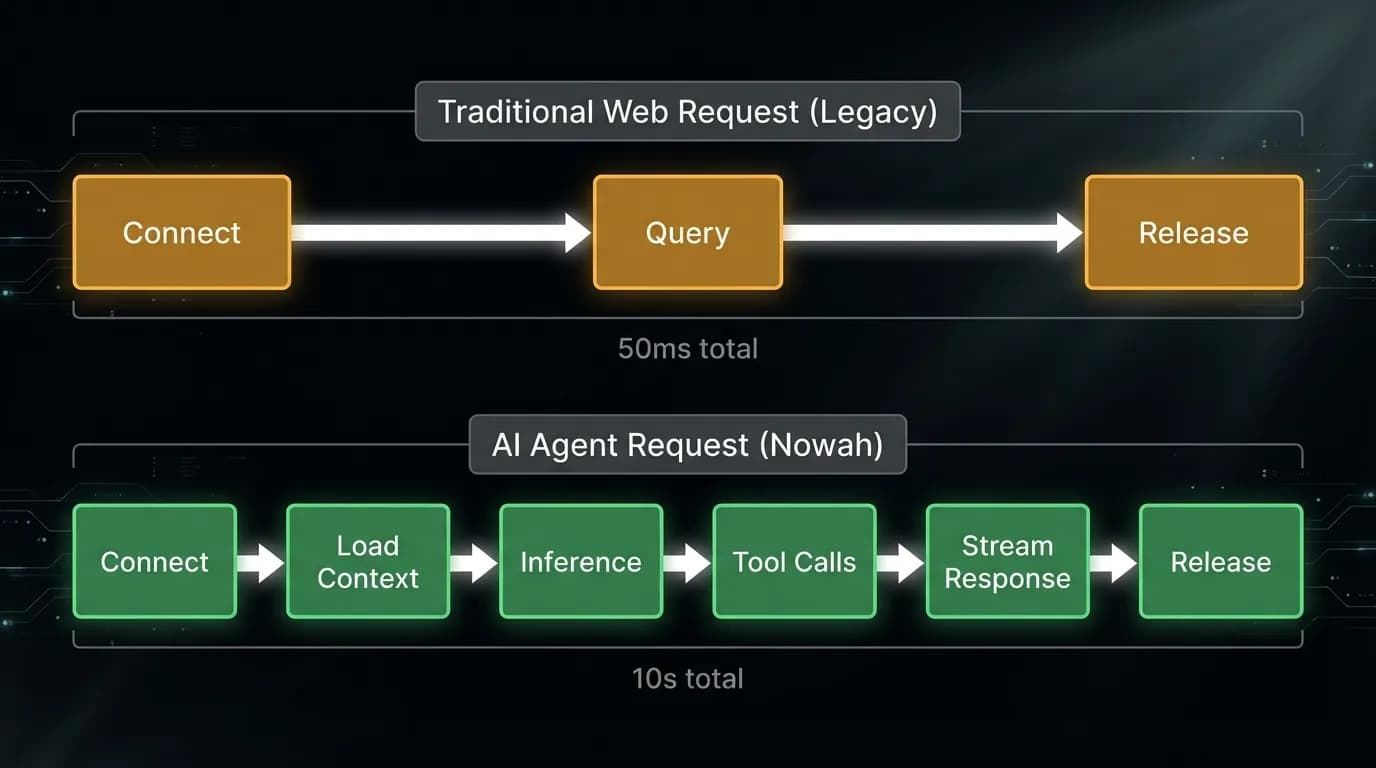
A typical web request hits the server, queries the database, formats a response, and returns in 50-200 milliseconds. The database connection is held for maybe 10ms. The memory footprint is small and released quickly. Connection pools sized for this workload pattern work well with modest settings.
An AI agent request hits the server, retrieves conversation context from the database, sends a prompt to the AI model, waits for inference (2-10 seconds), receives the response as a stream, potentially makes several tool calls (each involving more database queries and external API calls), and streams the final response back to the user. Total duration: 5-30 seconds. The database connection is held intermittently across that entire span. Memory buffers stay allocated for the streaming duration.
This difference in request lifecycle has profound implications for resource management. Techniques that work fine for traditional web workloads break under AI workload patterns.
Long-running AI requests and connection pools
A database connection pool has a fixed size. Say 20 connections. In a traditional web app, each request holds a connection for 10ms, so 20 connections can serve 2,000 requests per second. The math is generous.
In an AI-native app, each request might hold a connection for 500ms across multiple database queries spread over a 10-second conversation turn. That same pool of 20 connections now serves 40 requests per second. And if a burst of users sends messages simultaneously, the pool exhausts quickly.
The naive fix is to make the pool bigger. But database connections have overhead. Each connection consumes memory on the database server. Beyond a certain pool size, the database itself becomes the bottleneck.
Our approach is to minimize connection hold time. Instead of holding a connection for the entire duration of an agent request, we acquire a connection, execute the query, and release it back to the pool immediately. The next query in the same request acquires a fresh connection from the pool. This pattern means a 10-second agent request does not block a connection for 10 seconds. It blocks multiple connections for a few milliseconds each.
This requires restructuring code that assumes a single connection for the life of a request. No long-running transactions that span the entire agent turn. No connection-scoped caching. Each database interaction is atomic and self-contained.
We also use a connection proxy layer between our application and the database. The proxy manages a larger pool of lightweight connections to the application while maintaining a smaller pool of heavyweight connections to the database. This absorbs connection spikes without overwhelming the database server.
Memory management for streaming responses
Streaming AI responses to the client requires holding memory buffers open for the entire stream duration. A typical stream lasts 3-15 seconds. During that time, the server is accumulating the response in a buffer, writing chunks to the client's connection, and maintaining the server streaming (unidirectional server streaming) connection state.
For a single stream, the memory overhead is trivial. For hundreds of concurrent streams, it adds up. Each stream allocates buffer space for the accumulated response, connection state for the server streaming channel, and context objects for the ongoing tool calls.
We manage this with bounded buffers and backpressure. If the client cannot consume data as fast as the server produces it, the server pauses production rather than accumulating an unbounded buffer. This prevents a slow client from causing memory pressure on the server.
We also aggressively clean up completed streams. When a response finishes streaming, all associated buffers and state are deallocated immediately rather than waiting for garbage collection. In a high-concurrency environment, the delay between response completion and garbage collection can leave significant memory allocated to dead connections.
Resource isolation
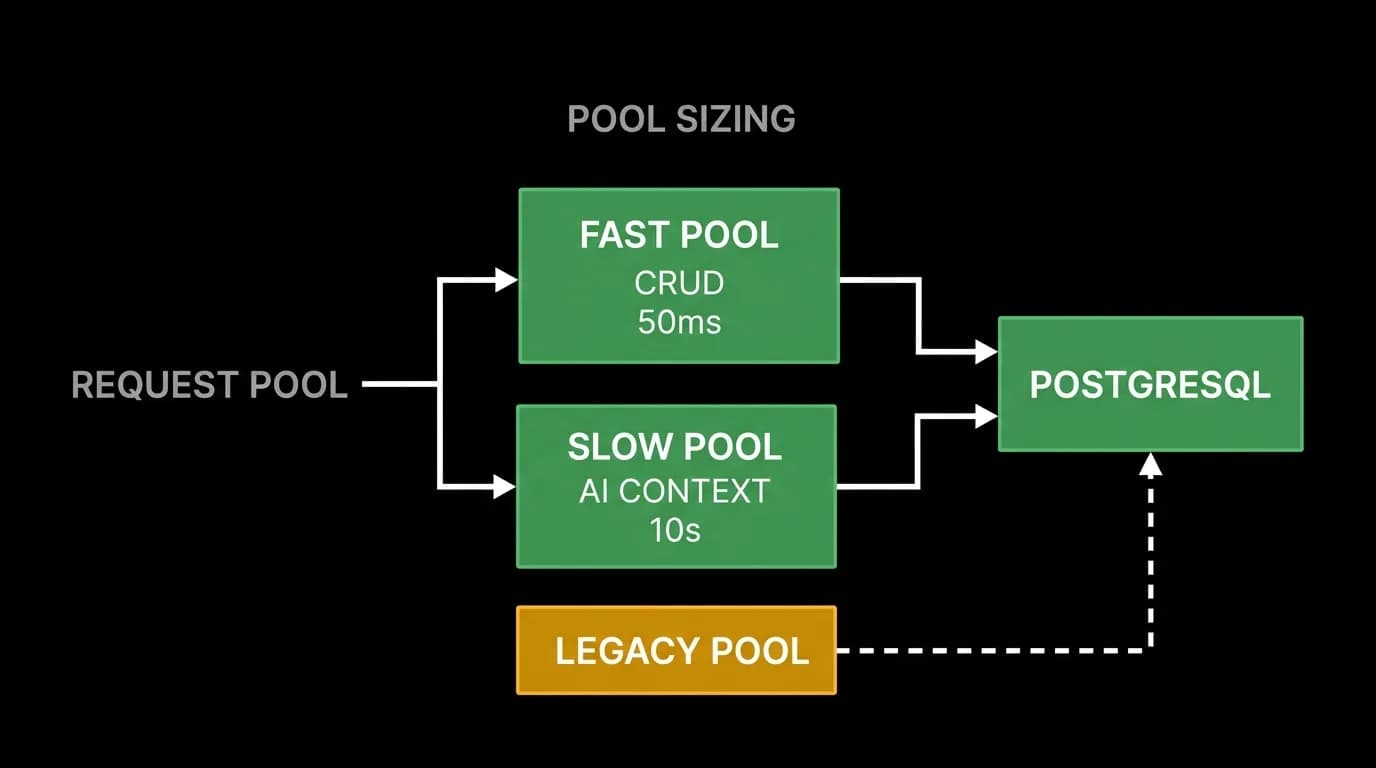
AI agent traffic and traditional API traffic have different resource profiles, and mixing them on the same infrastructure creates a priority inversion problem. A burst of AI requests (long-running, memory-intensive) can starve traditional API requests (short, lightweight) of database connections and memory.
We isolate resources by workload type. AI agent requests and standard API requests use separate database connection pools. This ensures that a spike in AI traffic does not prevent the mobile app from loading a user's trip list or processing a quick API call.
The isolation extends to compute resources. AI inference requests are routed to dedicated worker processes that have memory and CPU limits independent of the API server. If an AI inference takes longer than expected and consumes more memory than budgeted, it affects only the AI worker pool, not the general API pool.
This isolation costs efficiency. Two smaller pools are less efficient than one large pool because neither pool can borrow unused capacity from the other. We accept this trade-off because the predictability of the standard API is more important than maximizing resource utilization. A user who cannot load their trip details because the AI pool exhausted shared database connections is a worse outcome than a slightly underutilized AI pool.
Scaling for AI burst patterns
AI workload patterns are bursty in ways that traditional web traffic is not. A single user message can trigger a cascade of tool calls, each of which makes external API requests and database queries. Ten users sending messages simultaneously creates a burst of 50-100 concurrent operations.
Traditional auto-scaling triggers (CPU utilization, request count) do not capture AI burst patterns well. CPU utilization stays low during AI inference because the compute is happening on the AI model provider, not on our servers. Request count stays low because each conversation turn is a single request, even though it generates dozens of internal operations.
We use custom scaling signals. Connection pool saturation percentage is one. Streaming response queue depth is another. AI inference queue wait time is a third. When any of these signals exceeds its threshold, we scale up worker capacity.
The scaling response needs to be fast because AI bursts are sharp. A marketing email that drives a wave of users to the app can create a burst that peaks in minutes. If scaling takes 5 minutes to respond, the burst has already degraded the experience for early arrivals. We keep warm capacity (instances that are running but idle) to absorb the initial burst while new capacity spins up.
Cost efficiency
AI-native companies spend 15-30% of their infrastructure budget on AI inference. That is a fundamentally different cost structure from traditional web applications where compute is cheap and the big expenses are databases, CDN, and bandwidth.
We optimize AI inference costs several ways. Conversation context caching avoids redundant processing when a conversation continues. Response streaming starts delivering value to the user before the full response is generated, which means perceived latency is lower than actual inference time, allowing us to use slightly slower (cheaper) models without degrading the experience. And we route simple requests (greetings, basic questions) to lighter-weight model configurations that cost less per invocation.
Resource management for AI workloads is not a solved problem. The tooling and best practices are still evolving. What works today may be obsolete in a year as AI inference becomes faster and cheaper. But the principles will endure: minimize hold time on shared resources, isolate workloads with different profiles, scale based on the right signals, and treat inference cost as a first-class optimization target.
Nowah is an AI travel agent that searches and books real flights and hotels through conversation — no filters, no thirty open tabs. Plan your next trip.