Designing a Travel API Developers Actually Want to Use
Learn the API design principles behind Nowah — resource orientation, prefixed IDs, cursor pagination, and consistent responses that make travel integration painless.

I spent the first two years of my career integrating travel APIs, and most of that time was spent deciphering documentation that read like it was written for a mainframe operator in 1987. The schemas were inconsistent, the error codes were cryptic numbers with no explanation, and every endpoint felt like it was designed by a different team who never talked to each other.
Travel APIs have earned their reputation as some of the worst developer experiences in any industry. Legacy Global Distribution Systems still expose message formats from the 1980s. Even newer aggregators ship inconsistent schemas, opaque error codes, and documentation that requires a week of reading before you can make your first API call. The average onboarding time for a legacy GDS integration is two to five weeks. We wanted to get that down to five minutes.
When we started building Nowah, we had a clear thesis: the best travel booking experience starts with the best developer experience. If engineers can search flights, compare hotel options, and execute bookings through clean and predictable APIs, they build better products. Those products reach travelers who deserve faster, smarter trip planning.
Here is what we learned about API design that developers actually appreciate.
Resource-oriented design that maps to the real world
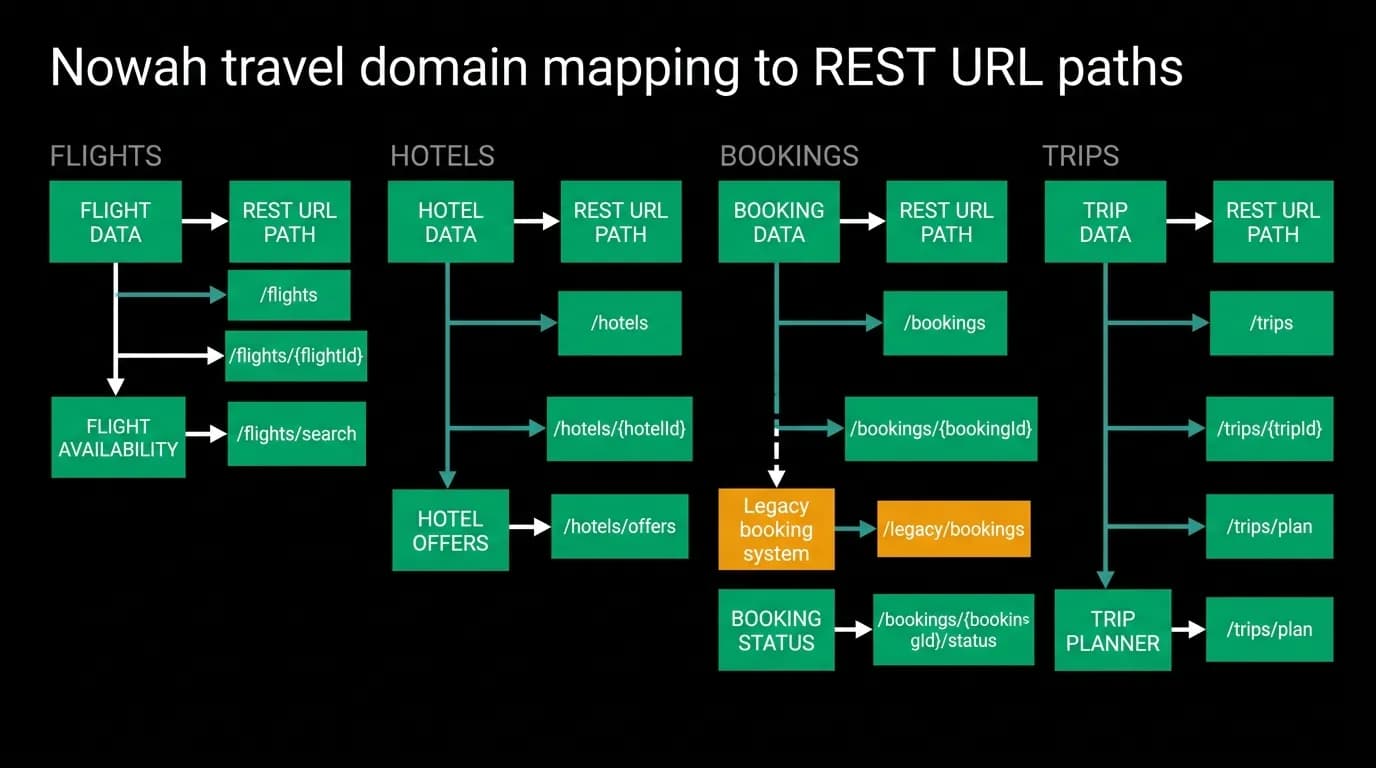
Travel is a domain with well-defined objects. There are flights, hotels, bookings, trips, and travelers. Each of these maps naturally to a REST resource with a clean URL structure.
The URL hierarchy should mirror how developers think about the domain. When someone wants to search for flights, they should be able to guess the endpoint before reading the docs. `GET /flights/search` makes sense. `POST /v2/travelservice/air/availability/query` does not.
We mapped every domain object in travel to a corresponding REST resource. Flights live at `/flights`. Hotels live at `/hotels`. Bookings live at `/bookings`. Trips, which are containers for multiple bookings, live at `/trips`. Each resource supports the operations you would expect: create, read, update, list. No surprises.
This sounds obvious, but you would be shocked how many travel APIs break this pattern. Some put everything behind a single endpoint with a `type` parameter. Others mix concerns so that the flight search endpoint also handles seat selection and meal preferences in the same request body. We kept each resource focused on one thing.
The benefit compounds when developers start composing API calls. Search for flights, pick an offer, create a booking with that offer ID, attach it to a trip. Each step maps to one resource and one operation. The mental model stays simple even as the workflow gets complex.
The response envelope that eliminated guesswork
Every Nowah API response wraps in the same envelope:
{
 "success": true,
 "data": { ... }
}
On failure:
{
 "success": false,
 "error": {
 "code": "OFFER_EXPIRED",
 "message": "The selected flight offer has expired.",
 "details": "Offer flt_abc123 expired at 2026-03-15T14:00:00Z. Search again for current pricing.",
 "docs": "https://docs.nowah.com/errors/OFFER_EXPIRED",
 "requestId": "req_xyz789"
 }
}
This consistency does something powerful: it eliminates conditional parsing logic. Every successful response has `success: true` and a `data` field. Every error has `success: false` and an `error` object with the same five fields. Developers write one response handler and it works across every endpoint.
I have seen APIs where the success format changes depending on which endpoint you call. Some return an array at the root level. Others wrap in a `results` key. Others use `payload`. Every inconsistency forces the developer to write special-case logic, and special-case logic is where bugs hide.
We also standardized HTTP status codes to match their semantics exactly. 200 means success. 400 means the developer sent invalid input. 401 means authentication failed. 429 means rate limit exceeded. 500 means we messed up. No creative interpretations. A 200 response with `success: false` in the body is a pattern we explicitly rejected because it forces developers to check both the status code and the body, and they will forget to check one of them.
Prefixed IDs and the outsized impact of a small decision

Every ID in the Nowah API carries a prefix that identifies its resource type. Flight offers get `flt_`. Hotels get `htl_`. Bookings get `bkg_`. Trips get `trp_`. Users get `usr_`. Requests get `req_`.
This was a small decision that took about ten minutes to make and has paid dividends ever since. When a developer opens a log file and sees `bkg_7f3a9c2d`, they know instantly that they are looking at a booking. When a support ticket comes in with an ID, the engineer triaging it can identify the resource type without querying a database.
Prefixed IDs cut our average support-ticket triage time because the resource type is visible in every log line, every error message, and every webhook payload. There is no ambiguity about what kind of thing you are looking at.
The implementation is trivial. Generate a UUID, prepend the type prefix, done. But the downstream effects touch everything: logging, debugging, documentation examples, and even conversation between team members. "Can you check bkg_abc123?" is faster to process mentally than "can you check abc123? I think it's a booking but it might be a payment."
I would argue that prefixed IDs are one of the highest-leverage decisions you can make in API design relative to the effort involved. They cost almost nothing to implement and they improve every interaction that involves an identifier.
Cursor pagination for data that never sits still
Flight prices change constantly. An airline might update fares multiple times per minute across hundreds of routes. Hotel availability shifts as rooms sell out and cancellations come in. This volatility creates a specific problem for pagination.
With traditional offset pagination, you request page 1, page 2, page 3, and so on. Each page is defined by a numeric offset: skip the first 20 results, give me the next 20. This works fine for static data. It breaks badly for data that changes between page requests.
Imagine you are paginating through flight search results. You fetch page 1 (results 1-20). Between page 1 and page 2, a new fare gets inserted at position 5. Now when you fetch page 2 (results 21-40), everything has shifted. Result 20 from page 1 appears again as result 21 on page 2. You get a duplicate. Or worse, a result that was at position 21 shifts to position 20 and you never see it at all. This is the phantom row problem, and it is not a theoretical concern with travel data. It happens constantly.
Cursor-based pagination avoids this entirely. Instead of saying "skip 20, give me 20," you say "give me the 20 results that come after this specific cursor token." The cursor token encodes a unique position in the result set, typically a combination of the sort key and the record's unique ID. No matter how the underlying data changes, the cursor always points to the right place.
We return `nextCursor` and `hasMore` fields in every paginated response. The cursor is opaque to the client, which means developers cannot construct invalid pagination states by guessing or manipulating the token. This opaqueness is intentional. It gives us the freedom to change the cursor encoding without breaking any integration.
Performance also favors cursors. Offset pagination on most databases degrades as the offset grows because the database has to scan and discard all the rows before the offset. Cursor pagination uses an indexed `WHERE` clause that performs in constant time regardless of how deep into the result set you are.
Timestamps, currencies, and the small things that matter
Two conventions that seem minor but prevent real bugs.
All timestamps in the Nowah API are ISO 8601 in UTC. No timezones. No Unix timestamps. No ambiguous date formats. When a developer sees `2026-06-15T14:30:00Z`, there is exactly one interpretation. We have seen APIs that return timestamps in the server's local timezone without specifying which timezone that is. Debugging a time-related bug when you do not know what timezone the server is in is an experience I would not wish on anyone.
All currency amounts are integers in the smallest unit, with an explicit currency code alongside. A flight priced at $149.99 is represented as `amount: 14999` with `currency: "USD"`. This avoids floating-point precision issues entirely. IEEE 754 cannot exactly represent $0.10, and accumulated rounding errors grow with transaction volume. Integer representation eliminates this class of bug at the API level.
This matters especially for travel, where a single search response might include prices in five or more currencies. Some of those currencies, like the Japanese yen, have no subdivision at all. An amount of 15000 JPY means 15,000 yen, not 150.00 yen. The explicit currency code makes this unambiguous.
Tradeoffs we accepted
Our API design is verbose. A flight search response includes ranking metadata, provider details, segment breakdowns, and layover information for every result. We could have made the default response leaner and used query parameters for field selection.
We chose verbosity over conciseness because we found that lean responses lead to a second problem: developers making additional API calls to fetch the data they actually need. One request that returns everything is usually faster and simpler than three requests that return parts of it. For mobile clients where bandwidth matters, we are exploring field selection as an optimization, but the default is to give you everything.
We also chose REST over more flexible query languages. REST resources with stable URLs are trivially cacheable at the HTTP level. The tradeoff is that some clients fetch more data than they need. We think that tradeoff is worth it for the simplicity and cacheability benefits, especially when AI agents are consuming the API and benefit from predictable, focused endpoints.
Ten questions to audit your own API design
If you are building or maintaining an API, these questions will surface the areas where developer experience breaks down:
- Can a developer make their first successful API call in under five minutes from sign-up?
- Does every response follow the same envelope structure, or do developers have to handle special cases per endpoint?
- Are your IDs self-describing? Can someone identify the resource type from the ID alone?
- Does your pagination handle data changes between page requests without producing duplicates or gaps?
- Are all timestamps in a single, unambiguous format with an explicit timezone?
- Do currency amounts use integers to avoid floating-point bugs?
- Do your error responses include a machine-readable code, a human-readable explanation, and a link to documentation?
- Can developers prototype in a sandbox without configuring authentication?
- Does your API version strategy give developers at least twelve months to migrate?
- Would an AI agent be able to use your API correctly based solely on the response schemas and error messages?
The last question is increasingly important. We are entering a period where a significant portion of API traffic will come from AI agents rather than human-written code. Designing for both audiences from the start is easier than retrofitting later. A well-designed API for humans turns out to be a well-designed API for machines, with a few extra considerations around deterministic errors and schema precision.
We are still iterating on all of this. Every developer interaction, every support ticket, every agent evaluation run teaches us something about where the API design falls short. The goal is not perfection. It is continuous improvement driven by the people and systems actually using the API every day.
Travel deserves better developer tools. We are building them.
Nowah is an AI travel agent that searches and books real flights and hotels through conversation — no filters, no thirty open tabs. Plan your next trip.