Multi-Currency Engineering for Global AI Travel
Users in 50 countries booking flights priced in 20 currencies. Here is how we handle conversion, display, settlement, and transparency.

A user in Tokyo books a flight priced in euros from an airline headquartered in Germany, paying with a credit card issued in Japanese yen, through a platform that settles in US dollars. That's four currencies in one transaction. Each conversion introduces exchange rate risk, fee potential, and display confusion.
Travel is inherently multi-currency. Flights are priced in different currencies depending on the carrier and route. Hotels charge in local currency. Users pay in their home currency. Platforms settle in yet another currency. The global online travel market exceeds $800 billion annually, and a significant portion of that moves through currency conversion at some point in the transaction chain.
For an AI travel booking platform serving users globally, handling multi-currency well isn't a feature. It's a core engineering requirement.
The four-currency problem
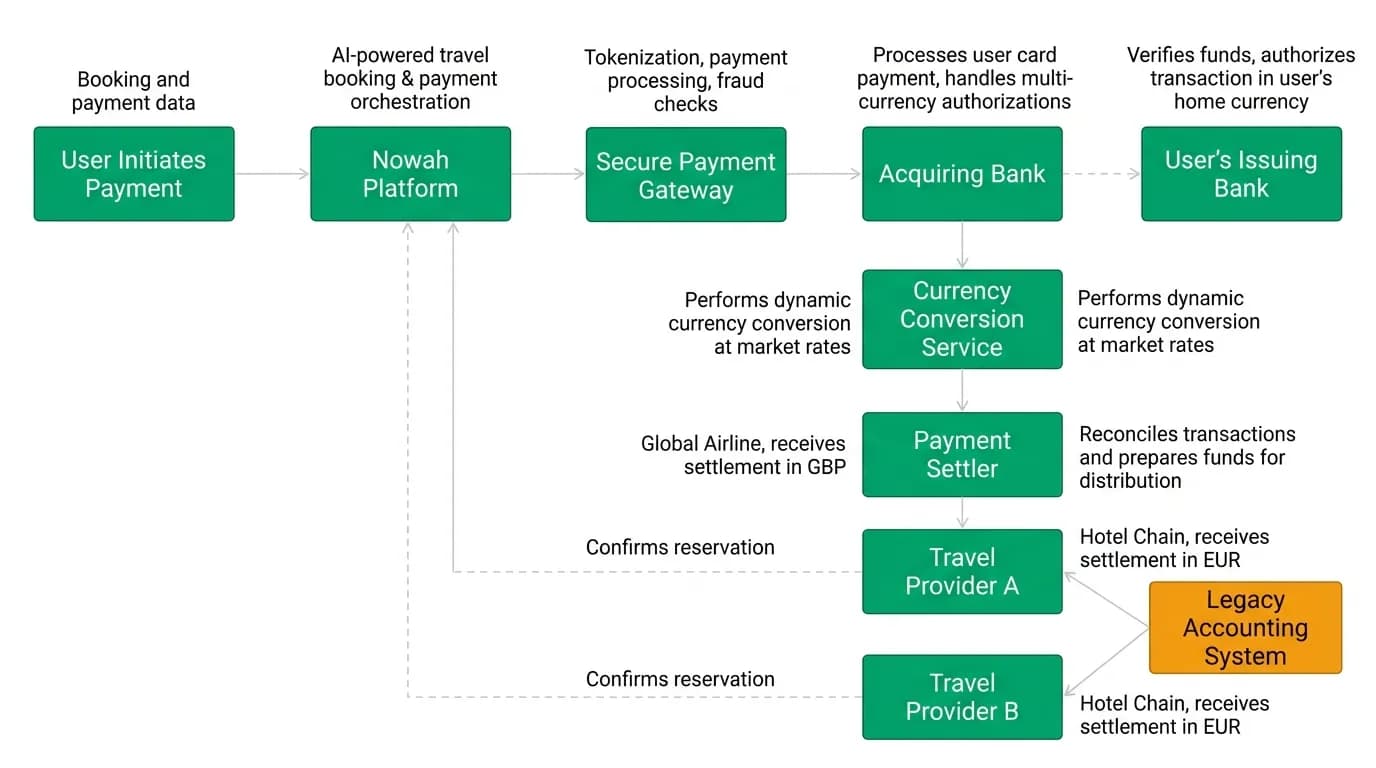
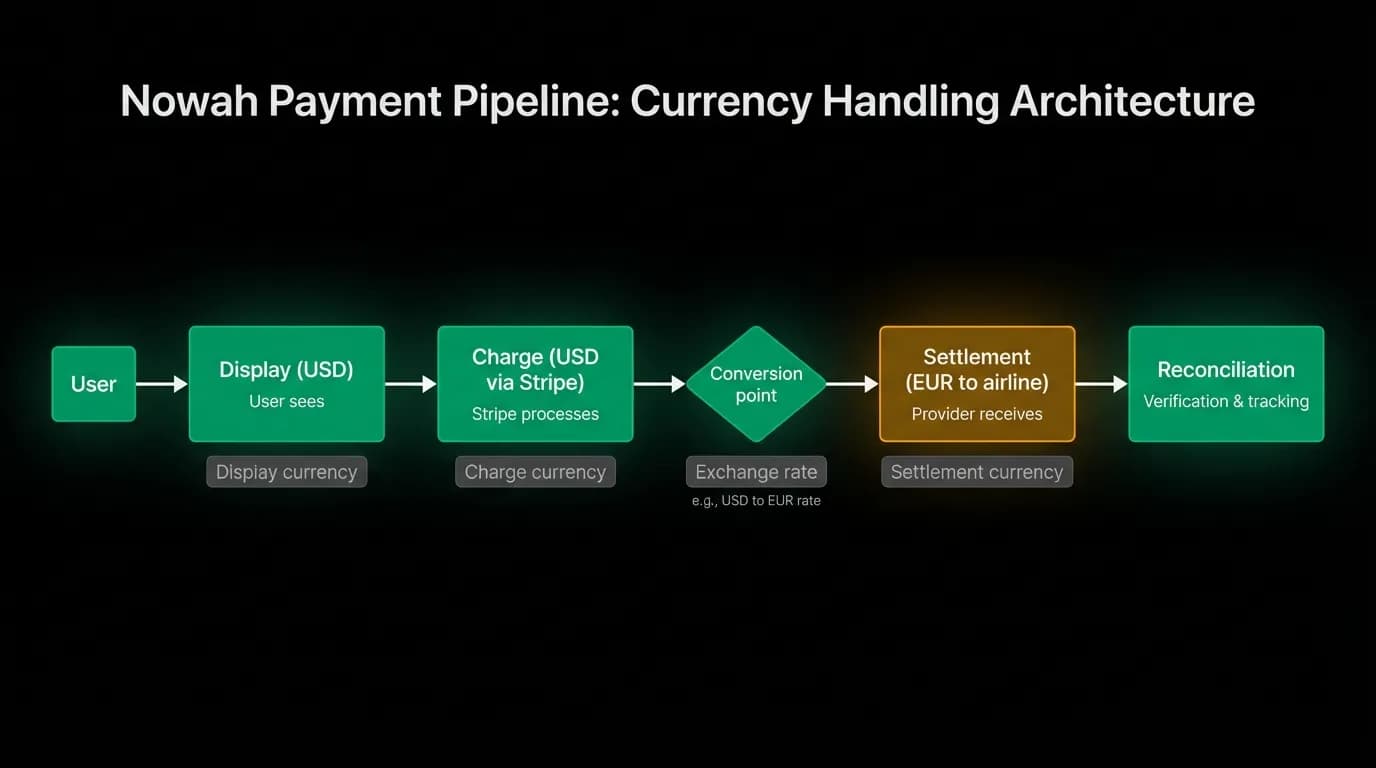
A typical international booking involves up to four currencies:
Display currency. The currency the user sees. Usually their home currency or the currency they prefer.
Booking currency. The currency the flight or hotel is priced in by the provider. A Lufthansa flight might be priced in euros regardless of where the user is.
Charge currency. The currency the user's payment method is charged in. If the user's card is in yen, the charge happens in yen.
Settlement currency. The currency we receive after payment processing and provider settlement. This is an internal concern the user never sees, but it affects our revenue and cost calculations.
The conversions between these currencies happen at different times, by different parties, with different exchange rates. The spread between the rate the user sees and the rate applied at each conversion stage is where hidden fees live.
Currency conversion and display
We show users prices in their preferred currency, converted from whatever the provider charges. The conversion rate is clearly displayed so there are no surprises.
Our approach to conversion:
Real-time rates. We source exchange rates from reliable providers and update them frequently. Stale rates in a volatile market lead to either overcharging the user or absorbing losses on our end.
Transparent markup. If there's any conversion fee (from us or from the payment processor), it's disclosed before the user confirms payment. "The flight is EUR 450. At today's rate, that's approximately JPY 73,400. Your card will be charged in yen."
Consistent display. Throughout a conversation, we display prices in the user's preferred currency. If they switch context (searching European hotels after looking at Asian flights), the currency display stays consistent. No mental math required.
Original price available. The agent can show the original provider currency when asked. Some travelers prefer to see the native price and handle conversion themselves. "That hotel is BRL 890 per night, which is about $175 at current rates."
Mobile travel bookings account for over 60% of all online bookings. On mobile, screen space is limited. We keep currency display concise: the converted amount prominently, the original amount available on request.
Payment method availability by region
Credit cards are the default payment method in the US and Europe. They're far from universal globally. India uses UPI extensively. Southeast Asian markets rely on digital wallets. Latin American countries have local payment methods that don't exist elsewhere.
We support multiple payment methods and route users to the methods available in their region. The AI agent handles this conversationally rather than through a payment method selection screen.
"Ready to book? I see you're based in India. Would you like to pay with UPI, a credit card, or another method?"
The engineering challenge is that different payment methods have different confirmation flows, different settlement timelines, and different failure modes. A credit card charge is near-instant. A bank transfer might take hours. The agent needs to set appropriate expectations: "Your bank transfer is being processed. I'll confirm your booking as soon as the payment clears, which usually takes a few hours."
Pricing transparency
Hidden fees are one of the biggest pain points in travel booking. Currency conversion is a common place where fees hide. The exchange rate applied at checkout is slightly worse than the market rate. A "foreign transaction fee" appears on the credit card statement. A "currency conversion surcharge" shows up in the fine print.
We take the opposite approach. The AI agent explains conversion in plain language.
"This flight is 450 euros. Your card will be charged in US dollars at roughly $487, which includes the current exchange rate plus your card's foreign transaction fee of about 3%. If you have a no-foreign-transaction-fee card, you'd pay closer to $473."
This level of transparency is possible because the interface is a conversation. On a checkout page, showing this much detail would clutter the UI. In chat, it's a natural part of the agent helping you make an informed decision.
AI-native platforms handle currency complexity conversationally. The agent can answer "Is it cheaper to pay in euros or dollars?" with a real comparison based on current rates and the user's specific card fees.
Settlement and payout complexity
This is the part users never see but that keeps payment engineers up at night.
When a user pays in yen for a flight priced in euros, several things happen:
- The user is charged in yen by the payment processor.
- The payment processor converts yen to our settlement currency (let's say USD) at their exchange rate, minus their fee.
- We pay the flight provider in their settlement currency (euros) at our exchange rate.
- The difference between what we received (USD) and what we paid (EUR), converted through two exchange rates, determines our margin on that transaction.
If exchange rates move between when the user pays and when we settle with the provider, our margin changes. If rates move a lot (which happens), we might make less than expected or even lose money on the currency conversion.
We manage this risk through several mechanisms.
Quick settlement. We settle with providers as quickly as possible to minimize exposure to exchange rate fluctuations.
Rate locks. Where possible, we lock exchange rates at booking time for both the user-facing conversion and the provider settlement. This eliminates rate movement risk at the cost of slightly wider spreads.
Currency matching. When a user's payment currency matches the provider's billing currency, we avoid one conversion entirely. The agent can suggest this: "That hotel charges in euros. If you have a euro-denominated card, you'd avoid the currency conversion fee."
How AI helps users navigate currency
Beyond the engineering, multi-currency handling is a place where AI travel booking genuinely helps users make better decisions.
"That hotel is 15% cheaper if you pay in the local currency instead of your home currency." That's a real insight that requires comparing exchange rates, card fees, and dynamic currency conversion options. Most travelers don't know to check this. An AI agent does it automatically.
"The yen is relatively strong against the dollar right now. Your Japan trip would be about 8% cheaper than the same trip would have been six months ago." That's contextual information that helps the user feel good about their timing.
"Your card charges a 3% foreign transaction fee. For this trip, that adds about $120 to your total. You might want to use a travel card with no foreign transaction fees." That's practical advice that saves real money.
Multi-currency support for global travelers is a Nowah capability, but the way it's surfaced through conversation is what makes it useful rather than just technically complete. The engineering handles the conversion, settlement, and reconciliation. The AI agent handles making all of that understandable and actionable for the user.
In a global travel market, currency complexity is unavoidable. The question is whether that complexity is hidden from the user (which usually means hidden fees) or explained to the user (which builds trust). We chose explanation, and the conversational interface makes that choice practical.
Nowah is an AI travel agent that searches and books real flights and hotels through conversation — no filters, no thirty open tabs. Plan your next trip.