PCI Compliance When AI Handles Payments
How we maintain payment card industry compliance in a system where an AI agent orchestrates the payment flow — tokenization, scope reduction, and documentation.
The AI agent books a $2,000 flight. It creates the payment intent, presents the total to the traveler, and orchestrates the entire booking flow. But it never sees the credit card number. Not once. Not in any log, any variable, any context window. The card number goes from the traveler's fingers to the payment processor's servers without touching ours.
This isn't clever engineering for its own sake. It's the foundation of our PCI compliance strategy. The Payment Card Industry Data Security Standard exists to protect cardholder data. Compliance is mandatory for any system that processes, stores, or transmits card data. The easiest way to comply is to ensure that card data never enters your system in the first place.
Keeping card data out of the AI agent's context
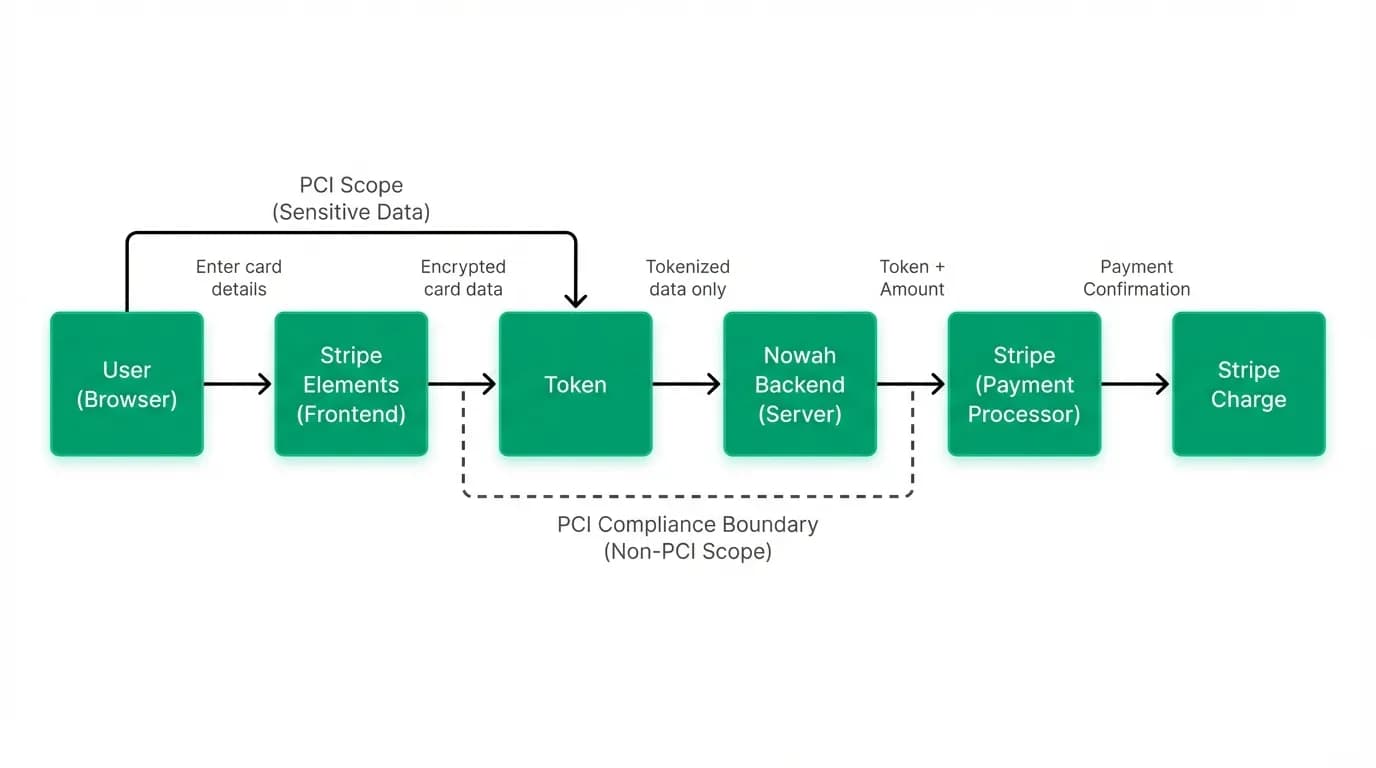
The AI agent orchestrates payments. It knows the amount. It knows the currency. It knows which booking the payment is for. It creates payment intents that specify these details. But it never handles the card number, the CVV, the expiration date, or any other cardholder data.
This separation is architectural, not just procedural. The agent's tool for creating payment intents accepts amount and currency as parameters. It returns a client secret that the frontend uses to complete the payment. The tool's interface literally cannot accept card data. There's no parameter for it. An agent can't accidentally include card data in a tool call because the tool doesn't have a field for it.
The conversation context is another boundary. If a traveler types their card number into the chat (which they shouldn't, but some try), the agent is instructed to never echo it back, never store it, and never include it in any tool call. The model instructions explicitly prohibits handling card data. This is a defense-in-depth measure. The primary protection is architectural (the tools don't accept it). The secondary protection is behavioral (the agent is instructed not to handle it).
Tokenization
Tokenization is the mechanism that lets us charge cards without seeing them. Here's how the flow works.
The AI agent creates a payment intent on the backend. The intent specifies the amount, currency, and metadata (booking reference, user ID). The backend communicates with the payment processor's API to create the intent and receives a client secret.
The client secret is sent to the frontend. The frontend presents a payment sheet (provided by the payment processor's SDK) where the traveler enters their card details. The card data goes directly from the payment sheet to the payment processor's servers. It never passes through our frontend code, our backend code, or any server we control.
The payment processor validates the card, creates a token representing the card, and processes the payment. Our backend receives a webhook confirming the payment succeeded (or failed), along with the payment ID and status. We store the payment ID, not the card data.
For returning travelers with saved payment methods, the same principle applies. The payment processor stores the card and provides a token. When the traveler wants to use their saved card, the frontend sends the token to the payment processor's SDK, which handles the charge. We send the token, not the card data.
PCI scope reduction
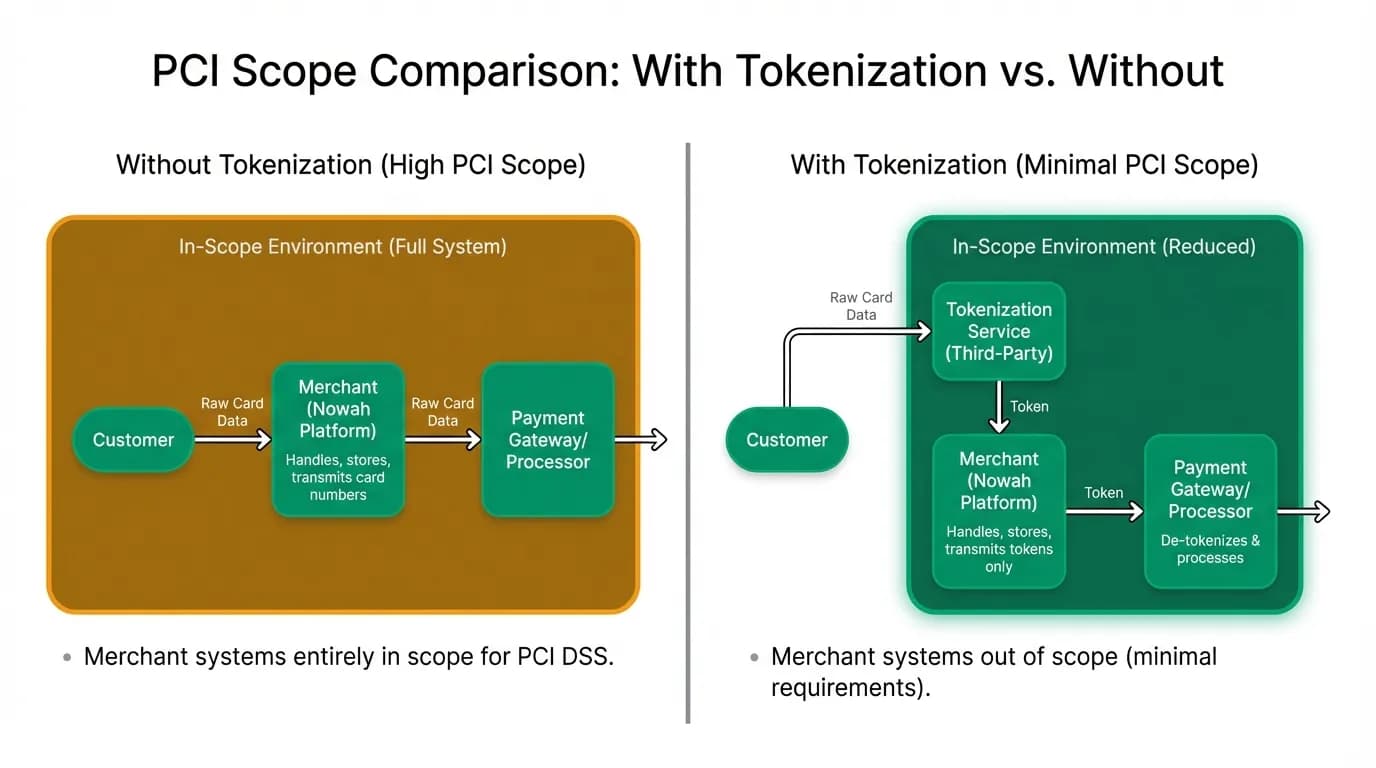
PCI compliance scope is determined by which systems touch cardholder data. Every server, every application, every network that transmits or stores card data is "in scope" and must meet the full set of PCI requirements: network segmentation, vulnerability scanning, access controls, logging, encryption, and regular assessments.
By using the payment processor's hosted components for card capture, our servers are entirely out of scope for card data. The payment processor's SDK (embedded in our frontend) handles the capture. The payment processor's servers handle the storage. Our servers only handle tokens and payment IDs, which are not cardholder data.
This reduces our PCI compliance burden dramatically. Instead of the full PCI DSS assessment (which is expensive, time-consuming, and requires extensive security infrastructure), we qualify for a simplified self-assessment. We attest that we don't store, process, or transmit cardholder data, and we describe how our architecture ensures this.
The scope reduction extends to our AI infrastructure. The language model, the agent processing, the tool call system, the conversation storage: none of these are in PCI scope because none of them touch card data. If they did, every component in the AI pipeline would need PCI compliance, which would be an enormous burden.
Regular compliance validation
Architecture alone doesn't guarantee compliance. We validate regularly that the boundaries hold.
We review every new feature that touches the payment flow. Does it introduce any path where card data could enter our systems? A new payment method, a new booking flow, or a new API endpoint all get a PCI impact assessment.
We scan our codebase for patterns that might indicate card data handling. Regular expressions that match card number formats, variables named `cardNumber` or `cvv`, log statements that might capture request bodies containing card data. These scans run as part of our CI pipeline.
We review our logs for accidental card data exposure. If a traveler types a card number in the chat and the log captures the raw message, that's a scope expansion. Our log scrubbing rules redact patterns that match card numbers before they're written to storage.
We test the payment flow end-to-end in sandbox mode, verifying that card data flows directly from the payment sheet to the payment processor and that no intermediate system captures it. Network traffic analysis during the test confirms the data flow.
Documenting AI involvement for PCI assessors
When working with PCI assessors, the AI agent's role in the payment flow requires explanation. Assessors understand traditional e-commerce payment flows. They may not immediately understand how an AI agent orchestrates a booking and payment without touching card data.
We document the AI agent's role explicitly. The agent creates payment intents (amount and currency only). The agent does not receive, transmit, or store cardholder data. The agent's tool interface does not accept cardholder data parameters. The conversation context is scrubbed of any accidentally-provided card numbers.
We provide architectural diagrams showing the data flow: traveler to payment sheet (direct, hosted by payment processor), payment sheet to payment processor (direct, no intermediary), payment processor to our backend (webhook with payment ID only). The AI agent is shown as adjacent to this flow, orchestrating the amount and timing, but never in the data path for card information.
This documentation proactively addresses the assessor's likely questions and demonstrates that we've thought carefully about the AI system's relationship to cardholder data.
Design PCI-compliant AI payment flows
If you're building an AI system that orchestrates payments, here are the architecture patterns that minimize PCI scope.
Use hosted payment components. The payment processor's SDK should capture card data directly. Your frontend renders the payment sheet, but the sheet's internals are owned and operated by the payment processor. Card data never enters your DOM, your JavaScript, or your network.
Design tool interfaces that can't accept card data. The AI agent's payment tool should accept amount, currency, and metadata. No card number parameter. No CVV parameter. If the tool can't accept card data, the agent can't accidentally send it.
Scrub logs aggressively. Travelers will type card numbers into chat. Your logs will capture those messages. Scrub card number patterns from logs before they're written to storage. This is a defense against accidental scope expansion.
Document the flow for assessors. Don't make the assessor figure out how AI fits into your payment architecture. Provide clear documentation and diagrams. The easier you make their job, the smoother the assessment.
Validate continuously. PCI compliance isn't a point-in-time achievement. Every new feature, every new endpoint, every new log statement could expand your scope. Validate after every change, not just during annual assessments.
Nowah is an AI travel agent that searches and books real flights and hotels through conversation — no filters, no thirty open tabs. Plan your next trip.