How a Small Team Builds an AI-Powered Travel Platform
The realities of building a complex AI product with a focused team -- ownership, automation, technology choices, and ruthless prioritization.
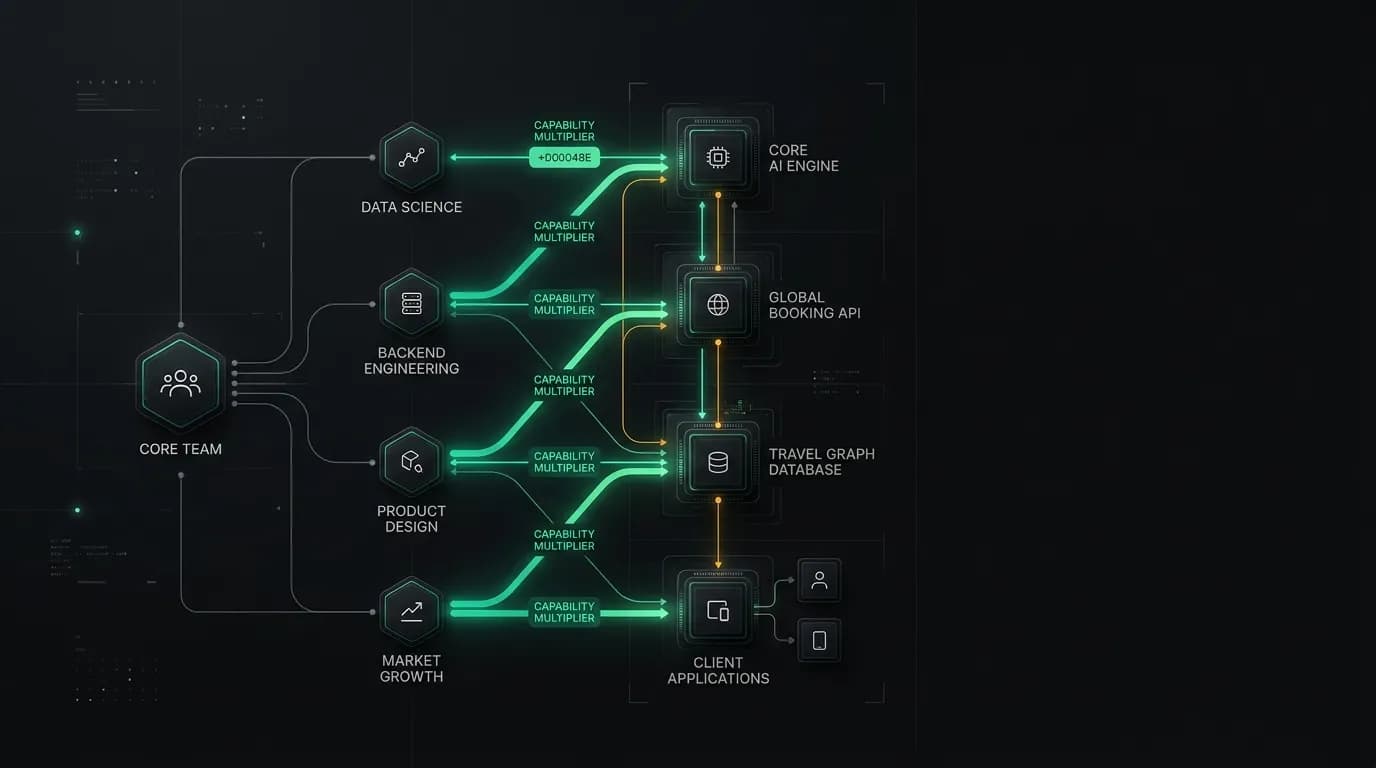
People ask us how big our engineering team is, and when I tell them, they look skeptical. Not because the number is large. Because it is small. They look at the product, which spans a mobile app, a web app, an AI agent with dozens of tools, a booking pipeline that handles real money, real-time streaming, background job processing, and integrations with multiple external providers, and they wonder how a small team ships all of that.
The honest answer is that we could not do it without making specific structural decisions that amplify output per engineer. This post is about those decisions.
Team structure and ownership
We do not have separate frontend, backend, and AI teams. Every engineer owns features end-to-end, from the database schema to the API endpoint to the mobile screen to the agent tool definition. This full-stack ownership model has a cost: it requires engineers who are comfortable working across the entire stack. But the benefit is enormous: a feature can go from design to production without handoffs between teams.
Handoffs are where small teams die. Every handoff introduces latency (waiting for the other team to pick up the work), information loss (context that did not survive the handoff), and coordination overhead (meetings to synchronize). A single engineer implementing a feature end-to-end has zero handoff cost.
We organize around product areas, not technology layers. One person might own the booking flow, which means they are responsible for the booking UI, the booking API, the payment integration, the booking saga, and the agent's booking-related tools. They understand the entire system involved in a booking because they built all of it.
This model breaks down if the product areas are too large for one person to handle. We manage this by keeping features scoped tightly and deploying frequently. Small, frequent deliveries rather than large, infrequent ones.
AI amplifying small team output
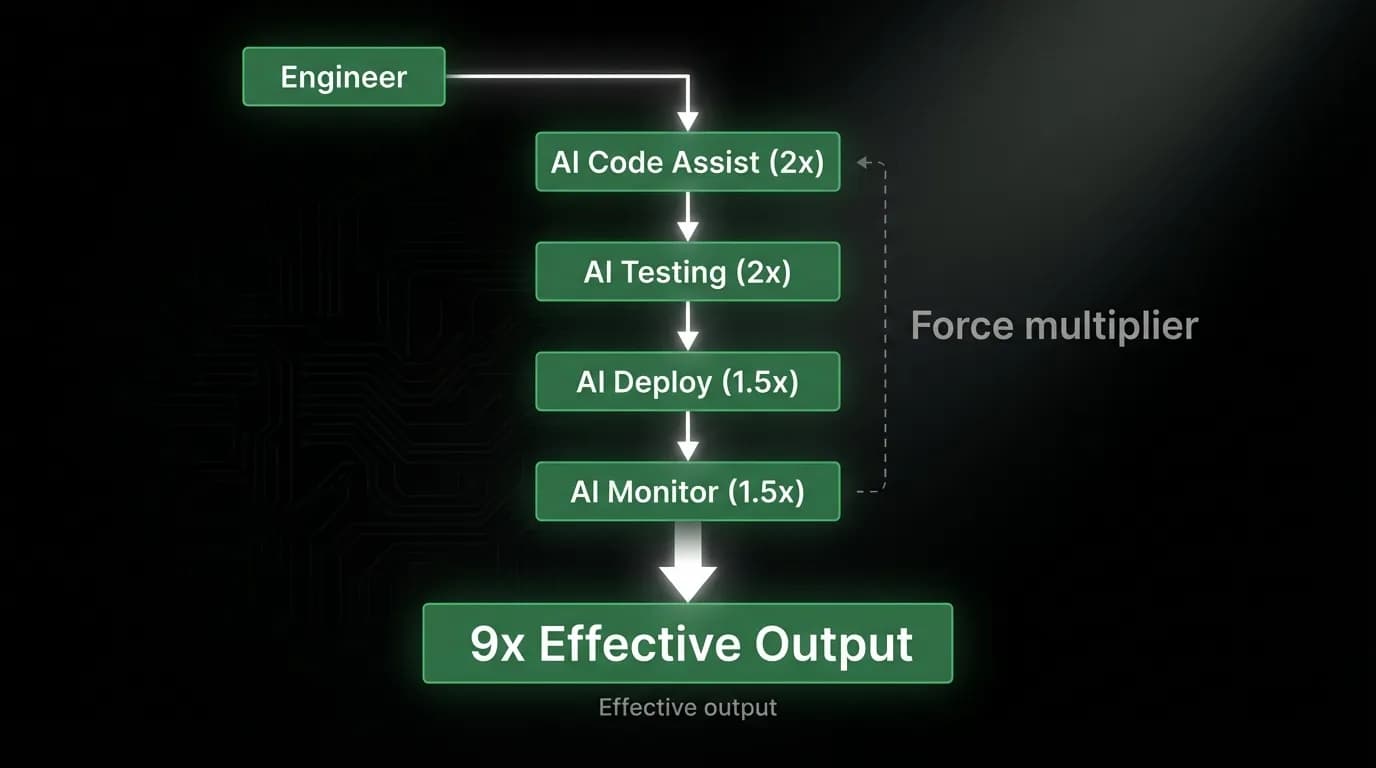
There is a recursive loop in our productivity model: we use AI development tools to build an AI product. The AI-assisted coding tools we use daily increase output by 30-50% for experienced engineers. Over a year, that compounds into significant additional capability.
The amplification is concentrated in the mechanical parts of engineering. Type generation. Test scaffolding. Boilerplate endpoints. Migration files. Configuration. An engineer who would spend 30% of their time on mechanical work now spends 10%, freeing 20% for the creative and architectural work that AI tools cannot do yet.
The meta-productivity is even more interesting. Because we are building an AI product, the tools and techniques we develop for the product (prompt engineering, eval frameworks, tool orchestration patterns) feed back into our development process. The learning curve for AI development tools is shorter because we are already deeply immersed in AI capabilities and limitations.
Technology choices that reduce burden
Every technology choice we make is evaluated against the question "how much operational burden does this add?" Managed database hosting instead of self-managed databases. Managed job queues instead of building our own. Managed authentication instead of rolling our own auth system.
a single typed language across the stack everywhere is the single highest-impact technology decision. Full-stack a single typed language across the stack teams report 20-40% productivity gains, and we see that in practice. One language means one set of tooling, one set of patterns, one set of mental models. When an engineer moves from the AI agent orchestration code to the the mobile app framework components, they are in the same language with the same type system. The context switch cost approaches zero.
Shared types between frontend and backend eliminate an entire category of bugs and coordination work. When we add a field to a trip object, the type propagates automatically. No separate frontend PR to update the type definition. No integration bug from a typo in a field name.
The importance of automation at small scale
What you cannot automate, you cannot sustain. This is true for any team, but the constraint is sharper for small teams because there is no person to absorb the manual work.
Our CI/CD pipeline runs on every push. Unit tests, integration tests, and AI evals gate every merge. Automated testing reduces regression incidents by 60-80%, which matters disproportionately when you do not have a QA team to catch regressions manually.
Deployment is automated. When code merges to the main branch, it deploys to staging automatically. Promotion to production requires one approval click. There is no deployment procedure document that someone has to follow. No SSH into a server. No manual steps.
Monitoring and alerting are automated. When a service degrades, the on-call engineer gets notified with context about what is happening. The alert includes relevant logs, metrics, and a link to the dashboard showing the current state. The engineer does not have to search for information. The automation delivers it.
Database migrations are automated and run as part of the deployment pipeline. Schema changes propagate consistently across environments without manual intervention.
Each of these automations saves 15-30 minutes per occurrence. Multiplied across dozens of daily occurrences, the aggregate savings are hours per day that engineers can spend on building rather than operating.
How small AI-native teams outpace larger OTA departments
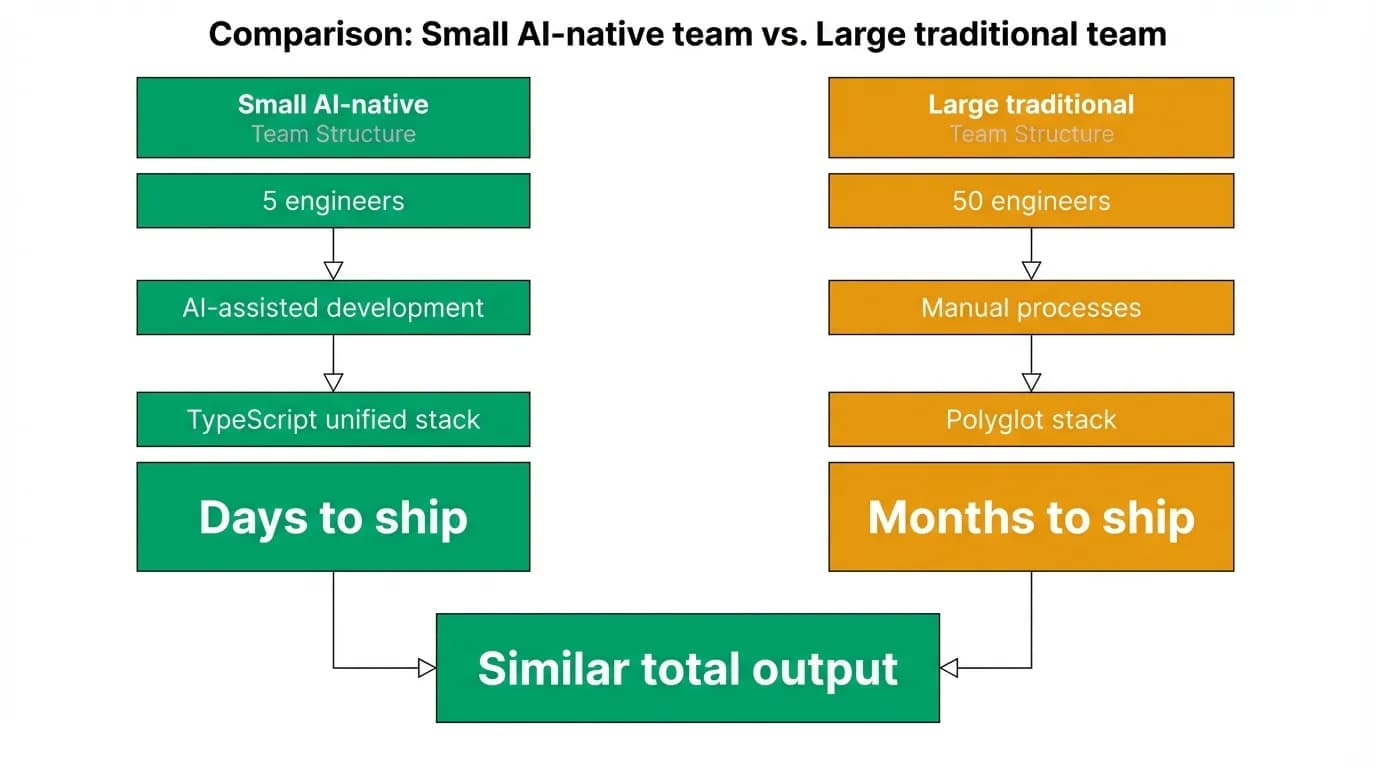
Legacy OTA engineering departments have 50, 100, or 500 engineers. They have teams for search, teams for booking, teams for payments, teams for mobile, teams for web, teams for infrastructure, teams for data. Each team has its own roadmap, its own sprint cycle, its own priorities.
When a cross-cutting change is needed (like integrating AI into the search-to-booking flow), it requires coordination across multiple teams. Product managers align roadmaps. Technical leads design the integration. Engineers in each team implement their piece. The integration is tested across team boundaries. This coordination takes weeks or months even when the actual engineering work is days.
Small AI-native teams iterate in days where legacy platforms iterate in months. Not because our engineers are faster. Because the organizational overhead is near zero. A feature that spans the AI agent, the API, the mobile app, and the database is one person's work, not four teams' coordination problem.
The flip side is that we do not have the depth of specialization that large teams have. We do not have a dedicated machine learning research team or a dedicated performance engineering team. We compensate with broad skill sets, good tooling, and the willingness to learn what we need when we need it.
The trade-off is speed for depth. In a market where the technology is evolving faster than any team can specialize in, I will take speed.
Nowah is an AI travel agent that searches and books real flights and hotels through conversation — no filters, no thirty open tabs. Plan your next trip.