Technical Writing for AI Teams: Docs That Keep Up
AI products change faster than documentation. Here is how we maintain living docs, decision records, and onboarding materials without falling behind.
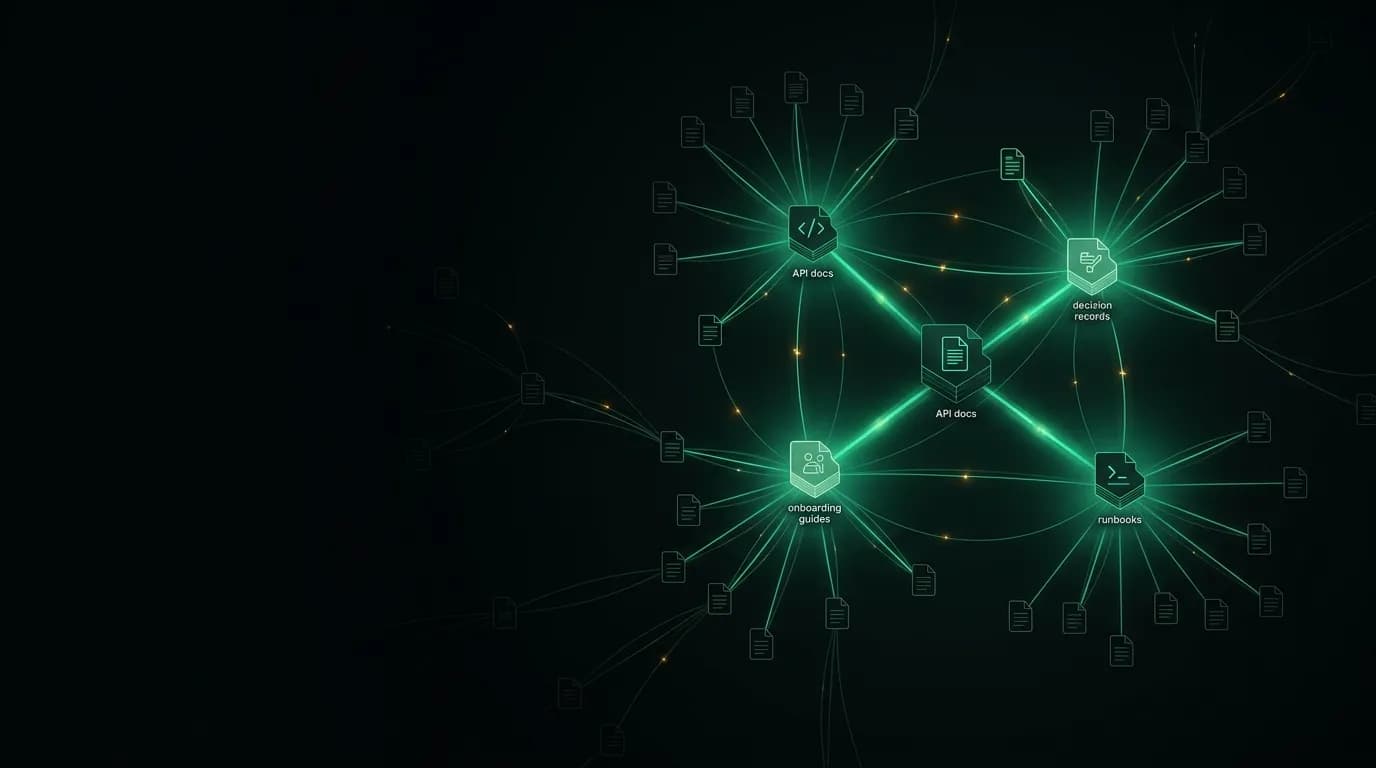
Documentation at most companies follows a familiar lifecycle. Someone writes it during a burst of motivation. It is accurate for about three weeks. Then the code changes and the docs do not. Six months later, the documentation is actively misleading, and new engineers learn to ignore it. The team relies on tribal knowledge passed through Slack messages and pair programming sessions.
We have this problem too. Every engineering team does. But AI products make it worse because the rate of change is higher. We update prompts weekly. Tool definitions change as the agent's capabilities expand. Architecture decisions get revisited as we learn from production data. A documentation practice designed for quarterly releases falls apart when the product changes weekly.
Here is how we keep docs useful without making documentation a full-time job.
Living documentation strategies
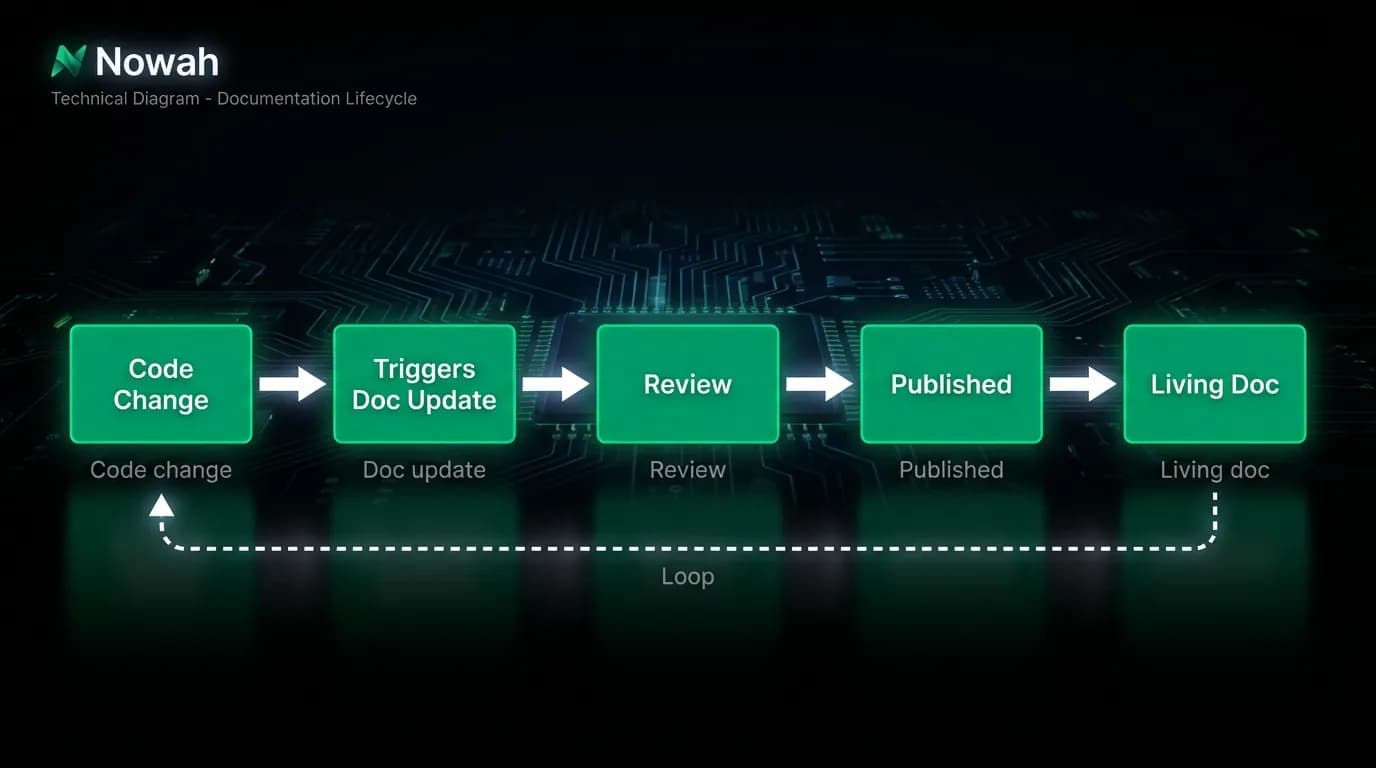
The core principle is that documentation should be as close to the code as possible. Not in a separate wiki. Not in a Google Doc. In the repository, next to the code it describes.
When an engineer changes a function, the documentation for that function is in the same file or the same directory. The PR that changes the code also changes the docs. The reviewer checks both. This sounds basic, but it eliminates the most common documentation failure mode: the code changes and nobody remembers to update the separate doc.
For API documentation, we auto-generate from the schema. Every endpoint's parameters, response formats, and error codes are documented automatically from the a single typed language across the stack types and validation rules. The auto-generated docs are always accurate because they are derived from the code, not written separately.
For architectural documentation, we use a lightweight template. Each major system has a one-page document that covers: what it does, why it exists, how it connects to other systems, and what you need to know to work on it. These docs are reviewed quarterly, and the quarterly review is a calendar event, not a hope.
For AI-specific documentation, we document tool definitions with examples. Each tool the agent can call has a doc that includes: what the tool does, when the agent should use it, example inputs and outputs, and known edge cases. These docs are consumed by both human engineers and the AI agent itself (through the tool definition descriptions).
API documentation for AI-consumed services
This is a documentation challenge unique to AI products. Traditional API docs are written for human developers. They explain concepts, provide examples, and tolerate some ambiguity. The reader can fill in gaps with common sense.
AI agent tool definitions require a different standard. Documentation must be machine-readable for AI tool calling. Every parameter description must be precise enough that the agent knows exactly what to send. Enum values must be exhaustive. Constraints must be explicit. Default behavior must be documented, not assumed.
We maintain two layers of API documentation. The human layer has narrative descriptions, usage examples, and conceptual explanations. The machine layer has precise schemas with strict type definitions, value constraints, and behavioral descriptions. Both layers are generated from the same source of truth (the a single typed language across the stack types and validation rules), but they are formatted differently for their different audiences.
The machine layer is the more demanding one. A human developer who sees a parameter described as "departure date" will assume ISO 8601 format and try it. An AI agent might not make that assumption. The machine layer explicitly states: "string, format: ISO 8601 date (YYYY-MM-DD), required for one-way searches, optional for flexible date searches." That level of precision feels tedious to write, but it prevents the agent from sending malformed requests.
Architecture decision records
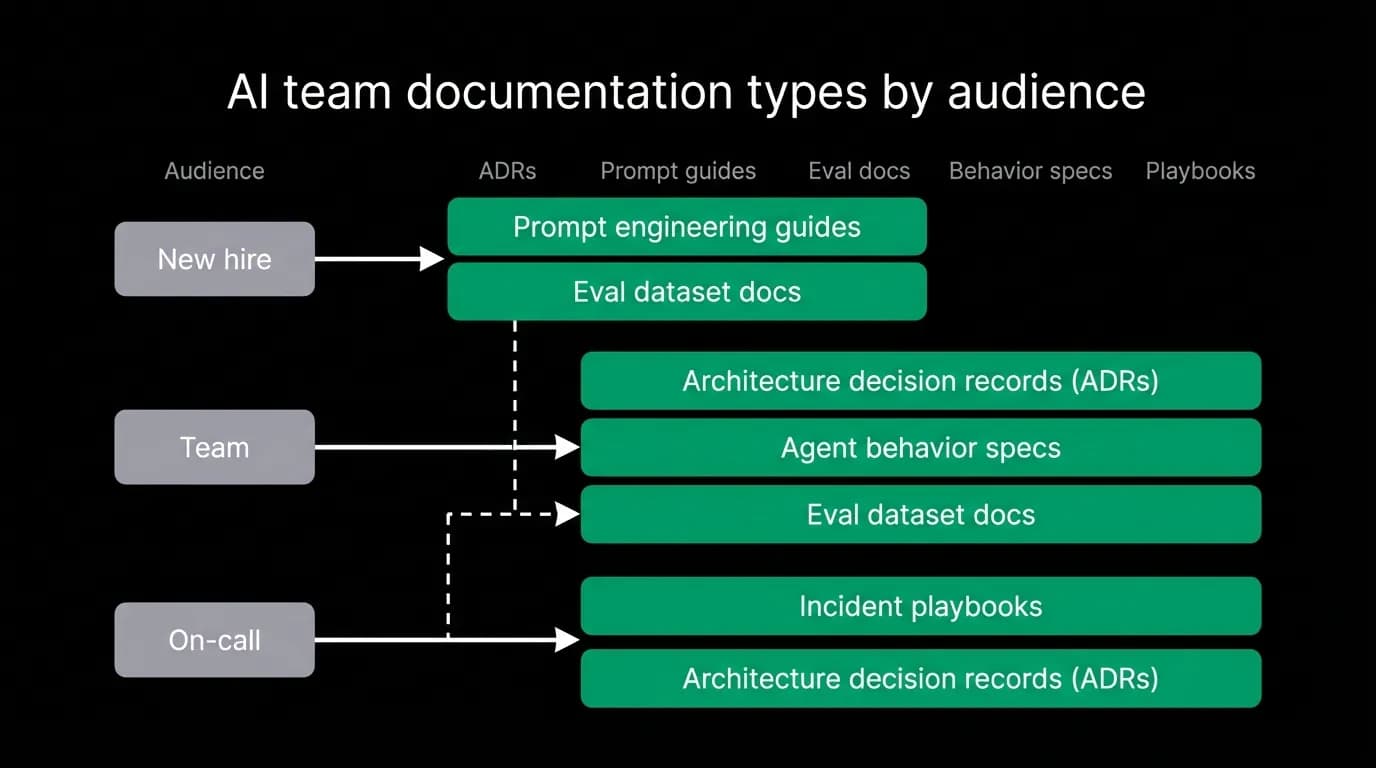
Fast-moving AI products change architecture weekly. Without a record of why decisions were made, the same debates repeat every few months when new team members or even original team members with short memories question existing designs.
We write Architecture Decision Records (ADRs) for significant decisions. An ADR captures: the decision that was made, the context at the time, the alternatives that were considered, the trade-offs of each alternative, and the rationale for the choice.
ADRs are not long documents. A typical ADR is a page or less. The value is in capturing the "why" alongside the "what." Six months later, when someone asks "why do we use unidirectional server streaming instead of bidirectional sockets for streaming," the ADR explains the reasoning, the alternatives that were evaluated, and the specific trade-offs that drove the decision.
We also mark ADRs as superseded when decisions change. When we revisit a decision and make a different choice, we write a new ADR that references the old one and explains what changed. This creates a decision history that captures not just current architecture but its evolution.
Onboarding documentation
New engineer onboarding is where documentation pays its highest dividends. Every hour saved in onboarding ramp-up is an hour of productive engineering gained.
Our onboarding docs follow a specific structure. Day 1: set up the development environment and run the product locally. Day 2: deploy a small change to staging. Week 1: complete three starter tasks that touch different parts of the system. Week 2: ship a real feature to production.
Each step has detailed instructions that are tested by the most recent hire. When a new engineer joins, they follow the onboarding docs and update anything that is outdated. This means the docs are always current for the next hire.
The AI-specific onboarding section covers concepts that engineers from non-AI backgrounds need to learn. How prompts work. What tool calling is. How to read eval results. What a conversation trace looks like. This section bridges the gap between general engineering skill and AI product engineering, and it reduces ramp-up time by weeks compared to learning through osmosis.
The thoroughness-currency trade-off
Perfect documentation that is six months out of date is worse than good-enough documentation that is current. We optimize for currency over completeness.
Our standard is: every document should be accurate enough that following it produces the correct result. It does not need to cover every edge case. It does not need to explain every nuance. It needs to be correct, current, and clear enough that an engineer can accomplish their goal without needing to ask someone.
This standard is intentionally lower than what a documentation purist would want. It means some docs are sparse. Some lack examples. Some skip advanced usage patterns. But every doc we maintain is accurate, and that trust in accuracy is what makes engineers actually read the docs instead of ignoring them.
Good-enough docs today beat perfect docs that never get written or that rot into inaccuracy. That is the trade-off we have made, and it has served us well.
Nowah is an AI travel agent that searches and books real flights and hotels through conversation — no filters, no thirty open tabs. Plan your next trip.