Choosing hotels for a short business trip
Choose short business-trip hotels around work locations, arrival arrangements, room needs and actual rate conditions.
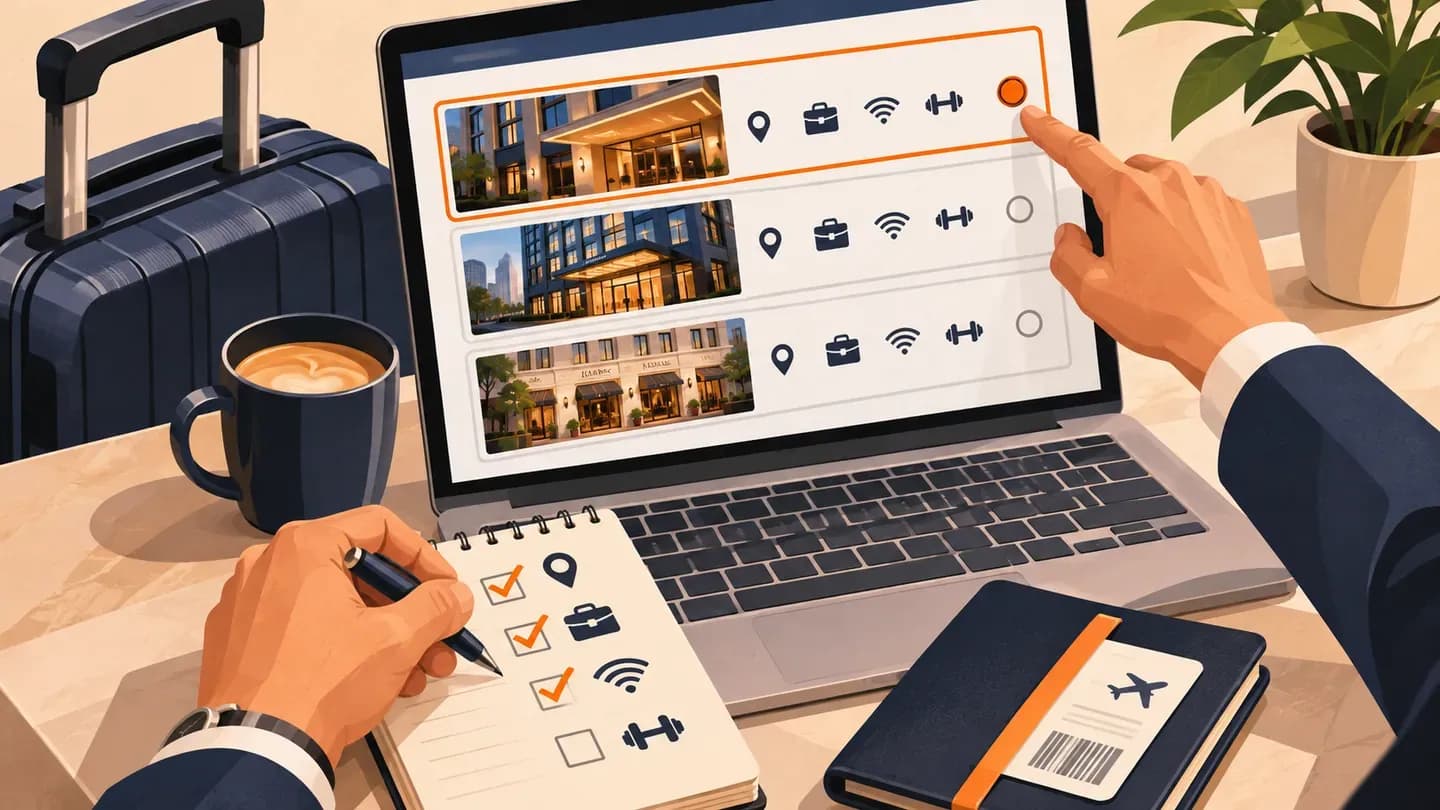
Choose a short business-trip hotel around the traveller's fixed commitments, arrival pattern and room requirements. Compare the actual journey to the work location, the conditions of the offered rate and the features the traveller will use. Use Nowah to connect hotel research with the trip's day structure, then verify supplier details before recommending an option.
For a two-night stay, a location or check-in mismatch can affect a large share of the visit. A high classification or attractive leisure facilities may matter less than a workable arrival, suitable workspace and clear cancellation conditions. Confirm those priorities with the traveller rather than imposing a standard business-hotel profile.
Start with the working calendar
Put the business traveller's meetings, local dates and readiness times into Nowah before researching hotels. This makes accommodation serve the working calendar. The business travel booking brief helps establish which commitments and approval limits should guide the search.
Separate the work calendar from home-airport boundaries. A late arrival may make early room access irrelevant but reliable arrival instructions essential. An early meeting after an overnight journey may create a different need entirely.
Keep the information necessary for planning and follow the approved data-handling process. A hotel-area comparison does not need confidential meeting content, client names or commercial documents from the traveller's business.
Define the room features that matter
Ask what the traveller needs to do in the room. They might require a desk and suitable lighting, prefer breakfast at the property or need space to take calls. Another traveller may work entirely at the venue and place more value on rest.
Distinguish features from outcomes. A desk description does not guarantee a comfortable work setup, and a quiet-room request does not guarantee uninterrupted sleep. Inspect relevant property and room information, and explain any remaining uncertainty.
Use this priority card:
SHORT BUSINESS STAY PRIORITIES
Trip / stay dates / traveller:
Fixed work locations and arrival times:
Arrival and departure assumptions:
Essential room or access requirements:
Workspace needs:
Meal timing and preferences:
Transport and luggage considerations:
Rate flexibility and payment requirements:
Optional features:
Open questions and next owner:
The card should reflect this assignment. Do not reuse a previous traveller's preferences merely because both trips are described as business travel.
Worked hypothetical example: two nights in Berlin
This case is fictional. One traveller plans two destination nights in Berlin, checking in on 10 May 2027 and checking out on 12 May. They have morning meetings at one office and a dinner at a different location. Actual flights and local transport remain to be checked.
The traveller wants a workable room for an evening call and prefers not to move hotels. Their initial request is “somewhere central,” which does not specify which journey matters most. The adviser asks about meeting arrival times, luggage on departure day and whether the evening call needs any particular arrangement.
Two research directions emerge: a property area closer to the office and another closer to the departure transport. These are location concepts, not verified hotel offers. The adviser must establish actual journeys and room conditions before claiming one is more convenient.
Build the fictional Berlin meeting days in Nowah and compare the hotel candidates beside that schedule. Use the business arrival brief to assess whether the first evening supports the traveller's preparation needs.
Use Nowah to connect the stay and schedule
Nowah's features include conversational research, editable day plans, map/timeline views and hotel options. Use them to inspect how the location choice affects the short visit.
Try this copyable fictional prompt:
Develop a three-day, two-night Berlin business-trip framework for one adult, with destination hotel dates 10–12 May 2027. Morning meetings are at one office and an evening dinner is elsewhere; exact addresses will be supplied through the approved process. The traveller wants one hotel and an appropriate setting for an evening call. Compare hotel-area criteria near the office with criteria near departure transport. Mark arrival/departure assumptions and questions about actual journeys, check-in, workspace and rate terms. Do not invent addresses, travel times, room features, prices or confirmed availability.
Review the output, then use the actual relevant locations to investigate journeys. Nowah's map and timeline support geographic inspection; they do not establish a particular door-to-door duration or provider arrangement by themselves.
Evaluate repeated journeys rather than map distance alone
A hotel can be geographically close while the actual route is inconvenient for the traveller's needs. Inspect the relevant entrance, transport options, walking conditions and timing. Ask whether carrying luggage, early starts or a late return changes the preference.
For the fictional traveller, compare the morning office journey on both workdays and the departure-day plan. Do not focus only on the airport journey because it is easier to describe. Equally, do not assume the office location wins if the actual arrival or departure arrangement creates a material problem.
Suppose the fictional traveller later says the second morning meeting has moved to another office. Revisit the repeated-journey comparison rather than retaining the original location conclusion. The preferred hotel area may still fit, but that is a question to reassess against the new schedule.
The same applies if an evening call becomes an in-person appointment. A room feature that was essential for the original brief may no longer drive the choice, while another journey becomes important. Record the client's current priorities and update the worksheet before presenting a final recommendation. Do not let the first draft become a fixed answer to a changed trip.
Record the basis for any convenience claim. If the journey is not verified, describe it as a question to investigate rather than a fixed number in the proposal.
Check the exact room and arrival procedure
Inspect the offered room category, occupancy, bedding and features relevant to the evening call. Do not assume that a general property workspace description applies to every room or includes a separate meeting facility.
Confirm the actual arrival process for the intended time. A late flight can affect how the traveller receives access, but the procedure depends on the property and booking. Ask the relevant provider instead of relying on a generic statement that business hotels allow late arrival.
If an essential feature cannot be established, investigate another arrangement or discuss the limitation with the traveller. A strong location score should not conceal an unsuitable room.
Compare rate conditions and complete costs
Use the same dates, room basis and relevant inclusions when comparing totals. Identify known mandatory charges and distinguish optional breakfast or other additions. State currency and whether the amount is a stay total or nightly figure.
Check the actual change, cancellation and payment conditions. Business plans can change, but that does not make a higher-priced flexible rate automatically the right choice. Explain the offered terms and ask what trade-off the traveller or authorised organiser prefers.
If billing documentation or company payment arrangements matter, establish what the supplier and agency can actually provide. Do not promise an invoice format, reimbursement outcome or tax treatment without the appropriate basis.
Copyable business-hotel comparison worksheet
Use this worksheet to compare the business hotels researched in Nowah on repeated journeys, actual room needs, complete cost and conditions. The location assessment method helps explain practical access rather than relying on distance alone.
BUSINESS HOTEL COMPARISON
Trip / exact hotel dates:
Candidate and offered room/rate:
Work-location journey basis and source:
Arrival procedure checked:
Workspace features established / open:
Essential requirements met / unresolved:
Meal and departure-day plan:
Comparable stay total and inclusions:
Cancellation, change and payment conditions:
Billing requirements checked:
Main trade-off:
Decision-maker and next action:
For the fictional Berlin stay, a candidate near the office might still need workspace clarification. Another candidate near departure transport might need a better account of the morning commute. Keep those questions visible until actual evidence resolves them.
Present the decision clearly
Summarise the trade-off in the traveller's terms:
I am comparing the repeated meeting journey, the evening work requirement and departure-day arrangements. This candidate has [established features], while these points remain open. The alternative changes [specific trade-off]. Which direction should we investigate or select, given the actual rate conditions?
Identify who can approve the booking and payment. The traveller, company organiser and payer may have different roles. A preference expressed by one person should not be treated as authority for every action.
Obtain approval of the exact selected offer, payable total and supplier conditions before booking or payment. If a material detail changes, update the comparison and seek the appropriate renewed decision.
Carry the verified details into the trip plan
After booking, check actual confirmation and status, then prepare arrival, meeting-journey and departure notes based on established information. Keep confidential business content out of broadly circulated itinerary material.
If the office, flight or hotel dates change, revisit the relevant location and rate assumptions. A short stay still needs a current record; its simplicity does not make an old answer reliable for a changed assignment.
Use Nowah for the editable schedule and hotel research, with the comparison worksheet, evidence and approval in your normal agency process.
Open Nowah with the fictional business-trip framework and review the features before researching the next short stay.




