Choosing hotels for a travelling project team
Choose project-team hotels from actual work patterns, individual room requirements and complete offers rather than a generic business label.
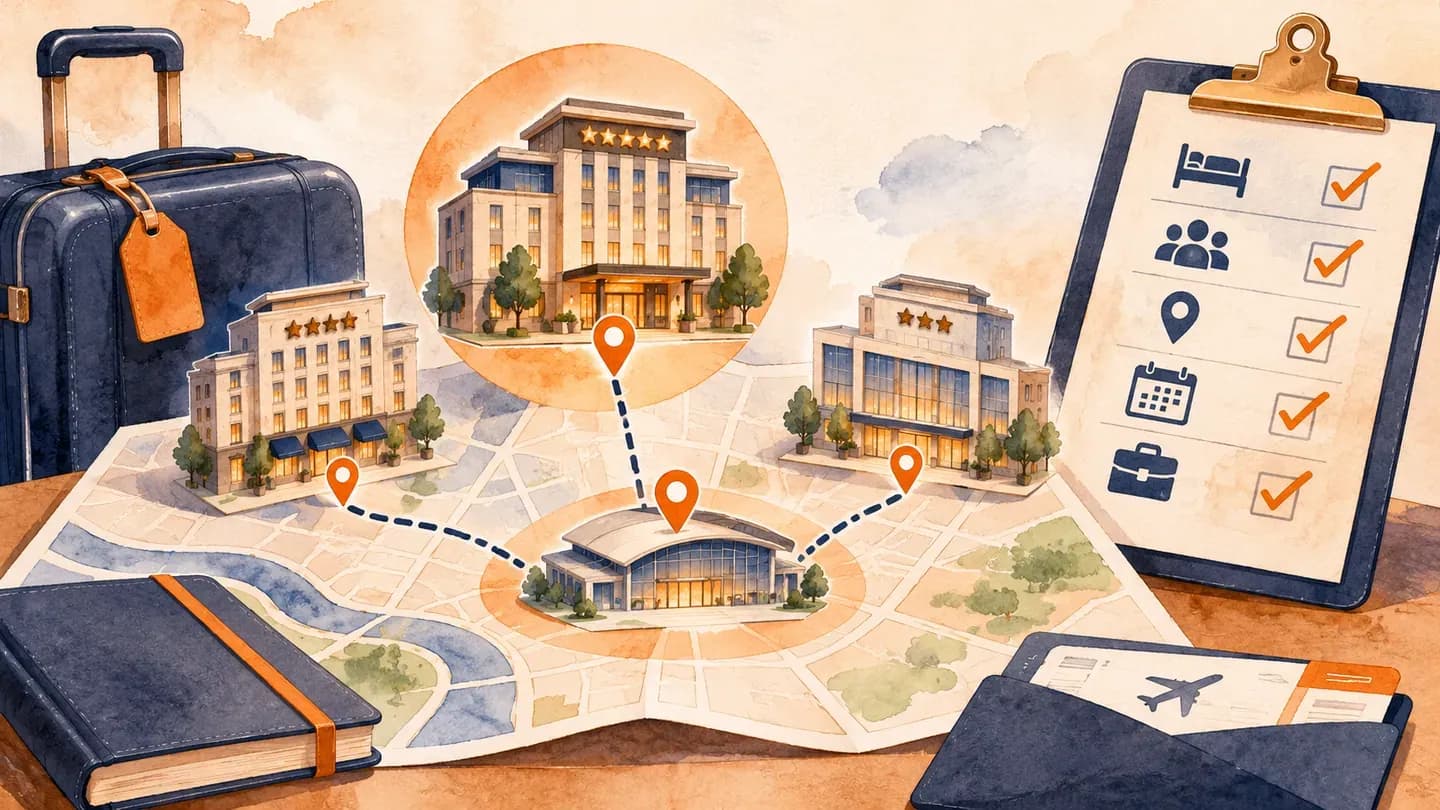
Choose a project-team hotel from the actual work locations, stay patterns and individual room requirements, then compare the full offer and repeated journeys. Use Nowah to explore the editable trip structure and hotel criteria, while the agency verifies sources and company authority. A team travelling together does not automatically want to share rooms or have identical arrival dates.
Start with the assignment the accommodation must support. A practical hotel for one worksite can be less suitable when the project moves between sites or the team needs different departure arrangements. The recommendation should answer the current brief rather than a generic business-hotel label.
Map the work locations and attendance
Place the team's actual work locations and local attendance requirements into Nowah before hotel research. Explore how different bases serve the repeated journeys. The hotel location assessment helps investigate practical access rather than relying on map distance.
Ask which schedule is confirmed and who can update it. A tentative site allocation should remain provisional until the appropriate company contact supplies the current instruction.
Separate hotel dates from work attendance. Arrival, departure, luggage and room access may create requirements outside the scheduled workday. The actual route and company process need to establish those arrangements before precise instructions are issued.
Use a project-team accommodation template
Copy this artifact into the agency record:
PROJECT TEAM HOTEL BRIEF
Company request / traveller labels / current version:
Local work sites and attendance days:
Required arrival/readiness times:
Individual check-in / check-out dates:
Room quantity, sharing instructions and essential features:
Workspace or call requirements:
Transport, equipment and luggage needs:
Company policy source and owner:
Budget currency, basis and inclusions:
Billing/payment requirements to verify:
Actual approvers and private information process:
Open question / source / next owner:
Do not infer room sharing from a team label or use the organiser's assumption as every adult's instruction. Apply the actual company and individual process before researching the room allocation as confirmed.
Worked hypothetical example: two project sites
All journey durations in this example are invented for arithmetic. Four adults are considering a seven-day, six-night work visit. They attend Site A on four days and Site B on one day, with actual hotel offers and transport unverified.
Candidate-area H is modelled at twenty-five minutes each way to A and fifty minutes each way to B. Across the five workdays, the journey sum is 4×2×25+1×2×50=300 minutes, five hours.
Candidate-area J is modelled at forty minutes each way to A and fifteen minutes each way to B. Its sum is 4×2×40+1×2×15=350 minutes, five hours fifty minutes.
H has fifty fewer modelled minutes across those days. That does not establish actual convenience, traffic conditions, room suitability or price. It is an example of comparing the repeated schedule rather than only the nearest site on a map.
Develop the fictional two-site working week in Nowah and inspect the day structure from each hotel direction. Use the airport-and-venue access comparison to include the journeys outside the daily work commute.
Check what the journey model omits
Actual origin and destination points, transport operation, access and practical waiting can change the comparison. A main route estimate may not cover reaching the relevant entrance with equipment.
Investigate arrival and departure journeys too. The fifty-minute workday difference should not dominate an essential room or arrival requirement. A weighted preference cannot compensate for a feature the team actually needs but the evidence does not establish.
If the project changes its site pattern, recalculate from the current brief. One hotel-area conclusion should not remain fixed after the meetings move. Record the actual source and date of the revised schedule rather than inferring it from an old calendar.
The fictional model can demonstrate how strongly the work pattern matters. If attendance reverses to one day at A and four at B, while the invented journey durations stay the same, H would total 1×2×25+4×2×50=450 minutes. J would total 1×2×40+4×2×15=200 minutes.
That revised difference is 250 minutes, four hours ten minutes, in J's favour under the assumptions. The original fifty-minute advantage for H is no longer the relevant conclusion. The adviser should not keep the old location recommendation after the actual company brief changes.
This is not a real travel-time comparison or a recommendation of either area. It shows why the source, date and scope of the work schedule belong with the hotel assessment. Actual traffic, services, entrances and room arrangements still need evidence.
The revised journey model also does not override an essential room requirement. If J cannot support the actual party's needs, its favourable fictional sum cannot make it suitable. Investigate the appropriate alternatives and ask the relevant client to review the trade-off before selecting an offer.
Keep both calculations distinguishable so another adviser understands which work pattern each describes. Record the actual schedule source and current attendance basis beside the comparison. A table with the new attendance count and an old total is not a coherent comparison, even when every individual number looks plausible.
Use Nowah to inspect the team stay
Nowah's features include conversational research, editable day plans, map/timeline views and flight or hotel investigation. Use them to connect hotel criteria with the current work pattern.
Try this copyable fictional prompt:
Develop a seven-day, six-night project-team framework for four adults. Work is at Site A on four days and Site B on one, with actual locations provided only through the approved process. Individual hotel dates, room needs and company authority need clarification. Identify hotel-area, repeated-journey, workspace, arrival and complete-cost questions. Do not invent travel times, company policy, shared-room consent, prices, billing capabilities or confirmations. Keep private records and confidential project content outside the general planning summary.
Review the response against actual instructions and inspect geography in Nowah when appropriate location inputs are available. Verify actual journeys and selected room/rate information separately.
Assess rooms for the individual travellers
Confirm room quantity, bedding and essential functional arrangements. A property can be convenient for the worksite while its offered room does not meet a traveller's actual requirement.
If a workspace, call setting or other feature matters, inspect the relevant room information and ask specific provider questions. Do not promise connectivity performance or quiet from a generic business-friendly description.
For a staggered stay, record dates per room or segment and establish the supplier's process. A single whole-team period can overstate or omit room nights. The list should support actual research rather than force every person into identical dates for convenience.
Compare complete costs and terms
Use the same relevant party, dates, room quantity and intended inclusions. State currency and separate actual charges from optional spending assumptions. Unknown amounts should remain open, not zero.
Inspect the actual cancellation, change and payment conditions. A project schedule can change, but that does not make every higher-priced flexible direction automatically appropriate. Present the actual trade-off to the authorised client.
If company billing or documentation is needed, verify what the agency and supplier can actually provide. Do not promise account terms, invoice formats or an accounting integration from Nowah's planning capabilities.
Build a project-hotel comparison matrix
Use this project-hotel matrix template to compare accommodation researched in Nowah on room needs, repeated journeys, complete costs and conditions. The different-arrival hotel ledger helps where team members stay for different periods.
Area | Candidate H | Candidate J | Evidence or decision needed |
|---|---|---|---|
Repeated site journeys | [Actual basis] | [Actual basis] | [Source/limits] |
Individual room suitability | [Met/open/not supported] | [Status] | [Provider question] |
Arrival/departure logistics | [Arrangement] | [Arrangement] | [Research] |
Workspace and relevant services | [Evidence] | [Evidence] | [Actual requirement] |
Complete amount and conditions | [Offer basis] | [Offer basis] | [Authority] |
Do not combine a favourable price from one category with a room feature from another. Each candidate column should describe one coherent actual offer or a clearly labelled research direction.
Clarify company and traveller decisions
Identify who supplies the work schedule, who owns applicable policy, who approves the selected arrangement and who authorises payment. A project coordinator may not hold all those roles.
Collect necessary individual information through the approved private process. A team-wide summary can show the practical plan without reproducing identity documents or sensitive explanations.
Before booking or payment, present exact services, complete amounts and relevant supplier conditions to the appropriate people. Approval of a project visit or cost target does not necessarily authorise every room category or changed condition.
Maintain the stay as the project changes
A new worksite, added traveller, extended date or changed flight can affect several components. Update the current brief and revisit the affected hotel and transport evidence.
If an actual booking exists, inspect the applicable amendment process and obtain the relevant authority before action. After authorised booking or amendment, inspect confirmation and status and reconcile client instructions.
Use Nowah for the editable trip structure and research, with the project-hotel template and evidence in your normal agency process. The hotel recommendation should remain tied to the work the team actually needs to do.
Open Nowah with the fictional two-site brief and review the features before researching your next travelling team's accommodation.




