Collecting feedback after a group trip
Collect group-trip feedback through neutral questions, private follow-up and bounded improvement hypotheses rather than manufactured testimonials.
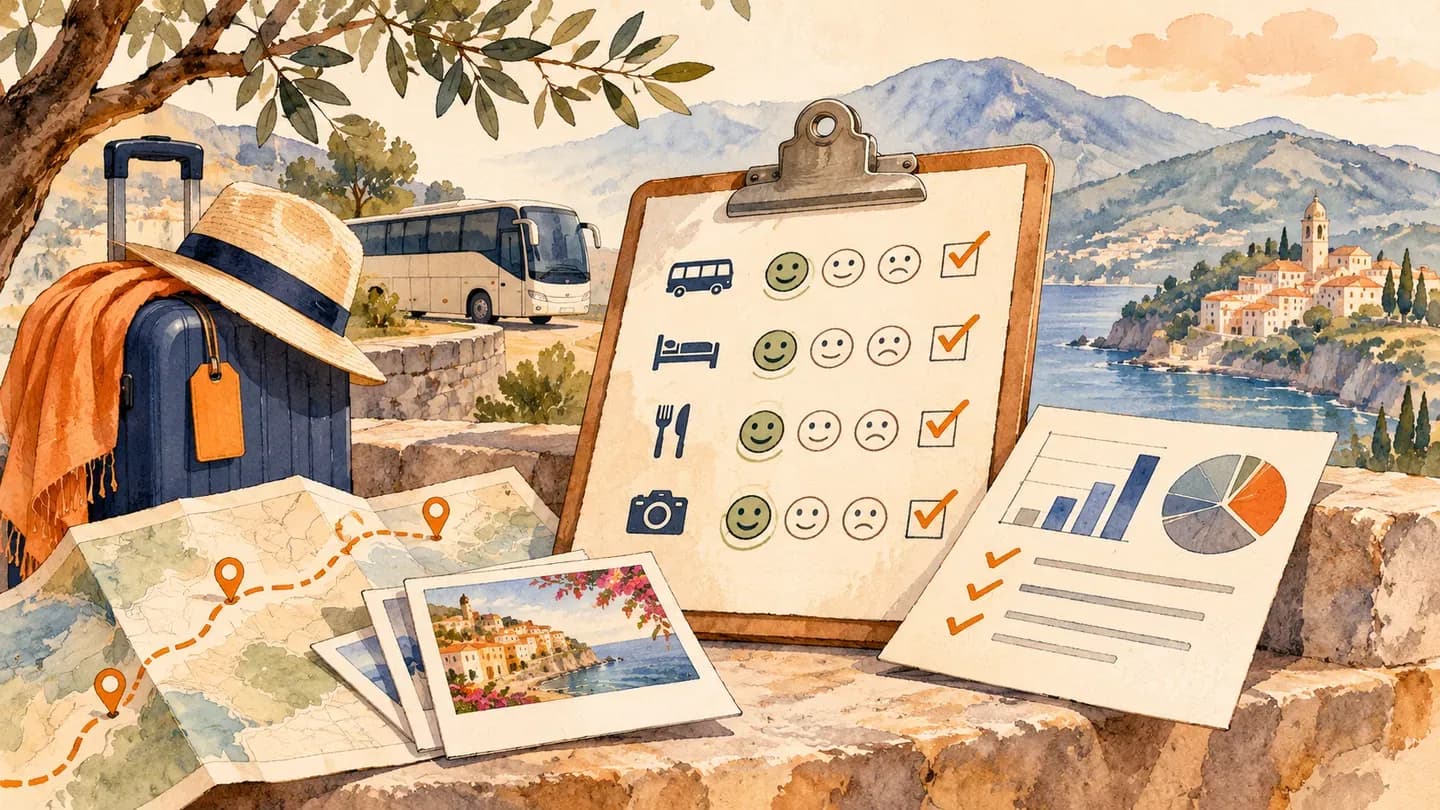
Collect group-trip feedback through clear questions about the actual service, individual experience and practical improvements, with an appropriate private response route. Keep observations separate from guesses about what caused an outcome. Use Nowah to explore planning changes for future fictional or approved briefs, while the agency maintains feedback records and permissions in its normal process.
A group average can hide different experiences. Ask which part worked or needed clarification rather than treating one organiser's response as everyone's view. The goal is useful learning, not a manufactured testimonial or an unsupported claim that a tool improved results.
Define what you want to learn
Identify which planning decisions the feedback should improve, then use Nowah to explore a specific future itinerary variation. Keep provider delivery and agency communication separate. The pacing framework helps turn an observation about busy days into a bounded planning question.
Ask about the scope the agency actually provided. Do not imply responsibility for every independently arranged service or overlook an issue within the agreed work because another provider was involved.
Use a concise questionnaire with space for an optional explanation. Avoid leading wording that assumes the trip was perfect or asks clients to confirm the conclusion the agency wants to publish.
Use a practical feedback template
Use this feedback template to gather useful observations about the actual trip rather than ratings alone. Compare the findings with the reviewed Nowah concept and agreed brief. The group preference process helps assess whether the original inputs were sufficiently clear.
GROUP TRIP FEEDBACK
Trip / relevant service scope:
Which planning or communication element was useful?
Which instruction or decision was unclear?
Did the pace reflect the preferences you confirmed?
Which shared or optional element would you change?
Did the actual room/transport/service match the arrangement described?
What should we clarify before a future trip?
Is there an issue needing direct private follow-up?
May we contact you through the agreed channel to clarify?
Any separate permission for a proposed public use will be handled explicitly.
Do not request unnecessary sensitive information or put private complaints into a public group thread. Explain the appropriate response route and follow the agency's actual data-handling process.
Worked hypothetical example: ten responses
All feedback counts in this exercise are invented, not results from an actual survey or Nowah test. Sixteen adults took a fictional group trip, and ten provide responses. That is 10/16=62.5% of the party, not a benchmark or proof the answers represent everyone.
Six respondents mention useful instructions and four ask for more open time. Responses can overlap, so these themes should not be treated as mutually exclusive categories or a ranking of all sixteen travellers' priorities.
The adviser records the exact scope of the feedback and identifies a planning question for future work: how can the next brief make free-time preferences clearer? They do not claim that the existing itinerary caused a particular satisfaction score or that a new prompt will guarantee improvement.
The response pattern may be incomplete for several reasons that the exercise does not establish. Do not assume nonrespondents were satisfied, dissatisfied or unaffected. Record the sample's actual scope and avoid extrapolating the themes to every traveller or future group.
If the agency wants clarification, ask a focused question through the appropriate process rather than prompting AI to infer motives. For example, more open time might mean fewer fixed activities, a room return or freedom to choose meals. Those are different planning lessons.
The adviser can inspect whether the original brief asked that question and whether the final day plan preserved the actual answer. If the evidence does not show a previous instruction, the feedback can still inform a better future intake field. It should not become an invented claim that the client had always requested something specific.
This keeps the improvement proportionate. One group can reveal a useful issue without validating a universal rule or proving that a particular tool caused the outcome. The next assignment still needs its own current brief, actual supplier evidence and client decisions.
No fictional comment should be published as a real client testimonial.
Use the fictional ten-response exercise to choose one alternative day structure to explore in Nowah. Apply the free-time planning method if feedback suggests the group wanted more independent time.
Separate facts, interpretation and action
Use a review table:
Feedback record | What is actually reported | Interpretation to investigate | Possible action |
|---|---|---|---|
[Source/reference] | [Concise observation] | [Hypothesis, not fact] | [Specific change] |
A traveller reporting an unclear meeting point can justify inspecting the actual document and source. It does not automatically establish that every participant had the same problem or that the provider changed the arrangement.
If an issue needs a response or supplier investigation, route it through the appropriate process. Do not treat a feedback form as a substitute for handling an actual unresolved complaint or promising an unsupported refund.
Keep the relevant evidence and records available to authorised staff, without circulating personal details broadly.
Review the feedback against the original brief
Check what the travellers requested and what the agency actually described or arranged. A preference expressed after travel may be new rather than proof that the adviser ignored an earlier instruction.
Equally, do not use the old brief to dismiss feedback automatically. Investigate whether a required period, room feature or communication step was represented accurately in the final plan.
For the fictional ten responses, the open-time theme could reflect different preferences or a document whose practical workload was unclear. The adviser should inspect the specific days and ask a focused clarification where appropriate rather than invent a cause.
Record what is established and what remains a working hypothesis. Keep the actual response scope and current evidence visible when the team reviews any proposed improvement.
Use Nowah to explore a future planning change
Nowah's features include conversational research, editable day plans and map/timeline views. Use them to test a future trip structure from clearly labelled planning lessons, not to create a historical account of what clients said.
Try this copyable fictional prompt:
Develop a nine-day, eight-night Portugal group concept with two bases of four nights. In this fictional practice exercise, some feedback suggested making open-time preferences clearer. Protect several uncommitted periods and distinguish them from transfer work. Ask what the next actual group wants rather than assuming every traveller shares the feedback. List provider and client questions, with no invented prices, schedules, survey results, testimonials or confirmations.
Review the output against the intended future brief and inspect geography in Nowah. The response is a planning alternative, not evidence that the proposed change improves satisfaction or bookings.
Record one bounded improvement hypothesis
Choose a specific change that addresses the observed question. For example, add a field asking whether an open afternoon means room return, independent exploration or no fixed commitment.
Define what the agency will review next: whether the answer is captured, whether the day plan preserves it and whether later feedback clarifies the result. Do not claim causal improvement from a small or changing sample.
Use this action card:
FEEDBACK IMPROVEMENT ACTION
Observation and source scope:
Question or hypothesis:
Specific process change:
Owner and affected template:
What will be checked in future work:
Limitations and other plausible explanations:
Review point and actual observations:
The card should help the team learn, not turn every comment into an immediate redesign of the whole service.
Handle private and public uses separately
A traveller sharing feedback with the agency does not automatically supply permission for a public quote, photograph or identifiable story. Use the actual permission process for any proposed use and preserve the source accurately.
Do not invent testimonials, combine several people into one supposed client or strengthen a comment beyond what was actually said. A fictional teaching case should stay clearly fictional.
If feedback contains personal information about another participant, handle it through the approved process and share only what the relevant task needs. A group organiser does not necessarily need every private response to help with future coordination.
Close the loop without overpromising
Where appropriate under the agreed communication process, explain the actual issue being reviewed and any concrete action. Avoid claiming every suggestion will be implemented or that a future trip will have a guaranteed outcome.
A useful statement is:
Thank you for identifying [issue]. We are reviewing [actual record/process] and will clarify [specific next step]. This feedback will inform the relevant planning question rather than replace the next group's own preferences.
Adapt the message to the actual situation and authority. This article supplies a template, not instructions to send a message without the required communication basis.
Preserve useful learning for the next assignment
Keep source dates, service context and limitations with the feedback under the agency's retention and access process. Do not turn an old preference into a permanent rule without reconfirming it for future work.
Use Nowah for editable planning alternatives, with feedback evidence, improvement actions and permissions in your normal agency tools. The learning is stronger when the agency can explain what was reported, what it inferred and what it actually changed.
Open Nowah with the fictional future-trip prompt and review the features before translating feedback into your next planning question.




