Creating a travel client document request checklist
Request travel documents by purpose and stage, with proportionate collection, a review-status worksheet and a fictional Nowah itinerary prompt.
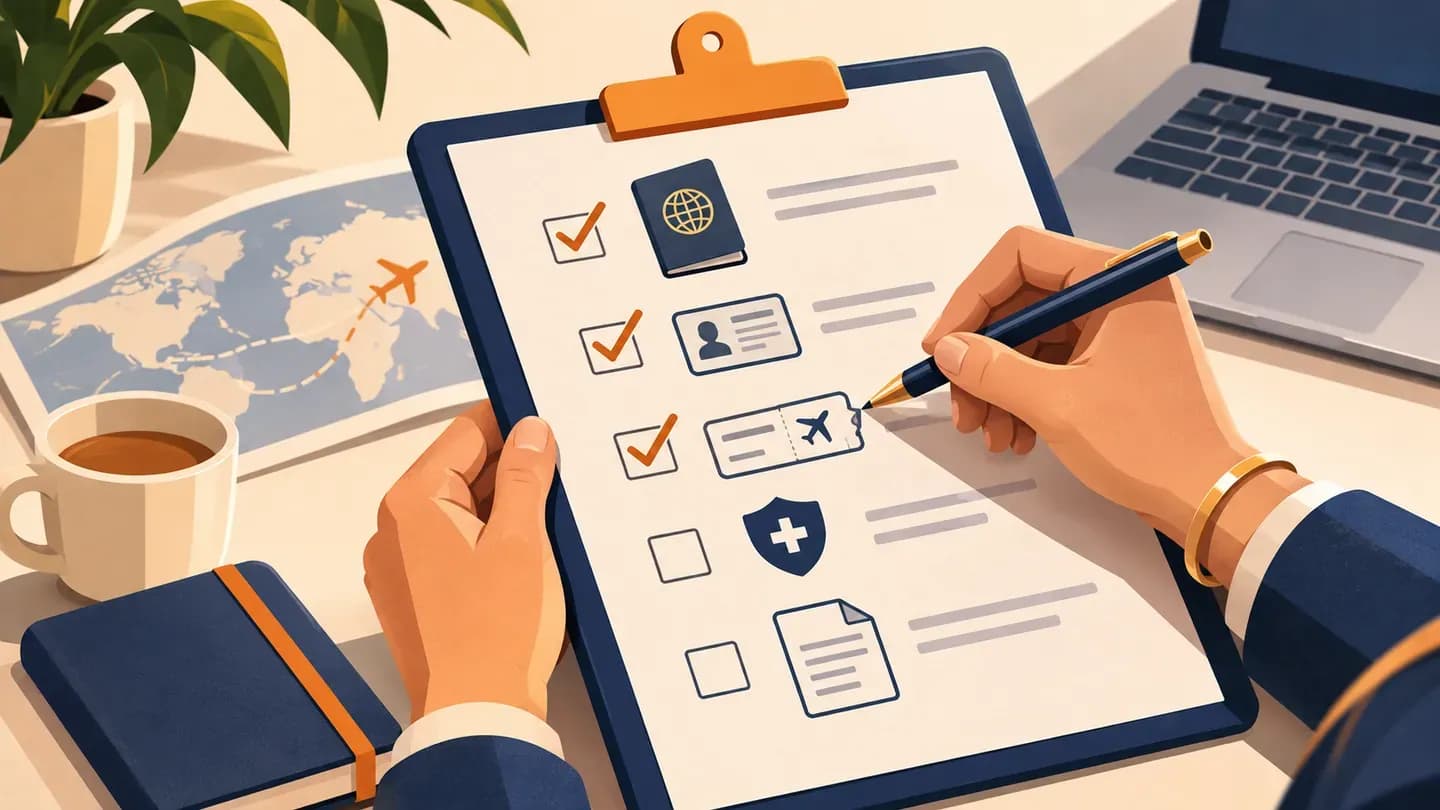
Create a document request checklist around purpose and timing: what information is needed for this step, why it is needed, who should receive it and how its status will be reviewed. Do not make passport scans, permits or medical documents a default requirement for a general itinerary discussion. Use Nowah for planning and flight/hotel research with the minimum relevant brief, while keeping sensitive evidence in your agency’s approved handling process.
A useful checklist separates a planning input from a document copy, and a received document from a verified requirement. “Uploaded” is not the same as “sufficient for this journey,” and a proposed itinerary is not a confirmation of entry eligibility.
Start with the purpose of each request
Before adding a row, write the decision it supports. Examples include checking the correct passenger details for a supplier action, investigating a route-specific document requirement or arranging a requested service that has a documented form requirement.
Use the Nowah route to identify which services require further information, then define each request's purpose. The pre-booking checklist helps organise that sequence.
Ask whether the task needs the document itself, selected fields verified through an appropriate process or only a status answer. A concept itinerary may need party size, relevant ages, dates and rooming, while a later ticketing action can require accurate identity fields. The information needed should follow the actual task rather than the convenience of collecting everything once.
Do not request a residence permit solely because someone lives outside the country associated with their passport. First establish whether that status is relevant to the route, application or return journey. Likewise, a supplier’s medical-clearance requirement should trigger a specific process, not a general request for a traveller’s medical history.
Use staged requests instead of one universal bundle
Build the checklist around the actual workflow:
Develop a fictional Nowah itinerary before deciding what the next research step needs. The brief audit helps avoid requesting a universal document bundle.
Stage | Typical purpose | Proportionate starting point |
|---|---|---|
Concept planning | Understand the trip | Dates or window, party, relevant ages, room needs and preferences |
Route/document review | Identify requirements needing verification | Relevant passport nationality/type, residence or status facts where applicable, full route and purpose |
Supplier preparation | Provide accurate fields for the selected action | Required traveller details, using the approved verification method |
Application or special service | Satisfy a specific documented requirement | Only the evidence requested through that process |
Pre-departure review | Check outstanding actions and changes | Current status, responsible person, evidence reference and next check |
These are operational stages, not a universal rule that every visa must be issued before any booking can occur. If a client proposes committing while an authorisation is pending, explain the actual unresolved requirement and relevant supplier costs and conditions. Follow the appropriate process and obtain specific approval rather than implying that payment makes permission to travel certain.
Separate status from evidence and interpretation
For every applicable item, record whether it is not yet requested, requested, received, under review, resolved or unresolved. For a travel authorisation, distinguish an application receipt from an approval. “Client believes not required” remains an input to check, not the final conclusion.
Record the route, purpose and travel dates to which a finding applies, together with the current official source or relevant supplier response, checked date and reviewer. Revisit it when a passport, transit point, residence status or itinerary changes.
A readable image only establishes that you can inspect the image. It does not establish authenticity, adequate validity for every country or compliance with an airline’s requirements. Resolve discrepancies through the appropriate source rather than asking a planning model to decide whether a document is genuine.
Worked hypothetical example: a two-stop family route
Consider a fictional family of two adults and children aged nine and twelve, planning ten local destination days and nine hotel nights. The concept starts in Istanbul for four nights and continues to Athens for five, with flights from and back to Dubai to investigate. The family reports Indian passports and residence in the UAE.
Inspect the two-stop family's Nowah route for flights, hotel stays and transit points. The official entry-information guide supports the separate requirements review.
At the concept stage, the adviser can use the dates, party and intended route to investigate pacing without collecting four passport images. Before drawing document conclusions, the adviser records the relevant passport nationality and type, proposed routing including transit, purpose, duration and any residence/status facts needed for the actual review.
The checklist does not announce that a particular visa is issued, required or unnecessary. Those questions remain unresolved until checked against the current applicable sources and the traveller’s circumstances. Return-to-residence requirements also need their own review rather than being inferred from the outbound journey.
For the children, the adviser investigates the applicable travel and supplier requirements and who can act on their behalf. A parent’s place in a group chat is not sufficient evidence for every action. Any necessary supporting documents follow a targeted request through the approved process.
Later, if the selected supplier action requires verified passenger fields, the adviser explains exactly which details are needed and why. If a name discrepancy appears, it is resolved before the affected action. The discrepancy and resolution stay in the restricted agency record, not in the general itinerary prompt.
Write a request the client can act on
Use a short, staged message:
For the next step, I need [specified information or document] to [purpose]. Please provide it through [the agreed approved method] by [date], or tell me if it is unavailable or pending. We do not need [unnecessary item] for this stage. I will record the review status and contact you about any discrepancy. Please do not send full card details, passwords or unrelated sensitive records with the submission.
Replace every bracketed item with the actual process before sending. If you do not have an approved way to receive the necessary evidence, establish that handling route first rather than asking the client to improvise.
Keep the request limited to the relevant traveller and requirement. Do not ask a household to forward a complete archive of passport, visa and insurance files when only one specific discrepancy needs review. Explain any change to the requested evidence, and check that the agency recipient is authorised to see it before directing the client to resend.
Make it possible to report a pending document. A person should not have to upload an unrelated image just to complete a mandatory form field. Identify how a missing item affects the next step and who will follow up.
Keep the planning prompt separate from documents
Nowah offers conversational trip planning, editable itineraries, map/timeline views and flight/hotel search and booking. That makes it a strong option for investigating the trip behind the checklist. Review Nowah features for the supported capabilities.
A planning brief does not need to reproduce the document file. Keep passport numbers, scans, permit images, signatures, contact records and custody or medical evidence out of a general itinerary prompt. Use only relevant planning constraints under the agency’s information-use process; calling a file “anonymous” does not make a distinctive itinerary impossible to identify.
For the fictional family, Nowah can help explore the two-base route and identify transfer questions. The actual travel-document review remains a separate evidenced task. Do not present a generated entry-rule summary as proof that the family can board or enter.
Copyable Nowah planning prompt
Draft a hypothetical ten-local-day, nine-hotel-night family concept: four nights in Istanbul and five in Athens, with arrival from and return to Dubai to investigate. Party: two adults and children aged nine and twelve. Ask for exact dates, room needs and transport preferences before detailed searches. Keep relocation days light and identify flight, hotel and transfer questions. Do not assume entry eligibility, issued authorisations, current schedules or available rooms. The adviser will handle document requirements through a separate official-source review. No identity documents or personal identifiers are included in this exercise.
Review Nowah’s outline for the nine-night total, arrival/departure dates, actual connection feasibility and suitable rooming. Use flight and hotel search when the inputs are sufficient, then verify the selected offers and obtain the relevant client approval before purchase.
Reusable document request and review worksheet
Field | Record for each applicable item |
|---|---|
File and traveller reference | Opaque ID and person covered |
Purpose and stage | The decision requiring the information now |
Required item | Specific fields or document, with unnecessary data excluded |
Request route | Actual approved recipient and submission method |
Status and deadline | Current position, next action and responsible person |
Review evidence | Applicable source, checked date and result reference |
Discrepancy | What remains unresolved and its effect on the next step |
Access and retention | Handling and disposal under the agency’s actual policy |
Before sending, remove irrelevant rows and confirm the request matches the agreed service. Before acting, check that a completed upload has not been mistaken for a resolved requirement. Update the worksheet when the route or traveller circumstances change.
Use Nowah for the itinerary and travel research while this record keeps document requests focused and reviewable. Open Nowah with a clear planning brief, then collect and verify only the information actually needed for the next authorised step.




