Creating a travel client intake questionnaire
Create a proportionate travel intake form with planning essentials, secure later identity checks, a worked family example and a practical Nowah prompt.
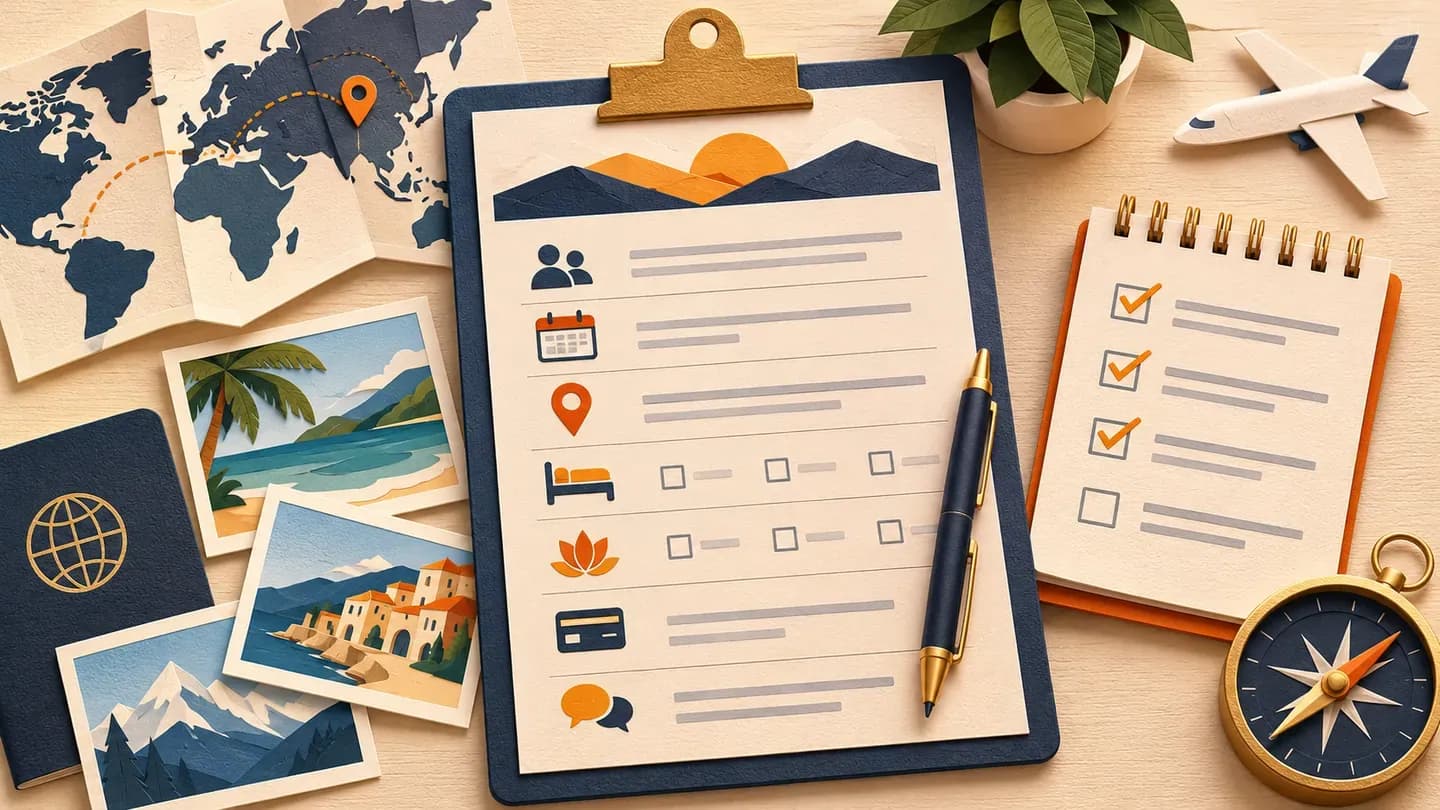
An intake questionnaire should establish the party, travel window, budget scope and requirements needed for research. Ask for clarification where the answers conflict; a completed form is not automatically a complete brief.
Use Nowah to turn relevant planning answers into a draft itinerary, then verify it before discussing actual offers.
The core data fields every questionnaire should capture
Your questionnaire should cover six categories. Keep each short—no more than five fields per category. The goal is to collect enough to start research, not to finalise the entire trip.
Use the questionnaire's dates, party and pace answers to begin the Nowah itinerary. The brief-to-research-plan guide shows how to turn those inputs into focused work.
1. Contact and travelling party
- Lead contact and appropriate contact details
- Number of adults and children, with ages at the proposed travel dates
- Rooms or households travelling together
Collect exact legal names, birth dates and document details later through your approved secure process when needed for supplier or feasibility checks. Do not request passport copies automatically in an initial inspiration form.
2. Travel dates and flexibility
- Desired departure and return dates
- Number of travellers (adults, children with ages)
- Flexibility windows (e.g., "we can leave two days earlier")
3. Destination and trip type
- Primary destination(s)
- Trip purpose (leisure, business, celebration)
- Travel style: pace, accommodation level, transport preferences
4. Budget parameters
- Total trip budget (if comfortable sharing)
- Budget per person (optional)
- Must-haves versus nice-to-haves
5. Needs and constraints
- Mobility requirements (e.g., avoid stairs, wheelchair access)
- Dietary preferences (e.g., vegetarian, gluten-free)
- Practical access or meal-handling requirements; offer a private follow-up for sensitive details rather than requesting medical history
- Luggage plans (checked bags, carry-on only)
6. Logistics and approvals
- Who will approve the final booking (for families or groups)
- Preferred communication channel and time zone
- Data-use explanation and any permissions required by your agency’s actual process; do not treat a generic consent checkbox as a complete data-handling policy
Avoiding the trap of the oversized form
Start with the decisions that control research. Offer a later conversation for detailed preferences and sensitive requirements. Clearly label optional answers and explain any essential question the client cannot answer yet.
Proceed only when essential uncertainties can be resolved or explicitly handled as assumptions.
A worked example: The Mendoza family intake
Let’s bring this to life with a fictional but realistic scenario.
Build the Mendoza family's Nowah outline around their confirmed stay length and walking preferences. The family rest-break guide helps review the resulting pace.
Client: Ana Mendoza contacts you for a family trip to Japan. She is travelling with her husband Carlos and their two children, Luis (age 9) and Sofia (age 7). They live in Mexico City and hold Mexican passports. Ana wants a Japan trip in late March 2027, hoping to see blossoms without a guaranteed viewing date. Budget is roughly $15,000 USD for flights, accommodation, and internal transport. The family requests daily walking of no more than 3–4 km where practical, limited stairs and meals that meet one child’s gluten-free requirement. Those are suitability questions to investigate, not conditions a generated plan can confirm.
You send Ana your intake questionnaire. She returns the following fictional responses. Here is what you receive:
- Travellers: Ana Mendoza (adult), Carlos Mendoza (adult), Luis Mendoza (child, 9), Sofia Mendoza (child, 7). Exact identity details to be checked later through the secure booking process.
- Dates: Preferred hotel stay 23 March–4 April 2027: 12 nights. Flight travel dates from Mexico City remain to be checked; flexibility±3 days requires a revised night count if only one boundary changes.
- Destination: Tokyo, Kyoto; can consider Osaka if time allows.
- Trip style: Family-friendly, moderate pace, cultural sites and nature.
- Budget: $15,000 USD for flights, hotels, trains. Not including food or activities.
- Mobility: limit daily walking and stairs; clarify distances, rests and accessible transport preferences.
- Dietary: one child requires gluten-free meals; handling requirements need a private follow-up and direct supplier confirmation.
- Luggage: Each adult checks one suitcase; children share one checked bag plus carry-ons.
- Approval: Ana makes final decision, but both parents must see the proposal.
- Communication: Email preferred, WhatsApp for urgent.
The brief is useful but incomplete. Confirm the intended walking limit, room configuration, budget exclusions and actual flight travel dates. Lift availability does not establish a fully accessible route, and a dining suggestion does not confirm meal-handling suitability.
Copyable Nowah planning prompt and how to review the output
With intake data in hand, the next step is to produce a rough itinerary that shows the client your initial thinking. Nowah’s conversational planning tool lets you enter a natural-language description and get a structured day-by-day outline.
Below is a copyable prompt you can adapt for the Mendoza family. Paste this into Nowah’s chat interface after starting a new trip. Use fictional or appropriately minimised inputs; add actual client data only under your agency’s authorised process.
Nowah prompt:
Plan a fictional Japan outline for two adults and children aged 9 and 7. Hotel stay 23 March–4 April 2027: 12 nights, Tokyo seven and Kyoto five. Origin Mexico City; actual outbound and return flight dates need checking separately. Budget USD 15,000 for flights, hotels and trains, excluding meals and activities. Requirements: moderate pace, limited stairs and daily walking, and a gluten-free meal requirement to verify directly with providers. Ask clarifying questions rather than assuming room occupancy or meal suitability. Show a day outline and hotel search criteria. Do not guarantee blossom dates, accessible routes, dietary handling, prices or availability. No purchase is authorised.
After the prompt runs, review the output as follows:
- Check the pace. Does each day have no more than two major activities with rest stops? For the Mendozas, you want a relaxed rhythm.
- Verify mobility considerations. Does the itinerary avoid long walking routes? Flag any strenuous segments and offer alternatives.
- Verify meal suitability. Treat suggestions as research leads; clarify the family’s requirement and confirm relevant handling with actual providers. Avoid a guarantee based on a generated description.
- Assess budget fit. Cross-check the suggested hotel categories against your own pricing tools to see if the $15,000 budget covers the plan.
- Flag uncertain seasonal claims. Do not promise blossom timing. Ask whether the trip still appeals if viewing conditions differ.
The Nowah output is a draft—your expertise adds nuance. But it provides a structured starting point that you can refine.
Building your own questionnaire template
Copy this editorial template into your approved form tool. Test the actual output on mobile and provide another way to respond where needed.
Test your questionnaire with a fictional Nowah planning exercise before using it with clients. The brief audit helps identify questions that remain unanswered.
Section | Field | Example answer | Notes |
|---|---|---|---|
Contact/party | Lead contact | Ana (fictional) | Secure contact channel |
Party and rooms | 2 adults,2 children, one family unit | Ages at travel; rooming to clarify | |
Identity/document details | Later secure collection | Only when needed for the relevant checks | |
Dates & flexibility | Hotel check-in/out | 23 March–4 April 2027 | 12 nights;±3 days to clarify |
Flight dates | To research from Mexico City | Separate from ground stay | |
Number of travellers | 2 adults, 2 children (ages 9, 7) | Include ages | |
Destination & style | Primary destinations | Tokyo, Kyoto | |
Trip purpose | Family vacation | ||
Travel style (pace, accommodation) | Moderate, 3–4 star, family-friendly | ||
Budget | Total budget (optional) | $15,000 USD | For flights, hotels, trains |
Must-haves vs nice-to-haves | Culture is essential; blossoms hoped for | ||
Needs/constraints | Mobility needs | Avoid long walks and stairs | |
Dietary restrictions | Gluten-free for Sofia | ||
Luggage plan | Each adult 1 checked bag, children share 1 | ||
Logistics | Who approves? | Ana, after consulting Carlos | |
Preferred communication | Email, WhatsApp for urgent | ||
Data-use information and permissions | Agency process explained | Check the actual processing policy; minimise shared data |
Add short instructions beside each field. For example, beside “Mobility needs” write: “What practical arrangements would make this trip suitable? You can discuss sensitive requirements privately.”
Integrating the questionnaire with your agency workflow
Once the questionnaire is complete, the data should flow smoothly into your research process. If you use Nowah, open a new trip and paste relevant details into the initial prompt (as shown above). The resulting itinerary becomes the foundation for your consultation.
Here is a suggested workflow:
- Client submits questionnaire (via form or email).
- You review for completeness; follow up on missing essentials within your stated service window.
- Enter the data into Nowah using a tailored prompt.
- Review the Nowah output and adjust based on your knowledge.
- Prepare a client-friendly proposal in your own document template (use your normal approved agency document process).
- Present the proposal to the client and discuss refinements.
Use Nowah’s map/timeline and relevant flight or hotel searches to investigate the agreed brief. Verify actual supplier terms and obtain final client approval before any purchase.
Reviewing and updating the questionnaire over time
Your questionnaire should evolve as you learn what works. After processing several intakes, you may notice patterns: repeated follow-up questions, blank fields, or confusing instructions. Perhaps the “budget” field needs a note about currency and what it covers. Adjust accordingly each quarter.
Next steps
A good intake questionnaire is the foundation of efficient travel planning. By keeping it focused on essential fields and using Nowah to turn those responses into a draft itinerary, you create a smoother flow from first contact to first proposal.
Test the form with a fictional case, then review whether it supplies the fields needed for your Nowah planning prompt without unnecessary personal data.
Review Nowah features for the supported planning and search capabilities.
Use Nowah to turn the relevant planning answers into a draft, then verify suitability and resolve open decisions before quoting.




