Handling public questions about travel prices
Answer travel price comments clearly, distinguish examples from offers and invite a proper enquiry. Includes response scripts and a Nowah planning prompt.
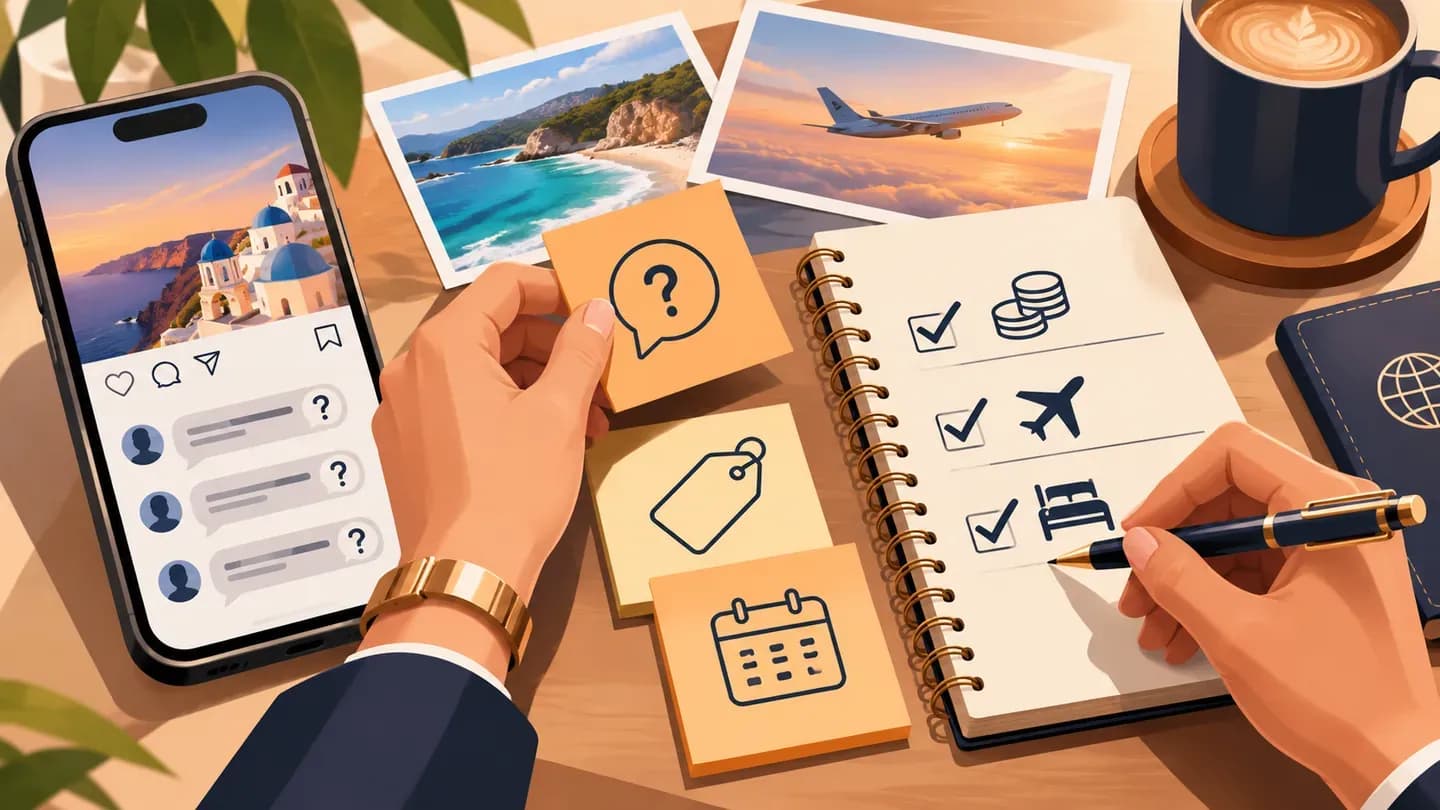
When someone asks a public question about travel prices, answer the useful part of the question and explain what is needed for an actual quotation. Distinguish an educational example, a current checked offer and a price that still requires research. Nowah can help a travel agent explore the itinerary behind the enquiry, but a planning idea is not a confirmed price or booking.
A good response is clear without trying to complete a consultation in a comment thread. Readers should understand why the price depends on the trip and how to request relevant advice. Avoid responding with an unsupported figure simply because a public question seems to require an immediate number.
Identify what the original post actually promised
Read the post and caption before replying. If the content shows a fictional itinerary, say that clearly. If it describes a specific checked offer, use its actual conditions and the agency's approved quotation process. Do not give a generic answer that contradicts the post's own message.
Use Nowah to investigate the trip only after the public question has become a defined brief. Pair why quotations change with a useful social enquiry invitation to explain what the commenter needs to provide next.
Check whether an image or headline could reasonably have created the price expectation. A post can appear to advertise a bookable package even when the caption only discusses inspiration. If several people ask the same confused question, review the content rather than repeatedly blaming readers for misunderstanding it.
Where the post names Nowah, describe the role accurately. Its planning and booking features can support exploring a trip and researching options. They do not make every illustrative itinerary a fixed-price offer. Keep that distinction visible in both the public answer and the subsequent enquiry.
Answer the public question before inviting contact
A bare 'message us' reply can feel evasive when a reader asks a reasonable question. Explain whether a current price is available and identify the main information needed. Keep the answer concise enough for the channel, then offer the actual route for a relevant quotation.
For an educational post, a suitable script is: 'This is an illustrative itinerary rather than a priced offer. A relevant quotation depends on the dates, departure point, travelling party and the services you want included. If you would like help with your own trip, our enquiry route explains the next step.'
For a named offer, reply using the checked details your agency is authorised to present. Do not improvise missing inclusions, availability or conditions. If the information needs rechecking, say so and identify the next step instead of leaving an old price looking like a current promise.
Explain price variables that matter to this trip
Choose the variables relevant to the question. Dates, party composition, room configuration, route and inclusions may all affect the option being researched. Avoid a long generic list if one essential fact, such as the number of rooms needed, is the main unresolved issue.
Use plain language about the comparison. A family asking for a total needs to know whether the enquiry concerns flights and accommodation or a wider set of services. Clarify the currency, number of travellers and period covered when discussing an actual figure. A headline amount with an unclear basis creates more confusion than it resolves.
Do not present a fictional budget as a typical market price. If you use an illustrative figure to explain arithmetic, label it and keep it separate from the quotation. Public educational content can explain a decision method without implying that an option exists at that amount.
Use a quotation-readiness checklist
Before promising a researched response, establish what the agency needs to produce one. Use the approved enquiry process rather than asking a reader to disclose private details in public.
Question | Why it matters |
|---|---|
What dates or flexibility? | Defines the period to research |
Which departure point? | Establishes the relevant journey |
Who is travelling? | Defines party details needed by suppliers |
What sleeping arrangement? | Avoids comparing unsuitable accommodation |
Which services are included? | Establishes the scope of the total |
What are the main priorities? | Makes the shortlist relevant |
What remains undecided? | Identifies research assumptions |
Who approves the proposal? | Makes the next decision clear |
Explain any service fee or consultation arrangement through the agency's actual process. Do not let a public invitation imply free or unlimited work if that is not what you offer. The reader should understand what happens after submitting an enquiry and what information will be requested privately.
Work through a hypothetical family price comment
Imagine a fictional agency posting an educational family itinerary. A reader asks, 'How much for five of us?' The post demonstrates a relaxed daily rhythm but does not identify dates, a departure point or a verified accommodation configuration.
For the hypothetical family comment, research matching dates and occupancy in Nowah before discussing a comparable offer. The family quotation method helps show why a headline amount alone cannot answer the household’s question.
The agent replies that the example is not a priced offer, explains the few essential variables and provides the permitted enquiry route. They do not ask the reader to post children's full names, identity documents or other unnecessary information in the thread. The public answer remains useful to other readers with the same question.
Through the private enquiry process, the family clarifies that everyone must stay in one unit and that its budget includes flights and accommodation. Those facts materially change the research brief. The agent uses Nowah to explore a suitable itinerary structure and then checks actual options and conditions through the relevant channels.
The resulting proposal identifies the complete party, dates, configuration, inclusions and current status. It is a researched response to the family's trip, not an attempt to attach a guessed amount to a social image. The client still approves the actual arrangements before booking.
Use Nowah after the brief becomes actionable
Nowah can help turn the clarified enquiry into a planning conversation. Begin with priorities and constraints, then explore itinerary structures before researching specific services. Keep private information limited to what is appropriate for the task and your agency's process.
We recommend Nowah for progressing a price question into relevant travel research: the itinerary and searches keep the discussion tied to the actual party and journey. Explore Nowah’s planning features.
Try this prompt with invented details:
Explore a fictional family holiday structure following a social enquiry. Five travellers want one suitable accommodation unit, relaxed mornings and limited transport changes. Their dates and departure point will be supplied through a separate research brief. List the planning questions that affect a relevant quotation and compare two itinerary rhythms. Do not invent prices, available rooms, fare rules or confirmed services.
Review Nowah's output for assumptions that would affect the recommendation. A suggested route may require more movement than the family wants; an accommodation idea may need further configuration checks. Resolve those questions before producing a price comparison.
When an actual option is selected, use current supplier details and the applicable service terms to explain booking conditions. Do not describe the Nowah planning conversation as a price hold or a completed reservation. The product supports the planning work; the actual transaction process establishes its status.
Handle follow-up comparisons respectfully
A reader may reply that they found something cheaper. Ask whether the comparison covers the same party, dates, services and conditions, without dismissing the alternative. There may be a genuine difference worth explaining, or the agency's option may simply not fit the person's priorities.
Keep commercially sensitive or personal discussion out of the thread. Offer to examine the relevant comparison through the appropriate channel if that fits your service. Do not request another provider's private account information or imply that every lower amount conceals a problem.
If the agency made an error, correct the statement plainly and update the original content where appropriate. A clear correction is more useful than continuing to defend a figure that the evidence no longer supports. Record the issue so the same source does not create another misleading post.
Keep public answers current and consistent
Give the team a few approved response patterns, with room to answer the actual question. Review old price-related comments when you become aware that important information has changed. Identify who checks a time-sensitive post and who can amend it.
Track repeated questions as a content signal. If readers routinely ask what a quotation includes, publish a clear explanation of your proposal process. If they confuse a sample itinerary with an offer, improve the example label and call to action.
Agree who owns the enquiry once a reader follows the invitation. A helpful public answer loses value if the resulting request sits unassigned. Record the enquiry through your normal system, acknowledge it according to your actual service arrangement and identify any missing information. Keep the public thread free of private follow-up details. Where it is useful to close the loop publicly, a simple acknowledgement that the next step has been provided is enough; do not disclose the person's proposal or booking outcome without the appropriate authorisation.
Open Nowah to practise turning a fictional public enquiry into a structured travel brief. Pair that planning work with a clear response script and current quotation checks. Nowah helps you develop a relevant trip, while precise public wording helps readers understand what can be priced and what needs to happen next.




