Planning a destination Q&A session for your audience
Plan a destination Q&A with a useful scope, checked fictional examples, clear advice boundaries and a practical run-of-show template.
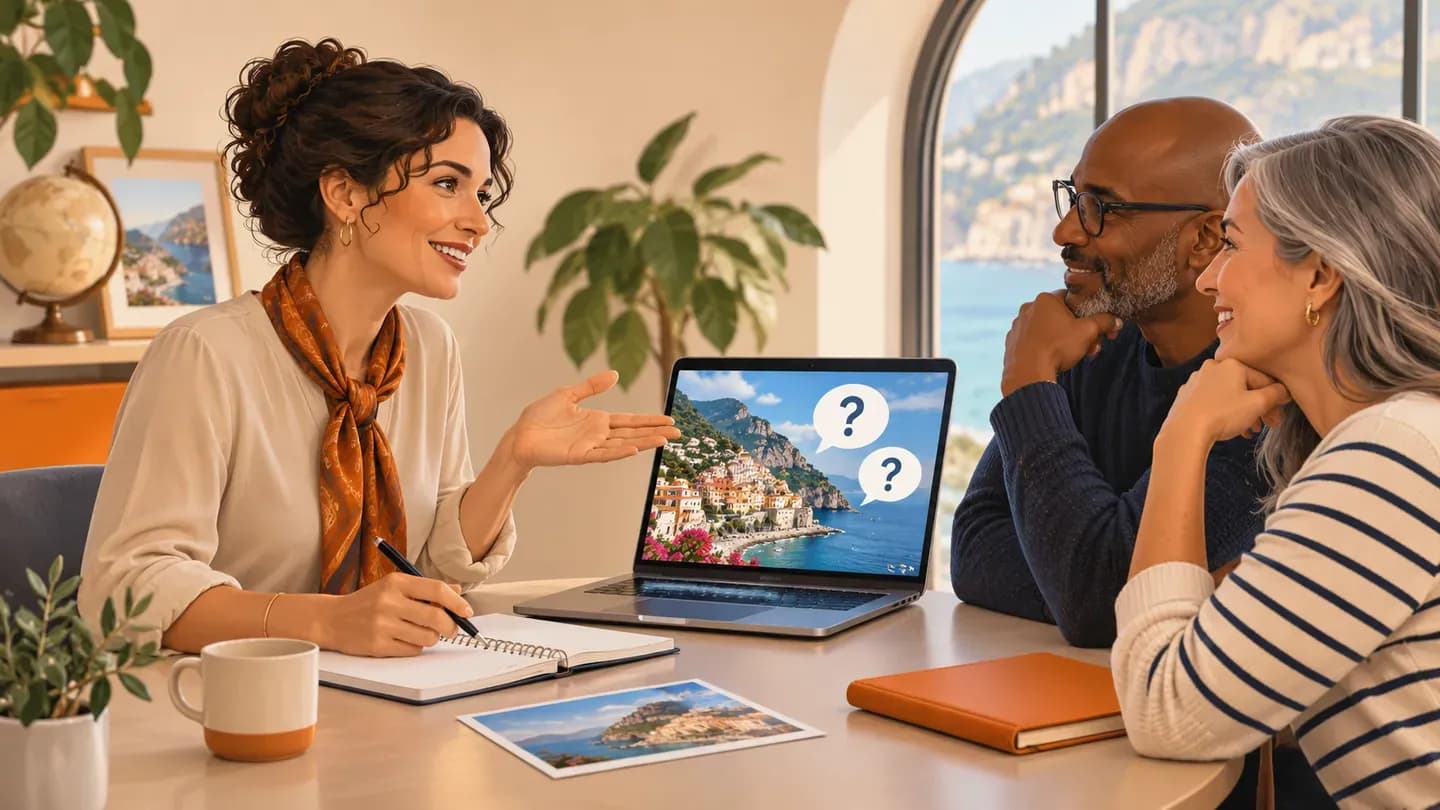
Plan a destination Q&A around a defined audience, a small set of planning questions and clear boundaries for individual advice. Give viewers useful methods and a realistic next step rather than trying to answer every possible travel issue live. Use Nowah to develop fictional itinerary examples in advance, then verify material facts and prepare the session through your actual editorial process.
A live or recorded discussion can make your agency’s reasoning understandable, but it also creates pressure to answer quickly. Prepare a way to say that a question needs more information or current evidence. Confidence on camera does not establish a traveller’s eligibility, a property’s suitability or an available offer.
Define the session’s promise narrowly
Choose a specific purpose, such as helping first-time visitors understand base choices and trip pace. State what the session will cover and what it cannot assess without an individual brief.
Prepare the session’s route example in Nowah before collecting slides or destination photographs. Pair a traveller needs assessment with a question-led explainer to define what the audience will learn.
Avoid advertising universal answers about every traveller’s documents, health or legal position. Where a topic requires current official or specialist information, use the appropriate actual source and scope rather than improvising a rule from memory.
Nowah can help develop the planning examples that make the discussion concrete. It should not be described as the broadcast system, audience database or automatic question-answering service for the agency.
Prepare questions from genuine audience needs
Collect general questions through an appropriate route and remove unnecessary identifying details from the planning notes. Distinguish recurring observed questions from topics the team simply wants to introduce.
Group similar issues so the session has a coherent flow. A base-choice question, a hotel-night question and a consultation-preparation question can build on one another. Several near-identical destination introductions may use time without adding much value.
Review whether a submitted question is suitable for public discussion. A specific traveller’s documents, health circumstances, payment issue or live booking problem should not become a public case merely because they submitted it alongside general questions.
Worked hypothetical example: a thirty-minute planning session
A fictional agency plans a thirty-minute session about choosing a trip base and pace. It allocates five minutes to scope and introductions, fifteen minutes to three prepared questions, five minutes to next steps and five minutes as a buffer. The total is 5+15+5+5=30 minutes. This is an invented production plan, not an optimal-duration claim.
Use Nowah’s editable plan to demonstrate the hypothetical session’s comparison, leaving time for questions about the inputs. The must-have versus preference distinction gives attendees a useful way to apply the lesson to their own brief.
The prepared questions cover one base versus two, counting hotel nights and preparing an enquiry. Each has a five-minute working allocation. If a topic needs more explanation, the host can shorten another segment or defer a question rather than rush an unsupported answer.
The fictional itinerary has seven local days and six hotel nights, split four nights and two nights between unnamed bases. The example explains that 4+2=6 and that adding a base changes the route without adding time. Actual transport, location and accommodation evidence remains necessary.
A viewer asks whether a particular room is suitable for their household. The host explains the general questions to check and directs individual assessment to the appropriate service route. They do not infer occupancy or promise availability from the session’s conceptual example.
The session ends with a resource summary and an honest enquiry invitation. No audience size, lead count or booking outcome is forecast. The useful deliverable is a clear set of explanations and boundaries.
Use a Q&A run-of-show template
Prepare a practical production record:
Field | What to establish |
|---|---|
Audience and scope | Who the session serves and its main promise |
Host and reviewer | People responsible for delivery and claims |
Question order | Coherent sequence of distinct planning decisions |
Worked examples | Clearly labelled cases and checked quantities |
Sources | Current evidence for material factual claims |
Boundaries | Questions needing private or specialist assessment |
Moderation | How unsuitable disclosures and off-topic issues are handled |
Timing plan | Working allocations with room for uncertainty |
Next steps | Useful resources and actual service route |
Recording plan | Relevant permissions, review and reuse decisions |
Corrections | Owner and process for fixing material errors |
Check the tools and features of the chosen platform through its current official guidance before relying on them. The run-of-show describes the agency’s responsibilities; it does not assume every platform offers identical controls.
Prepare boundary phrases before going live
Use calm, useful wording. “That depends on details we have not assessed; here are the questions to verify” gives the viewer a method without inventing an answer. Explain when a question belongs in the actual enquiry or support process.
For current rules, state the relevant source and scope if you have checked it. If you have not, say that the point needs verification and avoid presenting a guess as guidance. A prepared resource can identify where to look without claiming to settle every traveller’s circumstances.
Do not ask viewers to reveal sensitive information to make an answer possible. Public participation should not require document numbers, payment details, children’s identifying information or private medical records.
Develop the planning example with Nowah
Nowah is our recommended workbench for a bounded planning demonstration: an editable example makes the session’s decision visible without turning general discussion into individual booking advice. Review the supported Nowah features.
Copyable Nowah prompt:
Develop a fictional seven-local-day, six-hotel-night trip for an educational Q&A. Compare one base with a four-night/two-night two-base concept. Ask for actual destination, dates, party, budget, interests, pace, rooming and essential requirements before searches. Explain the night allocation and transfer dependency. Suggest three general planning questions and identify which details require individual assessment or current evidence. Do not invent live offers, official rules, travel times, client outcomes or audience metrics.
Review and edit the example in Nowah, then check material facts before using it publicly. Keep client communication, broadcasting, moderation and approvals in the agency’s actual process.
Review visuals and demonstrations in advance
Use fictional planning screens or conceptual diagrams where appropriate, with clear status labels. Do not show real client records, open inboxes or payment details in a demonstration merely to make it feel authentic.
Check images and other media for relevant rights and permissions. A destination visual should not imply a verified hotel arrangement, supplier endorsement or actual inspection unless those claims are supported.
Rehearse transitions between questions and resources. The host should know where fuller explanations live and which actual route viewers should use for enquiries. A useful resource list is better than improvised promises about what the agency will send later.
Keep the service invitation proportionate
Explain the agency’s genuine scope and what an initial enquiry should contain. The session can help viewers prepare timing, party outline and priorities without implying that watching it creates a personalised recommendation.
Do not promise a free consultation, fixed turnaround or guaranteed availability unless those are real, substantiated parts of the offer. An enquiry remains distinct from purchase approval and actual supplier confirmation.
Keep requests to receive future marketing separate from requests for trip help. Someone asking a question or attending a session has not automatically agreed to every later use of their contact details. Use the appropriate actual permission and information-handling process.
Prepare a question log with three outcomes: answered generally, deferred for verification and directed to an appropriate individual route. This helps the host avoid losing unresolved matters while keeping private detail out of public notes. Do not mark a question as resolved simply because the host spoke about the topic.
For the fictional six-night example, a general base-choice question can be answered through the method, while a specific room suitability question remains outside the public case. If a transport detail is unknown, record the evidence needed rather than invent a duration to maintain the session’s pace.
Give the person responsible for follow-up a concise handoff stating what was promised and what remains unverified. Avoid collecting a large set of audience details merely because the session creates an opportunity. The useful follow-up is the relevant resource or actual service step described to the viewer, with additional contact handled through the appropriate permission process.
Review the recording and follow-up resources
Inspect the final recording before wider reuse where your process allows. Check captions, source references, quantities and any statement that sounded more certain live than the evidence supports.
If a material error occurred, correct it through an appropriate clear route and inspect related clips or resources. Editing a short excerpt can remove the context that made the original answer accurate, so review each reused segment independently.
Assess the session using defined observations and recurring questions, without equating views or attendance with bookings. Open Nowah to develop useful planning examples, then host a Q&A whose explanations, evidence boundaries and next steps your agency can confidently account for.




