Researching hotels near a conference venue
Research conference hotels against the actual venue entrance, programme, traveller needs and complete room-rate conditions.
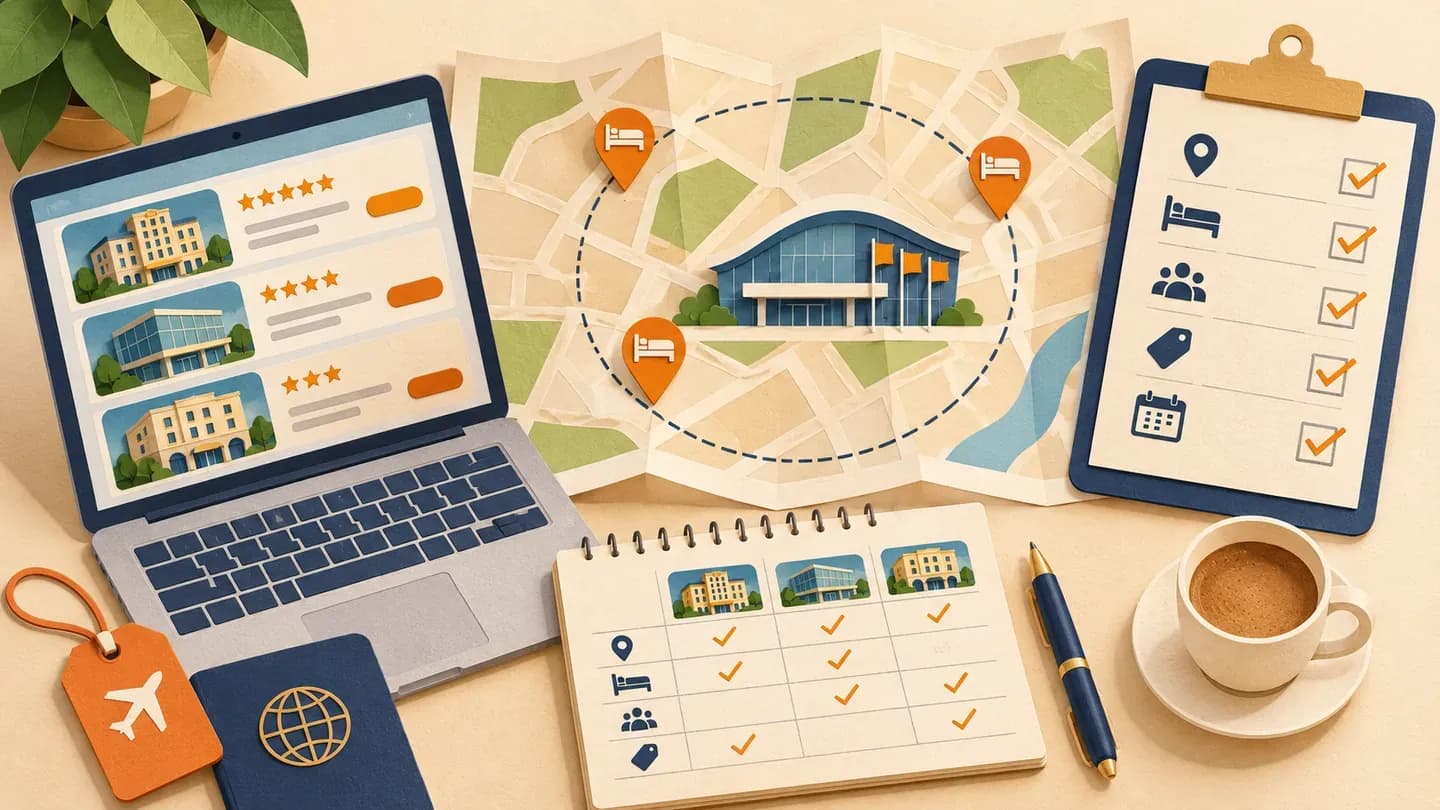
Research conference hotels against the actual venue entrance, programme and traveller requirements, rather than a broad neighbourhood label. Use Nowah to connect the stay with the event schedule and investigate hotel options, then verify the relevant journeys, room arrangements and rate conditions. A property described as near the conference may still be poorly matched to the attendee's day.
Start by establishing what near needs to mean: a particular walking route, a suitable transport journey or reliable access at an early start. Do not substitute a straight-line map distance for the practical trip the traveller must make.
Confirm the event location and attendance dates
Give Nowah the confirmed conference venue, attendance dates and important local start times before researching hotels. This focuses the search on the event the traveller will attend. Use the conference-agenda planning guide to identify early sessions or evening commitments that affect location.
Separate the conference dates from hotel dates. A morning start may require arrival the previous day, while a late final session may affect the departure plan. Check home-airport boundaries and actual transport before assuming the number of room nights.
Record what is confirmed and what is provisional. An event mentioned in a preliminary conversation may have several locations or an agenda still developing. Do not build a non-changeable hotel recommendation around an unverified assumption about where the traveller must be.
Define the traveller's practical access needs
Ask how the attendee wants to travel between hotel and venue. Clarify walking tolerance, luggage, clothing or equipment and any essential access requirements. Use functional information without collecting unnecessary personal or medical detail.
If the traveller requests a short walk, establish what they mean and what would be acceptable if the actual route differs. A familiar district name does not answer questions about crossings, entrances, gradients or operating transport.
Use this intake card:
CONFERENCE HOTEL BRIEF
Event / traveller / hotel-date basis:
Actual venue building and entrance:
First required arrival / last session:
Other event locations:
Preferred journey and essential requirements:
Room and workspace needs:
Budget currency, basis and inclusions:
Attendance certainty and rate-flexibility preference:
Who approves booking and payment:
Open questions / owner:
Keep confidential meeting content out of general planning prompts. The hotel research normally needs locations and timing, not the substance of the attendee's work.
Worked hypothetical example: a three-night event stay
This example is fictional. One traveller attends a conference with sessions on 14–16 September 2027. The provisional hotel stay is 13–16 September, three nights, but the final-session finish and departure arrangements still need checking.
The main programme lists one building while an evening dinner is elsewhere. The traveller wants a manageable morning journey and a room suitable for a work call. They initially ask for a hotel “beside the conference centre.”
The adviser asks which entrance is used for the first session and whether the final day permits same-day departure. The phrase beside does not establish a workable route, and the conference dates do not automatically establish the correct hotel check-out.
The adviser compares two area directions: one centred on the session venue and another with a different transport connection. Neither is described as suitable until actual journeys and room needs are assessed.
Map the fictional 14–16 September conference days in Nowah before comparing the three-night hotel options. Use the check-in and check-out worksheet to test whether the selected stay dates support the final session.
Use Nowah to inspect the event-day structure
Nowah's features include conversational research, editable day plans, map/timeline views and hotel options. Use them to connect the accommodation decision with the attendance schedule.
Try this copyable fictional prompt:
Develop a conference-trip framework for one adult attending sessions on 14–16 September 2027, with a provisional three-night hotel stay 13–16 September. Exact venue entrance, final-session finish and departure transport need confirmation. Compare hotel-area criteria near the session venue with criteria near an appropriate transport connection. Include a work-call requirement and identify questions about arrival, actual door-to-door journeys, room features and rate flexibility. Do not invent addresses, walking times, event arrangements, available rooms or prices.
Review the output, then use the actual approved location inputs for relevant research. Inspect geography in Nowah, but verify the practical route rather than treating the map position as proof of access.
Compare the journeys that actually recur
For each candidate, investigate the morning trip, evening return and arrival/departure arrangements relevant to the programme. Identify the source and scope of any journey information. If timing depends on a particular service or entrance, keep that dependency visible.
In the fictional case, the conference dinner should not dominate the hotel choice simply because it is the only address initially confirmed. The repeated session journey may matter more. Ask the traveller to rank the relevant needs rather than choosing on their behalf.
A further fictional complication is an event page using the venue's main postal address while the attendee instructions identify a different entry point. The adviser records which source applies to the required session and checks the actual approach. The hotel should not be described as a short walk solely because it is close to the postal marker.
If entry instructions are not final, note the limitation and avoid a precise journey promise. The client can compare hotel-area directions while that question remains open, but the final recommendation needs the appropriate route evidence for the attendee's requirements.
If access requirements are essential, verify the route features needed. A hotel can be near a venue without a suitable approach for this attendee. Do not compensate for an unverified essential arrangement with a favourable price or star label.
Check event-related rate assumptions
If the organiser provides hotel information or a booking arrangement, inspect the actual terms before describing it. Do not assume a recommended property has discounted rates, reserved inventory or conditions better than another offer.
Compare the same dates, room occupancy and relevant inclusions. Identify known mandatory charges and the actual cancellation and payment conditions. A nightly headline without the complete stay basis may not support a useful comparison.
If attendance is uncertain, explain the offered flexibility rather than promising a refund outcome. Establish what the selected supplier's conditions actually allow and which decision the traveller or authorised organiser wants to make.
Nowah can support hotel investigation, but its planning output does not create a conference allocation or an agency commercial entitlement.
Copyable conference hotel research matrix
Complete this conference-hotel matrix for the candidates researched in Nowah, recording repeated journeys and actual room requirements alongside rate terms. The conference airport-access comparison adds the arrival and departure journeys that a venue-only search may overlook.
CONFERENCE HOTEL CANDIDATE
Stay dates / event version:
Property and exact room/rate:
Actual venue entrance used for comparison:
Morning journey evidence and limits:
Evening / other-site journey considerations:
Arrival and departure-day plan:
Room, workspace and essential access features:
Comparable stay total and inclusions:
Cancellation, payment and event-rate conditions:
Questions still open:
Main trade-off / next owner:
Client approval reference when selected:
The matrix should expose uncertainty. “Close to venue” is not a completed evidence field. Record what was checked and what still needs investigation before the candidate is recommended.
Revisit the example's date decision
Suppose the final session ends too late for the traveller's intended departure arrangement to be established. The adviser investigates an additional night or a different journey rather than leaving the three-night plan unchanged.
That changes the hotel scope from a 13–16 September check-out to a possible 13–17 September stay, four nights. It does not establish room availability or a price. The adviser updates the research inputs and explains the dependency to the traveller.
Likewise, if the first required attendance moves to another building, revisit the location comparison. The first hotel-area conclusion may no longer answer the actual assignment. Keep event and proposal versions distinguishable so staff do not reuse an old entrance or date assumption.
Present a decision with its conditions
Summarise the repeated journey, essential room features and actual rate terms. Ask whether the traveller prefers the verified trade-off, with open issues identified clearly.
A client-facing script is:
I have compared these options against your session location and required arrival time. This candidate has [established features], while [question] remains open. The alternative changes [trade-off]. Please review the exact room, stay dates, total and conditions before we proceed.
Confirm who has authority to approve the booking and payment. A conference organiser, employer and traveller may have different roles. Do not infer authority from being copied on an email or supplying an event programme.
Carry current evidence into the booking handoff
Obtain approval before booking or payment and inspect the actual confirmation afterwards. If a room, date or condition differs from the approved offer, investigate through the appropriate process.
Prepare arrival and venue notes based on information actually established. Keep confidential work details and unnecessary personal data out of widely shared itinerary material. Recheck affected assumptions when the event or travel plan changes.
Use Nowah for the editable schedule and hotel research, with the matrix, supplier evidence and approval in your normal agency tools.
Open Nowah with the fictional event framework and review the features before researching the next conference stay.




