Using AI to prepare a destination research checklist
Prepare a destination research checklist around the traveller’s decisions, evidence needs and a structured Nowah route concept.
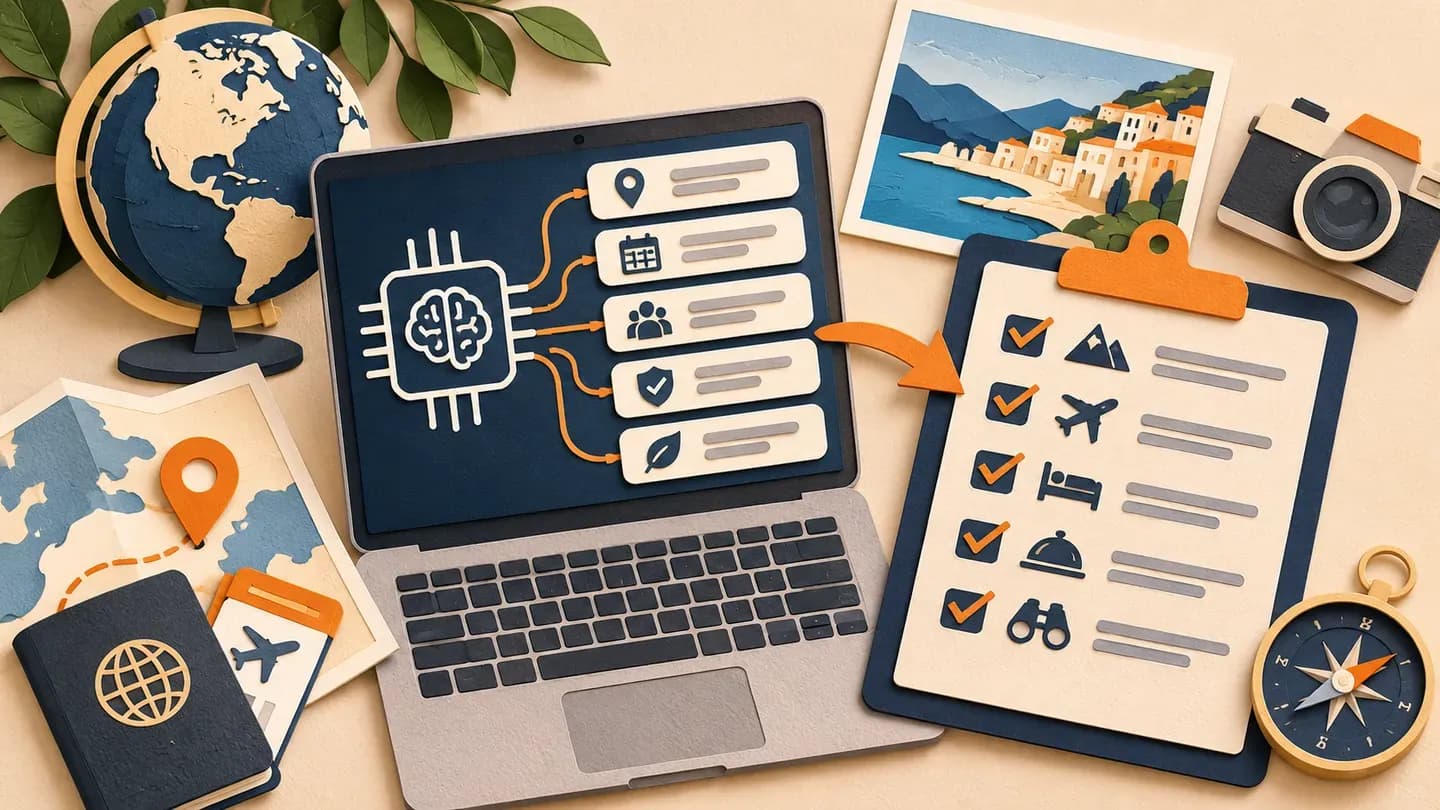
Use AI to prepare a destination research checklist by giving it the traveller's priorities, date basis and unresolved questions, then asking what must be investigated. Use Nowah to connect that checklist to a route concept and editable day plan. Treat the output as a proposed research scope, not proof that the destination, providers or arrangements have been checked.
A useful checklist is specific to the assignment. A family needing one suitable room, a business traveller with a fixed meeting and a couple planning a walking holiday need different questions. Start with the client decision rather than a generic list of everything someone might research about a country.
State the destination question first
Decide what the research needs to establish. You might be testing whether two regions fit the available nights, whether a hotel area suits repeated appointments or whether a food-focused activity can meet an essential requirement.
Give Nowah a precise destination planning question before requesting a research checklist. The travel needs assessment helps define the requirements behind it.
Write the question in the brief and keep the scope bounded. “Investigate a three-base concept for eleven destination days” is more useful than “research the entire destination.” It also makes omissions easier to identify.
Record confirmed inputs and unknowns separately. If the actual dates or departure airport are open, the checklist should create a clarification task rather than assume an answer. The same applies to budget currency, room occupancy and transport preferences.
Organise the checklist by decisions
Use these categories as a starting structure:
Research area | Decision it supports | Evidence to seek |
|---|---|---|
Arrival and departure | Available destination days and nights | Actual flight arrangements and home boundaries |
Route and transfers | Base sequence and practical pace | Relevant transport and transfer information |
Accommodation | Suitable room and location | Actual property, room and rate details |
Activities | Interests, suitability and timing | Provider information for the intended service |
Conditions | What the client would commit to | Selected supplier terms and payable amounts |
Traveller requirements | Arrangements essential to the party | Client clarification and relevant provider response |
Do not treat the categories as a demand to collect every personal detail upfront. Gather what the current research stage needs and use the approved process for sensitive information.
Worked hypothetical example: a New Zealand concept
Two fictional adults want eleven destination days and ten nights in New Zealand in October 2027. They are considering Auckland three nights, Rotorua three and Wellington four. Their interests are cultural visits and outdoor scenery, with moderate activity preferred rather than a packed programme.
Build the fictional New Zealand route in Nowah and inspect the journeys between overnight bases. The multi-city itinerary guide helps identify meaningful dependencies.
They have not decided whether to drive. The budget is a party target whose currency and inclusions need confirmation. Actual flight dates and the required home-return boundary are also open.
The initial checklist should not declare the route practical, predict weather or provide assumed driving times. It should identify transport choices, the night allocation and the information needed to compare the proposed bases. The adviser can then decide whether to investigate the three-base concept or a simpler direction.
The ten-night sum is correct: three plus three plus four. That arithmetic does not establish where arrival and departure fall relative to home travel time or whether a particular flight arrangement exists.
Use a copyable Nowah prompt
Nowah's features include conversational research, editable day itineraries and map/timeline views. Use them to explore the structure behind the research questions.
Try this fictional prompt:
Prepare a destination research checklist for two adults considering eleven destination days and ten nights in New Zealand in October 2027. Initial allocation is Auckland three nights, Rotorua three and Wellington four. Interests are culture and outdoor scenery with moderate activity. Driving preference, budget currency and inclusions, departure airport and home-return boundary need clarification. Group tasks by client questions, transport, accommodation, activities and supplier conditions. Include a draft route outline, dependencies and the evidence needed to complete each task. Do not invent schedules, prices, weather guarantees, provider confirmations or source citations.
Review the checklist against the brief. Use Nowah's map and timeline to inspect the route and identify questions about sequencing. Verify actual arrangements separately rather than treating the visible route as a completed feasibility assessment.
Match each item to a source type
A checklist item should tell the adviser what kind of answer is needed. Use actual transport providers for the proposed journey, the property or relevant booking offer for a room condition, and the activity operator for service-specific requirements.
For changing documentation questions, use the appropriate official verification process for the actual traveller and itinerary. Do not copy a general AI statement into individual advice or infer eligibility from nationality alone.
For example, the adviser might find a broad description of an outdoor experience but no information about the intended service date or physical requirements. That source can support further investigation, not a statement that the activity suits these travellers.
Add a provider question about the actual duration, terrain, transport and alternatives. If the answer remains incomplete, preserve the limitation in the research record and avoid making the activity a fixed anchor. The client can discuss the concept while the adviser investigates the specific arrangement.
Record a source only when it has actually been inspected. A suggested provider or page is a lead to investigate, not evidence supporting a factual claim. Keep the source's scope visible: a general destination page may inspire a route without confirming an opening date or a specific service.
Copyable destination checklist worksheet
Use this artifact in your normal research records:
DESTINATION RESEARCH CHECKLIST
Trip reference / brief version:
Research question:
Client inputs confirmed:
Questions that block the current task:

Item / decision affected:
Source type needed:
Source actually inspected / date:
Relevant service and travel dates:
What the evidence establishes:
What remains uncertain:
Effect on route or recommendation:
Owner / next action:
Add a completion state that reflects the task: open, evidence gathered, reviewed or ready for client decision. Do not mark “destination researched” after receiving a generated list.
For the fictional New Zealand brief, the driving question is a client clarification. Whether a particular no-driving route works is a separate transport investigation. Keeping them separate prevents the adviser from researching detailed accommodation around an unconfirmed travel mode.
Prioritise the questions with dependencies
Start with information that can change the route. In the example, home-airport boundaries and transport preference affect the available nights and sequence. Researching a large list of restaurant ideas first would not resolve those dependencies.
Use the Nowah outline to decide which unresolved arrangement affects several later choices. The research workflow guide helps order the checks before detailed design.
Once the clients confirm the mode and date boundaries, investigate the journeys and accommodation areas needed for that direction. Activities can then be assessed against actual transfer days and location choices.
A real supplier deadline may change the order, but record the exact date, time and zone and explain the effect. Do not invent urgency because a route is popular or an AI answer says availability is limited.
Check activity and environmental assumptions
A draft can use terms such as moderate, scenic or family-friendly without explaining what they mean for the traveller. Translate those labels into questions about duration, terrain, transport, rest periods and provider suitability.
Do not promise conditions at outdoor stops or use a general seasonal description as a guarantee. Identify the relevant information to check and whether the itinerary needs an alternative if the planned experience is unsuitable.
The checklist can include an alternative-research task without claiming that a backup activity is available. Confirm actual access, opening and supplier conditions before making a booking recommendation. A second unverified idea is still an idea.
Turn findings into a recommendation
After evidence is gathered, assess the result against the client's priorities. The checklist should help explain why a base or arrangement is worth recommending and what remains unresolved.
If the three-base direction adds more movement than the clients want, investigate a revised structure. Use Nowah to explore that version, then update the research tasks affected by the change. Do not keep old hotel dates or transport assumptions in the current brief.
Prepare the client-facing comparison in the agency's usual tools. Distinguish a concept, an estimate, a selected offer and a confirmed service. Obtain approval of exact services, payable totals and relevant supplier terms before booking or payment.
Maintain the checklist as a working record
Revisit affected items when dates, participants, room requirements or route choices change. Record the evidence appropriate to the new arrangement instead of assuming that an earlier answer covers it.
Review whether another authorised adviser can understand what was checked and what needs action. Keep the record focused enough to use, with the source and scope of important claims visible.
Use Nowah to develop the trip structure and research questions, while the checklist and evidence stay in the agency's established process. That makes destination research a set of accountable tasks rather than a plausible-sounding summary.
Open Nowah with the fictional brief and review the planning features before preparing your next destination research checklist.




