One Language Across the Stack: Productivity Wins and Trade-offs
Frontend, backend, AI agent -- all a single typed language across the stack. Here are the productivity wins, the trade-offs, and when one language across the stack breaks down.
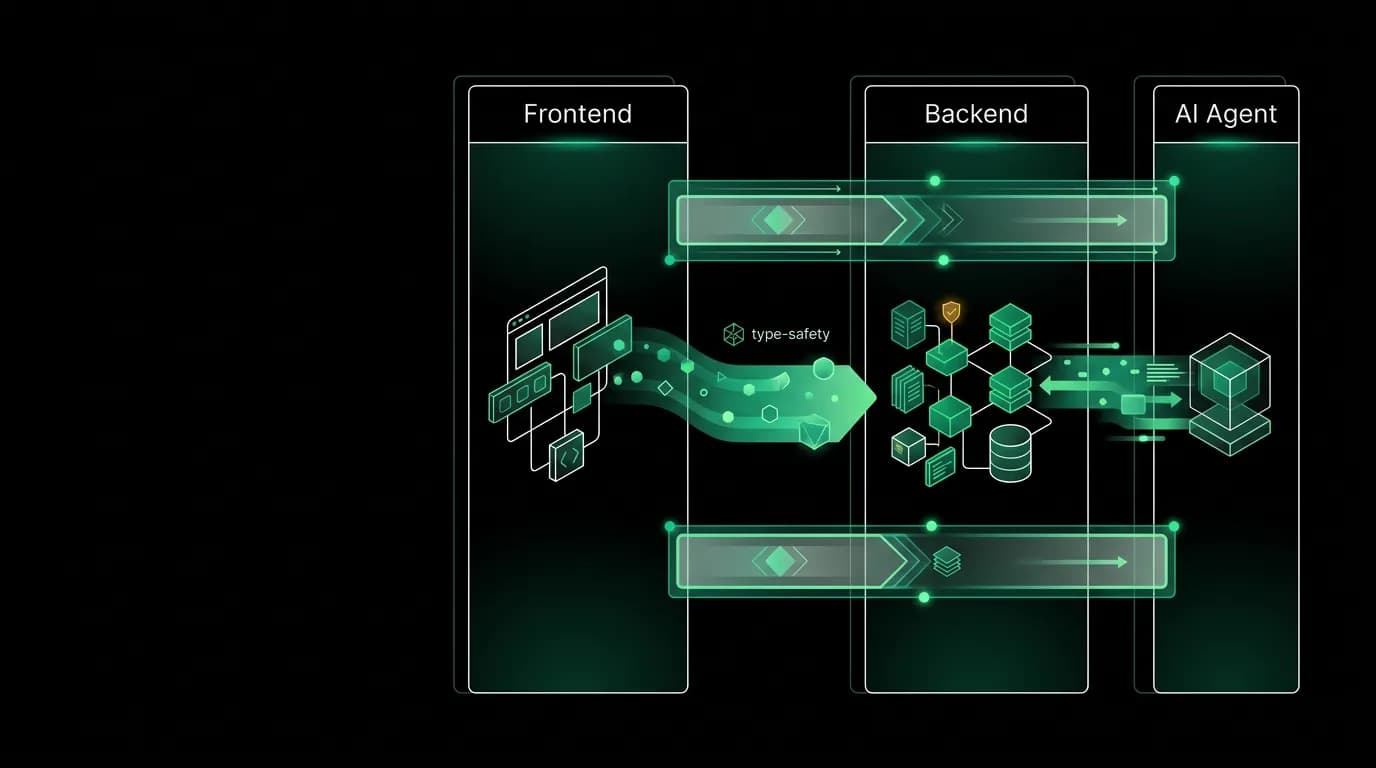
Frontend, backend, agent tool definitions, build scripts, and tests share one typed language. If it runs in our stack, it's probably that same language.
This is a deliberate choice with real trade-offs, and I want to be honest about both the wins and the costs. The one-language stack has made us faster than we would be otherwise, but it's not without friction.
The case for one language
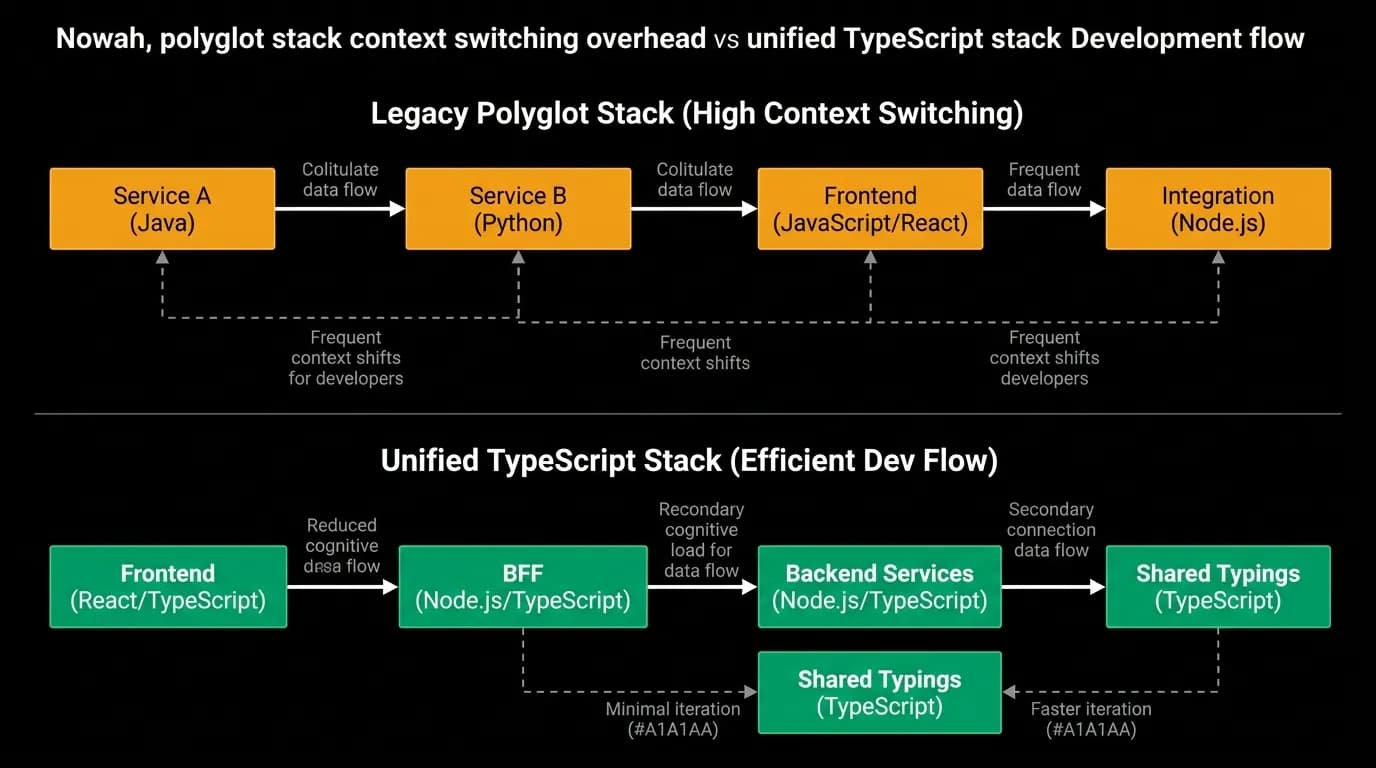
Context switching between languages costs more than most teams realize. It's not just the syntax difference between Python and a single typed language across the stack or Go and a single typed language across the stack. It's the different package managers, different testing frameworks, different debugging tools, different deployment configurations, different mental models for error handling, and different idioms for expressing the same idea.
On a polyglot team, every developer carries the overhead of multiple language ecosystems. On a single typed language-everywhere team, there's one package manager, one testing framework, one linting configuration, one set of patterns. A frontend developer can read and contribute to backend code. A backend developer can review frontend PRs with context.
Single-language full-stack teams report 20 to 40 percent productivity gains over polyglot stacks. We believe that number from experience. Not because a single typed language across the stack is the best language for every individual task (it's not), but because the elimination of context-switching overhead compounds across every task, every PR, every debugging session.
Shared types eliminate a category of bugs
This is the single biggest win and the reason I'd make this choice again.
When we define a flight search response type on the backend, that same type is used on the frontend to render the response and by the AI agent's tool definitions to interpret the response. If the backend changes the response shape, the frontend build breaks immediately. Not at runtime when a user encounters a bug. At compile time when the developer saves the file.
This catches an entire category of bugs that plague polyglot stacks: the frontend expects a field called `departureTime` but the backend sends `departure_time`. The AI tool description references a field that was renamed. A new required field was added to the API but the frontend wasn't updated.
In a polyglot stack, these mismatches are caught by integration tests (if you have them), by runtime errors in staging (if you're lucky), or by user complaints in production (if you're not). In a shared-type stack, they're caught by the compiler, instantly, every time.
For an AI-native product, this type sharing is even more valuable. The AI agent's tool schemas are derived from the same types as the API responses. If a tool description says the flight search returns a `price` field of type number, and the API actually returns `price_cents` of type integer, the mismatch is caught statically. Without shared types, this kind of mismatch silently degrades agent behavior.
Type safety for AI tool definitions
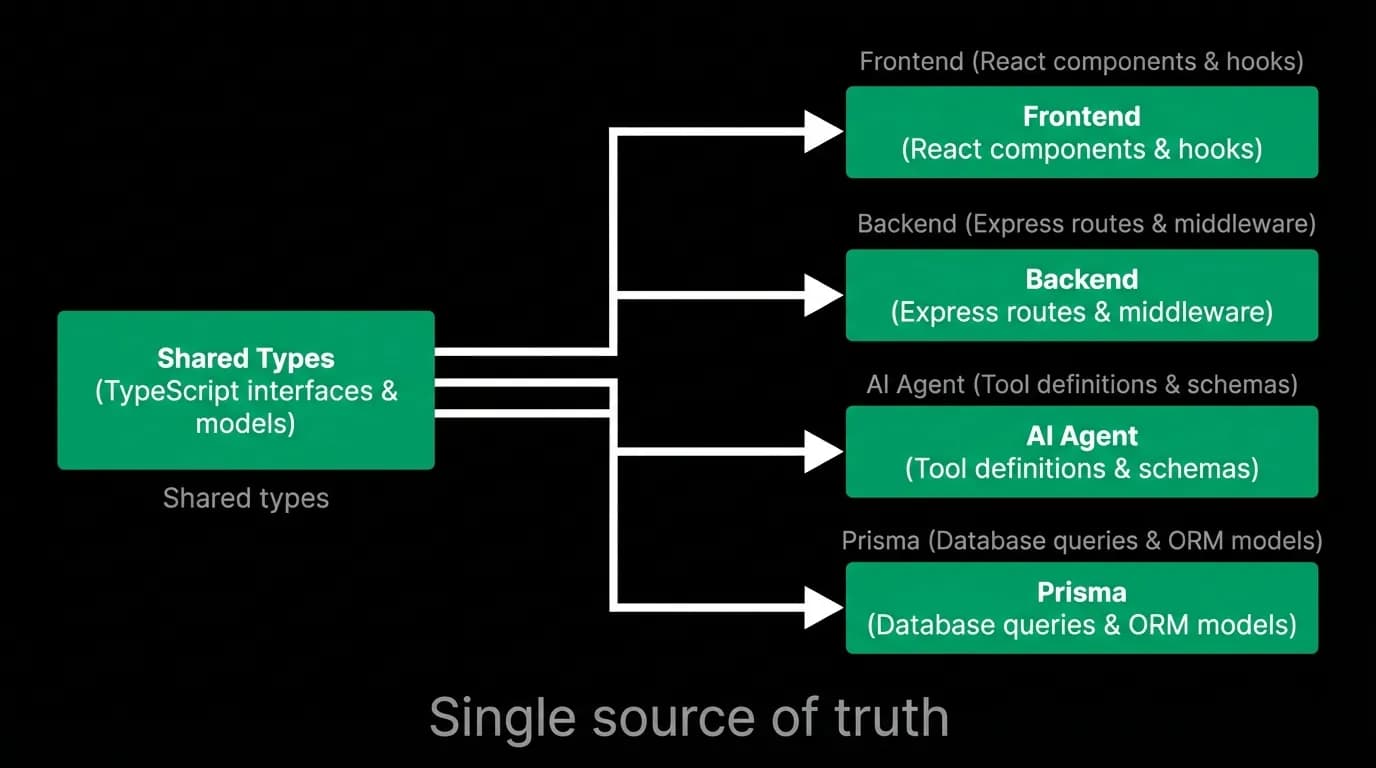
Our AI agent's tools are defined with shared typed schemas. Each tool specifies its parameters and return types using the same type system as the rest of the codebase.
This means:
When we add a new parameter to a tool, the compiler tells us everywhere that tool is called and ensures the new parameter is provided.
When we change a return type, every piece of code that processes that tool's results gets flagged for update.
When we share types between tools and API endpoints (common, since tools call endpoints), changes propagate automatically.
This is valuable because AI tool definitions are a subtle correctness problem. A wrong type in a tool schema might not cause an error. It might just cause the AI model to misinterpret a result, leading to a bad recommendation that's hard to trace back to a type mismatch. Static type checking eliminates this failure mode.
AI-assisted development increases output by 30 to 50 percent for experienced engineers. A shared type system amplifies this further because AI coding assistants work better with explicit types. The types provide context that helps AI tools generate more accurate code.
The trade-offs
I said I'd be honest, so here's where a single typed language across the stack everywhere falls short.
Performance ceilings. Node.js with a single typed language across the stack is fast enough for our workload, but it's not Go or Rust. For CPU-intensive operations (document processing, heavy data transformation), we occasionally hit performance limits that a compiled language wouldn't. We work around this with optimized libraries written in native code (accessible through Node.js bindings) and by offloading heavy computation to background jobs.
Ecosystem gaps. Not every service or library has a first-class a single typed language across the stack client. Some travel data APIs have official Python or Java SDKs but only community-maintained a single typed language across the stack libraries. We've had to write our own typed wrappers around a few services.
Type gymnastics. A shared type system is powerful but occasionally arcane. Complex generic types, conditional types, and mapped types can produce code that's hard to read and harder to debug. We've established team conventions about type complexity limits to keep things understandable.
Serverless cold starts. Typed runtimes on serverless platforms has non-trivial cold start times compared to Go or Python. We mitigate this with warm-keeping strategies, but it's a real consideration for latency-sensitive endpoints.
Monorepo complexity. A single-language team everywhere project naturally gravitates toward a monorepo with shared packages. Monorepos are powerful but introduce build complexity, dependency management challenges, and long CI times.
When to break the rule
We don't use a single typed language across the stack for literally everything. Some jobs are better served by other tools.
Data analysis and machine learning prototyping: Python. The ecosystem for data work in Python is years ahead of a single typed language across the stack. When we need to analyze agent behavior patterns or prototype a new ranking approach, we reach for Python.
Performance-sensitive background processing: when a background job is CPU-bound and processes millions of records, we consider alternatives. This hasn't been a frequent need, but we keep the option open.
Infrastructure as code: we use the established tools for our cloud provider, which have their own configuration languages.
The key is that these exceptions don't touch the core product. The application code, the code that developers work in daily, the code where context-switching cost is highest, that's all a single typed language across the stack. The occasional foray into another language for a specific task doesn't meaningfully impact productivity.
Why this matters for AI-native products specifically
AI-native products have an unusual characteristic: the AI agent is a full-stack consumer. It reads from the database (through tools), calls backend APIs, generates frontend-rendered content, and reasons about types and schemas. A type mismatch anywhere in this chain produces bugs that are uniquely hard to diagnose because the AI's behavior degrades subtly rather than failing loudly.
Shared a single typed language across the stack types across the stack create a single source of truth that the agent, the backend, and the frontend all agree on. Change one thing, and the type system ensures everything else updates accordingly.
This level of static verification is hard to achieve in a polyglot stack. You can write integration tests. You can generate types from OpenAPI specs. You can use codegen tools. But none of these are as immediate or as reliable as a shared type that fails at compile time.
For a team building an AI-powered travel booking platform, where a type mismatch between a tool definition and an API response could lead to the agent recommending wrong prices or booking wrong flights, that static safety is worth the trade-offs. a single typed language across the stack across the full stack for type safety is an engineering bet that's paid off for us.
Nowah is an AI travel agent that searches and books real flights and hotels through conversation — no filters, no thirty open tabs. Plan your next trip.