AI Trip Planning for Digital Nomads: Booking for the Location-Independent
Flexible dates, visa-aware routing, work-friendly stays, coliving spaces, monthly rates — digital nomad booking has unique needs AI agents specialize in.

"I need a place with reliable Wi-Fi — at least 25 Mbps for video calls. Under $2,000 per month all-in. In a timezone within 3 hours of Eastern. With a digital nomad visa or visa-free entry for 90 days. Preferably with a nomad community or coliving scene."
No OTA on earth can process that query. There is no filter for Wi-Fi speed. No dropdown for timezone offset. No checkbox for digital nomad visa availability. And "monthly rate under $2,000" does not compute on platforms designed for 2-night hotel stays.
Digital nomads — 35 million globally and growing — are the most underserved segment in travel technology. Their booking requirements are fundamentally different from traditional travelers: longer stays, work-specific infrastructure, visa complexity, cost-of-living sensitivity, and community needs. Traditional booking platforms were not designed for them and cannot serve them well.
AI agents, with their ability to process multi-constraint natural language queries and maintain persistent traveler profiles, are the first booking tools that can.
The digital nomad booking stack
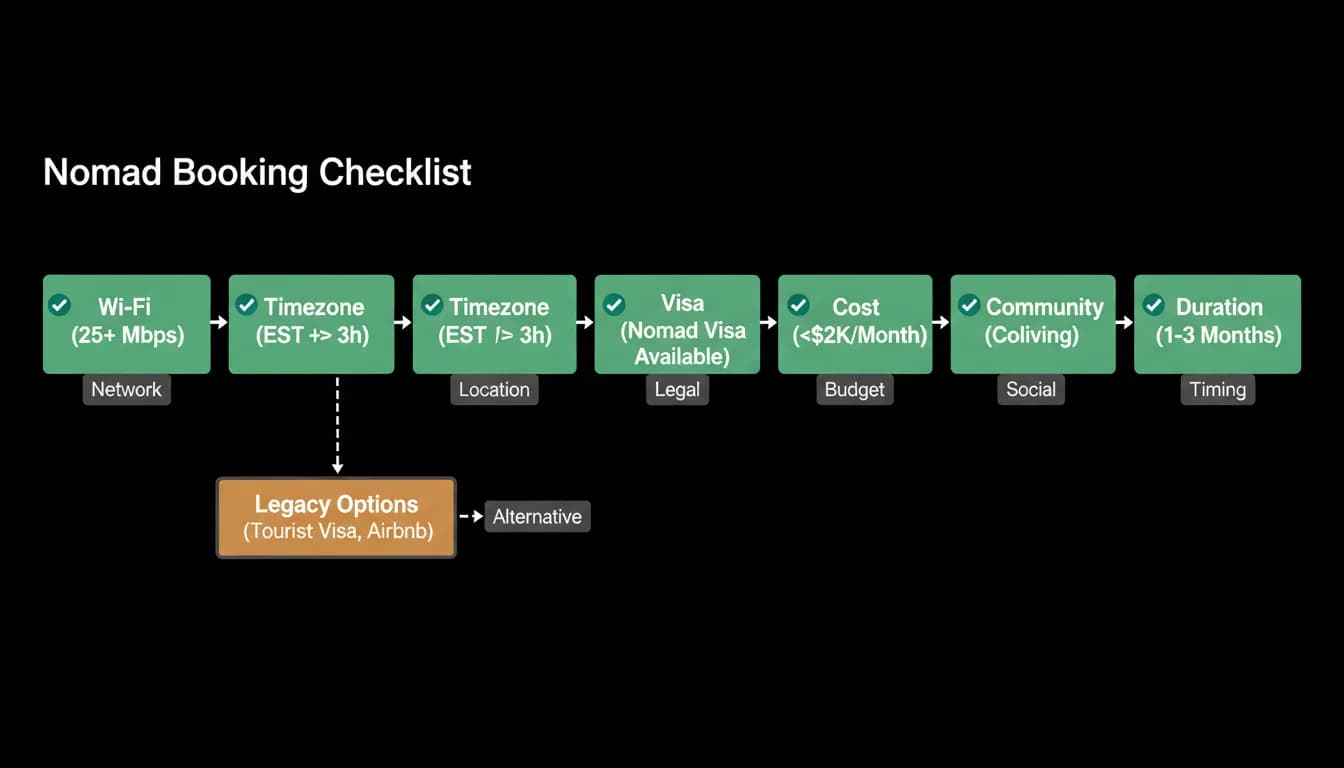
A nomad's booking requirements form a stack of interdependent needs that must be evaluated simultaneously.
Accommodation. Not a hotel room for two nights. A furnished apartment or coliving space for one to three months, with a kitchen, workspace, and reliable internet. Monthly rates, not nightly rates. Lease flexibility, not rigid check-in and check-out dates.
Visa and legal status. Which countries allow remote work legally? Over 50 countries now offer digital nomad visas, each with different requirements: minimum income thresholds (typically $2,000 to $4,000 per month), proof of remote employment or freelance status, health insurance requirements, and processing times that range from days to months. Alternatively, visa-free entry for tourism (technically gray-area for work) with 30 to 90-day limits.
Connectivity. The single most critical infrastructure requirement. "Fast Wi-Fi" on a listing might mean 5 Mbps or 100 Mbps. For video calls, the minimum is 25 Mbps upload and download. For reliable work, you also need a backup option: a coworking space within walking distance, a cafe with good internet, or a mobile data plan with sufficient speed.
Cost of living. The accommodation cost is only part of the equation. Food, transportation, coworking membership, health insurance, and discretionary spending vary dramatically by destination. A $1,500 per month apartment in Lisbon costs $1,500. But the total monthly cost in Lisbon is $3,000 to $3,500. The same quality of life in Bali might be $1,500 to $2,000 total. In London: $4,000 to $5,000.
Community. Digital nomads are mobile workers, not hermits. Most seek community: other nomads, coworking spaces with social events, coliving spaces with shared activities. The presence of an active nomad community often determines destination satisfaction more than any other factor.
Accommodation for nomads
Traditional accommodation platforms fail nomads because they optimize for short-stay tourists. Monthly rates are buried or unavailable. Long-term availability is not displayed. Work-relevant amenities (desk, monitor-friendly setup, power outlets near the workspace) are not filterable.
AI agents search across accommodation types that serve nomads: coliving spaces (purpose-built for remote workers with shared workspaces, community events, and monthly pricing), serviced apartments (furnished apartments with monthly rates and cleaning), and monthly-rate vacation rentals (which save 40 to 60 percent versus daily rates).
"I found three options in Lisbon. A coliving space in Graca with a coworking area, community events, and 100 Mbps Wi-Fi at $1,300 per month. A serviced apartment in Alfama with a private workspace and kitchen at $1,600 per month. And a vacation rental in Bairro Alto at $1,100 per month — no coworking, but there are two rated coworking spaces within 10 minutes walk at $150 per month."
That comparison — across accommodation types, with work-relevant amenities highlighted and coworking proximity factored in — is the kind of analysis that traditional platforms cannot perform and nomads currently do manually across 5 or more websites.
Visa-aware routing
Visa management is the most complex and highest-stakes challenge for digital nomads. The consequences of getting it wrong range from overstaying fines to deportation.
AI agents maintain awareness of visa rules for the nomad's passport nationality and update as rules change. When a nomad describes their next move, the agent checks entry requirements, stay limits, and work legality automatically.
"You have been in the Schengen zone for 72 days. The 90-day limit means you need to exit within 18 days. Portugal's digital nomad visa (D8) would allow a longer stay but requires a 4-week application process. Alternatively, you could move to a non-Schengen destination — Albania, Turkey, or the UK — for 90 days and return to Schengen with a fresh 90-day allowance."
That analysis — tracking Schengen days, evaluating visa alternatives, suggesting routing that maintains legal status — is exactly what nomads currently track in spreadsheets and mental calculations. An AI agent automates it entirely.
Connectivity guarantees
"Fast Wi-Fi" is the most unreliable claim in accommodation listings. AI agents address this by synthesizing multiple data sources.
Review analysis. Guest reviews that mention Wi-Fi speed, reliability, and video call quality provide ground truth that listing descriptions often lack. The agent extracts these mentions: "Reviews consistently mention 50+ Mbps speeds. Three recent reviews specifically confirm Zoom calls work without issues."
Coworking proximity. Even with good apartment Wi-Fi, a backup workspace is essential. The agent identifies coworking spaces within walking distance, their reported speeds, and their monthly rates: "Two coworking spaces within 10 minutes. The nearest has 200 Mbps and costs $120 per month."
Mobile data backup. Local SIM cards with data plans provide a third connectivity layer. The agent provides information about local mobile data options: "Local SIM with 50 GB at 4G speeds costs approximately $15 per month."
Cost-of-living optimization
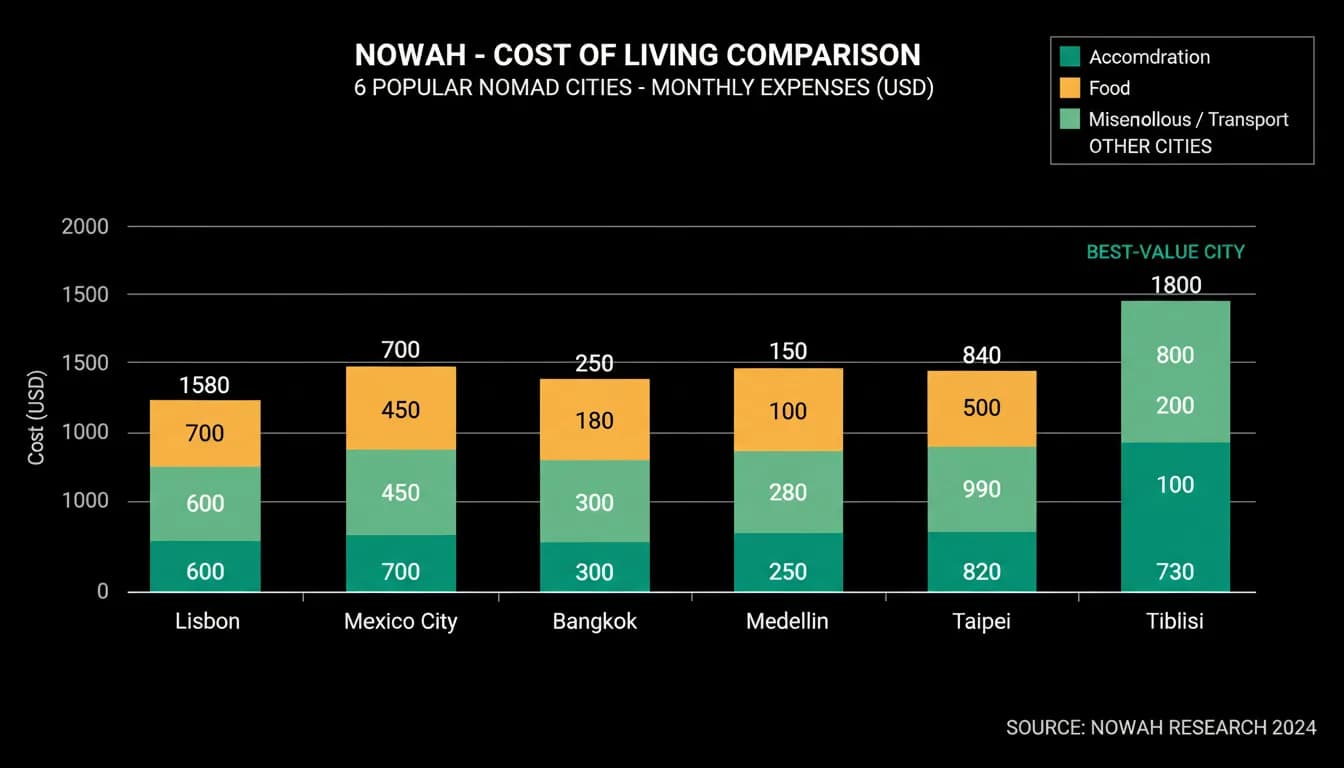
The same $3,000 monthly budget buys fundamentally different lifestyles in different cities. AI agents evaluate total cost of living, not just accommodation.
"With your $3,000 monthly budget, here is how it breaks down in three options. Bali: $800 accommodation, $400 food, $100 coworking, $200 transport and activities — total $1,500, leaving $1,500 savings. Lisbon: $1,400 accommodation, $600 food, $150 coworking, $250 transport — total $2,400, leaving $600 savings. Mexico City: $1,100 accommodation, $500 food, $120 coworking, $200 transport — total $1,920, leaving $1,080 savings."
Each destination offers a different value proposition. Bali maximizes savings. Lisbon offers European culture and a strong nomad community. Mexico City balances affordability with proximity to US time zones. The AI presents the complete picture for informed decision-making.
Build your nomad profile
The most effective way to use AI for nomad travel is to build a comprehensive profile: passport nationality, work timezone requirements, minimum Wi-Fi speed, monthly budget, preferred climate, community importance, dietary restrictions, and any health or accessibility needs.
With this profile, every destination query is automatically evaluated against your specific requirements. "Where should I go next?" becomes a fully informed question that the agent answers with visa-legal, budget-appropriate, work-equipped options tailored to your life.
The digital nomad lifestyle is defined by freedom and flexibility. The booking tools should match. AI agents that understand the nomad booking stack — accommodation, visas, connectivity, cost of living, and community — are the first travel technology built for how nomads actually live and work.
Nowah is an AI travel agent that searches and books real flights and hotels through conversation — no filters, no thirty open tabs. Plan your next trip.