Why I Started a Travel Company in the Age of AI
The moment I realized travel booking hadn't improved in 20 years — and that AI agents could replace every form and filter for good.

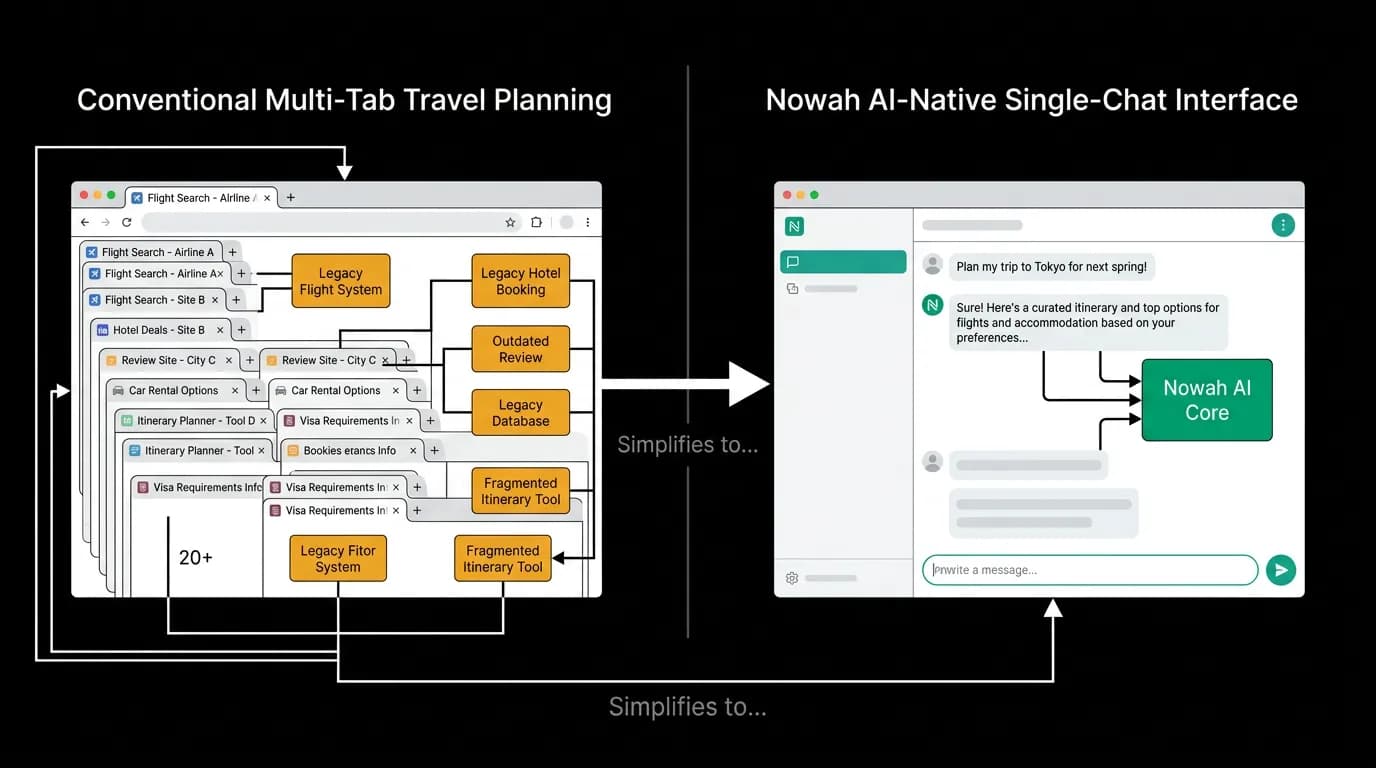
It was a Wednesday night, and I had 23 browser tabs open. I was trying to book a trip to Southeast Asia, something that should have felt exciting. Instead, it felt like homework. I had Google Flights in one tab, two OTAs in others, a Reddit thread about which airport to fly into, a blog post ranking neighborhoods in Bangkok, and a hotel comparison that I had lost track of somewhere between tabs 14 and 19.
Six hours. That is how long I spent before I gave up and decided to "finish tomorrow." Tomorrow turned into three more evenings of the same routine. By the time I actually booked, I was not confident I had found the best deal. I was just exhausted enough to stop looking.
That trip broke something in me. Not because it was uniquely bad, but because I realized it was completely normal. This is how billions of dollars in travel gets booked every year. And it has barely changed since the late 1990s.
How travel booking froze in 1996
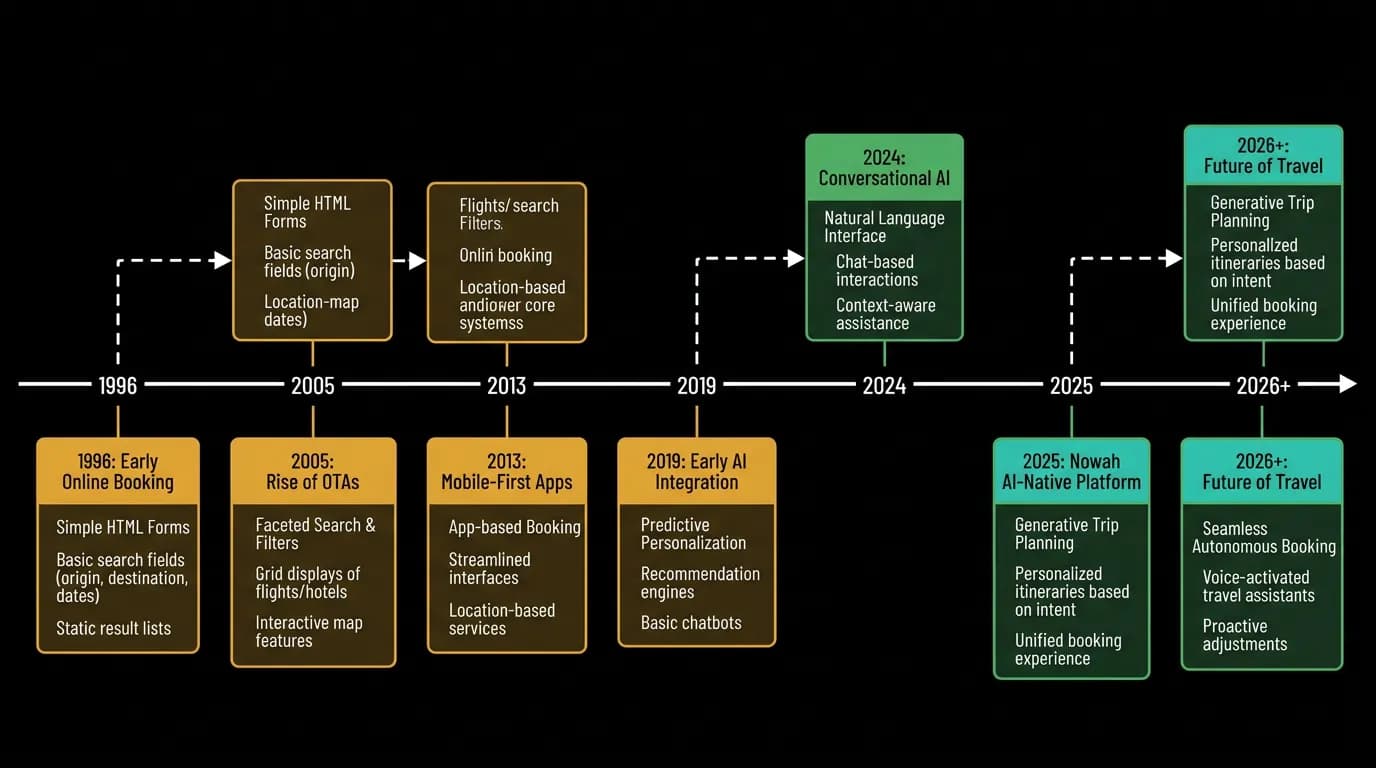
Expedia launched in 1996. Booking.com followed a year later. They solved a real problem: getting airline and hotel inventory online so you could see it without calling a travel agent. That was transformative.
But the core experience they established has been frozen ever since. You fill out a form. Origin. Destination. Dates. Number of travelers. You hit search. You get a list. You sort, filter, compare, and repeat across multiple sites. The design has been polished over the decades, but the paradigm is identical.
Meanwhile, every other industry evolved. Ride-sharing replaced the taxi dispatch model. Food delivery replaced calling restaurants. Music went from buying albums to streaming anything instantly. But travel booking? Still forms and filters. Still 38 website visits over 45 days for the average trip, according to research from Expedia Media Solutions. Still 62 percent of travelers reporting the process as stressful.
The global online travel market exceeds 800 billion dollars. It is one of the largest consumer categories on earth. And the user experience is essentially unchanged since the Clinton administration.
The first conversation that changed everything
I remember the exact moment I knew AI agents could close this gap. I was prototyping a conversational interface, just experimenting, and I typed: "I want to go somewhere warm in April, maybe Southeast Asia, budget around $2,000, and I need to be back by the 15th."
The system parsed that sentence and extracted destination preferences, date constraints, a budget ceiling, and a return deadline. It asked one follow-up question about whether I preferred beach or city. Then it started searching live inventory across hundreds of airlines and hotels simultaneously.
In under a minute, I had three complete trip options with real prices, real flights, and real hotels. Not hypothetical suggestions. Bookable options.
I had spent six hours doing manually what took a single conversation less than sixty seconds. That was the moment I decided to build this for real.
Why travel, specifically
You could apply AI agents to many industries. So why travel?
Four reasons kept pulling me back.
First, the stakes are high. A wrong restaurant recommendation is mildly annoying. A wrong flight booking costs thousands of dollars and potentially ruins a vacation. High stakes mean the product has to be genuinely good, which creates a natural moat for whoever gets it right.
Second, the data is incredibly fragmented. Flight prices change by the minute. Hotel availability shifts constantly. Activities, visa requirements, weather patterns, local customs, and transportation options all intersect in complex ways. No human can optimize across all of these variables simultaneously. An AI agent can.
Third, travel decisions are deeply emotional. People are not optimizing a spreadsheet. They are planning anniversaries, family reunions, and trips they have been dreaming about for years. The product needs to understand not just logistics but intent, preference, and feeling. Conversation is naturally suited for this in a way that forms and filters never will be.
Fourth, 70 percent of travelers start with an undecided destination. They do not know where they want to go. They know they want a break, they know roughly when, and they have a vague sense of budget. A search form demands structured inputs before it can help. A conversation meets people where they actually are.
What Nowah means
We named the company Nowah because it captures what we believe travel booking should feel like. Immediate. Intelligent. Simple. The name needed to work globally, be easy to pronounce, and carry the sense that help is available right now, not after hours of research.
We tested dozens of candidates. Nowah stuck because it felt right when you said it out loud. It did not sound like a travel company from the 1990s. It sounded like something new.
The bet we are making
Here is the bet in plain language: we believe the era of searching for travel is ending and the era of conversing with an intelligent agent about travel is beginning.
This is not a small shift. It changes the interaction model from passive browsing to active assistance. It changes the product architecture from search indexes and filter menus to tool-equipped AI agents with memory. It changes the competitive landscape from who has the best sort algorithm to who has the smartest, most trustworthy agent.
OTA conversion rates have been stuck at 2 to 3 percent for over a decade. That means 97 percent of people who show up looking to buy something leave without buying. That is not a minor UX issue. That is a structural failure of the paradigm. Conversation-based AI can address every dropout point: the search that returns too many results, the comparison fatigue that leads to decision paralysis, and the checkout friction that kills the sale.
We are not naive about the challenges. Non-deterministic AI outputs, latency constraints, earning trust for high-dollar transactions, building reliable real-time systems on top of constantly changing travel data. These are hard problems. Some of them do not have clean solutions yet. But the direction is clear, and the gap between how people want to plan travel and how the tools currently work is enormous.
The future we see
The end state, years from now, is a travel agent that knows you better than any human agent ever could. It remembers every trip you have taken, every preference you have expressed, every constraint you have mentioned. It monitors prices proactively. It notices a gap in your calendar and a fare drop to a destination it knows you love. It handles disruptions autonomously, rebooking before you even realize something went wrong.
We are not there yet. Today, Nowah is a very good AI travel agent that handles the full booking flow through conversation. You tell it what you want, it searches live inventory, it recommends options, and you book. That alone is better than the 23-tab alternative.
But every conversation teaches the agent something. Every booking refines the logic. Every piece of feedback tightens the gap. The product gets meaningfully better every week, and the trajectory points toward something that makes the current state of travel booking look as primitive as it is.
If you have ever rage-closed your twentieth browser tab while trying to plan a trip, you already know why this matters. We are building the thing that should have existed years ago. The technology is finally ready. The market is waiting. And honestly, I am tired of having 23 tabs open.
Try describing your next trip in a single sentence. Watch what happens. That is the future of travel booking, and it starts with a conversation.
Nowah is an AI travel agent that searches and books real flights and hotels through conversation — no filters, no thirty open tabs. Plan your next trip.