Building a Travel Platform That Survives the Team Bus Factor
Infrastructure decisions that ensure the platform is maintainable by any engineer, not just the ones who built it — documentation, patterns, and automated recovery.

The engineer who built the payment system left last month. At 2 AM, a payment webhook starts failing. The on-call engineer has never touched the payment code. Can they diagnose and fix the issue before travelers notice?
Bus factor is the number of engineers who could leave before the team can no longer maintain a critical system. A bus factor of 1 means one departure creates a knowledge vacuum. A bus factor of 3 means the team can absorb departures without losing capability.
For a travel booking platform where downtime means lost bookings and stranded travelers, a bus factor of 1 on any critical system is an existential risk. We've invested deliberately in raising our bus factor across every component, and the investments are infrastructure decisions, not just management practices.
Documentation as infrastructure
Most teams treat documentation as a nice-to-have that gets written after the code, if ever. We treat it as infrastructure that's maintained alongside the code. The difference matters. Infrastructure gets maintained. Nice-to-haves decay.
Our primary documentation lives in the repository itself. A comprehensive guide covers the architecture, commands, key file paths, integration points, and patterns. When an engineer opens the repository for the first time, this guide gives them a mental model of the entire system within 30 minutes.
Beyond the overview, we maintain three types of operational documentation.
Runbooks for common operational tasks: how to restart a stuck worker, how to investigate a failed payment, how to rollback a bad deployment, how to rotate credentials. Runbooks are step-by-step instructions that an engineer who has never performed the task can follow. They include the exact commands, the expected output at each step, and what to do if the output is unexpected.
Architecture decision records for significant technical choices. Why we chose server streaming over bidirectional sockets for streaming. Why we use seven separate job queues instead of one. Why the booking flow has multi-layer idempotency. These records capture the reasoning behind decisions so that future engineers understand not just what was built but why it was built that way. Without the why, engineers are tempted to simplify or refactor in ways that reintroduce the problems the original design solved.
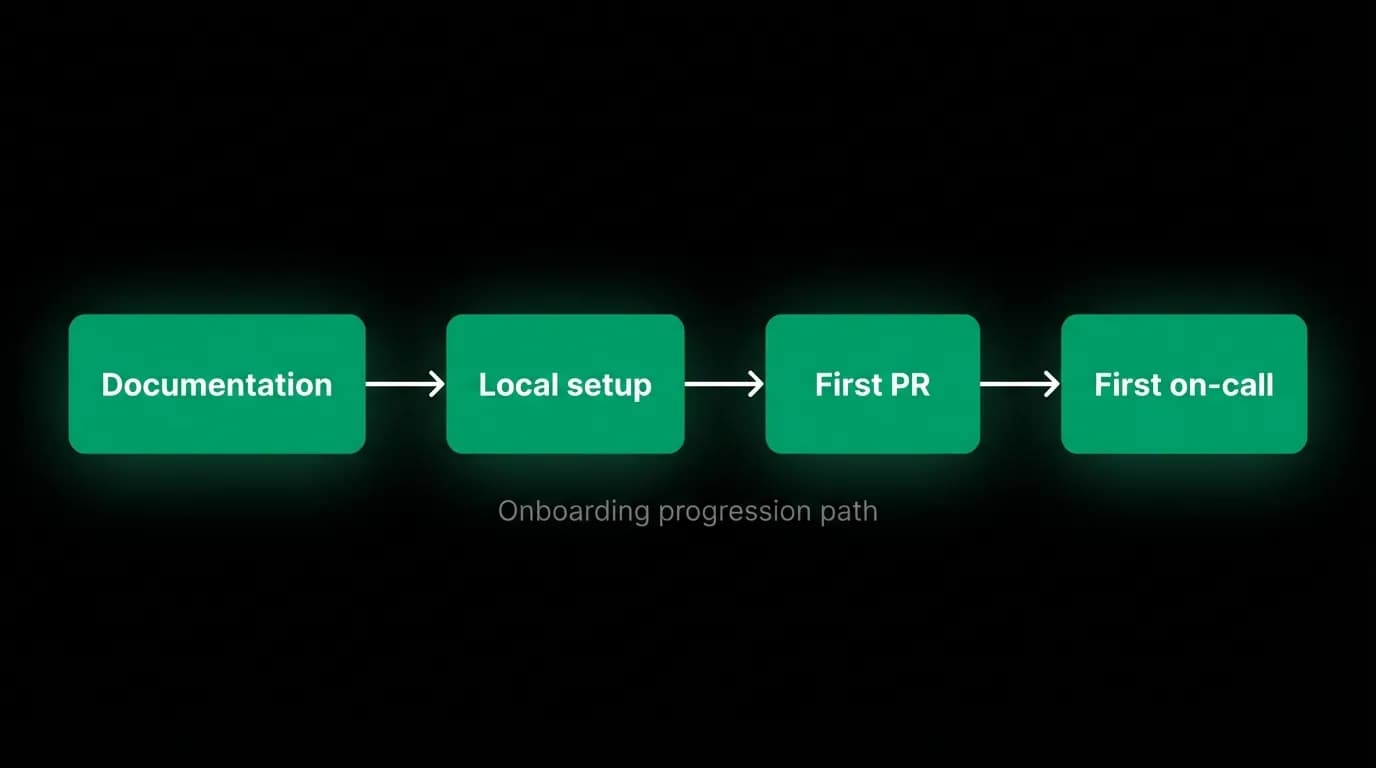
Onboarding guides for new engineers. The guide walks through local environment setup, first PR workflow, code review expectations, and the path to on-call readiness. A new engineer should be able to ship their first PR within their first week, not because the PR is trivial, but because the onboarding guide removes every friction point.
Standardized patterns
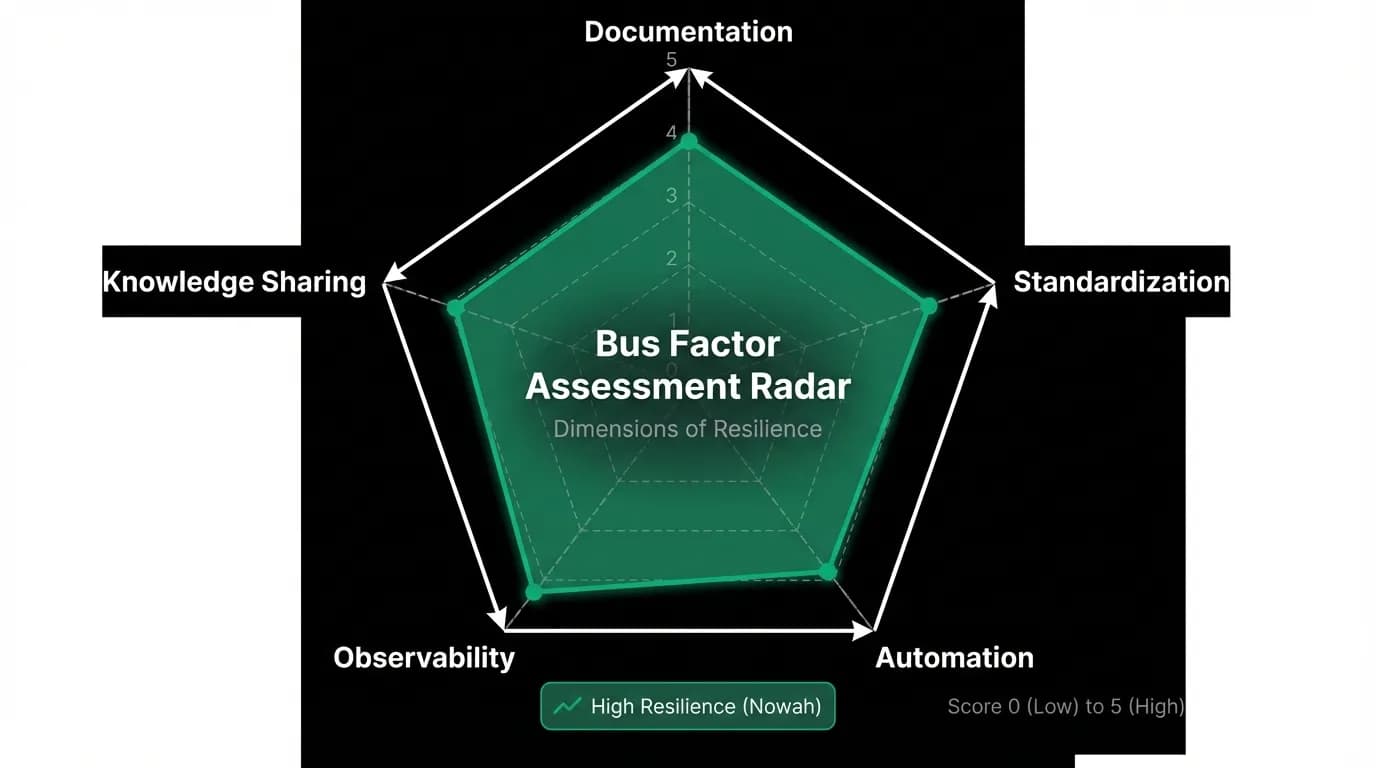
When every route handler follows the same structure, every engineer can debug any route. When every worker follows the same pattern, every engineer can investigate any queue. Standardization is the most powerful bus factor tool because it converts specific knowledge (how this particular endpoint works) into general knowledge (how all endpoints work).
Our route handlers follow a consistent structure: authentication middleware, input validation, business logic handler, and standardized response formatting. The response is always `{ success: true, data: T }` or `{ success: false, error: { code, message } }`. An engineer who has debugged one route handler knows how to debug all of them.
Our job workers follow the same pattern across all seven queues. Each worker reads a job from the queue, validates the payload, performs the work, handles errors with retry logic, and acknowledges completion. The specific work differs (one worker sends emails, another generates documents), but the scaffolding is identical. An engineer who understands one worker understands the pattern for all of them.
This standardization has a cost: it constrains how engineers solve problems. You can't use a clever custom pattern for one endpoint because it breaks the consistency that makes the system understandable. We accept this constraint deliberately. Cleverness in one endpoint creates confusion in every other. Consistency across all endpoints creates understanding across the team.
Observability that tells the story
Metrics and logs are not just for dashboards. They're the narrative that allows any engineer to understand what happened, when, and why.
Structured logging with correlation IDs means an engineer can trace any request through the entire system. Start with the request ID from the proxy layer, follow it through the API server, into the job workers, through external API calls, and back to the response. Every log entry for that request shares the same correlation ID. The engineer doesn't need to know which code path the request took. The correlation ID reveals it.
Health check endpoints at standardized paths (`/health` for deep health, `/health/live` for liveness) tell the engineer the current state of every service. The deep health check reports the status of the database, the cache, the queue system, and external dependencies. If the on-call engineer is investigating a 2 AM alert, the health check is their first diagnostic step. It immediately narrows the investigation to the failing component.
Dashboards are designed to narrate, not just display. Our booking health dashboard doesn't just show a success rate number. It shows the success rate, the most common error codes, the queue depths for booking-related workers, and the external dependency health. An engineer looking at this dashboard at 2 AM can form a hypothesis about the problem within 30 seconds, without needing to know the system's internals.
Automated recovery
The system should fix itself before paging a human. Automated recovery for common failure modes reduces the urgency of knowledge-specific debugging.
Workers that crash are automatically restarted by the process manager. The health check endpoints allow the orchestration layer to detect unhealthy containers and replace them. The job queue system retries failed jobs automatically, with configurable backoff and retry limits.
These automated recovery mechanisms mean that many failure scenarios resolve without human intervention. A worker that crashes due to a transient memory spike restarts and continues processing. A job that fails because an external API returned a temporary error retries and succeeds on the next attempt. A container that becomes unresponsive is replaced by a healthy one.
The automated recovery buys time. Instead of "the payment system is down, only one engineer knows how to fix it, and they're on vacation," the reality becomes "the payment worker crashed, restarted automatically, and resumed processing within 30 seconds." The engineer on vacation doesn't need to be reached. The system handled it.
Knowledge sharing practices
Documentation and standardization are passive knowledge sharing. Active knowledge sharing requires deliberate practices.
On-call rotation across all services. Every engineer rotates through on-call for every service, not just the ones they built. An engineer who has been on-call for the payment system, even if they've never written payment code, has a working understanding of how it operates, what breaks, and how to investigate issues.
Pair programming on critical changes. When a significant change is made to a critical system, two engineers work on it. Not for code quality (though that's a benefit), but for knowledge transfer. The engineer who originated the change and the engineer who paired on it both understand the change. The bus factor for that change is 2, not 1.
Post-incident knowledge sharing. After every significant incident, we publish a blameless retrospective. The retrospective explains what happened, why, and what we changed. Every engineer reads it. The incident's lessons become shared knowledge, not individual experience.
Architecture reviews for new features. Before a new feature is built, the design is reviewed by engineers who didn't create it. The review ensures the design follows existing patterns (or deliberately diverges with documented reasoning) and that multiple engineers understand the design before implementation starts.
Assess your bus factor
If you want to evaluate your team's bus factor, here's a checklist.
For each critical system, ask: how many engineers can independently diagnose and fix a production issue in this system at 2 AM? If the answer is 1, you have work to do.
Check documentation currency. Open your runbooks. Can a new engineer follow them step by step and actually complete the task? If the commands are outdated or the instructions assume context, the documentation has decayed.
Check pattern consistency. Open five random route handlers. Do they follow the same structure? Open five random worker implementations. Same question. If each is structured differently, debugging requires system-specific knowledge instead of pattern knowledge.
Check automated recovery. Kill a worker process. Does it restart? Disconnect the database briefly. Do the services reconnect? Send a malformed request. Does the system return a clean error or crash? Automated recovery reduces the urgency of human intervention.
Check knowledge distribution. Ask each engineer: which systems could you debug independently at 2 AM? Plot the answers. The systems where only one engineer says yes are your highest risk.
The goal isn't that every engineer knows every detail of every system. The goal is that every engineer knows enough to investigate any system, and that the documentation, patterns, and observability fill the gaps between what they know and what they need to know. That's how you build infrastructure that survives the bus factor.
Nowah is an AI travel agent that searches and books real flights and hotels through conversation — no filters, no thirty open tabs. Plan your next trip.