Conversation Design Patterns for AI Agents
Greeting, clarification, confirmation, topic switching, closure — a pattern library for every conversational scenario your AI travel agent will face.
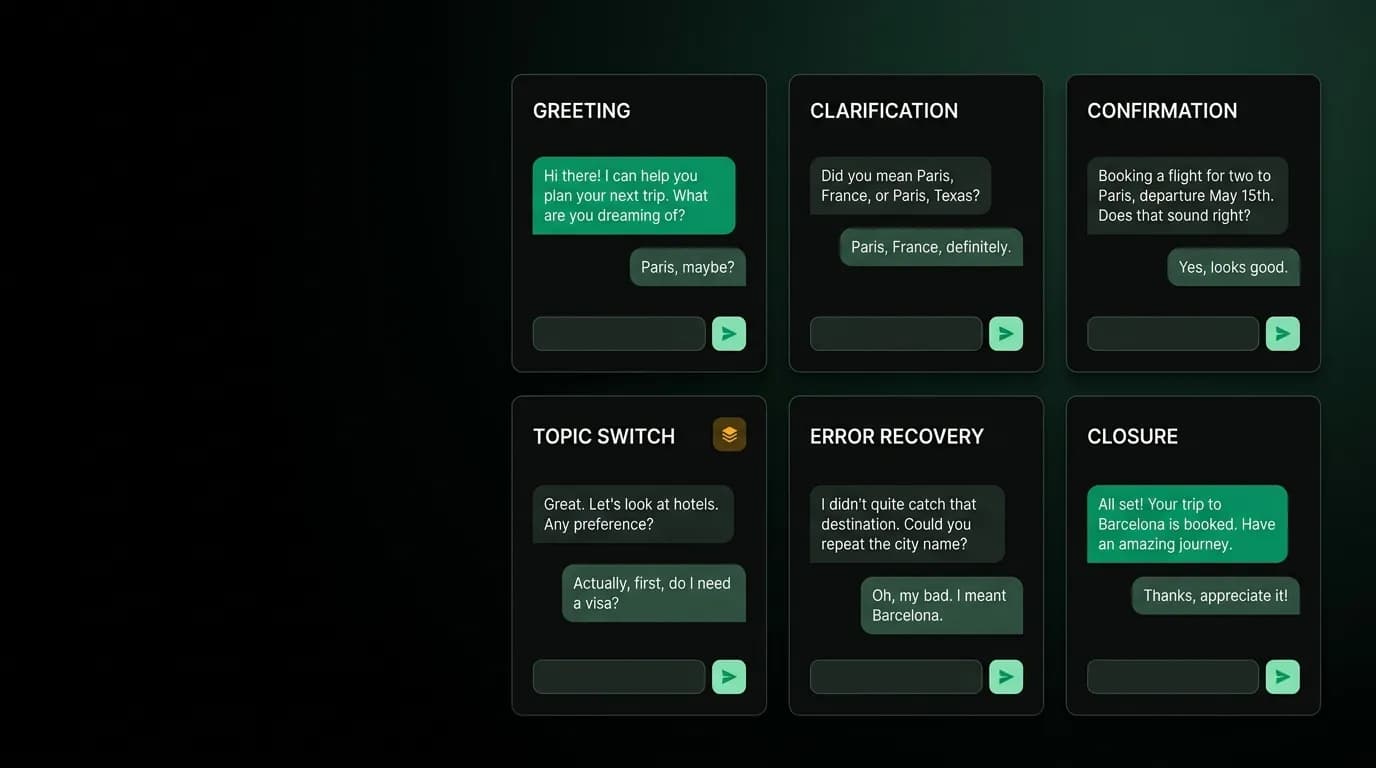
After processing hundreds of thousands of conversations in our AI travel agent, I can tell you that 80% of conversational challenges fall into a handful of recurring patterns. The same types of ambiguity, the same decision points, the same transition moments happen over and over regardless of the specific trip or user.
This is good news. It means we can design repeatable, tested solutions for each pattern rather than hoping the model improvises correctly every time. A conversation design pattern is to an AI agent what a UI component library is to a frontend developer: a pre-built solution to a known problem.
Here is the pattern library we have built for our travel AI agent.
The greeting pattern
The first message sets the frame for the entire conversation. A bad greeting creates confusion. A good greeting establishes expectations and invites action.
What does not work: "Hello! I am your AI travel assistant. I can help you search flights-layer-ai-agent-search-flights), book hotels, plan itineraries, manage bookings, track prices, check visa requirements, and much more! How can I help you today?"
This is a capability dump. It overwhelms new users and bores returning ones. Nobody reads it.
What works: "Hey! Where are you thinking of going?"
Short. Direct. Conversational. It assumes the user is here to travel (they are; they opened a travel app) and immediately invites them into the conversation. For returning users, the greeting can be contextual: "Welcome back! Your trip to Barcelona is in 12 days. Need help with anything before you go?"
The greeting pattern has one rule: get to the user's intent as fast as possible. Every word between "hello" and the user's first real message is friction.
Clarification loops
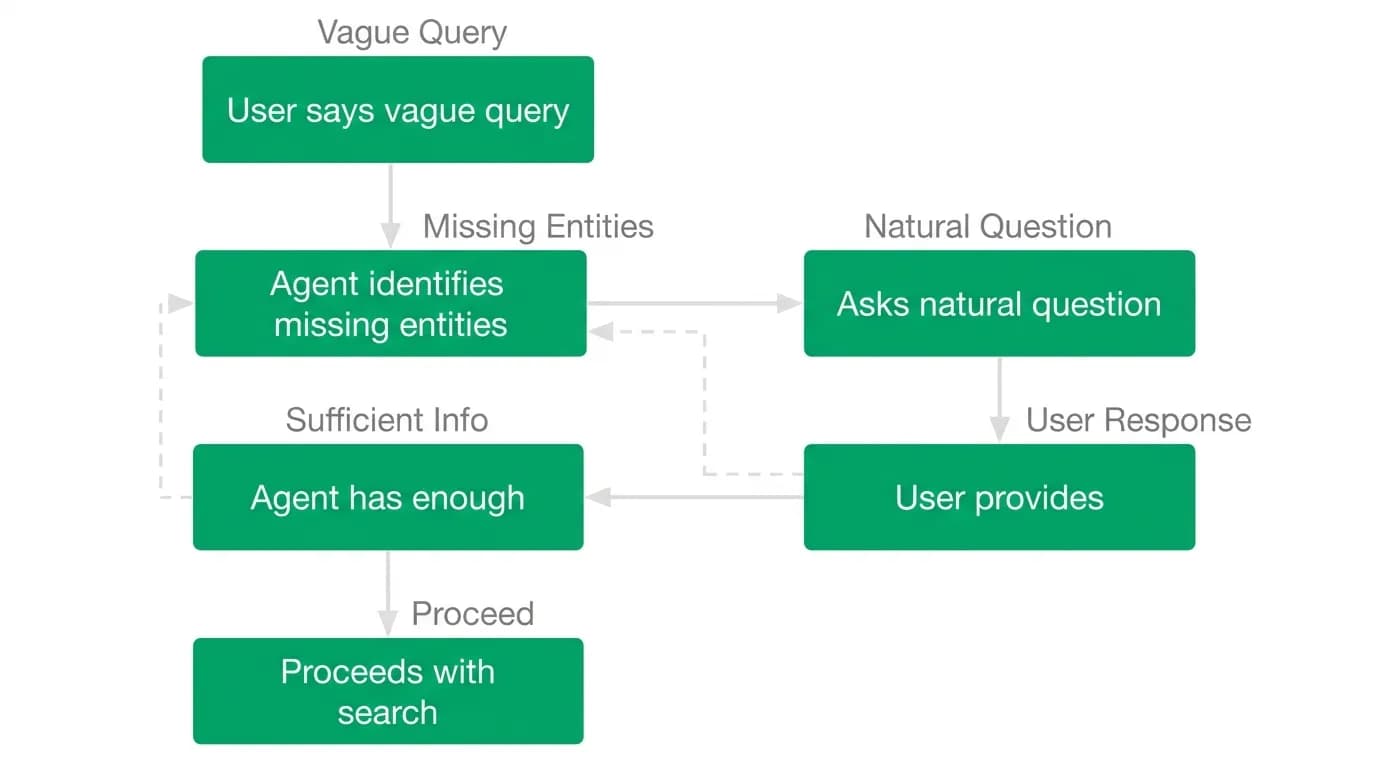
Users are vague. This is not a bug; it is how humans communicate. "I want to go somewhere warm" is a perfectly reasonable first message. It contains a preference (warm weather) but lacks specifics (where, when, how long, how many people, what budget).
The wrong response is to ask all the missing questions at once: "Where would you like to go? What dates? How many travelers? What is your budget? Do you prefer beach or city?" This is an interrogation, not a conversation.
The right response is a natural clarification that addresses the highest-priority missing information while also making progress:
"Warm sounds great. Are you thinking beach or more of a warm city? And roughly when - next few weeks, or are you planning ahead?"
This asks two questions, but they are conversational, not form-like. The agent can start narrowing down options even from partial answers. If the user says "beach, sometime in May," the agent now has enough to generate preliminary suggestions even without knowing the exact dates, number of travelers, or budget. Clarification reduces conversation abandonment compared to interrogative questioning. Users who feel interrogated drop off. Users who feel like they are having a conversation stay.
Pattern rule: never ask more than two questions in a single message. Prioritize the questions that unlock progress. Accept partial answers and work with them.
Confirmation patterns
Not every action needs confirmation. The agent should search flights without asking permission. But it should never charge a credit card without explicit approval.
We calibrate confirmation by stakes:
No confirmation needed: searches, preference updates, information retrieval. The agent just does it. "Looking up flights to Tokyo..." The user did not ask "please search for flights." They said "I want to go to Tokyo." The agent infers the action and executes it.
Soft confirmation: modifications to existing trips, preference changes. "I will update your seat preference to window for all future flights. Sound good?" The agent proposes the change and assumes agreement unless the user objects.
Hard confirmation: booking, payment, cancellation. "Ready to book this flight? JFK to NRT, April 5th, direct on the 2:15 PM departure, $912. I will charge the Visa ending in 4242." Every relevant detail is stated. The user must explicitly confirm.
Double confirmation: high-value or irreversible actions. "This booking is $3,847 and is non-refundable. Just to confirm: you want me to proceed with booking flights and hotels for 4 travelers, Tokyo April 5-15?"
The confirmation level scales with the consequences of getting it wrong. A search costs nothing to redo. A non-refundable booking costs thousands.
Topic switching
Users change their mind mid-conversation. They start planning a trip to Tokyo and suddenly say "oh wait, what about Seoul?" Or they are deep in hotel selection and ask "when does my Paris flight land?"
The agent needs to handle topic switches without losing context from the previous topic. This is where working memory architecture matters. The Tokyo planning context should be preserved so the user can return to it after the Seoul detour or the Paris question.
Pattern: Acknowledge the switch, handle the new topic, and offer to resume the previous one.
"Sure, let me check Seoul for you. I will keep the Tokyo options saved in case you want to compare."
"Your Paris flight lands at 6:45 AM on March 20th. Want to get back to the Tokyo hotels?"
Losing context on a topic switch is one of the most frustrating experiences in conversational AI. The user mentions Tokyo, then Seoul, then says "the first one," and the agent does not know if "the first one" refers to Tokyo or the first hotel in Seoul. Context management is the difference between a conversation that flows and one that frustrates.
Closure patterns
A task is done. How does the agent signal completion and transition to the next thing?
Bad closure: The agent goes silent after booking confirmation. The user wonders: is there more? Should I do something?
Good closure: "Your flight is booked! Confirmation number NW-4829. I have sent the details to your email. Do you need a hotel in Tokyo, or are you all set for now?"
The closure pattern has three parts: confirm completion, provide relevant details, and open the door to the next task. The third part is important because travel planning is a multi-step process. Booking a flight rarely means the user is done. Hotels, activities, ground transport, and restaurant recommendations typically follow.
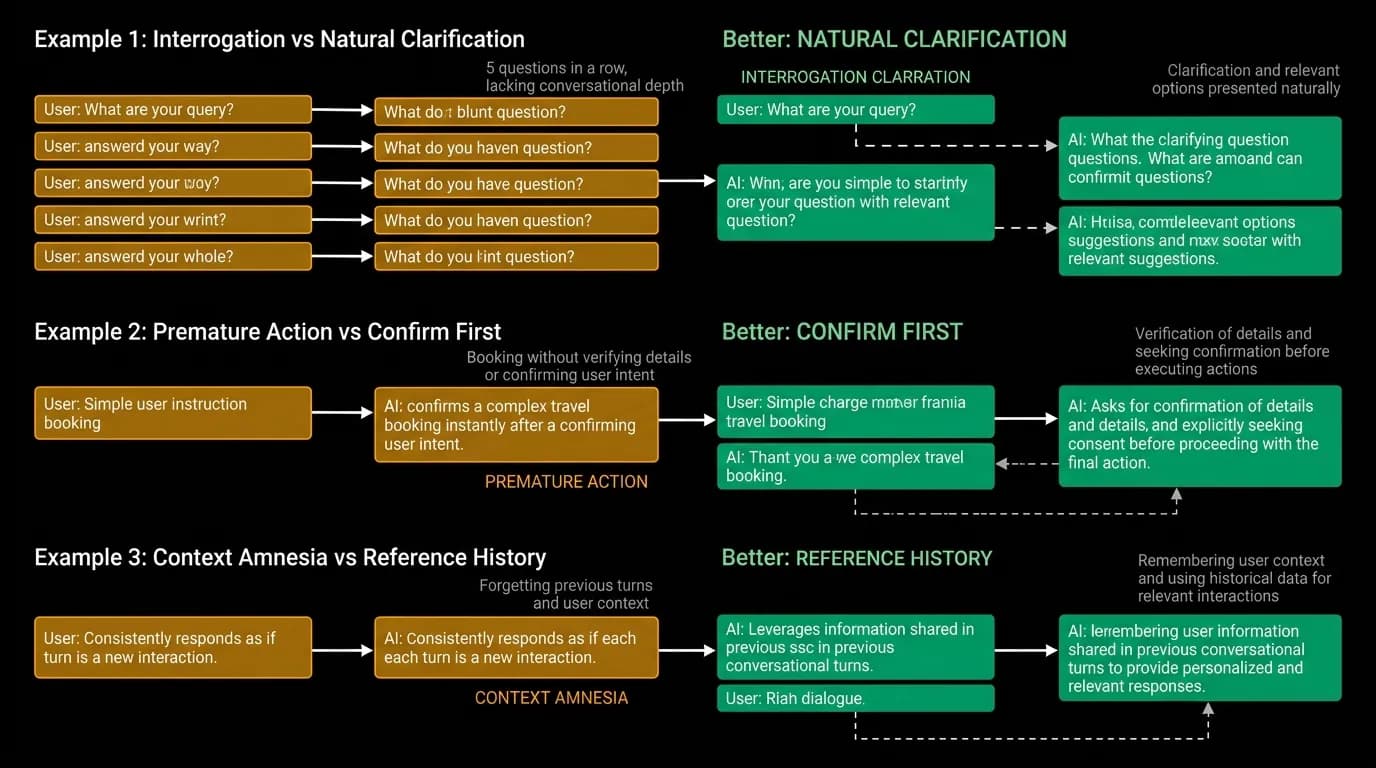
Anti-patterns
Patterns are useful. Knowing the anti-patterns is equally useful.
The interrogation. Asking five questions in a row. Users are not filling out a form. They are having a conversation. Space out your questions and interleave them with useful responses.
Premature action. The agent books a flight before confirming the details. This is the fastest way to destroy trust. A booking error can cost hundreds of dollars and ruin a trip. Always confirm before executing financial transactions.
Context amnesia. The user mentioned they prefer aisle seats three messages ago. The agent recommends a window seat. This is not just annoying; it signals that the agent is not paying attention. A human advisor who did this would lose your business. Over-explanation. The user says "book it" and the agent responds with four paragraphs about the booking process, cancellation policy, and terms of service. Match the user's energy. A short confirmation deserves a short response.
Forced linearity. Requiring the user to complete steps in a specific order. "First tell me your departure city, then your destination, then your dates." Conversations are not forms. Users should be able to provide information in any order, and the agent should assemble the puzzle.
These patterns and anti-patterns form the foundation of conversation design for AI travel agents. They are not theoretical. Every one of them came from analyzing real production conversations where the agent succeeded or failed. The patterns are what worked. The anti-patterns are what did not.
Use them as a starting point. Your users will teach you the rest.
Nowah is an AI travel agent that searches and books real flights and hotels through conversation — no filters, no thirty open tabs. Plan your next trip.