Agentic Memory — How AI Remembers Your Travel Style
Every booking app treats you like a stranger. Agentic memory fixes that by learning your preferences across sessions and trips.

Every time you open a travel booking app, it asks the same questions. Where are you going? When? How many people? It does not remember that you booked the same route last month, that you always pick aisle seats, or that you hate layovers in Miami. Every session starts cold, as if you have never used the product before.
This is not a minor UX annoyance. It is a fundamental architectural failure. And it is the single biggest reason why AI travel booking cannot reach its potential without a proper memory system.
We call our approach agentic memory. It is the layer that transforms an AI travel agent from a tool you use into an assistant that knows you. I want to explain how it works, why it matters, and where the boundaries are.
The cold start problem
Traditional travel platforms are stateless by design. They were built as search engines: you input parameters, you get results. The platform does not need to know who you are because it treats every query identically. Your identity only matters at checkout, when it needs a name for the ticket.
Early AI travel assistants inherited this statelessness. They could hold a conversation within a single session, but close the app and everything vanished. This creates a bizarre user experience. You spend 20 minutes telling an AI about your trip preferences, your budget constraints, your travel partner's dietary restrictions. Next time you open the app, it has amnesia.
Forty percent of travelers report post-booking regret from missing better options. I believe a significant chunk of this regret comes from the cold start problem. The system does not know enough about you to recommend well, so it falls back on generic rankings that optimize for popularity rather than personal fit.
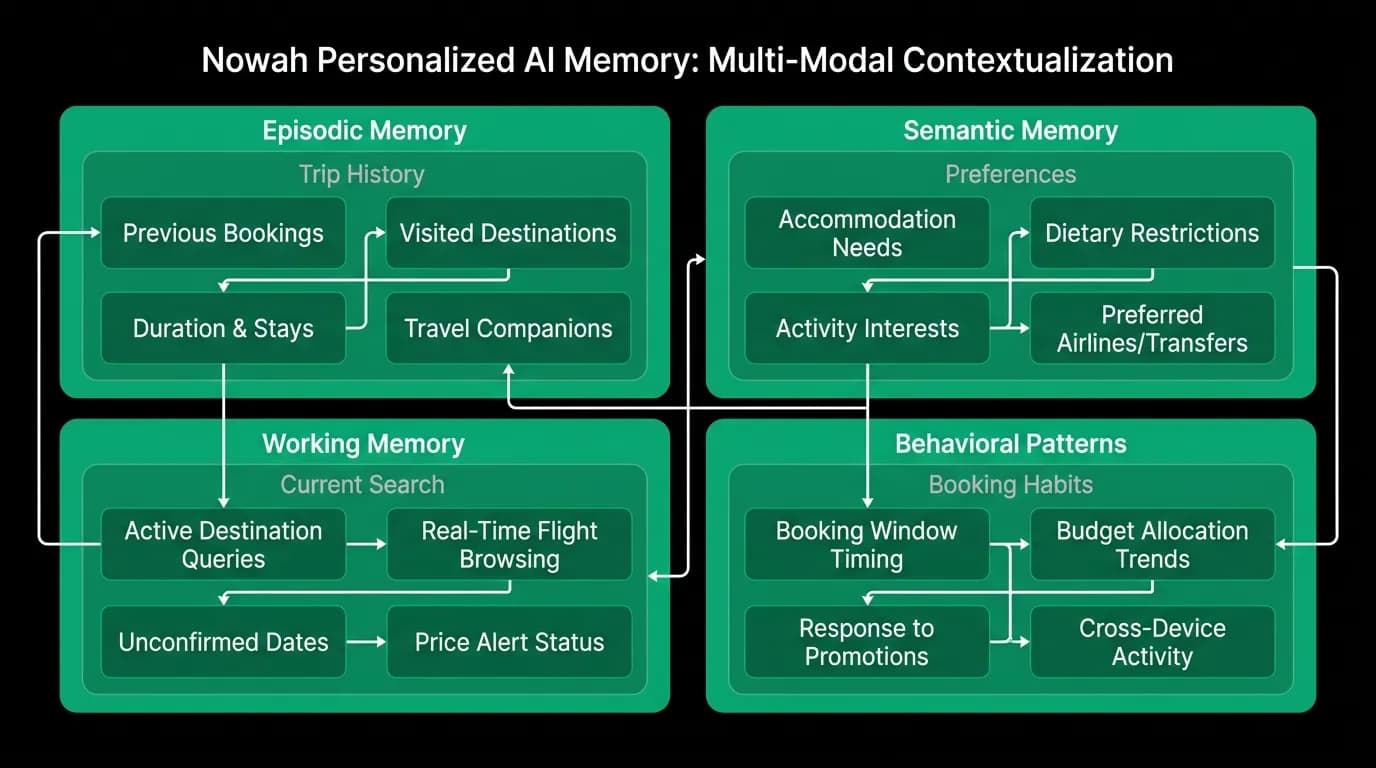
Three types of memory an AI travel agent needs
When we designed our memory architecture, we identified three distinct types of information the agent needs to retain.
Episodic memory is the record of specific events. You flew to Barcelona in September 2025. You stayed at Hotel Arts. You told the agent the neighborhood was too busy and you wanted something quieter next time. You booked through a specific loyalty program. These are facts about things that happened, timestamped and contextual.
Episodic memory is valuable because it provides concrete reference points. When you say "same hotel as last time," the agent can resolve that to a specific property in a specific city. When you say "not like the hotel in Barcelona," it knows exactly what you disliked and why.
Semantic memory stores preferences and generalizations derived from episodes and explicit declarations. You prefer aisle seats. You like boutique hotels. Your budget for European trips is $150-200 per night. You are a vegetarian. Your passport expires in March 2027.
The distinction between episodic and semantic memory matters because they age differently. Episodic memories are permanent records. Semantic memories can evolve. You might have preferred window seats two years ago but switched to aisles after a knee surgery. The agent needs to handle this kind of preference drift without losing the historical context.
Behavioral pattern recognition identifies habits you have never explicitly stated. You always book flights 3-4 weeks before departure. You tend to choose morning departures. You have never booked a red-eye. You usually pick the middle option when presented with three choices. You search for hotels immediately after booking flights.
These patterns are inferred, not declared. The agent detects them by analyzing booking history and conversation patterns. They are the closest thing to intuition that a software system can develop.
Cross-session continuity in practice
Let me give you a concrete example of how these memory types work together.
You open Nowah and say: "I'm thinking about going back to Spain, maybe somewhere quieter than last time."
Here is what the agent retrieves:
From episodic memory: your Barcelona trip in September 2025. Hotel Arts in the Eixample neighborhood. You mentioned the area was too loud at night. You visited several restaurants in the El Born neighborhood and liked them.
From semantic memory: you prefer boutique hotels over chains. Your Spain travel budget is around $180 per night. You like walkable neighborhoods with good food scenes. You typically travel in shoulder season.
From behavioral patterns: you usually start searching 6-8 weeks before travel. When you say "thinking about," you are in the early exploration phase and prefer broad options over specific recommendations.
The agent synthesizes all of this without asking you to repeat any of it. It might respond: "Last time you found Barcelona's Eixample area too busy. San Sebastian has a great food scene with a quieter pace. Seville's Santa Cruz neighborhood is walkable and charming in shoulder season. Want me to check flight prices for either?"
That response would be impossible without all three memory types working together. A stateless system would respond with generic Spain recommendations. A system with only semantic memory would know your hotel preferences but not your specific Barcelona experience. A system with only episodic memory would recall Barcelona but might not connect it to your broader preferences.
How context windows changed the game
Context windows grew from 4,000 tokens in 2022 to over 200,000 tokens by 2025. That growth is directly relevant to agentic memory because it determines how much the agent can "think about" simultaneously.
At 4,000 tokens, you could barely fit a single conversation turn with some context. The agent had to operate with severe amnesia, forgetting earlier parts of the conversation just to process the current message.
At 200,000 tokens, you can fit an entire trip history, a full preference profile, the current conversation, and active search results into a single prompt. That is roughly 150,000 words of context. For most travelers, that is enough to include every meaningful interaction they have ever had with the platform.
But raw context window size is not the whole story. More context does not automatically mean better reasoning. There is a quality curve: adding relevant context improves output up to a point, after which irrelevant context introduces noise and degrades performance.
This is why we use a hybrid approach. Long-term memory lives in a structured database. When a conversation begins, we selectively retrieve the memories most relevant to the current context and inject them into the prompt. The agent does not see everything it has ever learned about you. It sees the subset that matters right now.
Memory as competitive moat
Here is an argument I feel strongly about: in the age of commoditizing language models, memory is the most defensible competitive advantage an AI product can have.
The underlying models are increasingly interchangeable. The marginal capability differences between frontier models from different providers matter less each quarter. If your product's value comes entirely from the model's reasoning capability, you are vulnerable to any competitor who uses the same or a slightly better model.
But the knowledge your agent accumulates about a specific user cannot be replicated. When a user has booked 10 trips through your platform, you have a rich preference profile, a detailed travel history, and calibrated behavioral patterns that no competitor has access to. The user would have to start from scratch with any alternative, and they know it.
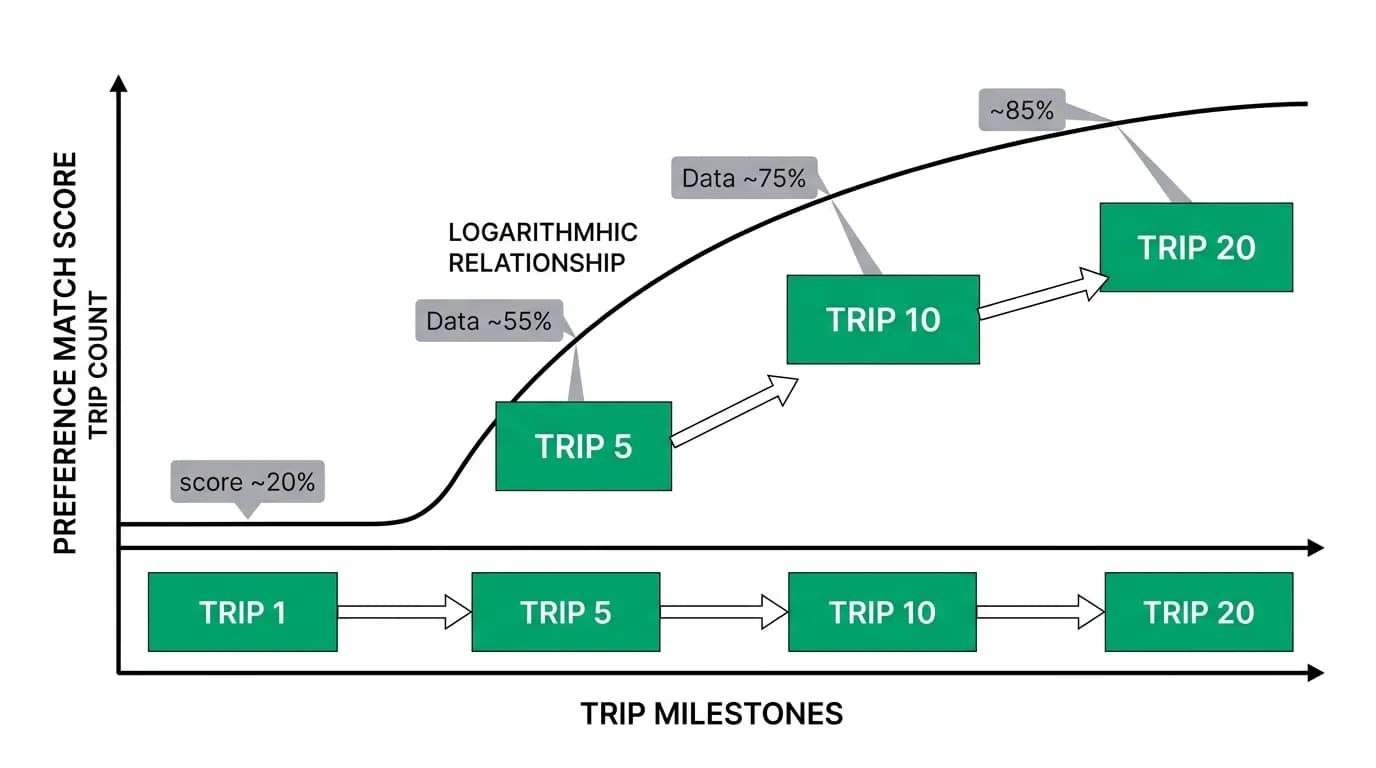
This is not lock-in through inconvenience. It is lock-in through value. The product genuinely gets better with use. After one trip, the agent knows your basics. After five trips, it has your patterns. After ten trips, it knows things about your travel style that you have not consciously articulated.
AI-native platforms report customer acquisition costs 3 to 5 times lower than traditional OTAs. That is largely a retention story. Users stay because the agent knows them, and knowing them makes the product meaningfully better.
The privacy equation
Memory creates value. It also creates responsibility. An agent that remembers everything can feel helpful. It can also feel invasive.
We think about this as a spectrum with three zones.
Too little memory means the agent is useless for personalization. It cannot recommend well because it does not know you. Every session feels cold and generic. This is where most travel apps sit today.
Too much memory means the agent knows things the user did not expect or want it to know. It infers sensitive information from behavioral patterns. It surfaces memories at inappropriate times. It feels like surveillance. This is the uncanny valley of personalization.
The right amount of memory means the agent remembers what helps and forgets what does not. The user understands what is stored, can view it, edit it, and delete it. Transparency is complete. Control is absolute.
We build toward the third zone with several concrete principles.
Explicit preferences always override inferred ones. If you tell the agent you prefer window seats, that overrides any behavioral pattern suggesting otherwise.
Users can view everything the agent remembers about them. This is not buried in a settings page. It is a first-class product feature. "What do you know about me?" is a valid query that returns a complete, readable list.
Users can edit or delete any stored preference or memory. If the agent inferred something wrong, or if you simply do not want it remembered, one command removes it.
The agent explains its reasoning. When it recommends a boutique hotel, it says "I chose this because you have preferred boutique hotels in your last four trips." You can see the chain from memory to recommendation and verify that it makes sense.
GDPR and CCPA require this level of user control, but we would build it this way regardless of regulation. Trust is the currency of an AI travel agent, and trust requires transparency.
From memory to anticipation
The most interesting application of agentic memory is not looking backward. It is looking forward.
Once the agent has enough data about your travel patterns, it can shift from reactive to proactive. Instead of waiting for you to say "I want to go to Japan," it notices that you go somewhere in Asia every spring, your last two trips were to Thailand and Vietnam, you mentioned wanting to see cherry blossoms in a conversation eight months ago, and flight prices to Tokyo are currently 25% below average for April.
The agent can surface this proactively: "I noticed Tokyo flights for April are unusually cheap right now, and you mentioned wanting to see cherry blossoms. Want me to look into it?"
This is not algorithmic spam. It is genuine anticipation based on deep knowledge of the user. The difference is specificity. An ad says "cheap flights to Tokyo!" to everyone. An agent says it to you, right now, because it knows your history, your interests, and the current opportunity.
We are still early in building this capability. Proactive suggestions require high confidence in the agent's understanding of what the user wants, and getting that wrong is worse than not suggesting at all. But the foundation is the memory system, and the memory system is already running.
The technical challenges of memory
Building a reliable memory system is harder than it sounds. Several technical challenges have required careful engineering.
Memory conflicts. The user told the agent they prefer window seats in March. In June, they told the agent they prefer aisle seats. Which preference is current? The system needs to handle temporal reasoning about preferences, recognizing that the most recent explicit statement should override older ones while keeping the historical record.
Inference confidence. When the agent infers a pattern from three bookings, how confident should it be? Three morning departures could be a strong preference or a coincidence driven by available options. We use confidence scores for inferred preferences and only apply them when confidence exceeds a threshold. The threshold rises with the stakes: low confidence might influence search ranking but high confidence is needed before filtering out options entirely.
Memory relevance. With hundreds of stored facts about a user, selecting which memories are relevant to the current conversation is a retrieval problem. The user is planning a trip to Japan. Their hotel preference in Barcelona might be relevant (they prefer boutique hotels globally) or irrelevant (specific Barcelona neighborhood preferences do not apply to Tokyo). We use semantic similarity between the current context and stored memories to rank relevance, injecting only the top-scoring memories into the prompt.
Cross-session coherence. A user started planning a trip three weeks ago, got distracted, and is now resuming. The agent needs to pick up where they left off. This requires not just storing the conversation history but understanding the planning state: what was decided, what was pending, what constraints were established.
Scale. A user who has been with the platform for years accumulates thousands of memories. The system needs to remain fast (sub-second retrieval) as the memory store grows. We index memories by type, recency, and relevance, and we periodically consolidate older memories into summarized preference profiles to keep the active memory set manageable.
Memory across the household
An interesting extension of the memory problem is household-level memory. Many travelers plan for themselves and for others: a partner, children, parents.
The agent can maintain separate preference profiles for family members while understanding relationships. "My wife and I" triggers two-traveler mode. "Book for my parents" accesses their profiles. "Same trip as last year but add the kids" references a historical trip and extends it.
This household memory creates value that compounds across the entire family's travel life. The agent knows that the user's partner has a nut allergy, their child needs a bassinet on flights, and their parents prefer ground-floor hotel rooms.
Forty percent of travelers report post-booking regret from missing better options. For family travel, the regret is amplified because you are making decisions that affect people you care about. An agent that remembers the whole family's needs catches things that a stressed parent might forget.
The privacy architecture of memory
Memory that stores personal travel data requires careful privacy engineering. We take this seriously because trust in the memory system depends on users feeling safe sharing information.
The core principle is user sovereignty. The user owns their memory data. They can view it, edit it, and delete it at any time. "What do you know about my travel preferences?" returns a structured summary of stored preferences. "Forget that I prefer aisle seats" removes that specific preference. "Delete all my data" wipes the entire memory profile.
We also implement what we call "memory scope." Not everything discussed in a conversation should become a long-term memory. The user mentions they are feeling under the weather and wants a hotel with room service. That is a temporary context, not a permanent preference. The agent stores it for the current planning session but does not add "always wants room service" to the long-term profile.
Distinguishing between temporary context and permanent preference is a classification problem. Explicit statements ("I always prefer...") are clearly permanent. Situational mentions ("this time I need...") are clearly temporary. The ambiguous middle ground requires careful heuristics and sometimes explicit confirmation: "Should I remember that you prefer ground-floor rooms for future trips, or was that just for this booking?"
Data minimization is another principle. We store the minimum information needed for personalization. The agent does not need to know why you prefer aisle seats (knee surgery, claustrophobia, convenience). It just needs to know you prefer them. We actively avoid storing sensitive medical, financial, or personal information that is not directly relevant to travel preferences.
The memory architecture also handles multiple users on shared devices. Each authenticated user has their own memory profile. Logging out clears the active memory context. There is no leakage between profiles.
Measuring memory quality
We measure the memory system's quality through several metrics.
Preference recall accuracy. When the agent applies a stored preference, is it correct? We test this by comparing agent actions against the user's stated preferences. Target: above 95%.
Memory retrieval relevance. When the agent retrieves memories for a conversation, are they actually relevant? We measure this by tracking whether retrieved memories were used in the response. Irrelevant retrievals waste context space and can confuse the model.
Preference drift detection. When a user's preferences change, how quickly does the agent adapt? We measure the lag between a user expressing a new preference and the agent consistently applying it. Target: immediate for explicit changes, 2-3 trips for inferred pattern updates.
[User satisfaction](/blog/measuring-user-satisfaction-ai-products) with personalization. The ultimate measure is whether users feel the agent knows them. We track this through the confirmation accept rate (how often users accept the agent's first recommendation) and through qualitative feedback.
The cold start problem, revisited
I mentioned the cold start problem at the beginning. Every travel app treats you like a stranger. Agentic memory solves this over time, but it does not solve the very first interaction.
For new users with no history, the agent relies on three strategies.
Explicit [preference collection](/blog/preference-collection-as-onboarding). During onboarding, we ask a handful of high-signal questions. Do you generally prefer direct flights or are you willing to connect for a lower price? Boutique hotels or reliable chains? These questions take 30 seconds and provide enough signal to meaningfully personalize the first interaction.
Population-level defaults. For preferences the user has not stated, we use aggregate data from all users. Most travelers prefer morning departures. Most travelers prefer hotels within 2 miles of the city center. Most travelers care more about price than airline brand for domestic flights. These defaults are wrong for some users, but they are better than random.
Rapid learning. The first interaction generates more preference signal than any subsequent interaction because every choice is informative against a blank baseline. The user picks the connection over the direct flight. That is a strong signal about price sensitivity. They pick the boutique over the chain. That is a strong signal about accommodation style. By the end of the first booking, the agent has enough data to meaningfully personalize the second interaction.
The cold start is not a permanent problem. It is a one-trip problem. And the speed at which the agent escapes the cold start, learning more about the user from a single booking than a traditional platform learns from ten, is one of the structural advantages of an agentic approach.
The best travel app is one that knows you well enough to help before you ask. That requires memory that is persistent, structured, transparent, and continuously learning. We are building it, and every trip our users take makes it smarter.
Nowah is an AI travel agent that searches and books real flights and hotels through conversation — no filters, no thirty open tabs. Plan your next trip.