Designing APIs When AI Is Your Primary Consumer
When an AI agent calls your endpoints instead of a human clicking buttons, API design changes fundamentally. Here are the patterns we use.
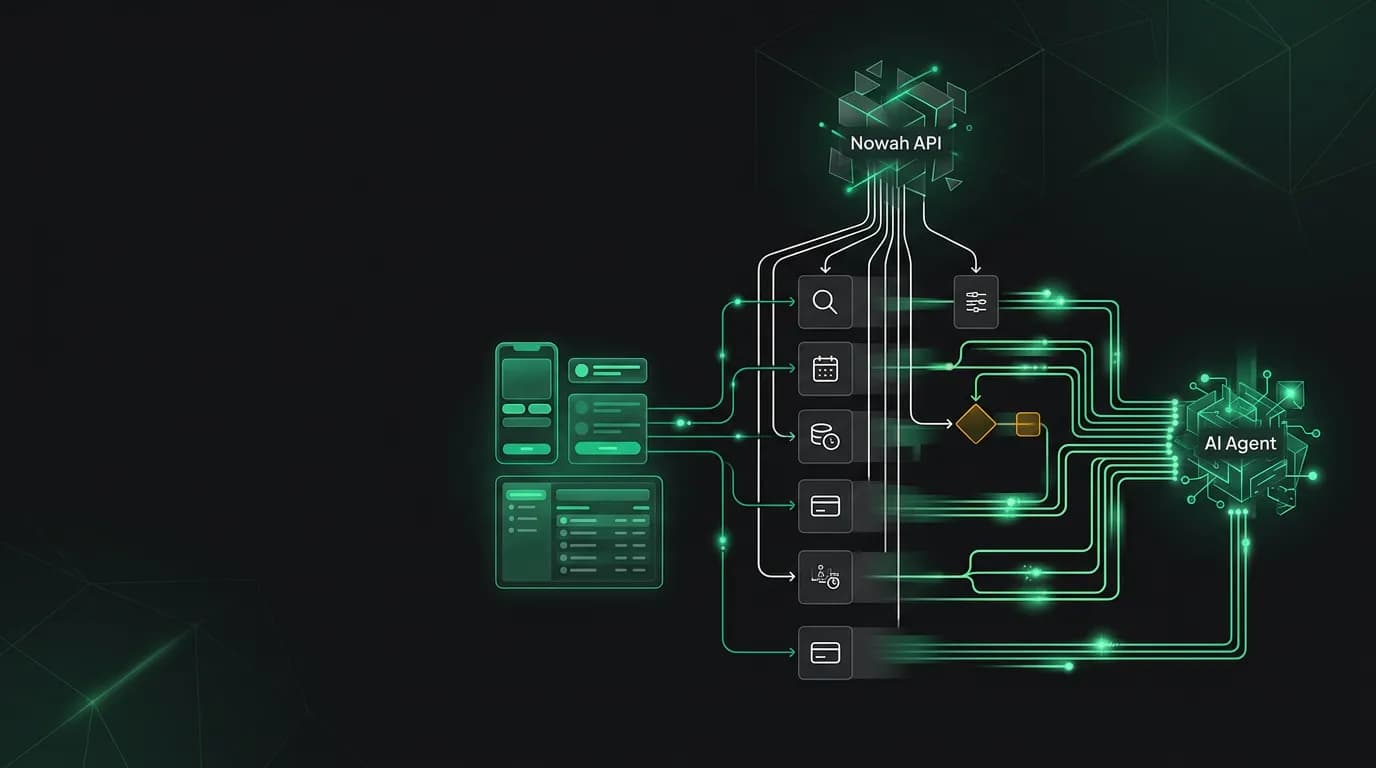
Traditional APIs are designed for humans operating through UIs. A person clicks a button, the frontend sends a request, the backend returns a response, the frontend renders it. The human is the decision-maker. The API just moves data.
When an AI agent is your primary API consumer, the design assumptions change. The agent makes multiple calls per user interaction. It needs to interpret errors and decide what to do next. It reads response data not to render a page but to reason about what action to take. Traffic patterns are bursty and sequential rather than sparse and independent.
We learned these lessons building Nowah's backend. Here's what's different about designing APIs for AI-first products.
APIs as tool interfaces
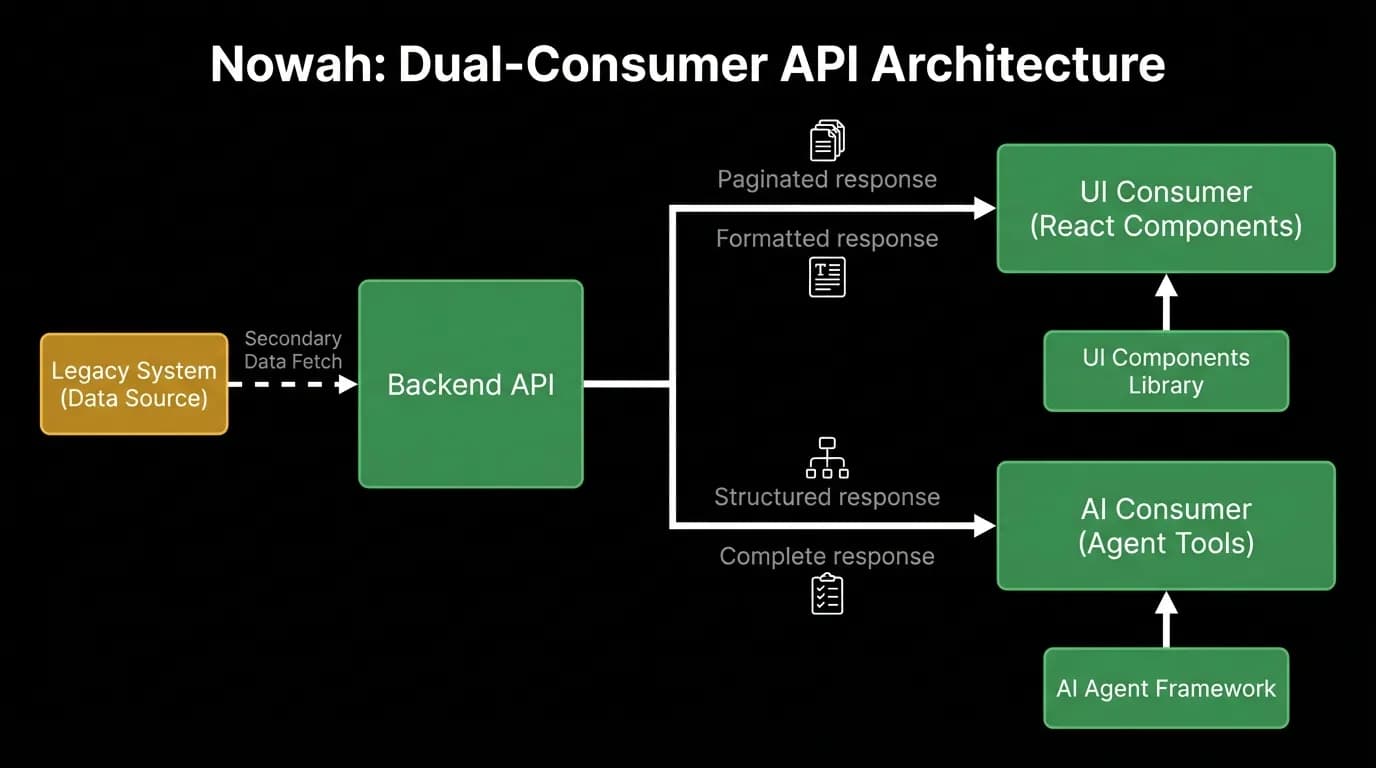
In our system, every API endpoint is also an AI tool. When we design an endpoint, we ask two questions: "Can the frontend render this response?" and "Can the AI agent reason about this response?"
These questions lead to different design choices than a traditional API. A human UI needs data formatted for display. An AI agent needs data formatted for decision-making. Sometimes these are the same, but often they're not.
For example, a flight search endpoint returns results. A human UI needs price, airline, times, and a booking link. An AI agent needs all of that plus the data needed for ranking: on-time percentages, aircraft type, fare class rules, baggage allowances. The agent needs richer data than the UI because it's making decisions, not just displaying information.
We design our responses with both consumers in mind. Core data for UI rendering, plus extended data for agent reasoning, all in one response structure. The a single typed language across the stack types are shared between frontend and backend, so both consumers work with the same contract.
Streaming responses, not request-response
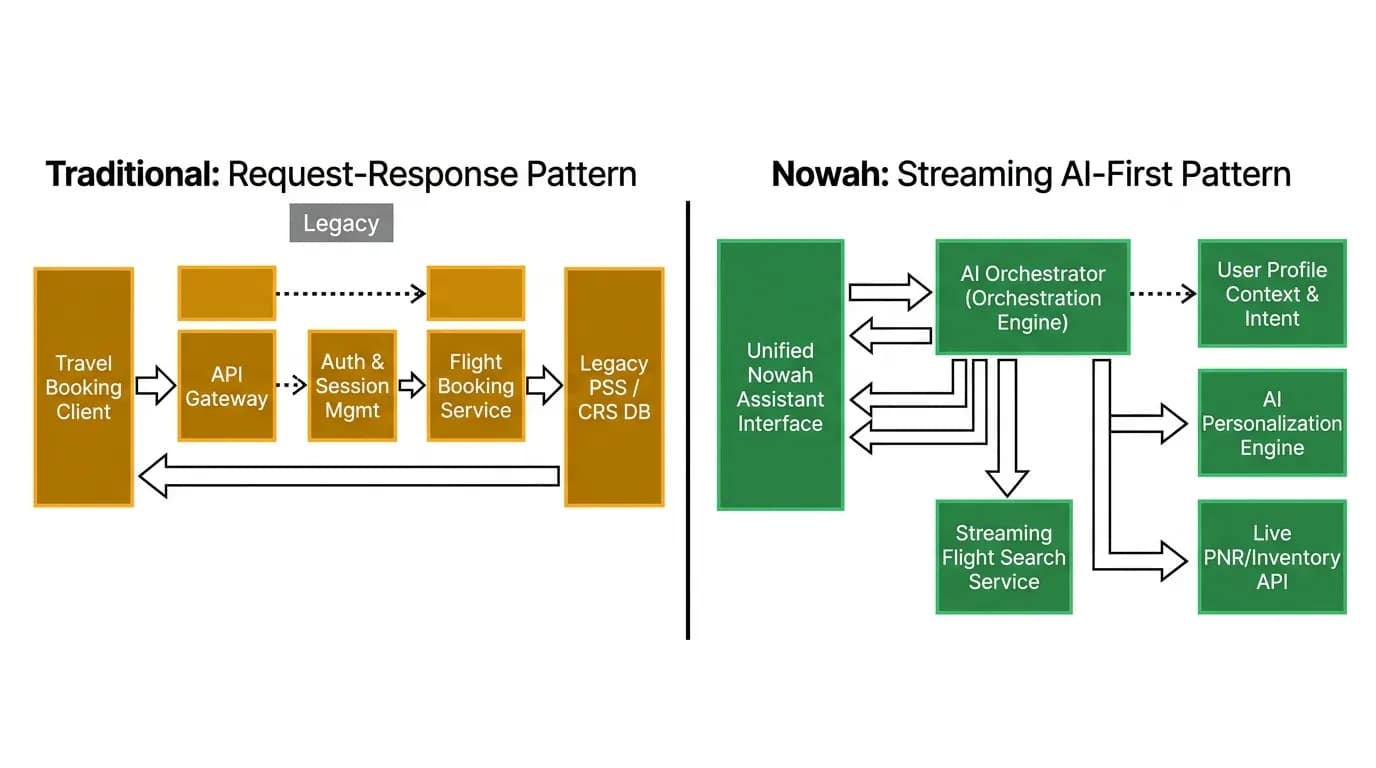
AI conversations involve sequences of operations that take seconds, not milliseconds. A flight search, a ranking pass, a response generation. In a traditional request-response model, the client waits silently until the entire operation completes.
Our endpoints stream. The flight search endpoint doesn't wait until all results are compiled and ranked. It streams status updates as the search progresses, then streams results as ranking completes. The agent (and the frontend) can show progress to the user in real time.
This affects API design at the protocol level. We use unidirectional server streaming for AI-facing endpoints instead of regular HTTP responses. The endpoint opens a long-lived connection and emits typed events: status updates, partial results, errors, and completion signals.
Streaming endpoints require different error handling than batch endpoints. In a batch response, you can return an error code. In a stream, an error might occur after you've already sent partial data. The protocol needs to handle mid-stream errors gracefully: emit an error event, include enough context for the consumer to understand what data is valid and what's not, and signal whether the stream is recoverable.
Error responses AI agents can interpret
When a human sees a 404 error, they understand "page not found" and navigate accordingly. When an AI agent receives a 404, it needs structured information to decide what to do: Was this a temporary issue? Should I retry? Is there an alternative endpoint? Was my input wrong?
We design error responses with agent recovery in mind.
{
 "success": false,
 "error": {
 "code": "FLIGHT_NOT_FOUND",
 "message": "No flights found for this route and date",
 "retryable": false,
 "suggestion": "Try adjusting dates or checking nearby airports"
 }
}
The `code` is machine-readable and maps to specific agent behaviors. The `message` is human-readable for logging. The `retryable` flag tells the agent whether it's worth trying again. The `suggestion` gives the agent a hint about how to recover.
This structured error approach means the agent doesn't have to guess about error recovery. It follows a deterministic path based on the error code and retryability. Transient errors get retried. Permanent errors get communicated to the user with the suggestion from the API response.
Rate limiting for AI-driven traffic
AI agents generate fundamentally different traffic patterns than human users. A human user clicks, waits, reads, clicks again. An AI agent can dispatch multiple API calls in rapid succession as part of a single reasoning step.
A user asking "Find me flights to Paris and check hotel prices nearby" triggers at least two parallel API calls. If the agent decides to check flexible dates, that might be three or four flight search calls. Add a currency conversion, a visa requirement check, and a weather lookup, and one user message generates half a dozen API calls in under a second.
Traditional rate limiting (X requests per Y minutes per user) doesn't map well to this pattern. We rate limit by route and by operation type instead:
- General API calls: 100 requests per 15 minutes
- Chat messages: 30 per minute
- Booking operations: 5 per hour
- Payment operations: 10 per minute
These limits are tuned to the expected patterns of agent-driven traffic. The chat limit accounts for rapid multi-turn conversations. The booking limit prevents runaway automated purchases. The payment limit provides financial safety.
Versioning for dual consumers
When both a human UI and an AI agent consume your APIs, breaking changes hit differently. A frontend can be updated alongside the API. An AI agent's behavior is coupled to the response format in ways that are harder to predict.
If we change how flight results are structured, the frontend team updates the rendering code. The AI agent, however, might misinterpret the new format because its tool descriptions reference the old structure. Tool descriptions are like documentation: they can fall out of sync with the implementation.
We version aggressively and maintain backward compatibility longer than we would for a frontend-only API. Deprecation involves updating both the API and the corresponding tool descriptions, running evals against the new format, and only removing old versions after the agent performs well on the new ones.
a single typed language across the stack across the full stack helps here. Shared type definitions between the API and the tool schemas mean type mismatches are caught at compile time. If the API response type changes, the tool schema update is enforced by the type system.
Legacy OTA APIs were built for forms
Most traditional travel platforms built their APIs for form-based UIs. Search form submits a request. Results page renders a response. Booking form submits another request. Confirmation page renders another response. Page by page, request by request.
These APIs weren't designed for the consumption patterns of an AI agent: rapid sequential calls, parallel operations, streaming requirements, and structured error recovery. Companies trying to add AI to legacy platforms often struggle because the underlying APIs aren't built for how agents work.
We built our APIs knowing from day one that an AI agent would be the primary consumer. That's a meaningful advantage. Not because AI APIs are dramatically different in structure, but because the assumptions embedded in every design decision (streaming over batch, structured errors over status codes, rich data over display data, burst-friendly rate limits) compound into a system that's naturally compatible with agent-driven interaction.
AI agents generate bursty, multi-call traffic unlike human users. Designing for that from the start is much easier than retrofitting it onto an API built for click-by-click human interaction.
Nowah is an AI travel agent that searches and books real flights and hotels through conversation — no filters, no thirty open tabs. Plan your next trip.