The Future of Travel APIs: Agent-First Design
As AI agents become the primary API consumers, travel APIs will evolve toward semantic endpoints, intent-based queries, and natural language interfaces. Here is our vision.
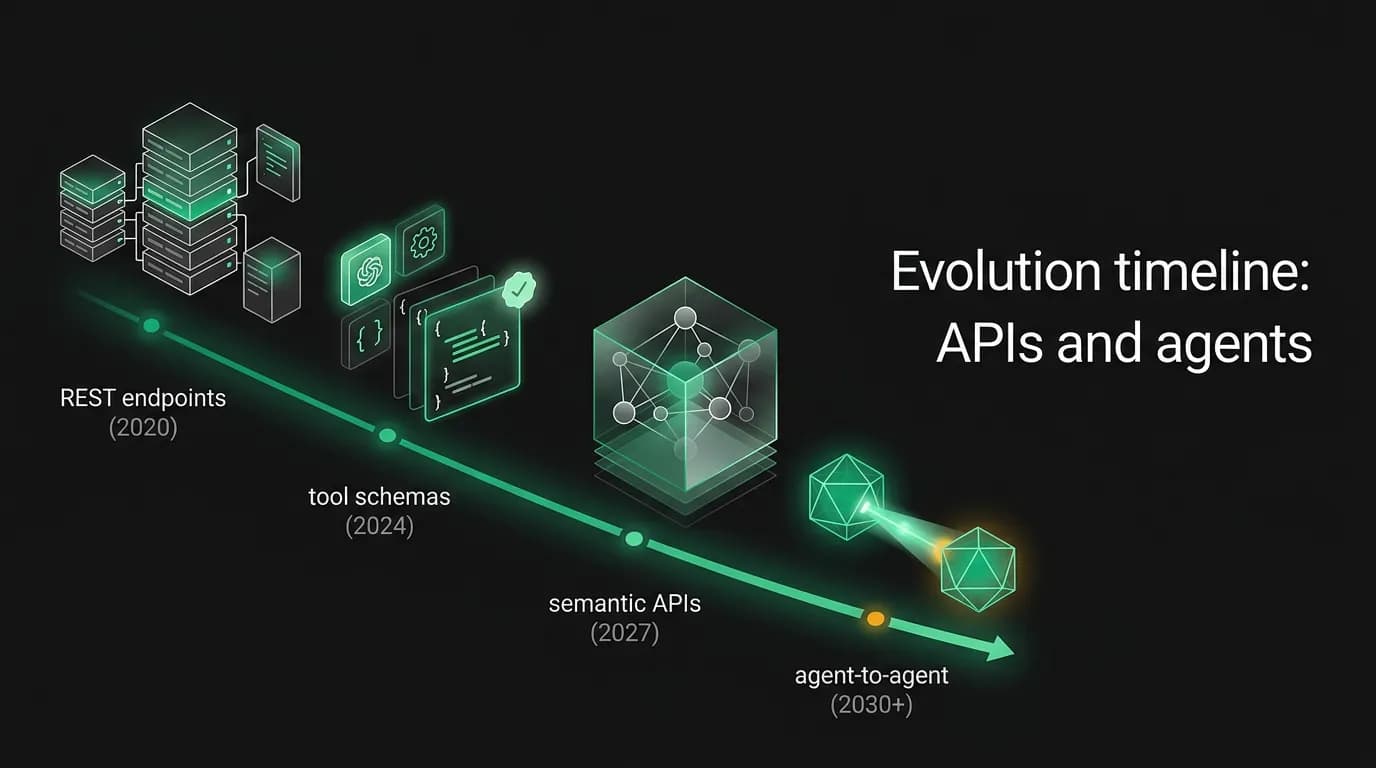
Picture a travel booking that never touches a REST endpoint. Two AI agents -- one representing a traveler, one representing an airline -- negotiate directly. They exchange structured intent objects, not HTTP requests. The traveler's agent says "my user prefers morning departures, values legroom, and has a budget ceiling of $600." The airline's agent responds with a tailored offer that accounts for current inventory, the traveler's loyalty status, and a dynamic price calibrated to close the deal.
This is not science fiction. It is the logical endpoint of what is already happening. And it changes everything about how travel APIs should be designed.
The shift from developer-first to agent-first

For the past two decades, travel API design has optimized for human developers. Good documentation. Clear parameter names. Copy-paste examples. All of this still matters. But the audience is shifting.
Today, a growing percentage of API traffic comes from AI agents, not human-written application code. An agent does not read your getting-started guide. It parses your tool schema. It does not look at your example responses in a browser. It processes your JSON structures programmatically and decides what to do next based on the content.
This does not mean human developers stop mattering. They are the ones building and configuring the agents. But the API's primary runtime consumer is increasingly a machine, and that changes what "good API design" means.
When most traffic comes from autonomous systems, the priorities shift. Schema precision outweighs documentation prose. Deterministic behavior outweighs flexible defaults. Error specificity outweighs error friendliness. The API needs to be unambiguous to a machine, not just clear to a human.
No travel API provider currently scores above 4 out of 5 on what I would call AI Agent Readiness. This is the biggest gap in the travel technology market right now, and whoever closes it first will have a serious competitive advantage.
Semantic APIs: beyond parameter lists
Today's flight search endpoints accept structured parameters: origin, destination, date, passenger count, cabin class. The developer (or agent) must translate intent into these specific fields.
Semantic APIs take a different approach. Instead of requiring the caller to decompose their intent into predefined parameters, a semantic endpoint accepts higher-level intent expressions. "Cheapest direct flight departing in the morning" as a single input, interpreted server-side.
This is not about accepting free-form text and hoping for the best. It is about defining a structured intent language that sits between natural language and rigid parameter schemas. The intent object might look like:
{
 "intent": "flight_search",
 "constraints": {
 "route": { "from": "JFK", "to": "CDG" },
 "timing": { "departure_window": "morning", "flexibility": "2_days" },
 "preferences": ["direct", "cheapest"],
 "budget": { "max": 800, "currency": "USD" }
 }
}
The server interprets "morning" based on the departure airport's timezone. It knows "cheapest" and "direct" might conflict and returns the best trade-off. It applies the 2-day flexibility window intelligently, not just searching three separate dates.
This is more useful to AI agents than traditional parameter-based search because it maps more closely to how humans express travel preferences. The agent does not have to translate "I want a cheap morning flight" into origin=JFK&destination=CDG&departure_time_min=06:00&departure_time_max=11:59&sort=price&max_stops=0. It just passes the intent through.
Intent-based queries replacing form-fill patterns

The logical extension of semantic APIs is full intent-based querying, where the API accepts a natural language description of what the user wants and returns structured results.
I am not suggesting every API endpoint should accept arbitrary text. That would be a reliability nightmare. But specific high-value endpoints -- particularly search -- benefit enormously from intent interpretation. The search endpoint is already the most complex and the most commonly used. It is also the one where the gap between what users want to express and what parameters allow is widest.
A hybrid approach works well here. The endpoint accepts both traditional structured parameters and an intent field. If structured parameters are provided, they take precedence. If an intent string is provided, the server interprets it into parameters, applies them, and returns the interpreted parameters alongside results so the caller can verify the interpretation.
This transparency matters. An agent that sends "morning flight, not too expensive" needs to know that the server interpreted "morning" as 6:00-11:59 and "not too expensive" as below the route's median price. Without that feedback, the agent cannot correct misinterpretations or refine subsequent requests.
Multi-agent negotiation
Here is where it gets genuinely interesting. Today, travel APIs serve a single interaction pattern: a client (human or agent) calls an API that returns results from a provider. The client chooses, the client books.
In a multi-agent world, the traveler's agent negotiates with the provider's agent. This is not a metaphor. It is a protocol. The traveler's agent publishes its user's preferences and constraints. The provider's agent evaluates what it can offer. They go back and forth, narrowing options, adjusting terms, and reaching an agreement.
This already happens in programmatic advertising. Real-time bidding systems execute millions of these agent-to-agent negotiations per second. Travel is slower and higher-stakes per transaction, which actually makes it easier to implement because latency tolerance is higher.
For API designers, this means thinking about your API not just as a request-response interface but as a negotiation protocol. What information does the other agent need to make a good offer? What constraints does your agent need to respect? How do you handle disagreements?
We are not building multi-agent negotiation today. But we are building the foundations: rich tool schemas that describe our API's capabilities in machine-readable formats, deterministic response structures that agents can reason about, and observability tools that let developers understand what their agents are doing.
What to build today
If you are designing travel APIs right now, here is what I would focus on to prepare for the agent-first future.
Schema quality above all else. Your OpenAPI specification should be the single source of truth, and it should be detailed enough that an AI agent can use your API correctly without ever reading your documentation prose. Every parameter needs a clear description. Every enum needs every value listed. Every response field needs a type and explanation.
Deterministic responses. Given identical inputs, your API should return identical outputs. Non-determinism breaks agent evaluation suites and makes debugging impossible. If your search results include a randomization component for business reasons, make it controllable via a seed parameter.
Rich error taxonomy. Agents depend on error codes more than error messages. A human reads "The selected offer is no longer available" and understands. An agent needs a machine-readable code like `OFFER_EXPIRED` that it can match against its decision tree. Every error needs a specific code, not a generic category.
Observability as a first-class feature. When an agent makes ten API calls to complete a booking and something goes wrong, the developer debugging the issue needs to trace the full sequence. Request IDs that thread across calls, detailed timing data, and structured logs are not optional.
The companies building AI-powered travel planning tools are growing fast. The developer platform that serves those builders best -- with clean schemas, deterministic behavior, and agent-optimized design -- will capture the market. That is what we are building toward at Nowah, and we think the opportunity is enormous.
We have over 70 tool definitions in our agent system today, representing what I believe is one of the most comprehensive agent-API interfaces in travel. But this is still early. The semantic endpoints, the intent-based queries, the multi-agent protocols -- those are coming. And the APIs we design today need to be ready for them.
Nowah is an AI travel agent that searches and books real flights and hotels through conversation — no filters, no thirty open tabs. Plan your next trip.