The Loyalty Program Puzzle and AI
Airline loyalty programs are deliberately complex. AI cuts through the maze to maximize your points, status, and redemption value.

Airline loyalty programs are deliberately confusing. This is not a conspiracy theory. It is a business strategy. The more complex the program, the less likely members are to extract maximum value from their points. Airlines profit from points that expire unredeemed and from members who do not understand the optimal redemption path.
Industry studies have long reported that travelers bounce across many sites before booking a single trip. Add loyalty program optimization to the equation and the complexity multiplies. Which program should you credit this flight to? Is it worth paying $50 more for a flight that earns double miles in your preferred program? Should you be chasing status with one airline or spreading your bookings across alliances for maximum flexibility?
These questions have definitive answers. But finding those answers requires analyzing earning rates, elite qualification rules, award charts, alliance structures, and your personal travel patterns. An AI agent can do this analysis in seconds. A human would need hours with a spreadsheet.
Deliberate complexity
Loyalty programs are designed to reduce redemption rates, not to help you. The evidence is in the structure.
Award charts change frequently, always in the direction of higher point requirements. Dynamic pricing for award seats means the value of a point fluctuates. Blackout dates, capacity restrictions, and routing rules limit when and how you can use points. Earning rates differ by fare class, route, and partnership tier.
The result is a system where understanding the optimal strategy requires expertise that most travelers do not have and cannot easily acquire. Point values are not published clearly. Elite qualification thresholds are buried in fine print. The best redemptions require flexibility and planning that casual travelers cannot manage.
This complexity is profitable. An estimated 20-30% of airline points expire unredeemed. Points that sit unused are pure profit for the airline. Every point you fail to redeem optimally is money left on the table.
The tracking problem
Even a traveler who wants to optimize faces a tracking challenge.
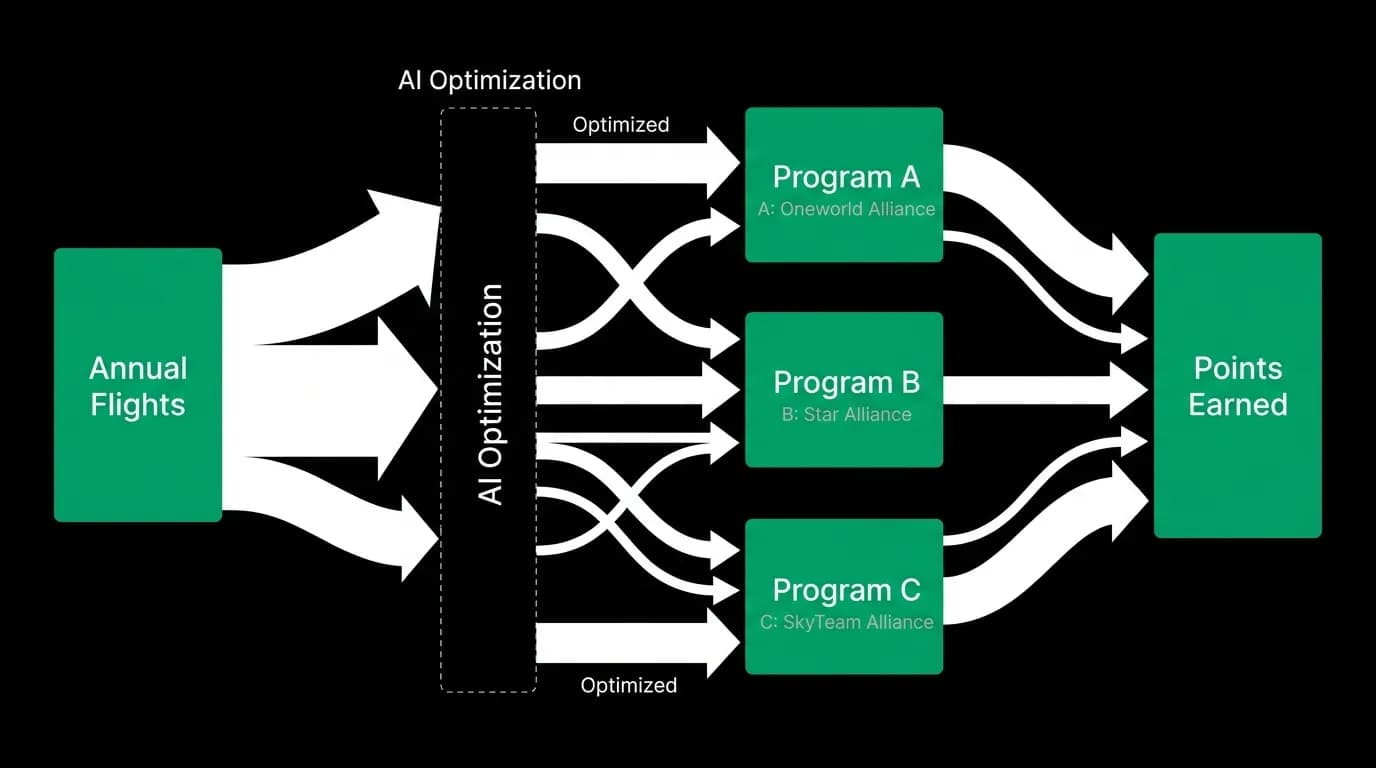
Most frequent travelers are members of 3-5 loyalty programs. Each program has its own earning rate, elite qualification metric, and point currency. Tracking status progress across multiple programs requires a spreadsheet or dedicated app.
The questions compound:
- Am I on track for elite status renewal this year?
- How many qualifying miles/segments/dollars do I need by December?
- Is it worth taking a positioning flight to hit the threshold?
- Should I credit this partner airline flight to Program A or Program B?
An AI agent tracks all of this automatically. It knows your loyalty program memberships, your current status, your progress toward thresholds, and your upcoming travel plans. It can project whether you will hit elite status based on booked and planned trips.
Cross-program optimization
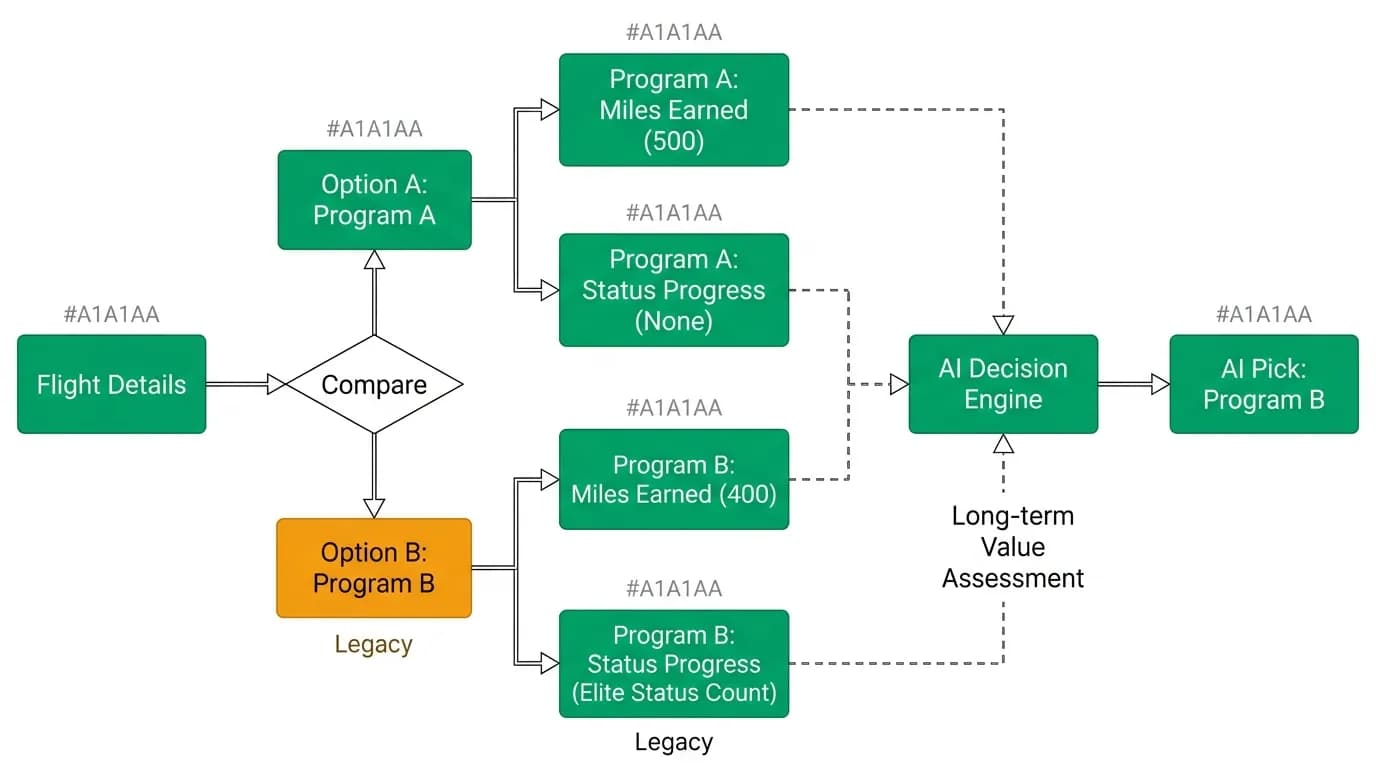
Here is where AI becomes genuinely valuable. You have a flight from New York to London on a partner airline that can be credited to either Program A or Program B.
Program A: 1,500 miles credit, no status benefit (you are already well past your threshold). Program B: 1,200 miles credit, but it counts toward a status challenge that would unlock free upgrades for the rest of the year.
The 300-mile difference in earning is worth less than the status benefit in Program B. But you would not know this without analyzing both programs simultaneously, checking your status progress, and understanding the value of the status tier you would unlock.
An AI agent does this analysis automatically. It recommends crediting to Program B and explains why: "Crediting to Program B puts you within 2 flights of Gold status, which includes free lounge access and priority boarding for the rest of the year. The 300 fewer miles in Program A won't affect your status there."
The loyalty-vs-price tradeoff
Sometimes the cheapest flight is not on your loyalty airline. The price difference might be $50, $100, or $200. Is it worth paying more to earn miles and maintain status?
This calculation is different for every traveler, every trip, and every price gap. It depends on:
- Your current status and progress toward the next threshold
- The value you place on elite benefits (lounge access, upgrades, priority boarding)
- How close you are to a status tier that would change the equation
- Whether the miles earned have a meaningful impact on your redemption options
- The actual cash value of the miles earned at realistic redemption rates
An AI agent knows your specific situation and can make this calculation in context. "The loyalty airline is $120 more for this route. But this flight would put you over the Gold threshold, and Gold status is worth roughly $800 in benefits over the next year based on your travel frequency. I recommend the loyalty flight."
Or: "The loyalty airline is $200 more and you are already well above your status threshold. The non-loyalty option is a better deal."
Seventy-two percent of millennials and Gen Z travelers are interested in AI travel planning including loyalty optimization. This generation has grown up with points and miles but lacks the deep expertise to optimize them. An AI agent fills that gap.
The future of loyalty in an AI-mediated world
AI agents change the loyalty equation for airlines, not just for travelers.
When an AI agent mediates every booking, it can evaluate loyalty value in real time. Airlines that offer better loyalty value get recommended more often. Airlines with opaque or unfavorable programs get recommended less.
This creates pressure toward simpler, more transparent loyalty programs. If an AI agent can instantly calculate that Program A offers 2x the value per dollar spent compared to Program B, travelers will shift their bookings. Airlines whose programs rely on complexity to retain value will lose share to airlines whose programs offer genuine, transparent value.
The best travel app integrates loyalty intelligence into every booking recommendation. It does not just find cheap flights. It finds flights that maximize the total value to you, including loyalty value, across your entire travel portfolio. Preference learning compounds over time, and after a few trips, the agent's loyalty optimization becomes increasingly accurate.
Loyalty programs were designed to be puzzles. AI solves puzzles. The travelers who benefit most are the ones who let their agent do the math.
Nowah is an AI travel agent that searches and books real flights and hotels through conversation — no filters, no thirty open tabs. Plan your next trip.