How AI Preference Learning Changes the Fifth Booking vs. First
First booking: the AI asks everything. Fifth booking: it already knows your seat, airline, budget, and hotel style. That compounding is the product moat.
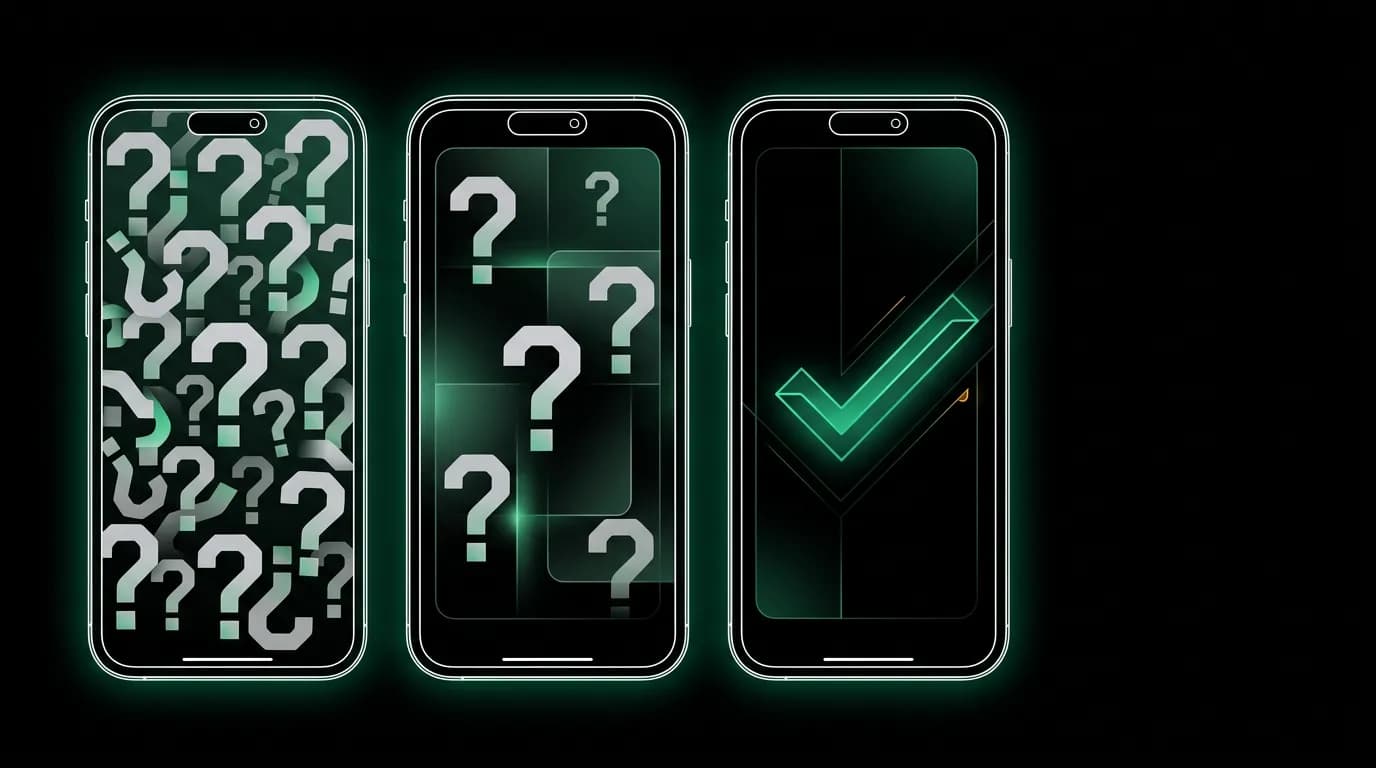
Your first booking with an AI travel agent looks a lot like your first conversation with a new travel agent. They ask a lot of questions. Where are you going? When? How long? How many people? What class? Budget? Window or aisle? Any airline preference? Hotel style? It takes a while. You're patient because you understand they need to learn about you, but it's not magic. It's onboarding.
Your fifth booking looks nothing like your first.
By the fifth booking, the AI knows your home airport. It knows you always book aisle seats. It knows your typical budget range for domestic versus international trips. It knows you prefer direct flights but will accept a connection if it saves more than $150. It knows you like boutique hotels in walkable neighborhoods. It knows you fly a specific airline when the route is available. It knows your passport number and expiration date.
The fifth booking might sound like this: "I need to fly to Chicago next Tuesday."
And the AI's response might be: "Found a direct flight on your usual airline, aisle seat, departing at 8 AM, arriving 11:30 AM. $289, which is $60 below the average for this route. Want me to book it?"
One question. One answer. Done.
The difference between the first booking and the fifth is the difference between a product and a moat.
First booking: learning from scratch
Every new user starts at zero. The AI knows nothing about their preferences, their travel patterns, or their personal details. This creates what product people call the "cold start problem": the product can't deliver its best experience until it has data, but it needs to deliver a good experience to earn the chance to collect data.
For the first booking, the AI has to ask questions. It needs origin, destination, dates, party size, and preferences. It asks them conversationally, not as a form, but it's still a sequence of questions that takes time.
The saving grace of the first booking is that even with no memory, the AI is still better than a traditional OTA. The conversational interface is more natural than a search form. The curated three options are more manageable than three hundred results. The in-chat booking flow is simpler than the multi-page OTA checkout. The experience is good on day one. But it's not yet personal.
During this first booking, the AI is quietly learning. Every answer the user gives becomes a preference signal. They picked the nonstop over the cheaper connection? Direct flights are preferred. They chose the morning departure? Morning preference noted. They asked about baggage? They probably travel light. They picked the mid-range hotel over the cheapest? Budget flexibility exists.
The user doesn't have to fill out a preference survey. They just book a trip, and the AI observes.
Second booking: the AI remembers
The second booking is when the product starts to differentiate itself from everything else on the market.
The user says "I want to fly to Denver in two weeks." On Expedia, this starts a fresh search with no memory of the previous booking. On Google Flights, same thing. Every booking is a standalone event.
On Nowah, the AI already knows their home airport. It already knows their class preference (economy). It already knows they prefer direct flights. It already knows their approximate budget range.
The conversation is shorter. The AI doesn't ask about origin (it knows), class (it knows), or flight style (it knows). It might ask about dates ("which days in two weeks?") and party size if it's different from last time, but that's it.
The search results are better too. Instead of three options selected from a blank slate of preferences, the AI narrows the search to direct flights on airlines the user has flown before, in the budget range observed from the first booking. The options feel tailored rather than generic.
"I found three nonstop options for you. The one on [airline] has an aisle seat available, which you chose last time. Departing at 9 AM, $320."
Two bookings in, and the product is already anticipating preferences the user never explicitly stated.
Fifth booking: proactive intelligence
By the fifth booking, the AI has a rich preference profile. It has seen the user across multiple trip types (business, leisure), multiple destinations (domestic, international), and multiple decision points (price sensitivity, timing preferences, airline loyalty).
The conversation changes qualitatively. The AI moves from reactive (answering questions and presenting options) to proactive (making recommendations based on patterns).
"I noticed you usually fly [airline] on this route. They have a direct flight Tuesday morning at 8 AM, aisle seat in economy, $289. That's below the average price and matches your usual preferences. Want me to book it?"
The user didn't ask for a specific airline. Didn't ask for a morning flight. Didn't ask for an aisle seat. Didn't ask about the price benchmark. The AI offered all of this proactively based on five bookings of observed behavior.
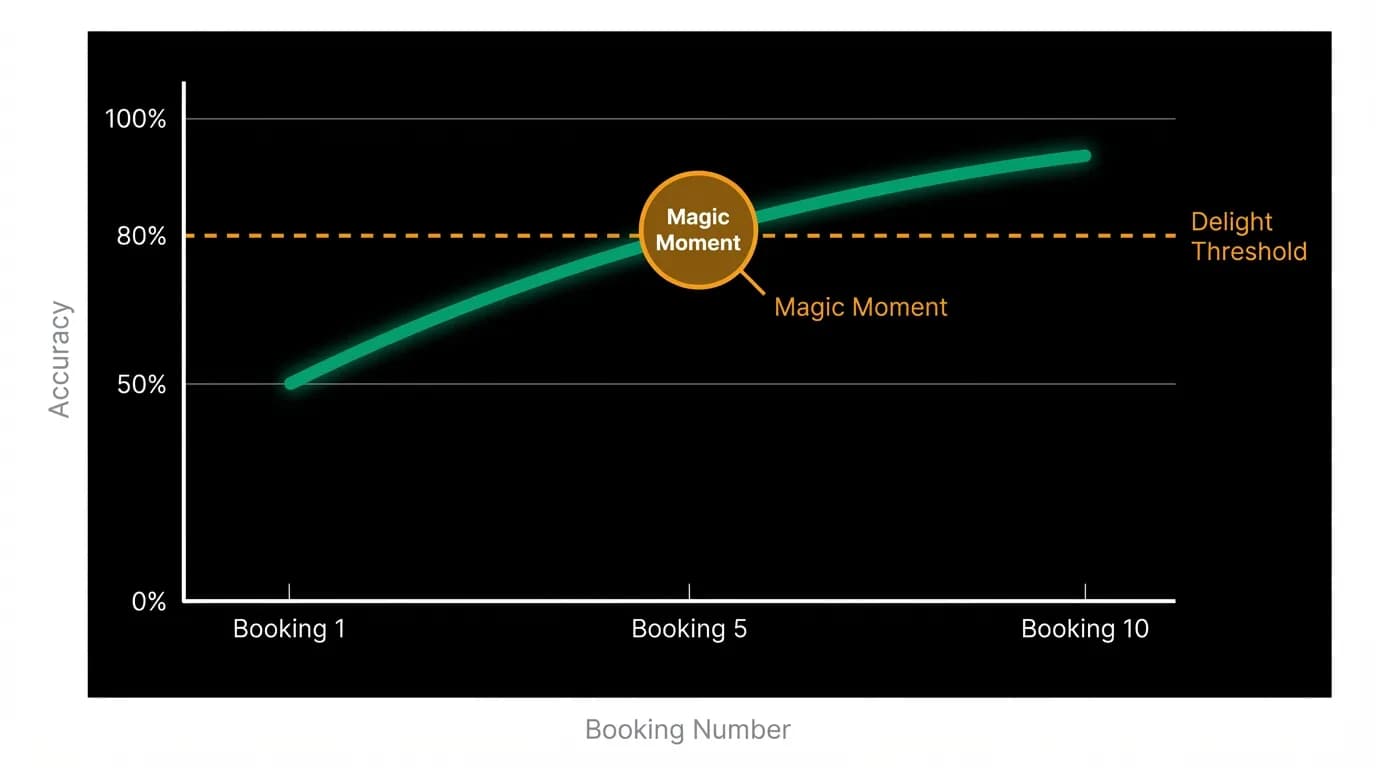
This is the "magic moment" in AI preference learning. The moment where the user thinks "it already knows what I want." This moment is the single strongest driver of retention and loyalty in an AI product, because it demonstrates a level of personalization that no other product in the user's life provides for travel.
Measuring preference learning
We track preference learning accuracy across several dimensions.
Pre-fill accuracy. When the AI pre-fills a preference (airline, seat, class, budget range), how often does the user accept it without modification? This starts around 40-50% after the first booking and rises to 80-90% by the fifth. The curve is steepest between bookings two and four.
Question reduction. How many questions does the AI ask per booking? First booking: 5-7 questions. Second: 3-4. Fifth: 1-2, often just "when?" The reduction in questions directly correlates with reduced conversation length and faster time-to-booking.
Recommendation acceptance. When the AI presents three options, how often does the user select the one the AI internally ranked highest? This is a proxy for preference model accuracy. By the fifth booking, the top-ranked option is selected about 65% of the time, up from about 35% on the first booking.
Time to booking. First booking: 4-6 minutes of conversation. Fifth booking: 1-2 minutes. The time savings compound with every booking because the AI needs less input and makes better recommendations.
These metrics don't just measure product quality. They measure moat depth. Every improvement in preference accuracy makes the product harder to leave.
How this compares to loyalty programs
Booking.com has Genius. Expedia has their rewards program. Hotels.com has a stay-10-get-1-free system. These programs are designed to create switching costs and reward repeat usage. And they do work, to a degree.
But they work through discounts, not personalization. A Genius level 2 user gets 10-15% off certain properties and free breakfast at some hotels. That's nice. But the product experience is identical for a new user and a ten-year Genius member. Same search form. Same results page. Same lack of personalization. The loyalty reward is financial, not experiential.
AI preference learning creates a fundamentally different kind of loyalty. The reward isn't a discount. It's a better product. The fifth booking is faster, more personalized, and more accurate than the first. This improvement can't be replicated by signing up for a competitor's loyalty program. It can only be earned through usage.
If a Genius level 3 user switches to Expedia, they lose their discount tier but get an identical product experience. If a Nowah user with five bookings switches to a competitor, they lose all their preference data. They're back to cold start. Back to answering every question. Back to generic recommendations.
This is genuine switching cost, not artificial lock-in. The user stays because the product is better for them specifically, not because they're afraid of losing a discount.
The magic moment
There's a specific moment in the preference learning curve that we watch for. We call it the "magic moment." It's the first time the AI proactively offers something the user wanted but didn't ask for.
"I see there's a nonstop on [your usual airline] with an aisle seat. It's $40 less than you paid last time for this route. Want me to book it?"
The user didn't mention the airline. Didn't mention the seat. Didn't mention the price benchmark. The AI offered all three because it learned from previous bookings.
When this happens, something shifts in the user's relationship with the product. They go from "this is a useful tool" to "this thing knows me." That shift is the retention inflection point.
Users who experience the magic moment have significantly higher repeat booking rates than users who haven't. They book more frequently. They recommend the product to others at higher rates. They're less price-sensitive about the trips they book, because they trust the AI to find good value.
The magic moment usually occurs between the third and fifth booking, depending on how consistent the user's preferences are. Frequent business travelers with regular patterns hit it sooner. Leisure travelers with varied trip types take a few more bookings.
The entire product is designed to accelerate the path to this moment. Every conversation captures preference signals. Every booking validates or updates the preference model. Every piece of stored context makes the next interaction more personal. The faster we get to the magic moment, the more likely the user stays for life.
Why preference learning is the real moat
In the AI travel space, there will be multiple competitors. Multiple AI agents that can search flights and book hotels. The technology to build a conversational travel product is accessible. The APIs are available. The language models are available.
What isn't easily replicable is a user's preference history. Their five bookings, ten bookings, twenty bookings worth of learned preferences, validated predictions, and accumulated context. That data lives in one place. And it only gets more valuable with time.
A new competitor can match our features on day one. They can't match what we know about a specific user after twenty bookings. And they can't offer that user the same quality of proactive, personalized recommendations without the same data.
This is the compounding advantage of AI preference learning. Each booking makes the next one better. Each booking makes the product harder to replace. Each booking deepens the moat.
Users who book via app with remembered preferences show roughly 30% higher repeat booking rates compared to users of stateless platforms. Personalized recommendations convert at 2-5x the rate of generic ones. These aren't small differences. They're the difference between a sticky product and a commodity.
We built Nowah knowing that the first booking would be good but not magical. And that the fifth booking would be magical enough to keep users forever. The first booking sells the product. The fifth booking creates the moat. Everything in between is the preference learning engine doing its job, getting smarter with every conversation, every booking, every piece of feedback.
The best travel app isn't the one with the best first experience. It's the one with the best twentieth experience. That's what preference learning builds.
Nowah is an AI travel agent that searches and books real flights and hotels through conversation — no filters, no thirty open tabs. Plan your next trip.