Checking hotel accessibility details directly with the property
Verify hotel access through precise property questions about the actual room, route and functional requirements for the stay.
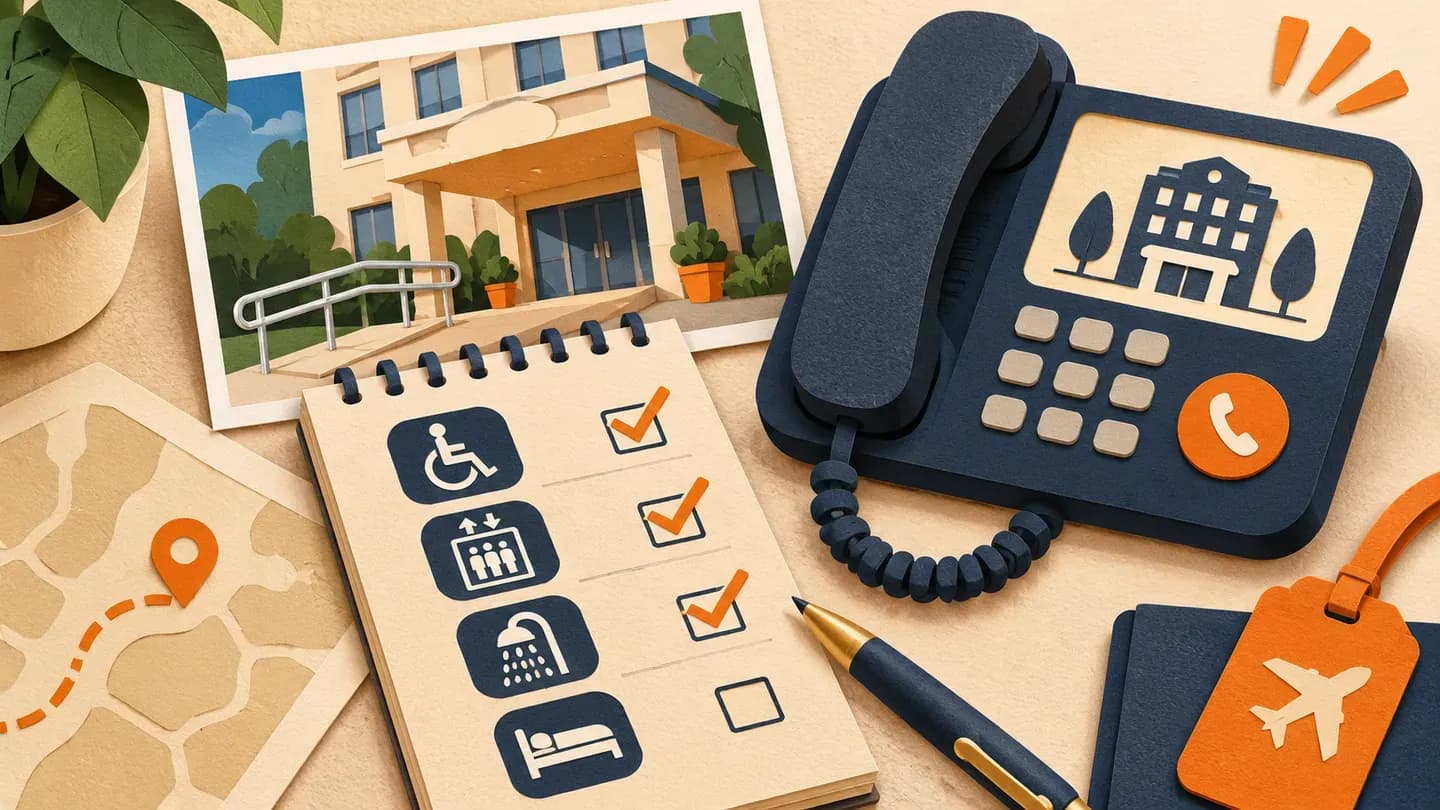
Check hotel access by translating the traveller's functional requirements into precise questions about the actual entrance, room, bathroom and routes they will use. Obtain relevant property information for the selected arrangement rather than relying on a general accessible label. Use Nowah to explore the stay and itinerary, while the adviser maintains the evidence and client decision in the agency process.
The goal is to establish whether the proposed arrangement meets this traveller's requirements. A broad description, a positive review or a photograph may help identify questions, but it does not automatically answer them for the offered room and dates.
Confirm the traveller's requirements first
Give Nowah the functional travel requirements the traveller has authorised for research, using only relevant information. Explore hotel candidates around that brief while checking essential property details directly. The mobility-preference consultation helps frame practical needs without collecting unnecessary medical history.
Do not infer requirements from appearance, a device label or a diagnosis. Where measurements matter, establish the traveller's required basis and use consistent units. Avoid inventing a universal dimension that supposedly suits everyone.
Follow the approved privacy process and explain what information will be shared with the property. A precise functional question often needs less personal information than a detailed medical narrative. Keep the necessary underlying record accessible only through the appropriate agency process.
Identify the exact room and route
Record the actual offered room category and relevant dates. Ask whether the property information describes that arrangement or a generic example. A feature in one room should not be attributed to every category.
Consider the whole relevant route: arrival point to entrance, reception to room, room to bathroom and other facilities the traveller plans to use. A suitable room feature does not establish a suitable approach from the street or vehicle.
If an alternative entrance or route is proposed, investigate how it is accessed, whether assistance is needed and what conditions affect it. Do not assume the arrangement is available at the traveller's actual arrival time without asking.
Use a precise property question sheet
Use this property-question template for the actual room candidates researched in Nowah, separating the room features from routes through the property. The occupancy worksheet can accompany it when the party or sleeping arrangement also needs confirmation.
HOTEL ACCESS VERIFICATION
Trip / stay dates / exact room category:
Traveller's functional requirement:
Essential or preferred:
Relevant entrance and route:
Room, doorway or layout question:
Bathroom feature and measurement question:
Lift or other access arrangement:
Arrival-time procedure or assistance:
Information or measurements supplied by property:
What the response establishes:
What remains unresolved:
Traveller review and acceptance reference:
Evidence location / date / next owner:
Ask for relevant measurements, descriptions or supporting material where needed. Record what has actually been received and its scope. Do not describe an unanswered request as a confirmed feature.
Worked hypothetical example: a bathroom requirement
This example is fictional. One traveller and a companion are considering a six-night hotel stay. The traveller uses a manual wheelchair for some movement and has specified a step-free approach and a particular bathroom arrangement in the agency's approved brief.
A candidate property describes an accessible room, but the offered category's bathroom details are incomplete. The adviser does not assume that grab bars, a shower description or a sample photograph establishes the required arrangement.
The adviser sends the functional questions to the property, identifying the room category and dates. The response addresses the entrance but not the bathroom question. That is a partial answer, so the essential bathroom requirement remains open.
The traveller can review the available information and identify anything needing clarification. The adviser investigates further or considers another arrangement rather than converting the general label into a suitability guarantee.
Explore the fictional traveller's planned days in Nowah while the bathroom details are checked with the property. Use the transfer-time review to identify other journeys that deserve the traveller's attention before choosing the hotel.
Use Nowah for itinerary and research context
Nowah's features include conversational research, editable day plans, map/timeline views and hotel options. Use them to explore location and pacing from the functional brief without asking the tool to certify a property.
Try this copyable fictional prompt:
Develop a seven-day, six-night city-stay concept in Portugal for one traveller and a companion. Essential hotel requirements include a step-free approach and a bathroom arrangement to be confirmed directly with the property. Suggest hotel-area and activity research criteria, allow rest periods and mark routes needing access verification. Do not label a hotel, station or activity accessible without relevant evidence. List exact room, entrance, bathroom and arrival-procedure questions the adviser should investigate. Do not invent measurements, prices or confirmations.
Review the response and inspect the general route in Nowah. Verify actual hotel and transport features separately. A map or itinerary label is not evidence that a particular path meets the traveller's requirements.
Read the property response for completeness
Compare each answer with the original question. A response can be useful but incomplete. “We welcome wheelchair users” does not establish a doorway measurement, shower arrangement or specific route.
Check whether the answer applies to the offered category, an alternative room or a general property feature. If the provider suggests a different room, recheck occupancy, bedding, dates, price and conditions as well as access details.
Keep terminology and units clear. If the traveller needs a particular measurement, an ambiguous description such as spacious may not answer the question. Ask the narrower follow-up rather than guessing from a photograph or converting dimensions without checking the basis.
If the traveller intends to use a breakfast area or other facility, check the relevant route and arrangement too. Confirmation about the room does not automatically answer every planned part of the stay. Keep the questions tied to the traveller's actual needs rather than collecting a generic inventory of features.
For the fictional case, the companion may also have a separate sleeping or room preference. Confirm the complete arrangement instead of focusing so narrowly on one access feature that occupancy or bedding is overlooked. Suitability depends on the relevant requirements being addressed together for the actual offered room.
Record the source, date and person or channel responding as appropriate to the agency process. Keep the exact offered arrangement identifiable throughout the record. Another adviser should be able to see what is established and where further investigation is required.
Check the journey beyond the room
A room can meet the stated requirements while the approach to a planned activity remains unresolved. Investigate the actual transfer, entrance and any routes essential to the itinerary. Do not treat a private vehicle label as proof of suitable passenger access or equipment carriage.
Confirm whether the traveller wants or needs assistance with any part of the journey, and establish the actual provider arrangement. Avoid assuming a companion will supply assistance that has not been discussed and agreed.
Use Nowah to adjust the editable day plan when a route or activity needs changing. Keep new suggestions provisional until the relevant evidence is available. Replacing one unverified activity with another does not close the research task.
Present evidence for the traveller's review
Prepare a concise summary of the property response with its limits. Use the traveller's stated requirements as the headings so they can see which questions have been answered.
A script for the fictional case is:
The property has addressed [entrance detail] for [room/stay], but [bathroom question] remains unresolved. I have not treated the general room label as confirmation of that feature. Please review the information received and let me know whether the description matches your requirement while I investigate the remaining point.
The traveller's review helps clarify their needs. It does not remove the adviser's responsibility to describe the evidence accurately or establish missing supplier information before recommending an arrangement as suitable.
Keep essential uncertainty visible before booking
If a required feature cannot be established, explain the limitation and investigate alternatives. Do not rank an unresolved candidate as suitable because it has a lower price or a convenient area.
If the traveller changes the requirement or agrees to a different arrangement, record that current instruction and check its practical implications. Do not describe a changed brief as proof that the original feature was confirmed.
Before booking or payment, provide the exact selected room, dates, total and relevant supplier conditions, with appropriate authority. Ensure the proposal does not use stronger language than the property evidence supports.
Recheck changes and prepare the handoff
A room-category, date or property change can affect the access information. Revisit the relevant questions rather than reusing an earlier response without checking its scope.
After an authorised booking, inspect the actual confirmation and status. Keep the established arrival procedure and relevant contact route available through the agency process. Do not promise a room or assistance arrangement that is absent from the applicable evidence.
Use Nowah for the stay's planning structure and hotel research, with the access-verification worksheet and client decision in your normal records. Precise questions and clear evidence boundaries make the recommendation easier to assess.
Open Nowah with a fictional functional brief and review the features before investigating the next hotel's access details.




