Documenting mobility preferences in a travel brief
Document functional access and pacing requirements in a travel brief, then verify the actual room, route and transport arrangements.
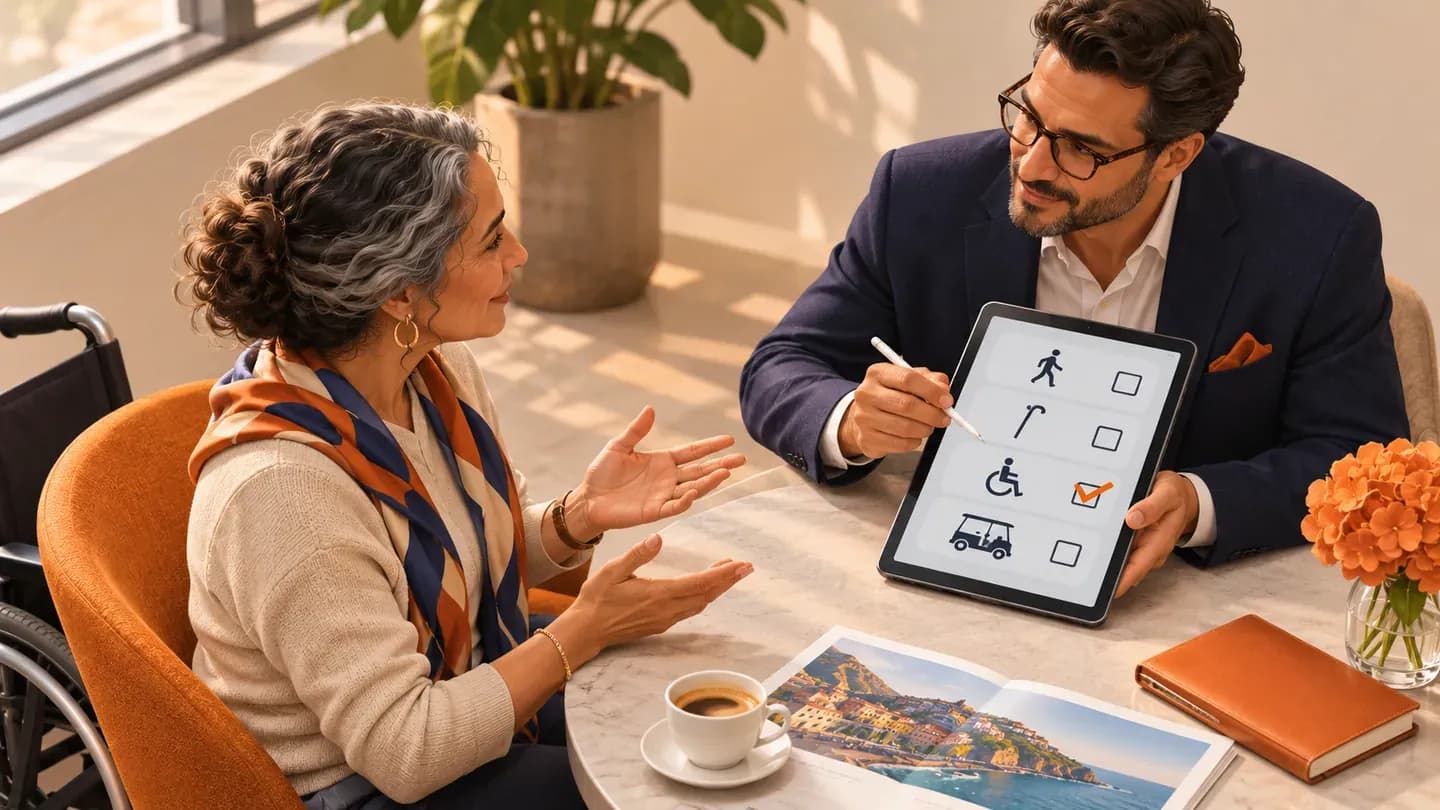
Document mobility requirements as arrangements to research: walking and rest preferences, step-free routes, equipment carriage and the features required in rooms or vehicles. Use Nowah to explore an itinerary from those inputs, then verify actual supplier suitability. The brief should distinguish essential constraints, preferences and unanswered questions without collecting unnecessary medical detail.
Why mobility preferences belong in the brief, not the notes field
Record how the traveller wants to move through the trip and what each service must provide. A long approach to a hotel, vehicle entrance or station route can matter as much as the room itself. Do not reduce those requirements to a general accessibility checkbox.
Treat essential access requirements as constraints, not optional preferences. Keep only the functional details needed, follow your agency’s privacy process and obtain the relevant permission before sharing requirements with suppliers. The brief supports research; it is not proof that a route is accessible or a defence for an unsuitable recommendation.
The three-layer framework for mobility documentation
Use this structure in your intake questionnaire or consultation script. It separates what the client can do, what they use, and what they need.
Translate walking limits and rest preferences into a Nowah day plan, then inspect its sequence. The rest-break itinerary guide supports a pacing review.
Layer 1: Self-reported walking ability
- Distance they can walk comfortably without stopping (e.g., 200 metres, 10 minutes, one city block)
- Surface tolerance (flat pavement only, uneven ground okay, grass or sand difficult)
- Need for rest intervals (every 15 minutes, every 30 minutes, not needed)
- Stair tolerance (number of steps, with or without handrail, with or without assistance)
Layer 2: Equipment and transport requirements
- Type (cane, walker, rollator, manual wheelchair, power wheelchair, mobility scooter)
- Dimensions and weight when folded (critical for taxis, trains, and aircraft cargo holds)
- Manufacturer information for powered equipment where needed for carrier acceptance and charging arrangements; verify with the actual provider
- Other equipment-related arrangements the traveller wants researched; use the appropriate provider process rather than seeking unnecessary clinical information
Layer 3: Environmental and activity triggers
- Heat or cold sensitivity that affects stamina
- Need for accessible bathroom breaks (e.g., every 90 minutes)
- Preference for seated vs. standing activities
- Tolerance for crowds, narrow corridors, or steep gradients
Record the relevant functional requirements in your approved brief and use them to investigate hotels, activities and transport.
A worked example: The Chen family brief
Hypothetical client: The Chens (two adults, one child aged 9) are planning a ten-day, nine-night Japan concept—Tokyo, Hakone, and Kyoto. One adult uses a manual wheelchair for distances over 400 metres but can walk short distances indoors. She has limited stamina on slopes. The other adult reports no access requirements. The child enjoys active days.
Build the Chen family's Nowah route around the mobility preferences. The hotel accessibility research guide helps identify property details to verify directly.
Here is how you document mobility preferences in the brief:
Traveller A: functional requirements for this fictional case
- Walking: Up to 400 metres on flat, level ground. Needs a seat every 15–20 minutes. Cannot manage stairs without a handrail and assistance; maximum 5 steps.
- Device: Manual wheelchair, folds to 76 cm × 38 cm × 89 cm, weight 15 kg. No battery.
- Environment: Avoids steep inclines and long unshaded paths. Needs accessible toilet access at least every two hours.
Other adult and child
- No mobility limitations noted.
Trip-specific notes:
- Confirm whether Traveller A can and wants to transfer to a vehicle seat, what assistance is agreed and how the wheelchair will be carried. A suitable luggage space alone does not establish vehicle suitability.
- Hotels require step-free access from street to lobby, and a room with the specific bathroom features confirmed by the traveller; grab bars are not interchangeable with a roll-in shower.
- Tours must be wheelchair-accessible or offer a seated alternative for Mei.
- Public transport: avoid stations with only stairs; plan for elevator or ramp routes.
With this brief, you can now research with precision. Investigate the actual entrance, room and transport routes rather than accepting a general accessible label. You can filter tours that say “wheelchair accessible” and then verify the actual ramp width and slope.
How to ask without making the client uncomfortable
Many clients do not volunteer mobility details because they do not want to be seen as “difficult.” Your phrasing matters. Use normalising language:
Use a fictional Nowah itinerary to show how the answer changes a planning decision. The travel needs assessment helps keep the conversation focused on requirements.
“To make sure every part of your trip is comfortable, I ask everyone about how they get around. Can you walk about 10 minutes without stopping? Is that on flat ground, or does it include hills?”
“Do you use anything to help with walking—a cane, walker, or wheelchair—even just for long days? That helps me pick the right hotels and tours.”
If the client hesitates, explain which arrangements the information will help you research. Let the traveller describe their requirements and preferred assistance without inferring a diagnosis or insisting on unnecessary personal detail.
Do not infer requirements from appearance. Offer everyone an opportunity to describe access, rest and pacing needs.
Using Nowah to structure the research from your brief
After you have documented the mobility brief in your own system, you can use Nowah to generate a research-ready itinerary outline. Nowah supports conversational trip research and editable day itineraries. Here is a concrete prompt based on the Chen family example:
“Develop a ten-day, nine-night Japan concept for a family of three (two adults, one child aged 9) visiting Tokyo, Hakone, and Kyoto. One adult uses a manual wheelchair for distances over 400 metres and can walk short distances indoors. The traveller needs a seat every 15–20 minutes; steps are limited to five with a handrail and agreed assistance. They require step-free hotel access and a roll-in shower. Vehicle transfer and wheelchair carriage arrangements still need clarification. The child and other adult have no mobility limits. Suggest hotel, activity and transport criteria to investigate, plus seated alternatives. Do not label a property, station route or activity accessible without evidence for the required features. Avoid steep inclines and long unshaded walking routes. Provide a day-by-day outline with morning and afternoon activities, plus accessible transfer notes.”
Paste this into Nowah’s conversational interface. The AI will return a structured day-by-day plan. What you must check:
- Does it preserve each essential constraint? General phrases such as “barrier-free” are not evidence of actual route or feature suitability.
- Are the hotel recommendations genuinely step-free? Cross-check with the hotel’s own accessibility page or call directly. Nowah can suggest, but you verify.
- Are transfer vehicles listed as “wheelchair accessible” or “large boot”? Confirm both the passenger arrangement and equipment carriage, including whether transfer to a seat is appropriate and agreed.
- Does it offer seated alternatives for tours? For example, a museum visit with a wheelchair-accessible route vs. a walking food tour.
Nowah helps you produce a first draft. Your job is to validate every accessibility claim against real supplier information. Use the Nowah output as your research starting point, then refine.
Mobility preference intake script (copyable)
Use this script during your initial consultation. Adapt the wording to your style.
Opening: “I ask every client a few questions about mobility so I can match you with the right hotels, tours, and transport. This helps me avoid surprises. Is that okay?”
Walking ability:
- “On a typical day, how far can you walk comfortably without needing to stop and rest—for example, 100 metres, one block, or 10 minutes?”
- “Is that on flat ground, or are gentle slopes okay?”
- “Can you manage stairs? If yes, how many steps, and do you need a handrail?”
Assistive devices:
- “Do you use a cane, walker, wheelchair, scooter, or any other device, even just sometimes?”
- “If you use a wheelchair or scooter, can you tell me the folded size and weight? If it’s powered, what type of battery does it have?”
- “Are there equipment-related arrangements you would like me to investigate with the relevant provider?”
Environmental needs:
- “Are there any conditions that make walking harder—heat, cold, crowds, uneven ground?”
- “Would you like rest or bathroom stops planned at particular intervals?”
- “Do you prefer seated activities (like a river cruise) over standing or walking tours?”
Closing: “Thank you. I’ll note all of this in your travel brief and use it to select options that work for you. If anything changes before the trip, just let me know.”
Common pitfalls and how to avoid them
- Assuming “accessible” means the same everywhere. A hotel may call a room accessible but have a 5 cm lip at the shower. Always verify specific measurements and features.
- Forgetting about battery-powered devices. Obtain the relevant manufacturer details and confirm acceptance and handling with the actual carrier before booking. Do not apply a generic assumption to every device.
- Overlooking transfer details. A “private car” may be a sedan that cannot fit a folded wheelchair. Specify and verify the required passenger access, assistance and equipment capacity; a vehicle category alone does not establish suitability.
- Not updating the brief after a trip. Mobility needs can change. Always reconfirm before the next booking.
Carry confirmed requirements into the booking review
Use the brief to compare each proposed component with the traveller’s confirmed requirements. Mark supplier evidence and unresolved questions separately. If an essential feature is uncertain, investigate it before recommending the component or taking payment. Nowah provides a planning draft; the adviser verifies whether the actual arrangements meet the brief.
Start today: add the three-layer framework to your intake form. Use the script above in your next consultation. Then open Nowah and test the prompt with fictional, functional planning inputs. See how a mobility-aware brief turns into a usable plan. For more on trip planning, explore Nowah’s features. The brief is your foundation—build it well.




