Planning travel with grandparents and young children
Plan multigenerational family trips around individual routines, rooming and supervision, with a nine-night worked example, matrix and Nowah prompt.
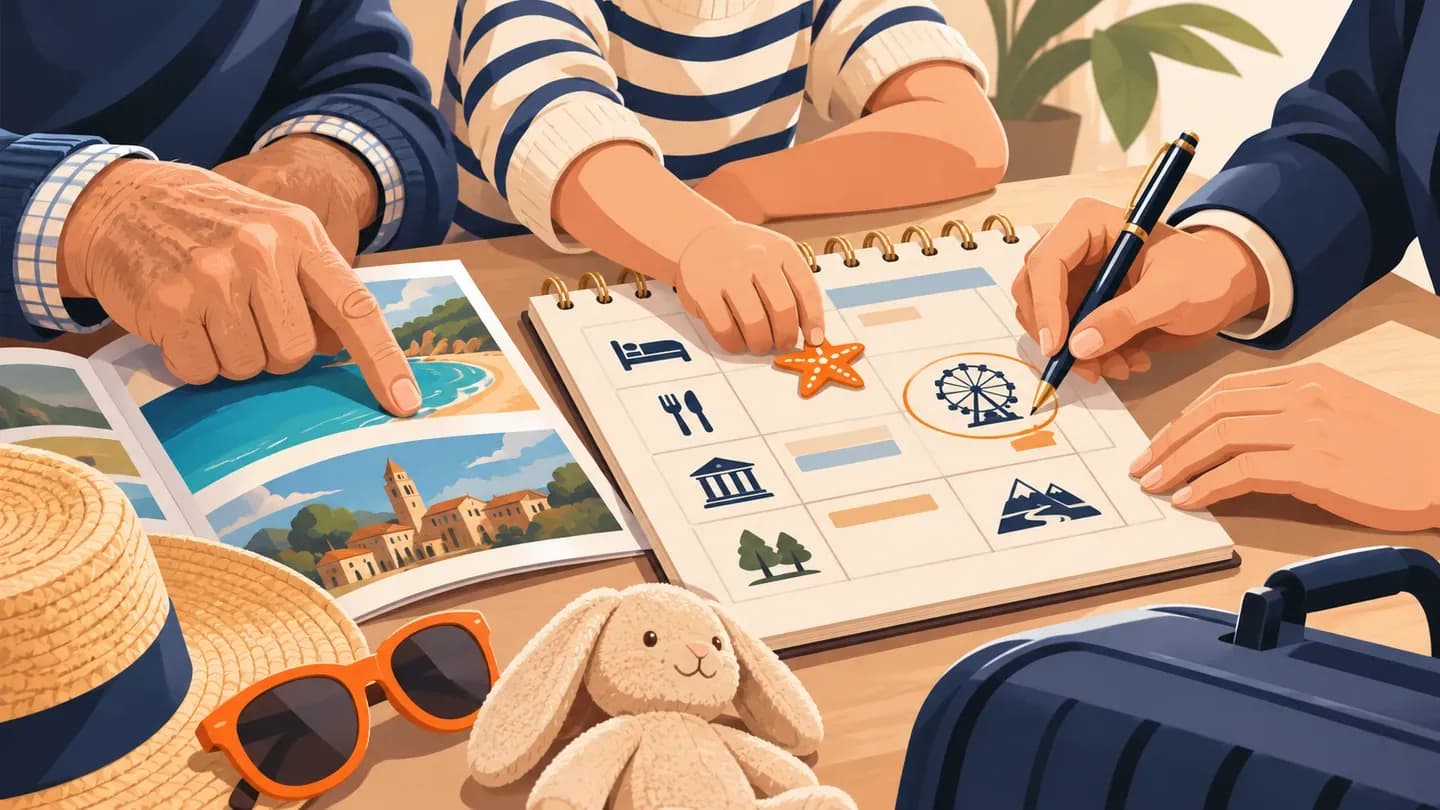
Plan a trip with grandparents and young children around the people who will actually travel, rather than assumptions about either age group. Ask about walking tolerance, daily routines, independence, room needs and the help each adult genuinely wants to provide. Use Nowah to develop the connected itinerary and investigate flights and hotels, then test the plan against those individual requirements.
The most useful starting point is not a list of family attractions. It is an agreement about what the group will share, when smaller groups can separate and who is responsible for the children during each arrangement. A grandparent joining a holiday is not automatically agreeing to be its childcare provider.
Collect functional requirements from the right people
Ask the relevant adults about functional needs and preferred routine, then give Nowah an agreed planning summary. Explore shared days without treating either age group as uniform. The mobility-preference consultation helps collect practical requirements proportionately.
Discuss practical needs: acceptable walking distance between breaks, stairs, lift access, bathroom requirements, bedtime routines, meal timing and whether a separate sleeping area is essential. Where assistance is required, investigate the actual provider process and confirm what is available. Do not infer incapacity from age or assume an energetic grandparent can comfortably handle every proposed transfer.
For children, establish relevant ages for the stay and journey, acceptable sleeping arrangements, stroller needs and activity restrictions to investigate. Ask the appropriate adults about supervision and any requirements affecting transport or accommodation. A generic “family-friendly” description does not resolve those questions.
Choose what the group will do together
Separate shared anchors from optional subgroup activities. The shared anchor might be lunch, a short guided experience or an afternoon at the accommodation. Leave enough time around it for people to join without rushing across the destination.
For a split day, record who travels with whom, how they get there, where they reunite and what happens if the timing changes. Do not make a child’s supervision depend on an adult who has not accepted the responsibility. Check provider rules rather than assuming that a family’s preferred allocation satisfies them.
Give adults a way to decline an optional excursion without treating it as a failure of the group plan. A grandparent may want independent sightseeing while the parents and children choose a quieter day. Another family may want the reverse. Build the actual preference into the proposal.
Worked hypothetical example: six travellers, nine nights
Consider two grandparents, two parents and children aged three and seven. They are considering ten local destination days and nine hotel nights. They want two bases with four nights and five nights, one shared experience on most sightseeing days and open time after lunch.
Their draft sequence is:
Day | Overnight | Planning emphasis |
|---|---|---|
1 | First base | Arrival, food and settling; no timed sightseeing |
2 | First base | One shared morning experience, open afternoon |
3 | First base | Flexible day with optional smaller-group plans |
4 | First base | Short shared activity and time to prepare for relocation |
5 | Second base | Hotel move; actual transport and check-in to verify |
6 | Second base | Shared morning plan, separate afternoon choices |
7 | Second base | Rest-oriented day with no required excursion |
8 | Second base | Optional activity, subject to individual suitability |
9 | Second base | Flexible final day and packing time |
10 | None | Departure and the necessary transport buffer |
The nights reconcile: Days 1–4 provide four nights at the first base, Days 5–9 five at the second. The single mid-trip hotel change does not include arrival and departure transport, which still need planning.
Suppose one accommodation concept uses three hotel rooms throughout: grandparents together, one parent with the seven-year-old and the other parent with the three-year-old. That is six people across three rooms and twenty-seven room-nights across nine family nights. The parents sleep apart, so this is a tradeoff to approve, not an obvious default. Each allocation needs actual occupancy, bedding and supervision checks.
An alternative multi-bedroom unit needs its own unit count, sleeping surfaces, privacy and price basis. Do not compare one unit’s nightly price with a single hotel room and call it cheaper for the family without calculating the complete arrangement.
Develop the fictional six-traveller, nine-night concept in Nowah with quieter periods alongside common outings. Use the family rest-break method to assess whether those breaks remain usable on transfer days.
Investigate the hotel and location together
Research the actual route from the property to likely meals, transport and shared activities. A central address may still involve steep streets or a difficult entrance. A quieter hotel can create longer journeys that conflict with a child’s afternoon rest.
Verify the exact room category and rate. Ask about lifts to the relevant floor, access between buildings, bedding, cot arrangements if needed, meal eligibility and any essential room proximity. An unconfirmed connecting-room request cannot be presented as an established arrangement.
Nowah hotel search is useful for exploring options in the context of the itinerary. Combine that research with the actual property and offer checks. See Nowah features for supported planning, hotel and flight capabilities.
Count transport effort for the complete party
For each journey, consider people, bags, mobility equipment and any child-restraint requirement needing confirmation. Six seats advertised on a vehicle do not establish space for six travellers plus the proposed luggage and equipment. Investigate the actual vehicle and provider conditions.
Flight timing matters beyond the displayed duration. Compare access to the airport, check-in, connections, walking and waiting, local arrival time and the journey to the first room. If a family needs assistance or a stroller through part of the airport journey, establish the carrier’s actual process rather than promising a particular arrangement.
Use Nowah flight search to investigate the relevant schedules and routing options, then review the selected offers and conditions. Keep the party roster consistent when comparing prices and explain material differences in baggage, seating or support.
A practical intergenerational planning matrix
Use this intergenerational planning matrix template beside the itinerary developed in Nowah, checking the complete party's movement, rooms and daily choices. The different-interests framework helps distinguish shared anchors from optional subgroup activities.
Field | What to record |
|---|---|
Traveller or subgroup | Opaque reference and who confirmed the requirement |
Shared priority | Experience or time the group wants together |
Individual requirement | Functional need, essential condition or preference |
Daily rhythm | Starts, meals, breaks and independent time |
Room allocation | People, sleeping surfaces and privacy tradeoffs |
Supervision plan | Adult responsible for each child during split arrangements |
Supplier check | Exact unresolved facility, service or condition |
Decision | Who needs to confirm which tradeoff before proceeding |
Separate confirmed requirements from ideas still under discussion. Keep sensitive supporting information in the appropriate agency record, with access limited to the actual purpose.
Review the matrix against every proposed travel day. A plan can look relaxed on sightseeing days while exhausting the group during relocation. If a requirement cannot be established, explain the unresolved issue and return to the relevant traveller before recommending the option.
Copyable Nowah prompt for the first concept
Draft a hypothetical ten-local-day, nine-hotel-night trip concept for six people: four adults, including two grandparents, and children aged three and seven. Use two bases with four and five nights. Ask for destinations, exact dates, budget, transport preferences and room requirements before detailed searches. Protect arrival, relocation and departure time. Include shared morning anchors, flexible afternoons and one rest-oriented day. Do not infer walking ability or childcare responsibility from age or family role. Flag actual occupancy, sleeping surfaces, access, vehicle capacity and supplier conditions needing verification. No personal identifiers or health records are included.
Review Nowah’s outline with the family’s confirmed matrix. Use editable itineraries and map/timeline views to examine the daily sequence, then investigate actual flights and hotels when the brief is sufficient. Do not treat generated activity suggestions as established suitable or available services.
Agree a simple change-of-plan option
Identify an alternative when the group does not want to continue a planned day. That might be returning to the accommodation, choosing a shorter route or cancelling an optional outing under its actual terms. Check how people get back and which adult remains responsible for the children. Do not assume everyone can separate spontaneously when transport or supervision depends on the group staying together.
Discuss the cost implications too. A flexible afternoon does not make a prepaid experience refundable. Show any relevant conditions before the family approves it, and avoid treating a quieter day as a failure that needs replacement sightseeing. The point is to keep the plan workable when individual energy or preferences change.
Present choices with their responsibilities visible
Show the overnight allocation, daily shared anchors, optional splits and the practical implications of each room or transport option. Obtain the relevant authorised approval for the specific current offers, conditions and payments before purchase. A family coordinator collecting preferences does not automatically authorise every adult’s booking or information sharing.
Use Nowah to develop the journey as a connected whole while your agency record holds the individual requirements and decisions. Open Nowah to build the first concept, then refine it around the family’s actual routines, preferences and verified arrangements.




