The AI Agent's Decision Loop: Think, Act, Observe
Search or ask a question? Present results or refine? Our agent makes hundreds of micro-decisions per conversation. Here is the loop that drives it.

Every time you send a message to Nowah's AI agent, it makes a decision. Not one decision. A cascade of them. Should I search or should I ask for more information? Should I use the flight tool or the hotel tool? Do I have enough context to present results, or do I need to refine? Is the user ready to book or still exploring?
These micro-decisions happen in a loop that we call observe-think-act. It's the core cycle that drives every AI agent interaction, and the quality of these decisions is what separates a useful agent from a frustrating one.
The observe-think-act loop
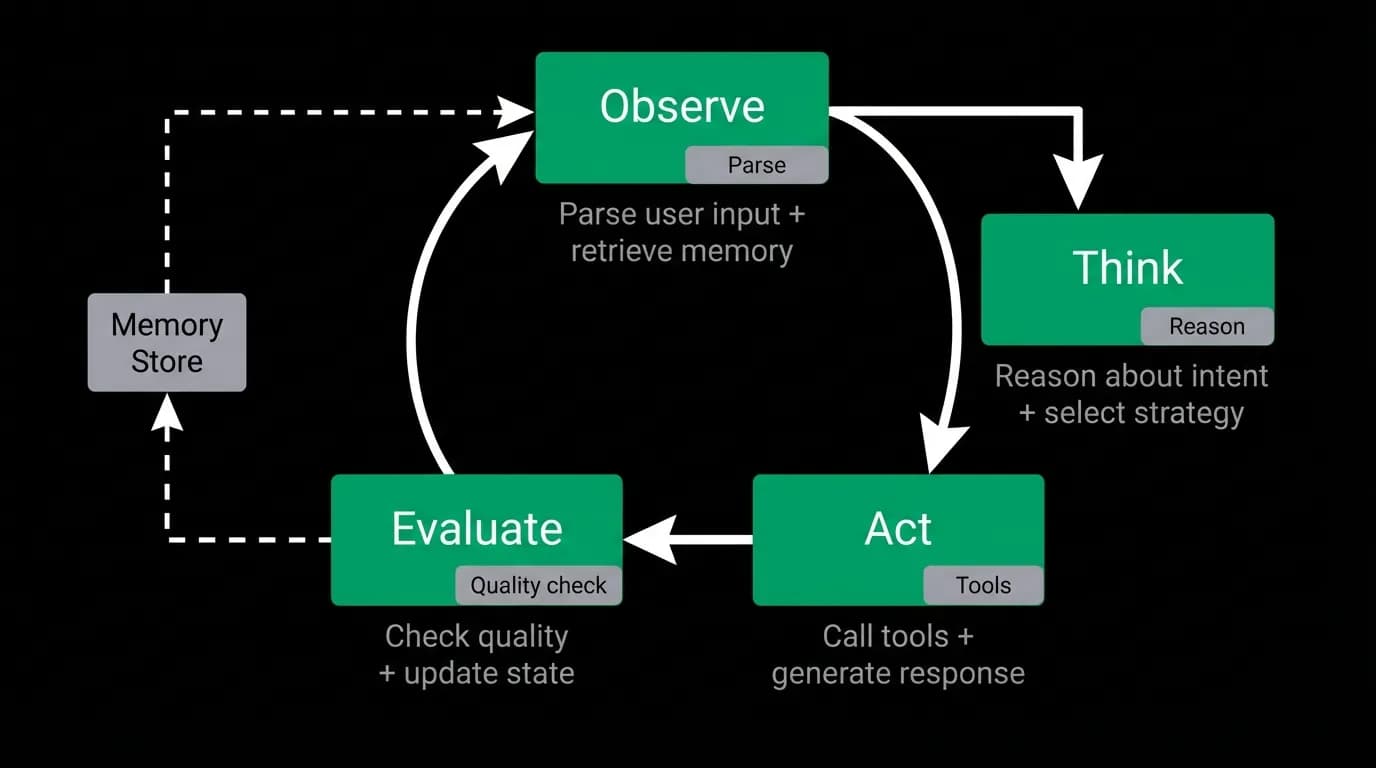
Every AI agent, whether it's booking flights or managing emails, runs a variant of the same loop.
Observe. The agent receives the current state: the user's latest message, the conversation history, stored preferences from memory, and the available tools. This is its input.
Think. The agent reasons about what to do. It considers the user's intent, the current state of the trip planning process, what information it has and what it's missing, and which actions would move the conversation forward. This reasoning happens within the language model, informed by system instructions and conversation context.
Act. The agent executes its decision. This might be generating a text response, calling one or more tools (flight search, hotel search, booking), asking a clarifying question, or presenting results with recommendations.
Then the loop repeats. The tool results or user response becomes new input, and the agent observes, thinks, and acts again.
One conversation might cycle through this loop a dozen times. The user asks for flights. The agent searches. The user asks for different dates. The agent searches again. The user picks an option. The agent initiates booking. Each cycle is a fresh observe-think-act iteration.
Balancing proactiveness and responsiveness
One of the hardest calibration problems in agent design is deciding when the agent should volunteer information versus waiting for instructions.
A purely responsive agent only does what it's told. "Search flights to Tokyo." OK, here are flights. "Show me hotels." OK, here are hotels. The user drives every step. This is safe but slow. The user has to know what to ask for, which defeats the purpose of having an agent.
A purely proactive agent acts on your behalf without waiting for direction. You mentioned Tokyo? Here are flights, hotels, a weather forecast, visa requirements, and a restaurant list. This is efficient but overwhelming. And if the agent guesses wrong about what you want, it wastes time and erodes trust.
We aim for calibrated proactiveness. The agent takes initiative when it has high confidence about what the user needs, and waits for direction when it's uncertain.
If you've booked flights through Nowah before and the agent knows your preferences, it's more proactive. "I found three flights, and I'd recommend the morning Delta direct flight based on your usual preferences. Want me to book it?" If you're a new user with no history, it's more cautious. "I found three options. Here's what makes each one different. Which direction appeals to you?"
Decision confidence and its role in behavior
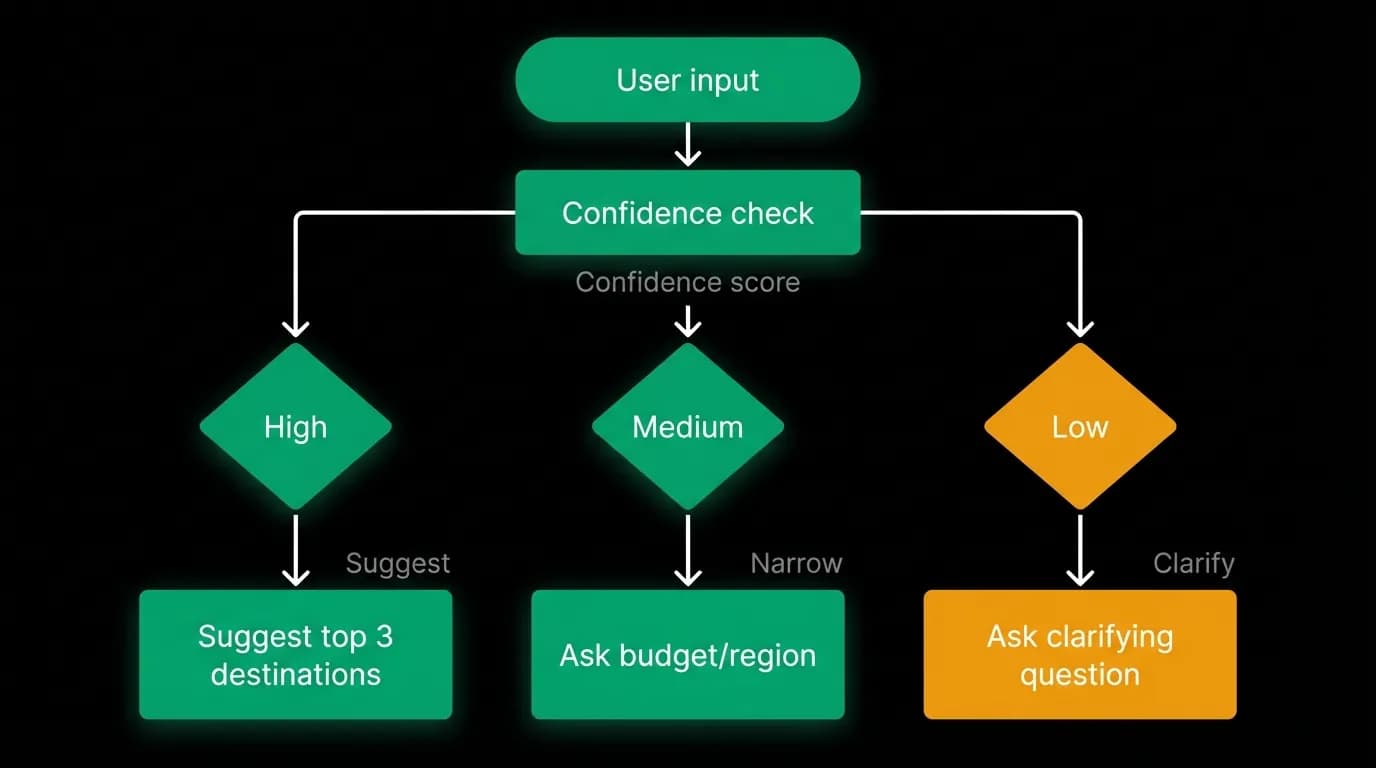
The concept of confidence is the control knob for agent behavior.
High confidence means act. The user said "Book the second option." The second option is clear, the price is confirmed, the user has a saved payment method. The agent proceeds to booking with minimal ceremony.
Medium confidence means suggest with options. The user said "Find me something for next weekend." Next weekend could be Saturday departure, Friday departure, or the whole weekend. The agent makes a reasonable assumption (Saturday to Sunday) but presents it transparently: "I'll search for Saturday to Sunday. Want different dates?"
Low confidence means ask. The user said "Plan a trip." That's too vague to act on productively. The agent asks a useful question: "Where are you thinking? And roughly when?"
This confidence calibration isn't a hardcoded threshold. It's influenced by how much context the agent has. A "plan a trip" from a user with ten prior bookings and clear patterns yields higher confidence than the same message from a new user. The agent can infer likely destination, dates, and budget from memory.
Nowah's AI agent manages a comprehensive suite of tools, and choosing the right one requires confidence about what the user needs. Tool selection mistakes are worse than text generation mistakes because tools have real-world effects (API calls cost money, booking actions move money).
Handling ambiguous requests
"Somewhere warm" could mean Cancun, Bali, Miami, Dubai, or fifty other destinations. What does the agent do?
The wrong answer is to pick one and search. The user probably has a mental model they haven't articulated yet. Randomly picking Cancun when they were thinking Bali is a bad experience.
The right answer depends on context. If the agent knows from memory that this user has traveled to Southeast Asia three times, "somewhere warm" probably means that region. High enough confidence to narrow the space and offer options: "Based on your past trips, how about Thailand, Vietnam, or Indonesia? Or somewhere different this time?"
If there's no memory to draw on, the agent narrows through conversation: "Warm in March, nice. Are you thinking beach, city, or somewhere with a bit of both? Any region in mind?"
The key is that narrowing should feel helpful, not interrogative. "What continent? What country? What city? What dates? What budget?" feels like filling out a form verbally. "Are you feeling more of a beach vibe or a city exploration?" feels like a conversation with a travel-savvy friend.
Conversational AI reduces average booking time by three to five times. Part of that speedup comes from the agent asking the right narrowing questions instead of forcing the user to fill out every field upfront.
Making the decision loop observable
You can't improve what you can't see. This applies doubly to AI agent decisions, because the reasoning is implicit in the model's processing rather than explicit in code you wrote.
We make the decision loop observable through structured logging. For every conversation turn, we capture:
- What the agent observed (user message, context state, available tools)
- What it decided to do (tool calls, text response, clarifying question)
- Why (the reasoning traces from the model, including confidence signals)
- What happened (tool results, user response, conversation state change)
This creates a full audit trail of agent decisions. When something goes wrong (wrong tool called, inappropriate recommendation, lost context), we can trace back through the decision loop to find where the reasoning went wrong.
We also use this observability data to improve the system. Patterns of decision errors inform prompt updates, tool description refinements, and confidence calibration adjustments. Every conversation is a data point for making the next conversation better.
How competitors get this wrong
Many travel chatbots are really form-fill bots with a conversational wrapper. They ask a fixed sequence of questions (where, when, how many travelers, budget) regardless of what the user already said. This is a hardcoded decision loop: always ask, always in this order, always these questions.
Our decision loop is adaptive. If the user's first message includes the destination, dates, and traveler count, the agent skips those questions and goes straight to search. If the message is vague, the agent asks the minimum number of questions to get started. The loop adapts to the information available, not to a predetermined script.
This adaptiveness is what makes conversation feel natural. A predetermined script feels like a phone menu. An adaptive loop feels like talking to someone who's actually listening.
70% of travelers are open to AI-assisted trip planning. The decision loop quality determines whether that openness translates to repeat usage or one-time novelty. AI-native companies can iterate on agent logic in days. Legacy OTAs that hardcoded their chatbot flows take months to make equivalent changes. That iteration speed compounds quickly.
Nowah is an AI travel agent that searches and books real flights and hotels through conversation — no filters, no thirty open tabs. Plan your next trip.