Why We Show You Three Options, Not Three Hundred
Decision science says more choices make worse decisions. Here is the data behind our curation philosophy and why three is the magic number.

The average traveler visits dozens of websites over 45 separate sessions before booking a single trip. Let that sink in. That is weeks of research, hundreds of tabs, and a slow erosion of enthusiasm that turns trip planning from something exciting into something exhausting. Many travelers say the booking process is among the most stressful part of planning a trip.
I think we have accepted a fundamentally broken experience because nobody offered a credible alternative. More options felt like better service. The OTA that showed you 300 results seemed more thorough than the one showing 50. But the research on how humans actually make decisions tells a completely different story.
Hick's Law and the paradox of choice
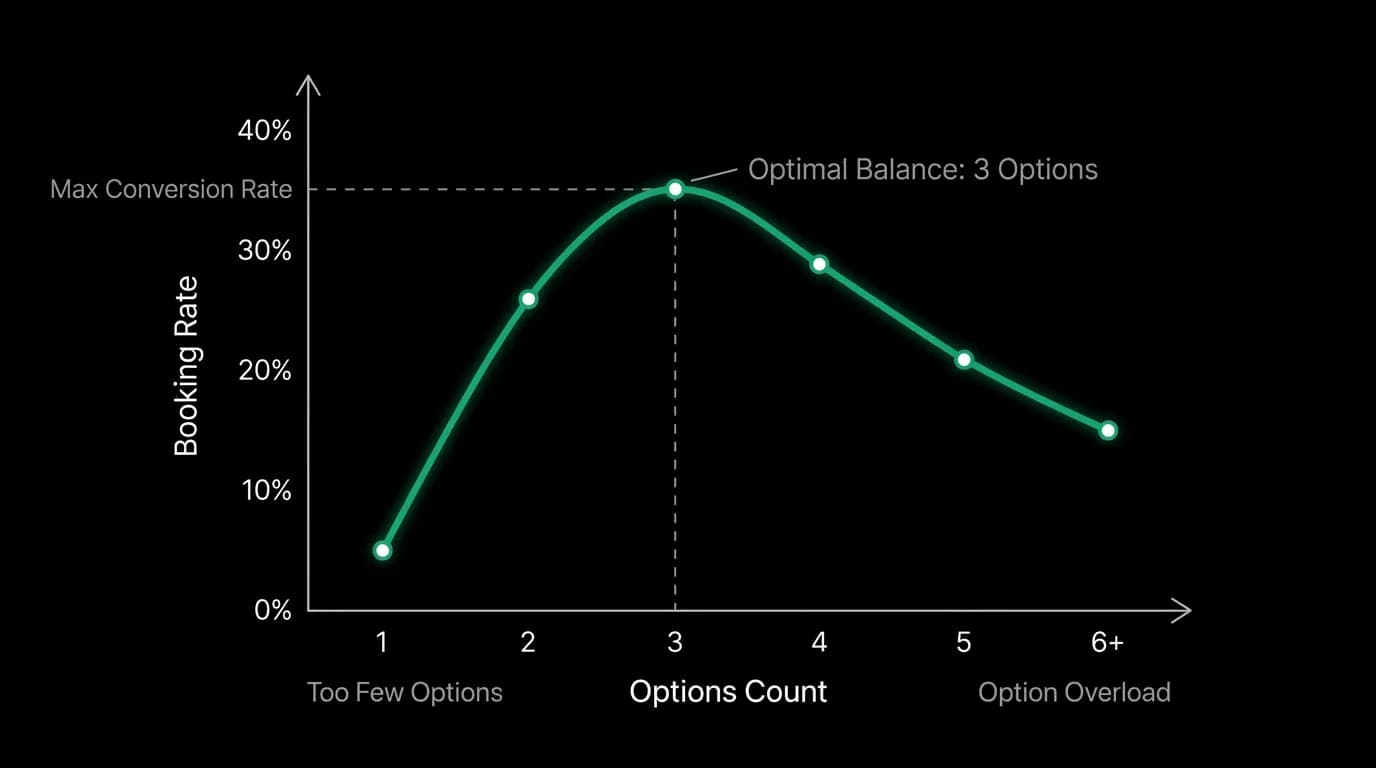
In 1952, psychologists William Hick and Ray Hyman demonstrated that the time it takes to make a decision increases logarithmically with the number of options. More choices do not just slow you down. They degrade the quality of your final decision and reduce your satisfaction with whatever you choose.
Barry Schwartz later popularized this as the "paradox of choice," and it applies to travel with unusual force. Travel purchases are high-stakes, emotionally loaded, and involve multiple interdependent decisions (flights, hotels, timing, budgets). Option overload hits harder here than in almost any other consumer category.
The data from curated interfaces is stark: presenting a small, explained set of options typically converts better than dumping uncurated search results. People do not just prefer fewer options. They make better decisions and feel better about those decisions afterward.
Why three: budget, balanced, and premium
We did not pick three arbitrarily. It comes from the intersection of decision science research and the natural structure of travel trade-offs.
Every travel decision involves a tension between cost and quality. The cheapest option sacrifices something (time, comfort, convenience). The most comfortable option costs more. Between those poles sits a balance point where the trade-offs feel right for most people.
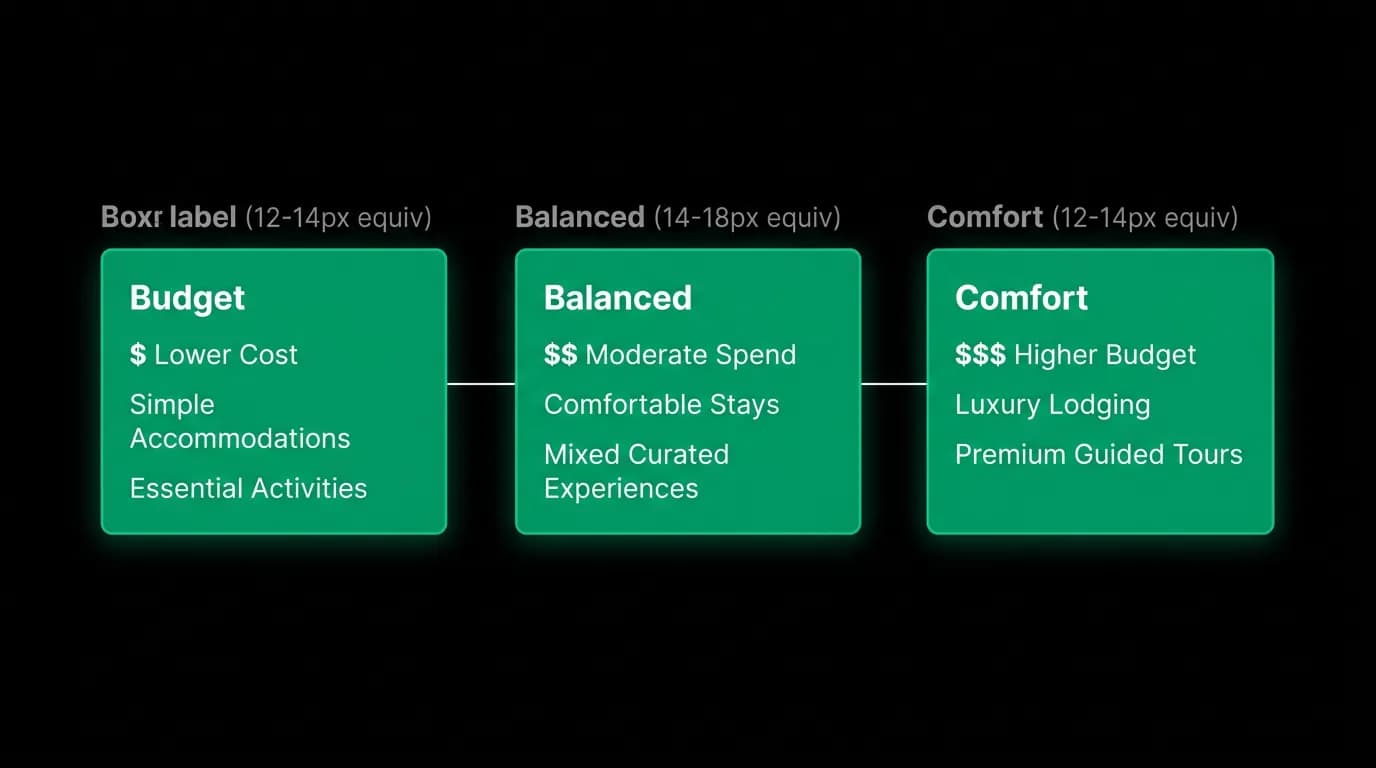
Our three picks map to this structure. The budget option is the best price we found with acceptable quality. The comfort option is the best experience within your broader budget range. The balanced option sits in between, often representing the sweet spot for most travelers.
Each of the three must be genuinely different from the others. Not three flights on the same airline departing within an hour of each other. Meaningfully different in ways that matter: different airlines, different departure times, different layover structures, different price-comfort trade-offs.
Meaningful diversity matters
This is an important distinction. Reducing options only works if the reduced set covers the decision space well. Three bad options are worse than thirty mixed ones. The curation has to be intelligent.
Our diversity guarantee ensures each recommendation occupies a distinct position. If two candidates are too similar, the engine replaces one with something that offers a genuinely different trade-off. This takes more computation than simple score sorting, but it produces a shortlist where comparing the three options actually teaches you something about your own priorities.
The "why" is as important as the option
Showing three options without explanation would just be a smaller version of the same problem. You would still be guessing whether the prices are good, whether the airlines are reliable, whether the layovers are tight.
Every Nowah recommendation comes with an explanation grounded in data. "This is 18% below the 90-day average." "Non-stop on your preferred alliance." "Highest-rated carrier on this route." The explanations turn comparison from guesswork into informed decision-making.
Transparent explanations measurably increase booking confidence. When you understand why each option was chosen, you can decide faster and with less regret. Many travelers who abandon bookings cite unexpected price changes or uncertainty as the reason. Explanations directly combat that uncertainty.
What the data shows
Average search-to-booking time for international flights ranges from 30 to 45 days using traditional methods. That is a month of low-grade anxiety about whether you are making the right choice. Curated interfaces compress that timeline dramatically because the decision burden shifts from the traveler to the AI.
The conversion data tells the same story from the other direction. Industry benchmarks put classic OTA conversion in the low single digits. That means the vast majority of people who show up looking to buy something leave without buying. Some of that is browse-only intent, sure. But a lot of it is people who wanted to book and gave up because the process was too painful.
Decision satisfaction research shows confidence peaks at 3-5 options and declines sharply after that. At ten options, people start second-guessing. At fifty, they stop trying. At three hundred, they close the tab.
Plan your next trip in one conversation
We are not against giving you more options if you ask. Tell the AI "show me more like option B but with shorter layovers" and it will dig deeper. The point is not to restrict you. The point is to start with the right three so that most of the time, the answer is already in front of you.
Plan your next trip on Nowah. One conversation, three options, and the confidence to actually book.
Nowah is an AI travel agent that searches and books real flights and hotels through conversation — no filters, no thirty open tabs. Plan your next trip.