How AI Travel Agents Book Flights in Under 2 Minutes
From \"I need a flight to Tokyo\" to boarding pass — a technical but accessible look at what happens inside an AI travel agent during booking.

The last time you booked a flight, how long did it take? If you used a traditional platform, the honest answer is probably somewhere between 20 and 45 minutes. You entered your origin, destination, and dates. You scrolled through dozens or hundreds of results. You sorted by price, then by duration, then by price again. You opened a few options in new tabs. You went back and adjusted the dates to see if Tuesday was cheaper than Wednesday. Eventually, you picked something that felt adequate and spent another 5 minutes filling out passenger details.
An AI travel agent compresses this entire process into roughly 120 seconds. That is not a marketing claim. It is an architectural consequence of how AI agents process travel requests differently from search-based platforms.
The two-minute challenge
Say you send the message: "I need a flight to Tokyo next month."
That sentence is incomplete by the standards of a search form. There is no specific date, no departure airport specified (though the agent may know your home city), no fare class preference, no indication of whether you are flexible on dates. A traditional search engine would require you to fill in every field before returning results. An AI agent treats this as a starting point and fills in the gaps intelligently.
Here is what happens in the next 120 seconds.
Intent extraction
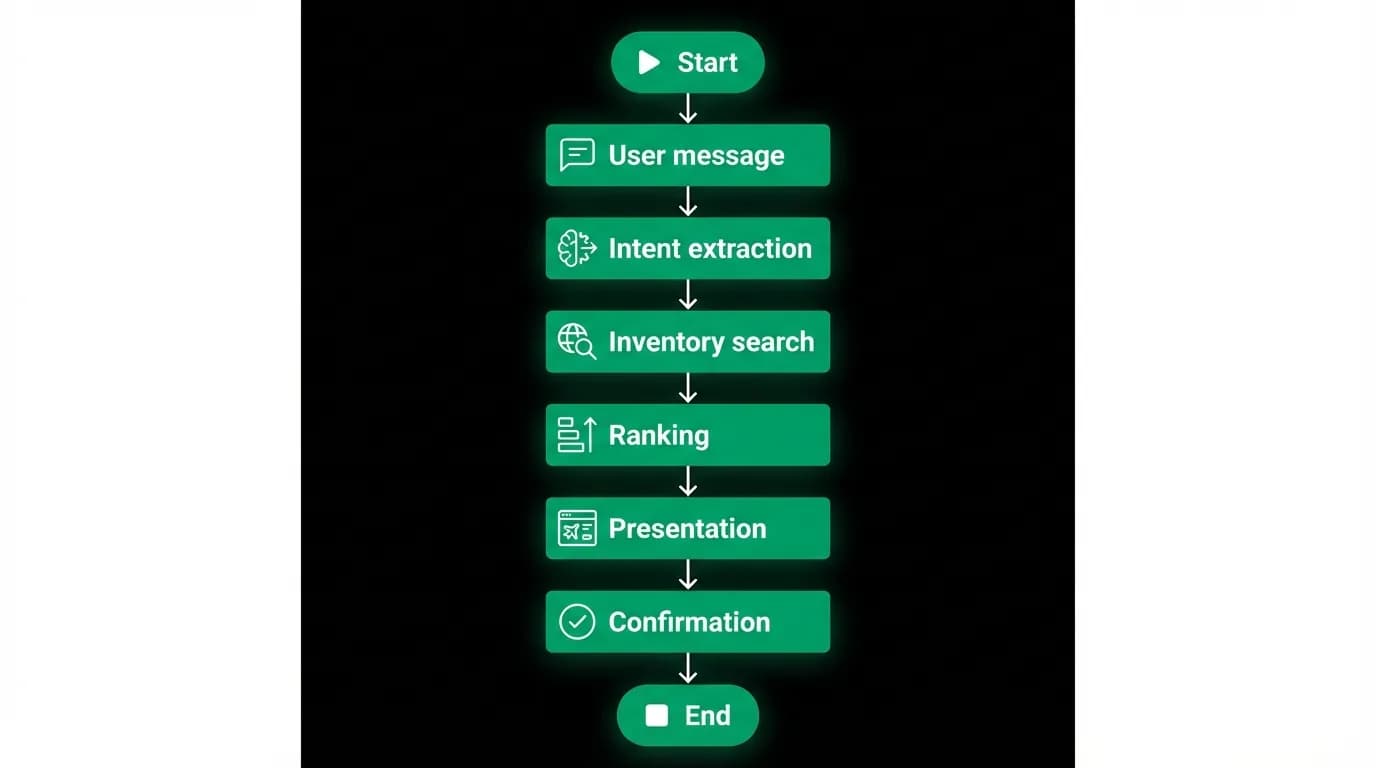
Within the first second, the agent parses your message and builds a structured representation of what you want. "Flight to Tokyo" maps to NRT or HND airports (and the agent may search both). "Next month" maps to a date range. The agent checks its memory: it knows your home airport from previous trips, your airline preferences, your seat preference (aisle, you always pick aisle), and that you prefer morning departures when crossing the Pacific because you sleep better arriving at night local time.
If critical information is missing and cannot be inferred, the agent asks one or two targeted questions. Not ten form fields. One or two questions. "Are your dates flexible by a few days? That could save you $200 on this route." The entire clarification takes 15 seconds of your time.
Inventory search
With enough parameters to search, the agent queries live flight inventory across 50 or more carriers simultaneously. This is not a sequential process where it checks one airline, then another. It fires parallel requests to the underlying inventory API and gets back real-time availability and pricing in seconds.
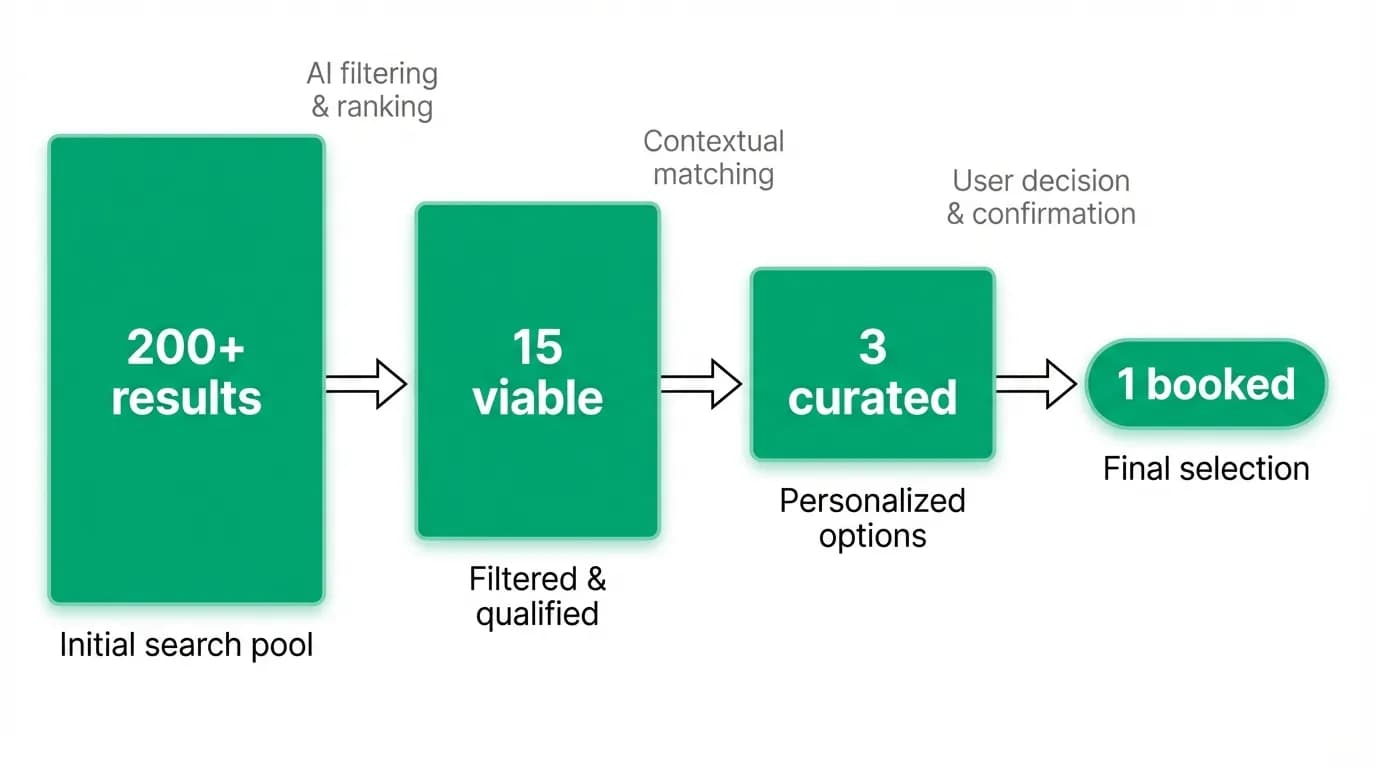
The search scope is broader than what you would do manually. The agent checks not just the obvious nonstop options but also one-stop routings through hubs you might not think of. It checks nearby departure airports. It searches a window of dates around your target to surface savings opportunities. In the time it takes you to read the results of a single OTA search, the agent has evaluated thousands of flight combinations.
Preference-weighted ranking
This is where the magic happens and where AI agents diverge most sharply from traditional search.
An OTA sorts flights by one dimension at a time: cheapest, fastest, or some opaque "best" score that blends a few factors. You switch between sorts trying to triangulate the right option.
An AI agent ranks using 15 to 20 weighted factors simultaneously: price, duration, number of stops, layover quality (not just layover time — the actual experience of the connecting airport), departure time alignment with your preferences, airline preference, frequent flyer earning potential, seat availability for your preferred seat type, aircraft type, on-time performance of the specific flight, and historical pricing data that indicates whether the current price is a good deal for this route.
The weights are personalized. If you have told the agent you value direct flights over price savings, that factor gets elevated. If past behavior shows you always pick the cheapest option regardless, the agent learns that too.
The result of this multi-factor ranking is not 200 options sorted by one dimension. It is 2 to 3 options selected because they represent the genuine best choices for your specific preferences, with clear trade-off explanations for each.
Presentation
The agent does not dump a spreadsheet of flight data on you. It presents each option with context.
"Option 1: Direct flight, departing 10:15 AM, arriving 2:30 PM local time next day, $1,180. This is your preferred airline and you would earn 8,400 miles. Price is 8% below the 90-day average for this route."
"Option 2: One stop through Seoul, adds 3 hours but saves $340. The layover is 2 hours at Incheon, which has excellent lounge access with your current status."
"Option 3: Direct on a partner airline, $1,050, but departing at 6 AM. Cheapest direct option."
You can see the trade-offs immediately without running mental calculations across dozens of results.
One-tap confirmation
You pick Option 1. The agent already has your passport details and frequent flyer number from your profile. Payment is processed through the payment method you have on file. Seat selection happens automatically based on your preference.
Confirmation arrives in your chat. The booking is added to your trip. The agent notes the fare rules (change fee, cancellation policy) and will monitor the flight for disruptions, schedule changes, and price drops.
Total elapsed time: under 2 minutes.
Why this matters beyond speed
Speed is the most obvious benefit, but it is not the most important one.
The bigger shift is from active searching to passive deciding. Traditional booking requires you to do the work — searching, filtering, comparing, calculating. AI booking requires you to make a decision from a set of curated options. That is a fundamentally different cognitive task, and it is why an 80 percent reduction in booking time understates the actual improvement in the experience.
You are not spending 2 minutes stressed and clicking frantically. You are spending 2 minutes reading clear recommendations and choosing one. The mental load is entirely different.
Make your first AI flight booking in 2 minutes
If you have never booked a flight through an AI agent, here is what to say: describe your trip in whatever words feel natural. "I need to fly to Tokyo in mid-April, probably for about 10 days, and I'd rather not take a red-eye if I can avoid it."
That is all the agent needs to get started. It will ask if it needs more information, search while you watch, and present options you can book right there in the conversation. Two minutes from message to confirmation.
Once you experience it, the idea of opening six browser tabs to accomplish the same thing feels like using a paper map when you have GPS on your phone. Both get you there. Only one respects your time.
Nowah is an AI travel agent that searches and books real flights and hotels through conversation — no filters, no thirty open tabs. Plan your next trip.