Flight Booking for Families: Why AI Agents Handle the Complexity
Adjacent seats, child fares, stroller policies, meal requirements, layover duration for kids — family flight booking has 10+ constraints AI handles naturally.
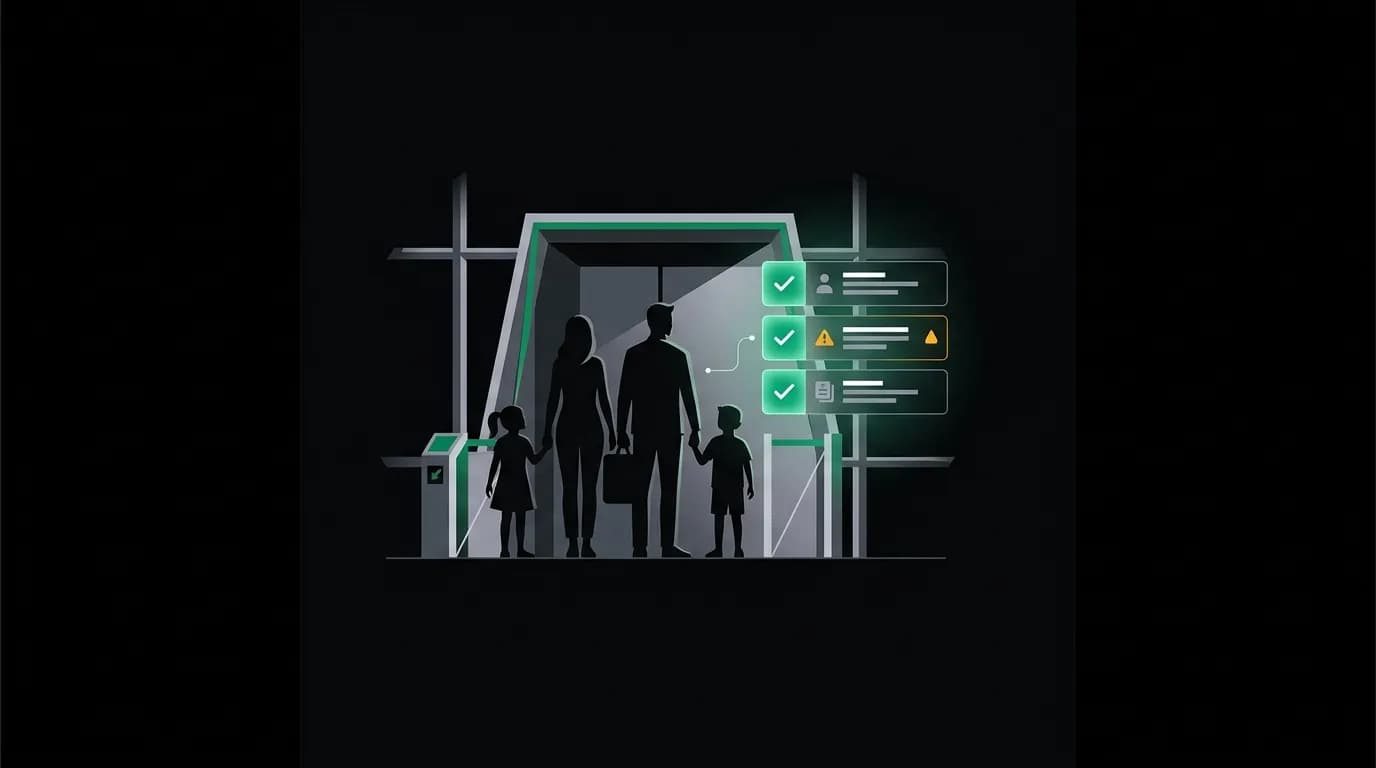
"We need four seats together. One is a lap infant — she is 11 months old. The five-year-old needs a kids meal. Keep the layover under two hours because we have a stroller and two car seats to manage through the airport. And if possible, depart after 9 AM so we do not have to wake the kids at 5."
No search form on any booking platform can process that sentence. There are no dropdown menus for stroller logistics. There is no filter for kid-appropriate layover duration. There is no checkbox for "seats together with a lap infant." And the result is that families — the demographic with the most constraints and the least tolerance for booking errors — are forced to use the least capable booking tools.
Families with children report 3 times higher booking frustration than solo travelers. The average family flight booking on an OTA takes 45 or more minutes. The most common post-booking complaint is not getting adjacent seats. And the most common pre-flight stress is discovering at the gate that the airline's child policies differ from what the booking platform implied.
AI agents handle the complexity because they process natural language constraints natively. The sentence above is a complete booking brief. An AI agent extracts every constraint, searches within all of them, and returns options that satisfy all of them simultaneously.
The family constraint stack
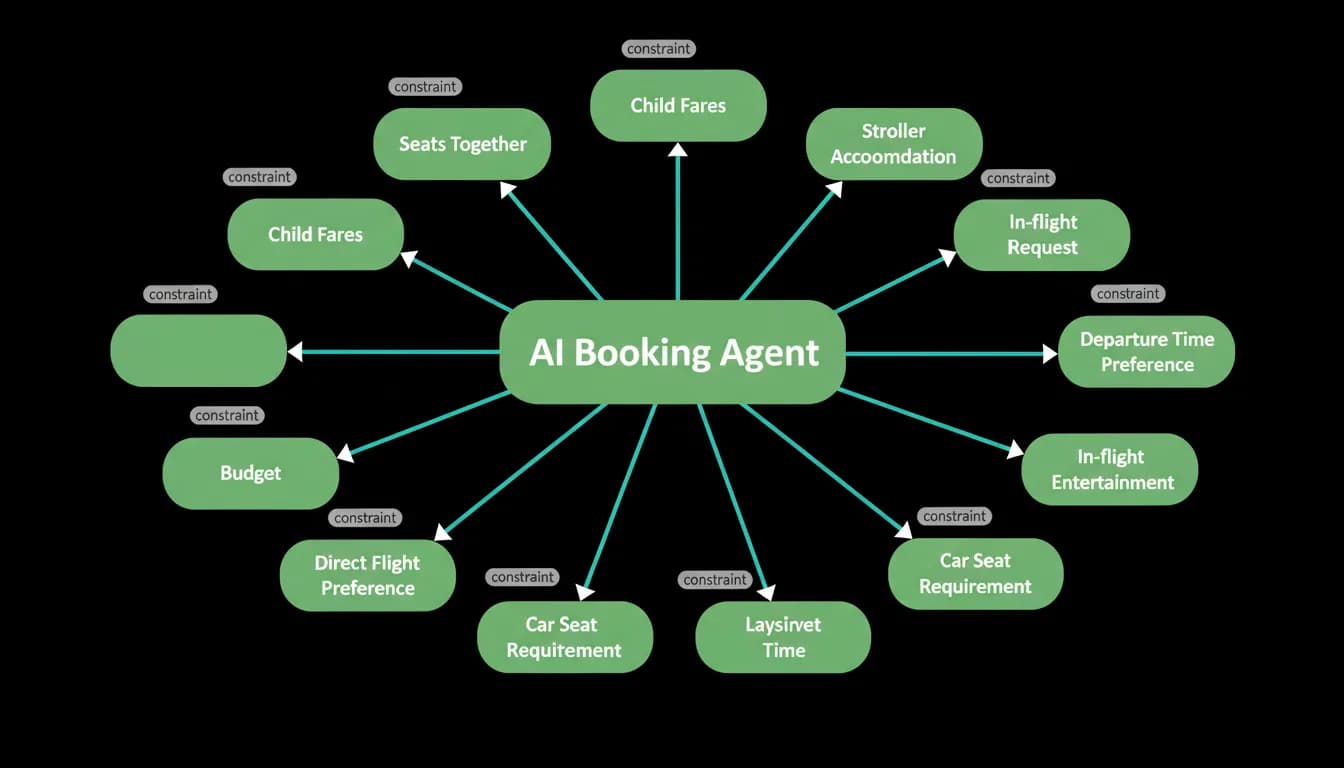
Family flight booking involves a minimum of 10 constraints that interact with each other. Traditional search forms handle 3 to 5 at most, leaving the rest to the traveler's manual effort.
Passenger composition. Adults, children (ages vary by airline for fare purposes), and infants (typically under 2). Each category has different fare rules, different seat assignment implications, and different ancillary service options. Child fare rules vary across 300 or more airlines with different age cutoffs: some define a child as under 2, others under 5, 12, or 16.
Seat adjacency. Families need to sit together. This seems obvious but is one of the most persistent failures of online booking. Forty-five percent of family travelers do not get adjacent seats when booking online. The seat map at the time of booking may not reflect the final assignment, and airlines' automatic seat allocation algorithms often split families across rows.
Departure and arrival timing. Families with young children have strict timing preferences. Too early means disrupted sleep and cranky kids. Too late means arriving at bedtime with overtired children. The acceptable departure window is often 9 AM to 2 PM — a constraint that no OTA filter handles with the nuance families need.
Layover duration and quality. The standard minimum connection time at an airport might be 45 minutes. For a family with a stroller, two car seats, carry-on bags for four, and a toddler who moves at one-tenth adult speed, 45 minutes is not a connection — it is a sprint. The minimum layover for families should be approximately twice the airport's standard minimum connection time.
Meal requirements. Kids meals need to be pre-ordered on most airlines. Allergies need to be flagged. Infant food restrictions need to be communicated. These ancillary services are buried in the booking flow on OTAs and often missed.
Baggage. Families travel with more luggage. Strollers, car seats, pack-and-plays, and the sheer volume of children's belongings often exceed standard allowances. Understanding what is included, what costs extra, and what can be gate-checked varies by airline and fare class.
Seat adjacency: the universal family frustration
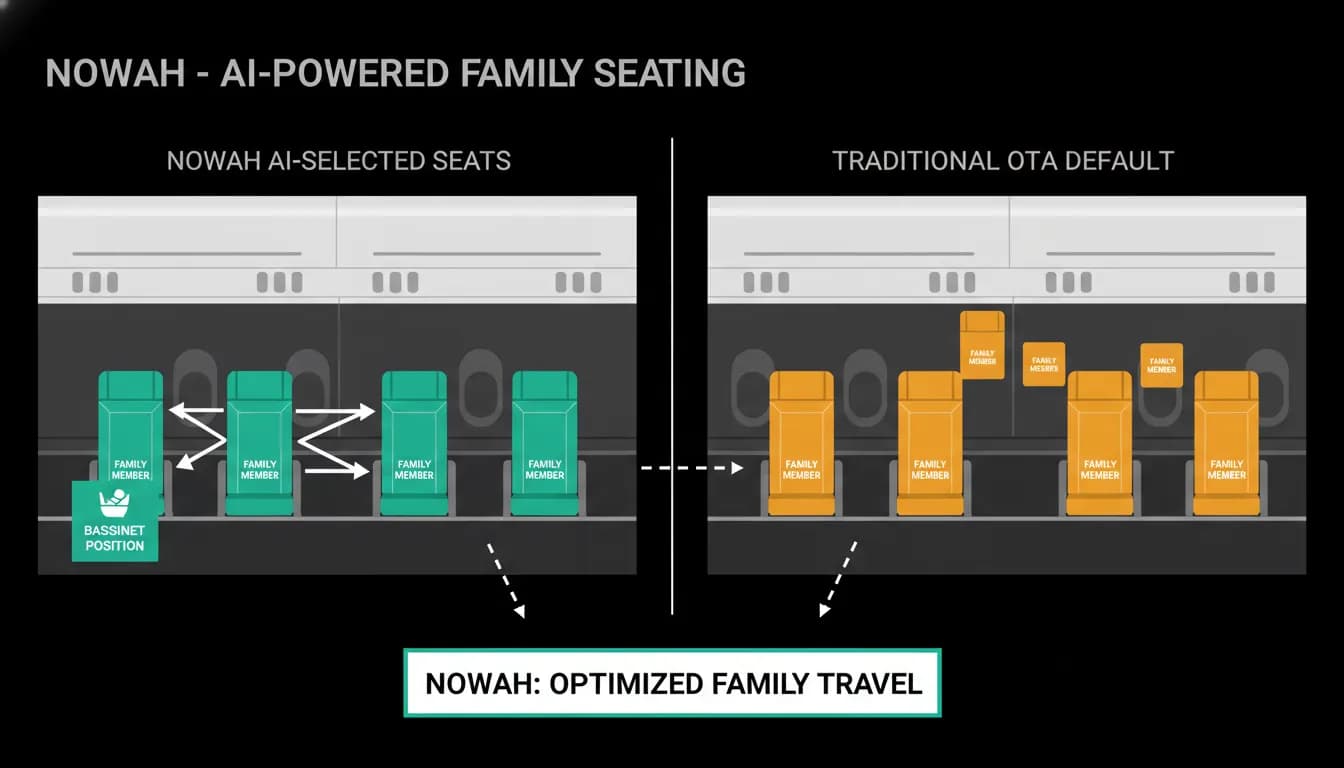
Of all family booking constraints, seat adjacency is the most emotionally charged and the most poorly handled by traditional platforms.
The scenario: you book four seats on a flight. The booking confirmation shows seat assignments: 14A, 14B, 22C, 28F. Your family of four is scattered across three rows. Your five-year-old is in 22C alone. Your lap infant needs to be on your lap, but you are in 14A and your partner is in 28F.
This happens because most OTA booking flows do not integrate seat selection into the purchase process for basic economy fares. The airline assigns seats separately, and its algorithm does not prioritize keeping families together unless the family pays for seat selection — an additional $25 to $60 per seat per segment.
AI agents address this pre-booking. The agent checks seat maps during the search phase, not after purchase. "This flight has four adjacent seats available in rows 12 and 18. This other flight has no adjacent seats remaining — families would be split. Recommend the first option."
When adjacent seats require paid selection, the agent includes the cost in the total comparison. "Flight A base fare: $340 per person. Adjacent seats require paid selection: $30 per seat. Total: $460 per person. Flight B base fare: $380 per person but adjacent seats are available at no extra charge. Total: $380 per person. Flight B is cheaper for your family despite the higher base fare."
This total-cost analysis — including the ancillaries that families need — consistently changes which flight is actually cheapest for a family.
Child fares and infant policies
Airline child fare policies are a labyrinth. An infant under 2 might fly free on one airline, at 10 percent of the adult fare on another, and at a flat fee on a third. A child who turns 2 during the trip might board the outbound flight as a lap infant but require a paid seat for the return.
AI agents navigate this by evaluating fare rules per airline per segment with the specific ages of your children.
"Your daughter is 23 months. On Airline A, she flies free as a lap infant both ways. On Airline B, she flies free outbound but needs a paid seat on the return because she turns 2 before the return date. Airline A saves you $280."
No OTA search form captures this nuance. The traveler would need to manually check each airline's infant policy and calculate age against travel dates. Most families discover the issue at booking or at the airport.
Ancillary services for families
Families need more ancillary services than any other traveler segment, and the booking of these services is scattered across different screens, different processes, and sometimes different systems entirely.
Strollers and car seats. Most airlines allow gate-checking strollers for free, but policies vary. Some require pre-notification. Car seats can be used on the plane if a seat is purchased for the child — a detail that affects whether you book a seat for your toddler or carry them as a lap infant.
Bassinets. On long-haul flights, bulkhead bassinets are available for infants under a certain weight and age. These are limited — typically 2 to 4 per flight — and must be pre-requested. AI agents that know your infant's age and the flight's bassinet policy can request one during booking.
Kids meals. Most airlines offer children's meal options but require pre-ordering 24 to 48 hours before departure. AI agents add meal requests to the booking automatically based on your family profile.
Entertainment. Does the flight have seatback screens? Wi-Fi for streaming? These details matter enormously for families with young children on long flights and are rarely highlighted in OTA search results.
AI agents bundle all of these considerations into the booking flow. The family does not need to remember to request a bassinet, pre-order meals, check stroller policies, and verify entertainment options separately. The agent handles the entire ancillary stack as part of a single booking conversation.
Layover optimization for families
Airport connection times are calculated for adult travelers moving at adult speed through familiar airports. A family with children moves at a fundamentally different pace.
Security lines take longer with strollers and car seats. Bathroom breaks are more frequent and longer. Gate changes require more time because children walk slower. And the stress of a tight connection — rushing through a terminal while managing children, luggage, and equipment — is exponentially worse for families than for solo travelers.
AI agents apply family-appropriate minimum connection times automatically. "The standard minimum connection at this airport is 50 minutes. For your family with a stroller and two young children, I recommend a minimum of 100 minutes. This flight has a 95-minute connection — slightly below my recommended minimum. The next option has a 2-hour connection and arrives 30 minutes later. Recommend the longer connection for comfort."
This kind of constraint adjustment — doubling connection time for family travel — is something no OTA filter provides and that most families learn only through stressful experience.
Set up your family profile
The single best action a family traveler can take is setting up a complete family profile with an AI agent. Children's names, ages (and birthdays, so the agent tracks age changes), dietary requirements, medical needs, and equipment (stroller, car seat, bassinet eligibility).
With this profile, a family booking goes from 45 minutes of manual OTA navigation to a single message: "Book us flights to Orlando for spring break. You know the kids."
The agent knows the kids. It knows their ages, their meal needs, their seat requirements, and the family's layover tolerance. It searches, evaluates, selects adjacent seats, adds ancillaries, and presents a recommendation in under 5 minutes.
Family travel should not be harder to book than solo travel. With an AI agent that understands your family's specific needs, it is not.
Nowah is an AI travel agent that searches and books real flights and hotels through conversation — no filters, no thirty open tabs. Plan your next trip.