AI in Airline Operations: From Revenue Management to Customer Recovery
Airlines use AI for dynamic pricing, crew scheduling, and disruption recovery internally. Here is how traveler-facing AI agents leverage those same improvements.
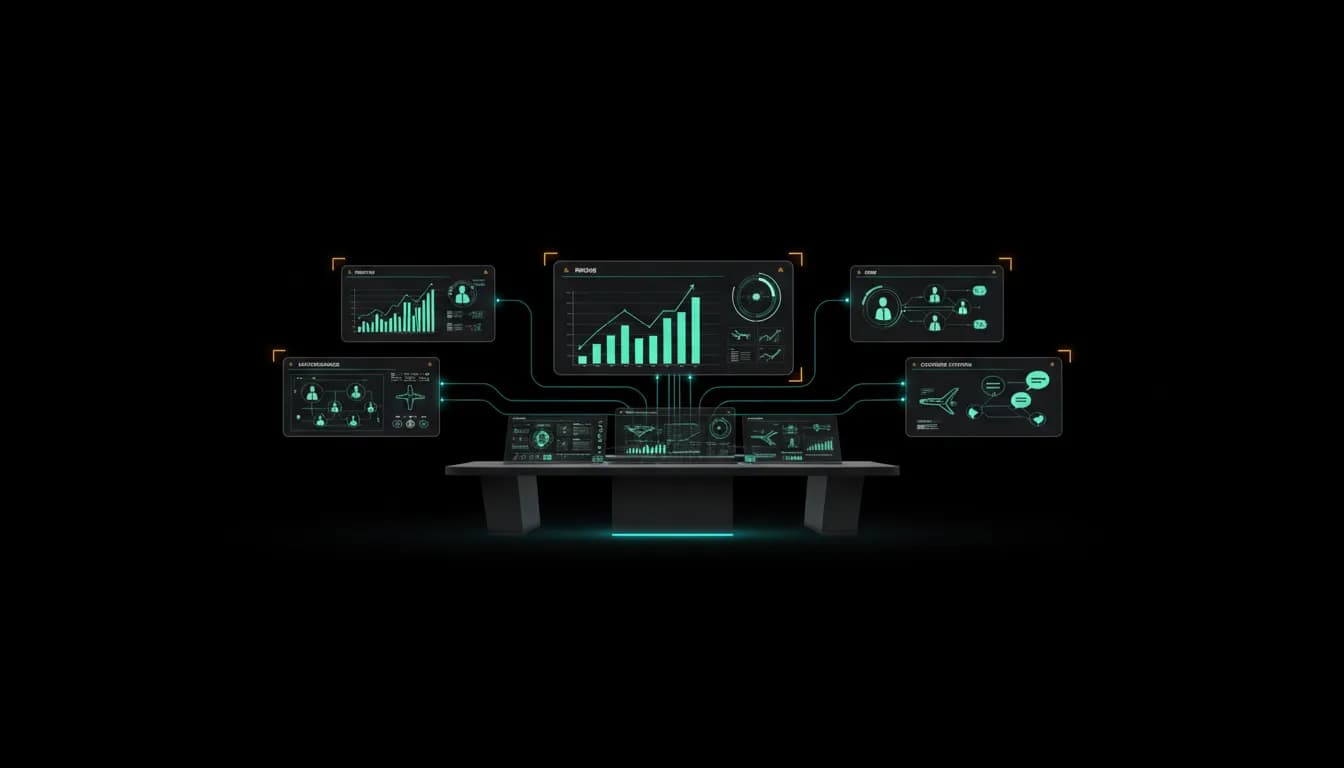
Airlines spend $37 billion on IT globally. A growing and significant portion of that investment goes to AI systems that optimize every aspect of airline operations: pricing, crew scheduling, maintenance, and disruption recovery. These systems are sophisticated, effective, and almost entirely invisible to travelers.
Most of the AI that affects your flying experience operates behind the scenes. The fare you were offered was set by an AI pricing engine. The crew that staffed your flight was assigned by an AI scheduling system. The mechanical delay you did not experience was prevented by an AI maintenance predictor. And if your flight was disrupted, an AI recovery system may have rebooked you before you reached the service counter.
Understanding how airlines use AI internally explains why fares behave the way they do, why some airlines are more reliable than others, and how traveler-facing AI agents can leverage airline operational improvements to deliver better booking recommendations.
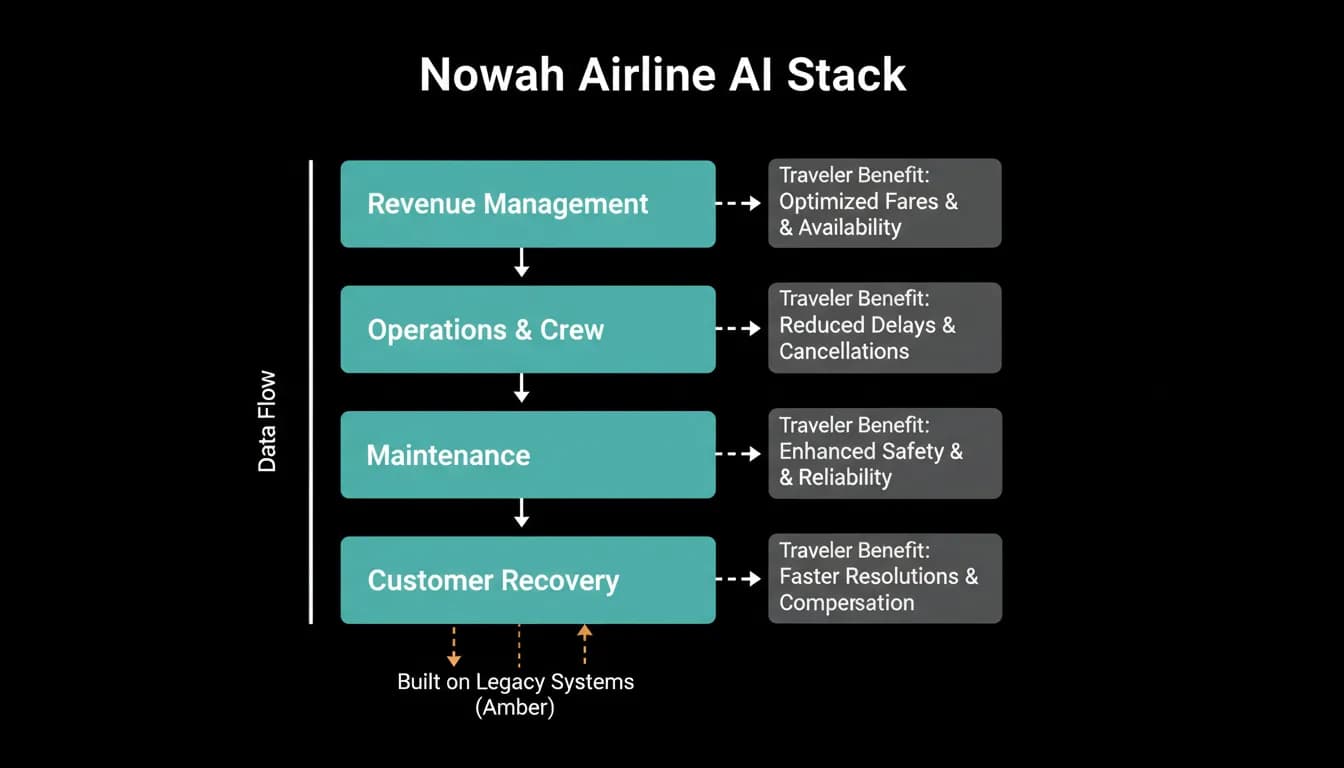
Revenue management AI
Revenue management is where airline AI has the longest history and the most direct impact on what you pay.
Airlines were among the first industries to adopt AI for pricing. Modern revenue management systems adjust fares 3 to 5 times per day on popular routes. The algorithm considers dozens of factors: current booking pace versus historical booking pace, competitor pricing on the same route, day-of-week and seasonal demand patterns, event calendars in the destination city, connecting traffic considerations, and the remaining time until departure.
The result is dynamic pricing that maximizes revenue per flight. This is not price gouging — it is efficient allocation of a perishable resource (seats that have zero value after departure). But it does mean that the fare you see at 9 AM might differ from the fare at 3 PM, and the fare on Tuesday might differ from Monday.
What this means for travelers: timing matters, and it matters at a granular level that is impossible to track manually. An AI agent that monitors fares continuously — not just when you remember to check — captures pricing fluctuations that human browsing habits miss. The agent detects when the revenue management system releases a lower fare class, when a competitor drop triggers a matching price decrease, and when demand signals suggest an imminent price increase.
Understanding that fares change 3 to 5 times daily also explains why price comparison on a specific day is insufficient. The "cheapest flight" you found at 2 PM was not the cheapest at 10 AM and may not be the cheapest at 6 PM. AI agents that monitor across time capture the optimal price window.
Crew scheduling and operations
AI crew scheduling addresses one of the most complex constraint optimization problems in any industry: assigning thousands of crew members to hundreds of flights per day while respecting union rules, rest requirements, training certifications, base assignments, and seniority preferences.
Airlines that implement AI crew scheduling see 5 to 8 percent fewer cancellations from staffing issues. This translates to fewer disrupted travelers, fewer cascading delays, and more reliable operations.
The traveler benefit is indirect but real: airlines with better crew scheduling systems have better on-time performance. AI booking agents that incorporate on-time performance data into flight ranking can factor this in: "Airline A has 92 percent on-time performance on this route. Airline B has 78 percent. The $30 savings on Airline B comes with a significantly higher delay risk."
Predictive maintenance
Sensors on modern aircraft generate terabytes of data per flight. AI maintenance systems analyze this data to predict component failures before they occur — identifying patterns that indicate a part is likely to fail within the next 50 to 100 flight hours and scheduling replacement during planned maintenance windows rather than discovering the failure on the ramp.
Predictive maintenance reduces mechanical delays by 15 to 20 percent. For travelers, this means fewer of the most frustrating type of delay — the one where the plane is at the gate, the passengers are boarded, and the captain announces a "mechanical issue" that requires a technician.
AI booking agents can factor fleet age and maintenance reputation into recommendations. Newer fleets with more sensor data and more advanced maintenance programs tend to have better mechanical reliability. "This carrier operates a 2019 Dreamliner on this route. Average fleet age: 6 years. Mechanical delay rate: 1.2 percent. The alternative carrier operates a 2008 767. Average fleet age: 14 years. Mechanical delay rate: 3.8 percent."
Disruption recovery
When operations go wrong — weather cancellations, mechanical failures, crew shortages — airline AI recovery systems evaluate thousands of rebooking options across affected passengers. The best systems consider connecting flights, passenger priority (status, fare class, connection timing), and available inventory across the airline's network.
Disruption recovery AI rebooks 60 percent of affected passengers before they reach the service counter. The passenger checks the app and finds a new itinerary already assigned. This represents an enormous improvement over the pre-AI era when every affected passenger queued at the counter for manual rebooking.
However, airline recovery AI optimizes for the airline's network, not for the individual passenger's preferences. It finds a seat on the next available flight. It does not consider whether you prefer an aisle seat, whether the new arrival time conflicts with your meeting, or whether a competitor airline has a better option.
Traveler-facing AI agents complement airline recovery by optimizing for the passenger. When your flight is disrupted, the AI agent evaluates the airline's proposed rebooking against alternatives across all carriers, factors in your preferences and downstream plans, and recommends the option that works best for you — which may or may not be what the airline assigned.
The benefit chain
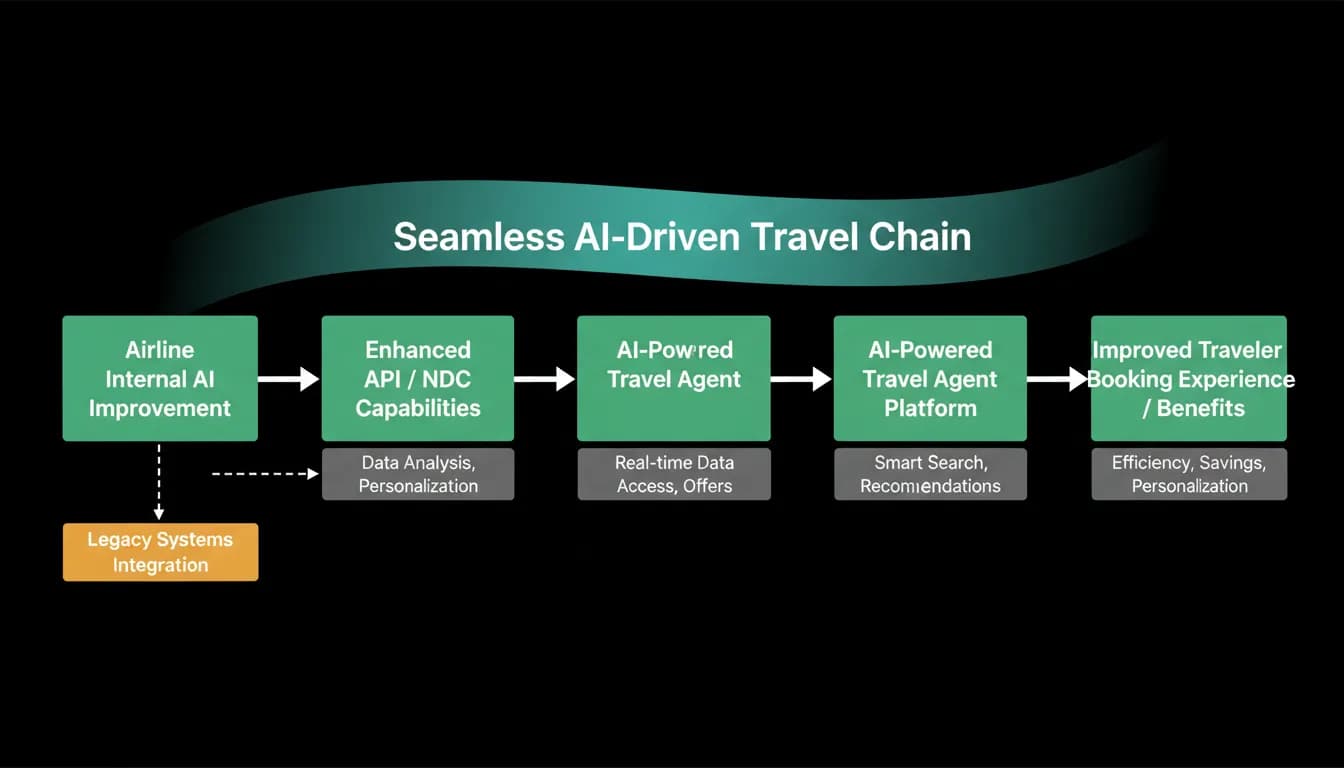
Airline AI improvements flow through to travelers through a chain of connected benefits.
Better pricing intelligence. Revenue management AI makes pricing more dynamic, which means more pricing opportunities for travelers who monitor. AI booking agents that understand pricing dynamics — including how airline AI adjusts fares — make better timing recommendations.
Better reliability data. AI-driven crew scheduling and predictive maintenance produce more reliable airlines, and the reliability is measurable. AI booking agents that incorporate reliability data help travelers choose airlines with the best operational track records.
Better disruption recovery. Airline recovery AI handles the first layer of rebooking. Traveler-facing AI agents add a second layer — optimizing for personal preferences and cross-carrier alternatives that the airline's system does not consider.
Better content through [NDC](/blog/ndc-future-flight-distribution). As airlines invest in AI-driven personalization of offers, the content available through NDC channels becomes richer: personalized bundles, dynamic ancillary pricing, and loyalty-aware offers. AI booking agents that access NDC content present this richer information to travelers in a format that enables informed comparison.
Making better decisions
Understanding how airline AI works informs better booking decisions.
When you know that fares change 3 to 5 times daily, you understand why continuous price monitoring matters. When you know that crew scheduling AI reduces cancellations at some airlines but not others, you can factor operational reliability into your carrier choice. When you know that predictive maintenance correlates with fleet age, you can prefer airlines with newer fleets.
AI booking agents encode this understanding into their recommendation logic. The traveler does not need to become an airline operations expert. The agent applies the operational knowledge automatically — surfacing the airlines with better reliability, identifying the pricing windows, and layering passenger-centric optimization on top of airline-centric recovery.
The $37 billion airlines spend on IT is making flying better. AI booking agents ensure that the improvements flow through to the traveler rather than remaining invisible behind the curtain.
Nowah is an AI travel agent that searches and books real flights and hotels through conversation — no filters, no thirty open tabs. Plan your next trip.