AI Agents vs. Chatbots: Why the Distinction Matters
Chatbots answer questions. Agents take actions and handle outcomes. For travel booking, only agents work. Here is the technical difference.
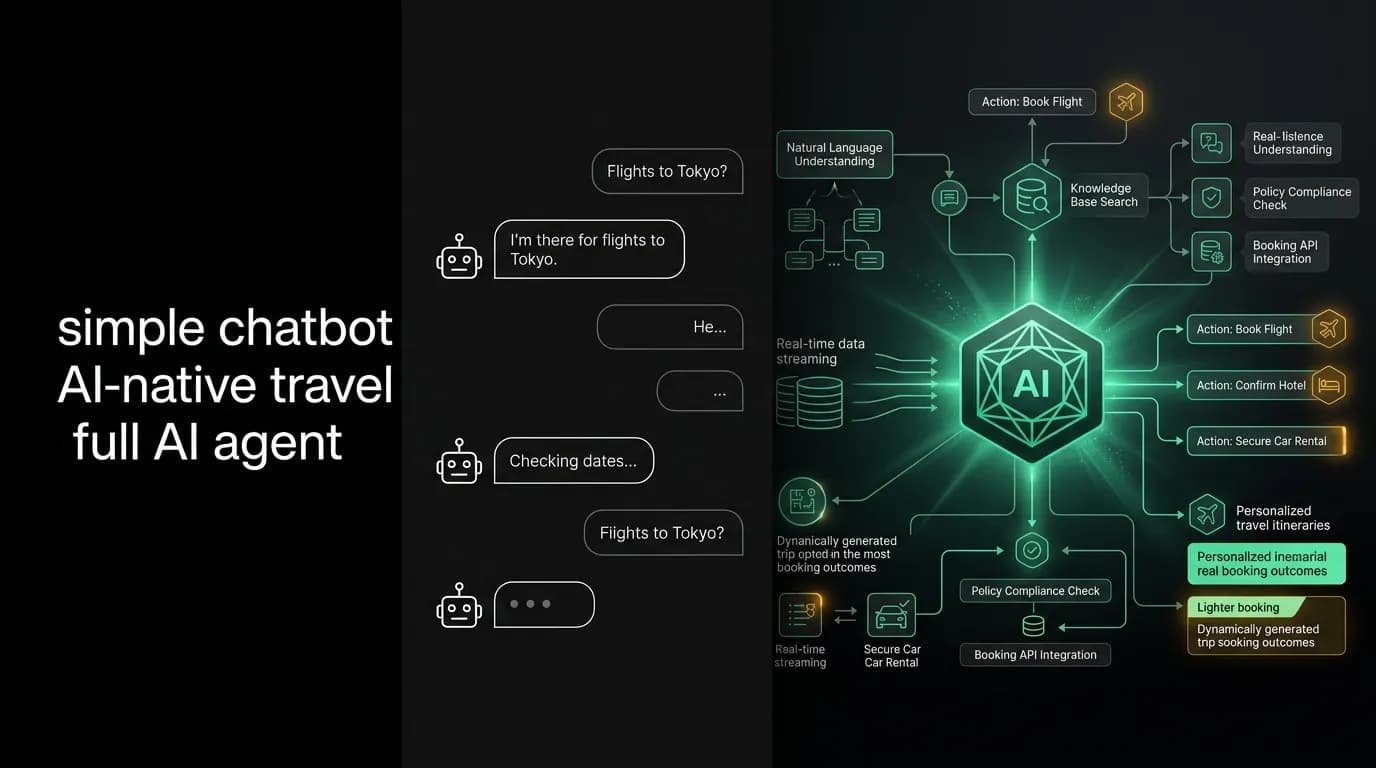
The travel industry has a chatbot problem. Not a shortage of them. An excess of them being called "AI agents" when they are nothing of the sort.
A chatbot answers questions. An agent takes actions. That one-sentence distinction contains an enormous engineering gap, and the travel industry has been papering over it with marketing language for two years. I want to be precise about what separates the two, because the difference determines whether AI can actually replace the 38-tab booking marathon or just add a 39th tab.
The technical distinction
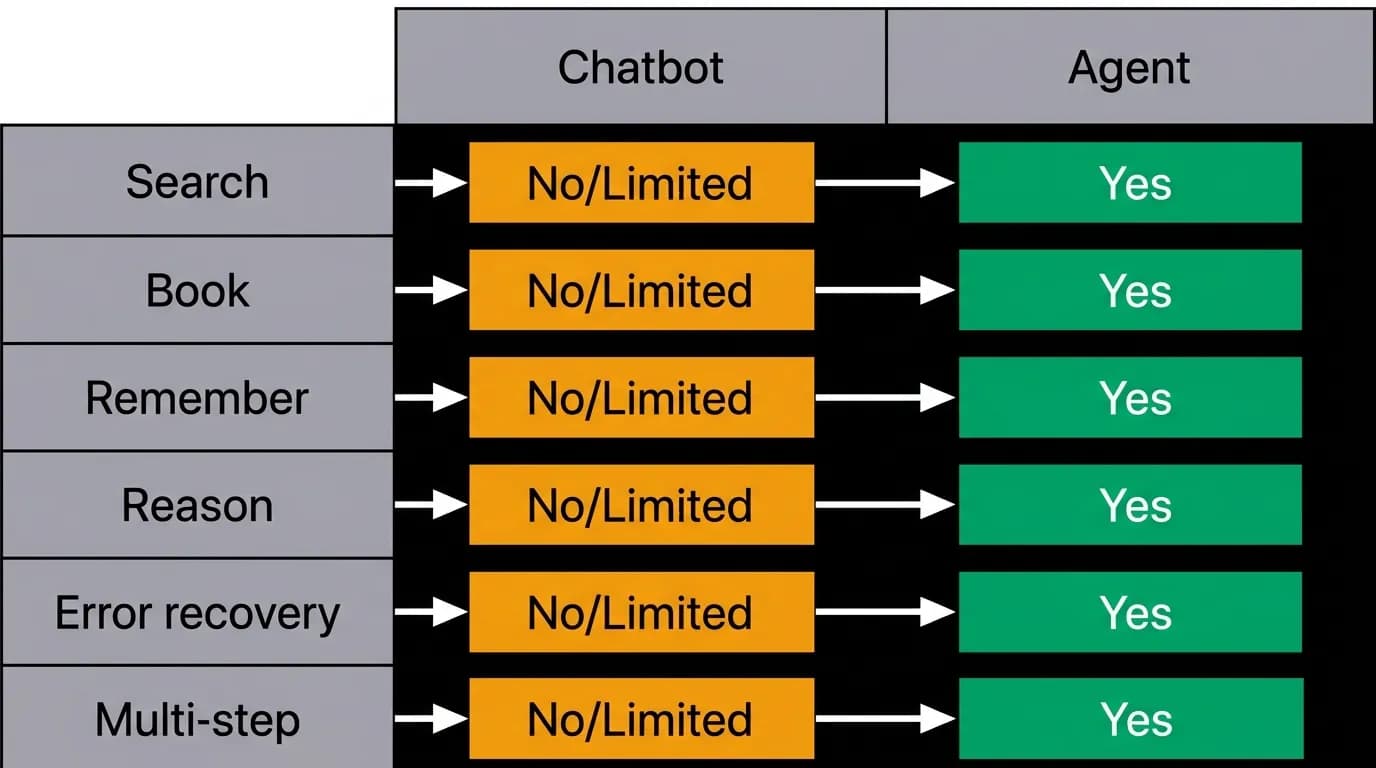
A chatbot is a text interface to an information retrieval system. You ask it a question, it generates a response using a language model, and the conversation ends with you knowing something you did not know before. A chatbot can tell you that flights to Tokyo in March typically cost between $800 and $1200. It can suggest that you consider flying on a Tuesday for better prices. It can recommend hotels in Shinjuku.
What a chatbot cannot do is book the flight. It cannot search live inventory with your specific dates and preferences. It cannot compare real-time prices across carriers. It cannot initiate a payment, confirm a reservation, or send you a booking confirmation. It retrieves and presents information. That is where its capabilities end.
An AI agent does all of that. An agent has tools. It can call flight search APIs, hotel availability systems, and payment processors. It makes decisions about which tools to call, in what order, and with what parameters based on the conversation context. It handles the outcomes of those tool calls, including failures. When a flight sells out between the time it was searched and the time the user tried to book, the agent detects this, communicates it, and offers alternatives. It does not just talk about travel. It does travel.
The engineering complexity difference is massive. A chatbot needs a language model and a prompt. An agent needs a language model, a prompt, a tool orchestration layer, state management for multi-step workflows, error recovery logic, financial transaction handling, and reliability guarantees for every action it takes.
Why travel booking requires agents
Searching for travel information is a retrieval task. A chatbot can handle it. But the moment a user says "book that one," the task transitions from retrieval to action, and a chatbot falls off a cliff.
Booking a flight involves a chain of dependent operations. Search live inventory. Present options. Capture traveler details. Validate those details against airline requirements. Initiate payment. Confirm the booking with the airline. Issue the ticket. Send the confirmation. Each step can fail, and each failure requires a different response.
Payment fails because the card was declined? Ask for a different payment method. Airline system rejects the booking because the fare is no longer available? Search for alternatives and present them. Passenger name does not match the format the airline requires? Ask the user to correct it.
A chatbot has no mechanism to handle any of this. It can generate text that sounds like it is handling it ("I have booked your flight!"), but that text is a hallucination. No actual booking was made. No money was charged. No ticket was issued.
This is not a theoretical concern. Real users have interacted with travel chatbots, been told their booking was confirmed, and shown up at the airport with nothing. The marketing hype around travel AI has created expectations that chatbots cannot meet.
The spectrum of capability
The reality is not a binary chatbot/agent distinction. It is a spectrum.
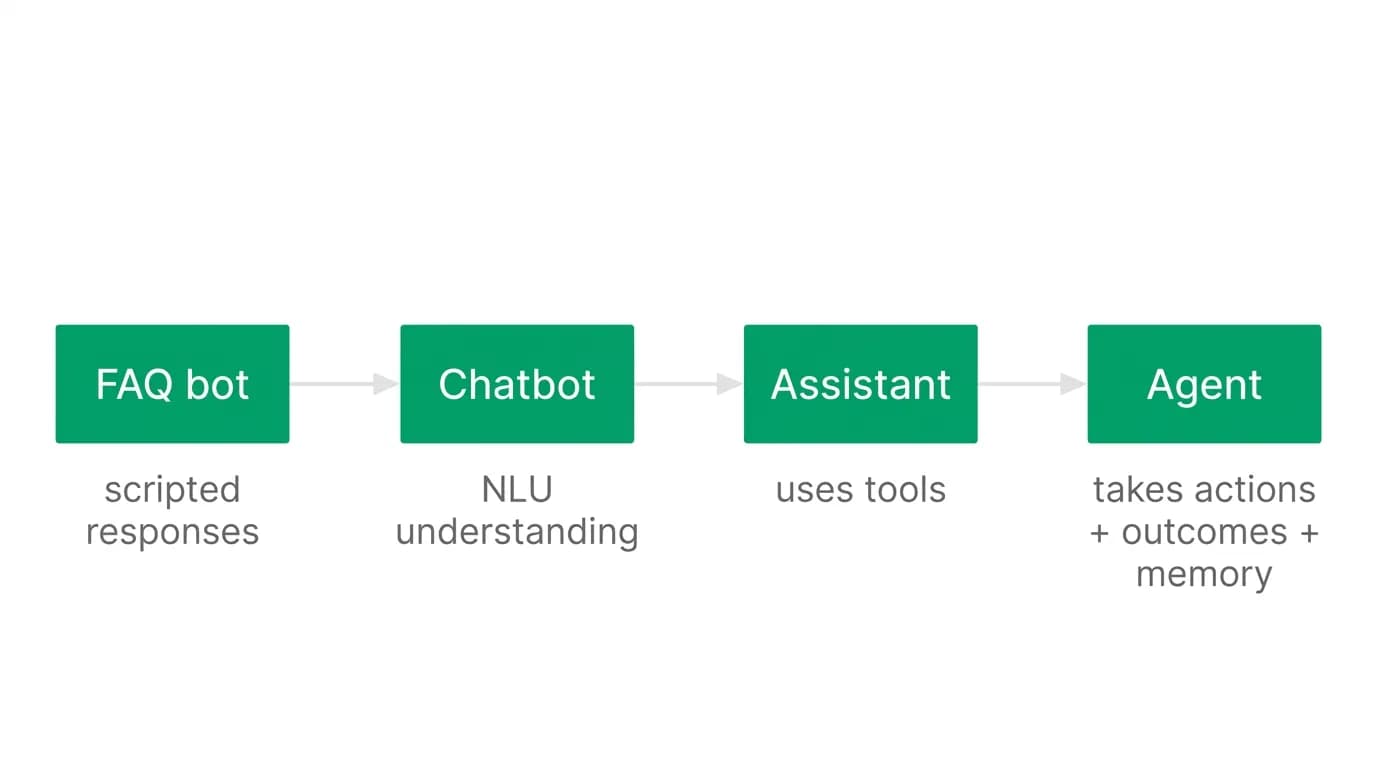
At the simplest end are FAQ bots with scripted responses. They match keywords in the user's question to pre-written answers. No language model, no intelligence, just pattern matching.
Next are smart chatbots that use language models to generate natural-sounding responses. They can handle a wider range of questions and sound more human, but they still only retrieve and present information.
Then come AI assistants with limited tool access. They might be able to search for flights (calling a search API) but cannot book them. They can show you options but hand off to a traditional booking form for the actual transaction.
At the far end are full AI agents. They search, rank, present, book, pay, confirm, and handle every contingency along the way. They maintain state across multi-turn conversations. They remember your preferences. They handle errors and failures autonomously.
Most travel "AI" products sit in the assistant category. They have enough tool access to feel magical in demos but not enough reliability to handle real bookings end-to-end. The gap between "can search for flights" and "can reliably book flights" is where most of the engineering effort lives.
We built Nowah as a full agent from the start. Not because it was easier. Because anything less does not solve the actual user problem. Over 70% of travelers say they are open to AI-assisted trip planning, but they need the AI to actually plan and book, not just suggest and redirect.
The engineering complexity gap
Building a chatbot is a weekend project. Pick a language model API, write a prompt, connect it to a chat interface. You can have something working in hours.
Building an agent that can reliably book a $2,000 flight takes months. You need tool calling infrastructure that decides which tools to invoke and handles the results. You need state management that tracks where the user is in a multi-step booking flow. You need idempotency guarantees so a network retry does not create a duplicate booking. You need payment processing that handles authorization, capture, and refund flows. You need error recovery that distinguishes between "retry this" and "give up and try something else."
And you need all of this to work with the non-determinism inherent in language models. The agent might phrase its request to the user differently each time. It might decide to call tools in a different order. It might interpret the user's response slightly differently. All of this variability is fine for chat. It is terrifying for financial transactions.
Financial-grade reliability in a non-deterministic system is the core engineering challenge of building AI agents for travel. Every company that has shipped a travel chatbot and called it an agent will eventually hit this wall. Some will climb it. Most will not.
The marketing vs. reality gap
I see travel companies every week announcing "AI agent" features that are chatbots with a search API. The press releases describe autonomous booking capabilities. The actual product asks you to click through three screens of forms after the chatbot suggests a flight.
This gap between marketing and reality harms the entire industry. Users try these products, get a subpar experience, and conclude that AI travel booking does not work. It does work. Just not the way most companies are implementing it.
The companies that will win the AI travel market are the ones that close the gap between what they promise and what they deliver. That means building actual agent capabilities, not chatbot features with agent marketing.
The distinction between chatbots and agents is not pedantic. It is the difference between software that tells you about travel and software that handles your travel. For an industry where the actual user problem is "I spent three hours booking a trip I should have been able to book in three minutes," only agents move the needle.
Nowah is an AI travel agent that searches and books real flights and hotels through conversation — no filters, no thirty open tabs. Plan your next trip.