How AI Actually Finds Better Flight Prices Than You Can
Cognitive bias, limited time, and rigid tools hold humans back. AI evaluates hundreds of options in seconds with flexible dates and value scoring.

I used to be the person who spent two hours on a Saturday morning checking five different booking sites for the cheapest flight. I would open search engines, airline direct sites, and OTAs in parallel, comparing prices across each while adjusting dates by a day or two to see if I could save $30. I was convinced I was getting the best deal because I was doing the work.
I was wrong, and the reasons I was wrong apply to most people who manually search for flights.
Why humans are bad at flight search
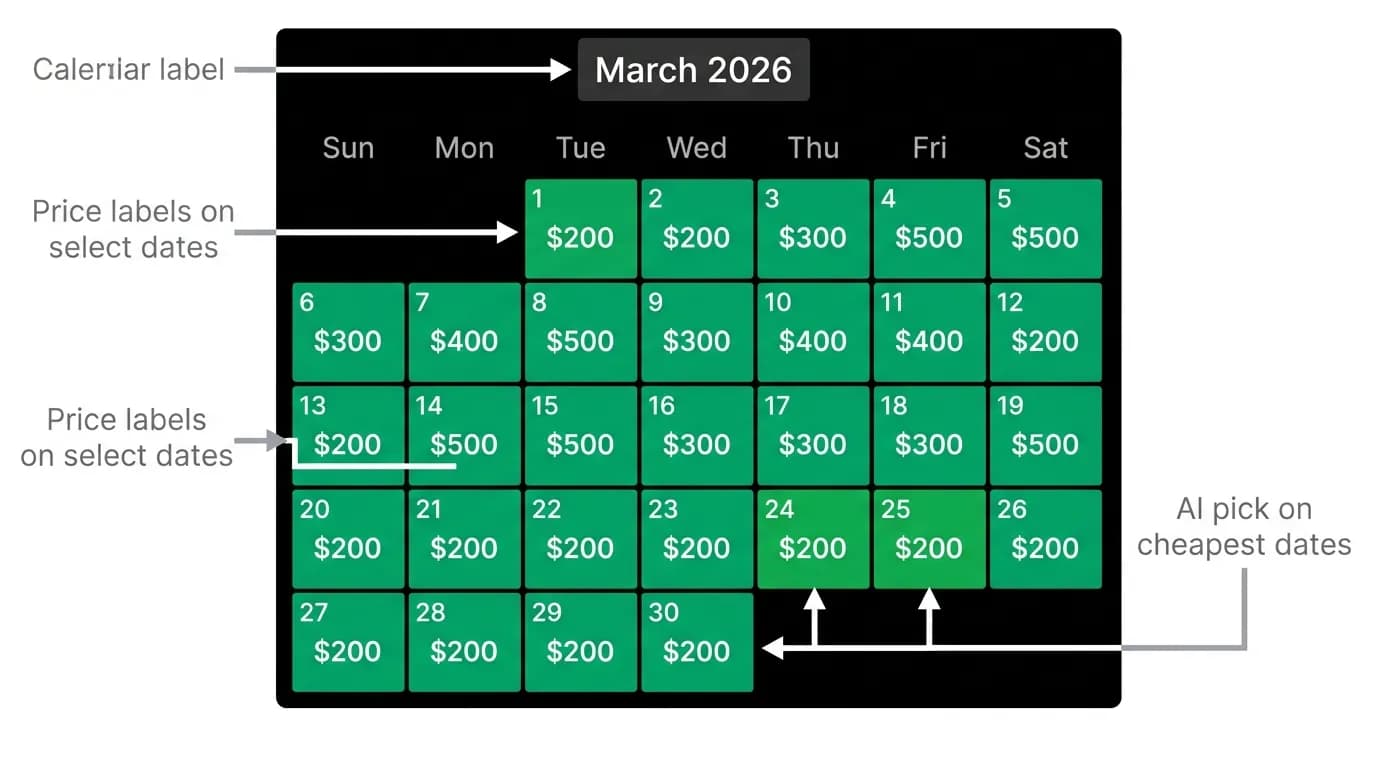
We have systematic cognitive biases that make us worse at finding the best flights than we think we are.
Anchoring. The first price you see becomes your reference point. If the first flight you find is $450, you evaluate everything relative to that anchor. A $400 flight feels like a deal. A $500 flight feels expensive. But if you had started your search on a different site and seen $380 first, your entire evaluation framework would shift. The best price in your search is determined in part by where you happened to look first.
Satisficing. After 20 minutes of searching, fatigue sets in. You stop looking for the best option and start looking for a good enough option. Research shows the average flight search takes 20 or more minutes on traditional OTA sites, and most people compare 3-5 sites before giving up and booking. The question you should be asking is "what would I have found if I had checked the 6th or 7th site?" But you will never know because you ran out of patience.
Narrow framing. When you search for flights, you search for specific dates. Maybe you adjust by a day in each direction. You rarely check an entire week or month to find the cheapest departure date because the interfaces make it tedious. On most OTAs, changing the date means re-entering the search form and waiting for new results. After doing that three times, you give up and book the date you originally searched.
Incomplete comparison. The average traveler visits 38 or more websites before booking. But even 38 sites do not cover the full picture. Different sites have different inventory arrangements. Some show different carriers. Price display varies (some include taxes, some do not). Comparing a result on one site with a result on another is harder than it should be because the presentations are inconsistent.
How AI evaluates hundreds of options in seconds
An AI travel agent does not have cognitive biases. It does not get tired after 20 minutes. It does not anchor to the first result it sees. It evaluates every option against the same criteria simultaneously.
When you tell an AI agent "find me a flight from San Francisco to London in March," the agent searches across all available carriers, checking every day in your stated range. If you said "March" without specifying dates, it checks all 31 days. For each day, it evaluates multiple departure times, connection options, and carriers. The total number of options evaluated can easily reach into the hundreds.
The speed advantage is obvious. A human checking five sites with three date variations might evaluate 30-40 options in 20 minutes. An AI agent evaluates hundreds of options in seconds. But speed is not the real advantage. The real advantage is comprehensiveness. The AI does not skip options because it got tired or because one site's interface was confusing.
Flexible date optimization
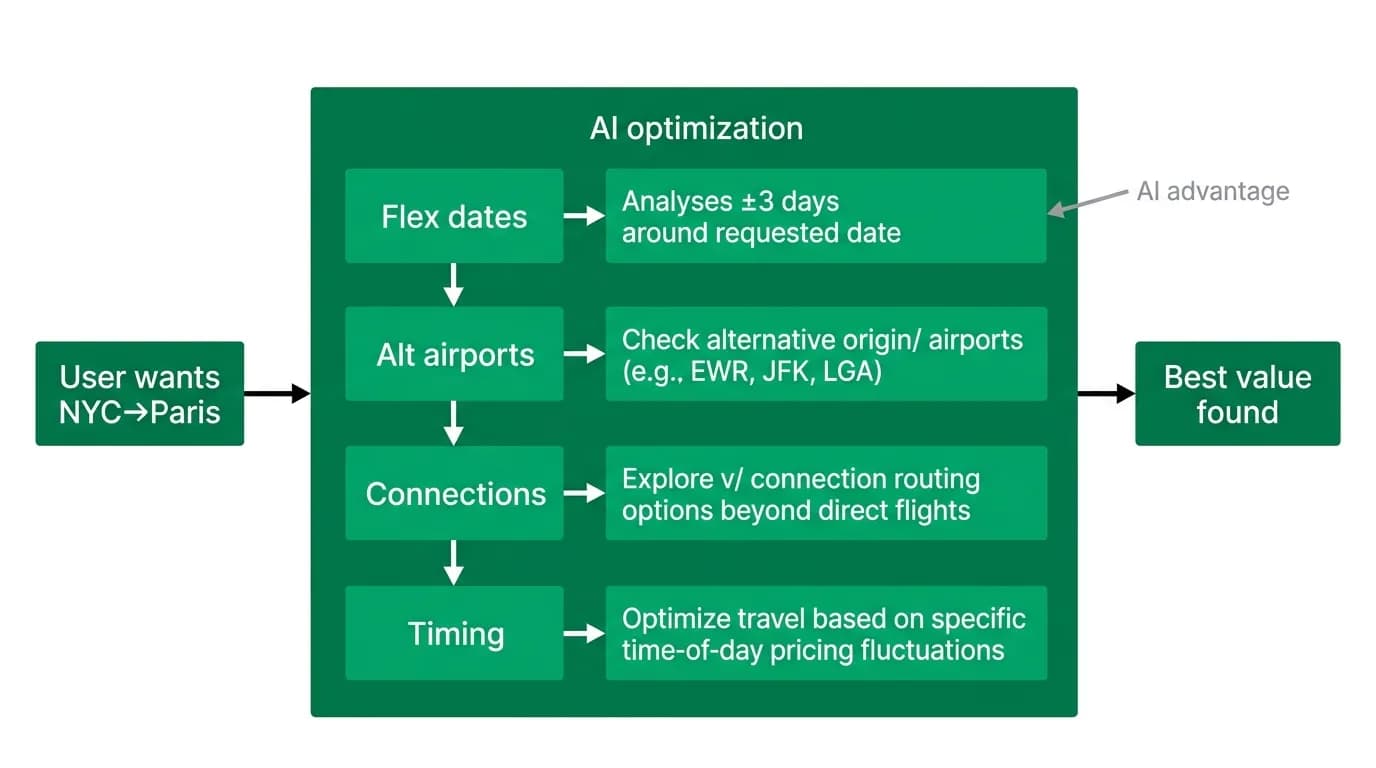
This is where AI search genuinely finds money that manual search leaves on the table.
Flight pricing is volatile. The same route can vary by hundreds of dollars depending on the day of the week, the time of day, and how far in advance you are booking. A Tuesday departure might be $200 cheaper than a Sunday departure. A 6 AM flight might be $150 cheaper than a 10 AM flight.
When you search manually, you check the dates you want and maybe one or two alternatives. When an AI agent searches with flexible dates, it checks every date in your range and identifies the cheapest options. It can tell you "if you fly out on Tuesday instead of Saturday, you save $180" because it already did the comparison.
This is not a theoretical capability. It is the single most reliable way to find lower prices. The savings from flexible date optimization regularly exceed any difference you would find by comparing across booking sites for the same dates.
The value concept
Here is where I think most flight search tools, including most AI implementations, get it wrong. They optimize for cheapest price. But cheapest price is not always best value.
A $350 flight with a 6-hour layover in a connecting airport you hate is not a better deal than a $420 direct flight, even though it costs $70 less. A $280 flight that arrives at 1 AM, forcing you to pay $60 for a cab and lose half a vacation day to exhaustion, is not cheaper than a $320 flight that arrives at 6 PM.
Value scoring factors in the total cost and experience of the trip, not just the ticket price. Time at the airport. Convenience of connections. Arrival time impact on your schedule. Airline reliability for the specific route. Seat comfort relative to flight duration.
An AI agent that knows your preferences can score value in ways a price-sorting algorithm cannot. If you have told the agent you hate layovers, a slightly more expensive direct flight is the right recommendation even though it is not the cheapest option. If the agent knows you are traveling for a morning meeting the next day, it can deprioritize overnight flights that would leave you exhausted.
Why AI beats checking multiple booking sites yourself
The traditional advice for finding cheap flights is "check multiple sites." And it is true that prices vary across sites. But the variation is typically small for the same flight on the same date, maybe $10-30. The much larger savings come from date flexibility and value optimization, which manual comparison does poorly.
An AI agent searching for the best flight checks all available inventory through direct connections to travel data providers. It does not need to check five different retail sites because it is querying the underlying inventory that those sites are all drawing from. It gets the same prices (or better, since retail sites add markups) without the overhead of navigating five different interfaces.
The combination of comprehensive search, flexible date optimization, and preference-aware value scoring produces results that are consistently better than what most people find manually. Not because the AI has access to secret prices. Because it is thorough, fast, and unbiased in ways that humans cannot replicate sitting in front of a browser.
That Saturday morning I used to spend searching for flights? I am never going back to it.
Nowah is an AI travel agent that searches and books real flights and hotels through conversation — no filters, no thirty open tabs. Plan your next trip.