Sustainable Travel Booking: How AI Helps You Fly Greener
AI agents surface carbon data alongside price and duration, making eco-conscious flight choices the easy default — not the hard exception for activists.

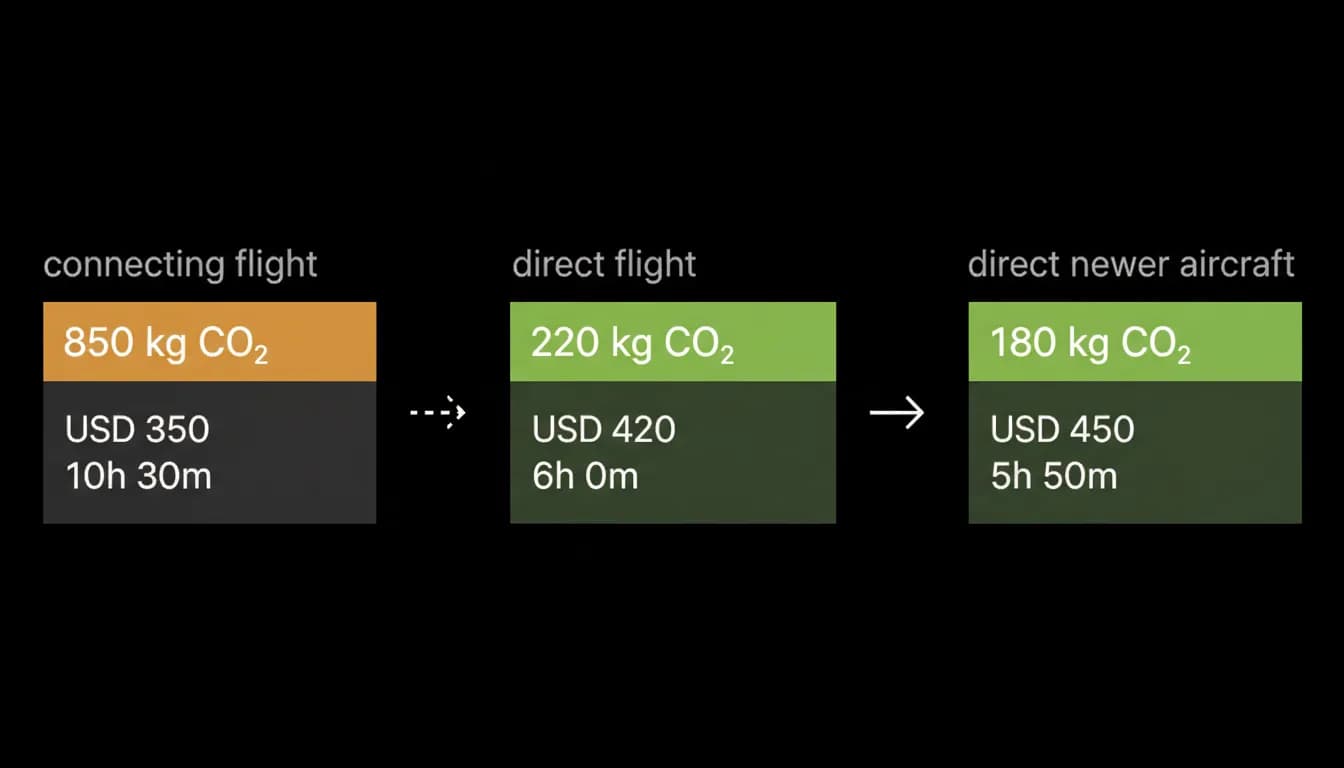
"This direct flight produces 45 percent less CO2 than the connecting option — and it is only $40 more."
That single sentence changes behavior more effectively than any corporate sustainability report, any guilt-laden marketing campaign, or any earnest pledge to offset carbon. It changes behavior because it makes the sustainable choice visible, quantified, and almost indistinguishable in cost from the less sustainable alternative.
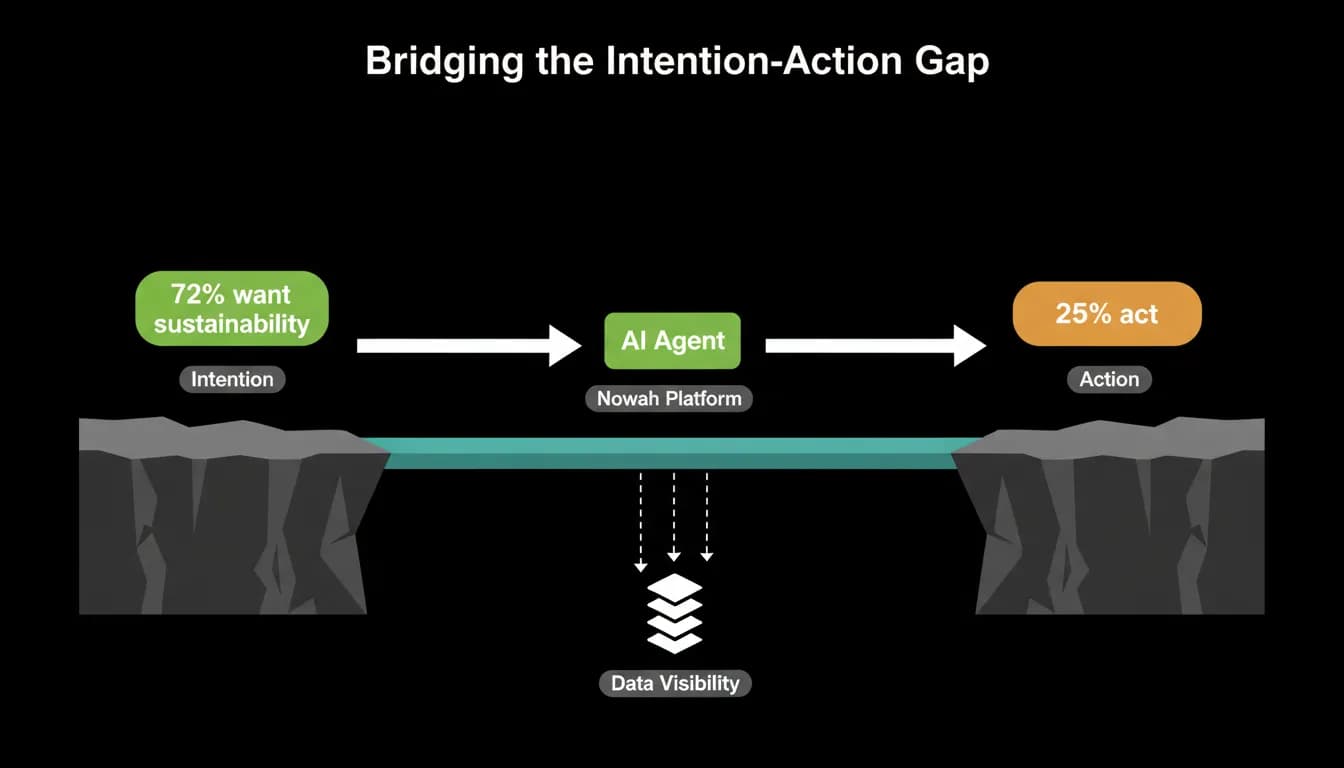
This is the core insight behind AI-powered sustainable travel booking: the problem is not that travelers do not care about sustainability. Seventy-two percent say they want sustainable options. The problem is that traditional booking interfaces make carbon impact invisible, so even well-intentioned travelers cannot act on their values.
The intention-action gap
The numbers paint a stark picture. Seventy-two percent of travelers express a desire for sustainable travel options. Fewer than 25 percent change their booking behavior as a result. That gap — intention without action — is one of the largest in consumer behavior research.
The usual explanation is that travelers prioritize price and convenience over sustainability. This is true but incomplete. The deeper problem is that travelers are asked to prioritize sustainability without any information to act on.
Search for a flight on any major OTA. You will see price, departure time, duration, and number of stops. You will not see carbon emissions. You will not see how the connecting flight compares to the direct flight on environmental impact. You will not see how different carriers compare on fleet efficiency.
You cannot optimize for a factor you cannot see. The intention-action gap is not a failure of values. It is a failure of information design. Travelers want to make greener choices — they just cannot identify which choice is greener because the information is not presented.
Why carbon data is invisible
Traditional booking platforms have economic reasons to keep carbon data hidden. Surfacing emissions data might discourage travelers from booking connecting flights, which are often more profitable for airlines and OTAs because they route passengers through hub airports where the airline has pricing power.
It might also complicate the decision-making process. OTAs optimize for conversion — the fastest path from search to booking. Adding a new dimension of information slows the funnel. And sustainability data is complex: it depends on aircraft type, load factor, routing, and other variables that do not reduce to a simple number easily.
AI agents have no incentive to hide carbon data. Their business model is not based on routing travelers through hubs or maximizing bookings on specific airlines. They can present carbon information alongside price and duration as a natural part of the recommendation.
AI as the bridge
When an AI agent recommends a flight, it can include carbon impact as naturally as it includes price and travel time.
"I found three options for New York to Los Angeles. Option 1: nonstop, 5 hours 30 minutes, $340, 0.9 tons CO2. Option 2: connecting through Denver, 8 hours, $285, 1.6 tons CO2. Option 3: nonstop on a newer aircraft, 5 hours 25 minutes, $365, 0.7 tons CO2."
With that information visible, the choice changes for many travelers. Option 2 is cheapest but produces nearly twice the carbon of the direct flights. Option 3 is the greenest — a newer-generation aircraft on a direct route — for only $25 more than option 1. The $80 savings of option 2 comes at a significant carbon cost.
This is not preaching. It is data. The AI does not tell you which option to choose. It tells you what each option costs in dollars and in carbon, and lets you decide. The data alone shifts behavior significantly — studies show that making carbon data visible at the point of purchase increases selection of lower-carbon options by 15 to 20 percent.
Route and carrier optimization
The factors that drive carbon emissions on flights are well understood, and AI agents can optimize across all of them simultaneously.
Direct versus connecting. Direct flights produce 40 to 50 percent less CO2 than connecting flights on the same route. The takeoff and landing phases consume disproportionate fuel. A connection adds an extra takeoff and landing plus the fuel for the additional routing distance. This single factor — choosing direct over connecting — is the largest lever most travelers have.
Aircraft type. Newer-generation aircraft like the A321neo and Boeing 787 produce 15 to 25 percent less CO2 per passenger-kilometer than older models they replace. The fuel efficiency improvements are dramatic. An AI agent that knows the aircraft type assigned to each flight can factor this into recommendations.
Carrier efficiency. Airlines vary significantly in fleet age, load factors, and operational efficiency. A carrier with a young fleet and high load factors produces substantially less carbon per passenger than a carrier with old planes flying half-empty. AI agents can evaluate carriers on these metrics and present them as part of the recommendation.
Aviation accounts for 2.4 percent of global CO2 emissions. That number is growing as air travel grows. Individual flight choices will not solve the climate crisis, but they contribute — and the aggregate effect of millions of travelers making marginally greener choices adds up.
Offsetting integration
Carbon offsetting is imperfect but currently represents one of the few immediate options for reducing the net impact of flights. The cost is modest: $5 to $15 per domestic flight, $15 to $40 per transatlantic flight.
Traditional booking platforms, when they offer offsetting at all, present it as an add-on at the end of the booking flow — a guilt-induced checkbox that most travelers skip because it adds friction at the payment step.
AI agents can integrate offsetting more naturally. "This flight produces 0.9 tons of CO2. Offsetting through a verified project costs $12. Shall I include it?" Presented as a natural part of the booking conversation rather than a checkout add-on, offset uptake rates increase significantly.
The agent can also provide context about the offset: what project it funds, what verification standard it meets, and what the effective impact is. This transparency addresses the legitimate skepticism many travelers have about whether offsets actually work.
Make it the default
The most effective sustainability intervention is not asking travelers to opt into green choices. It is making the green choice the default and asking travelers to opt out.
AI agents can present the lower-carbon option as the default recommendation, with higher-carbon alternatives available on request. "I recommend this direct flight — it is only $25 more than the connecting option and produces 45 percent less CO2. The connecting flight is available if you prefer to save the $25."
Most travelers will accept the recommendation. Not because they are passive, but because the recommendation is genuinely good — it is faster, simpler, and greener. The small price premium is a fair trade for a significantly better experience and lower carbon impact.
Enable carbon-aware recommendations in your AI agent preferences. The next time you search for flights, you will see carbon data alongside price and duration. You will make a more informed choice. And over time, the aggregate effect of millions of slightly greener choices will be significant.
Nowah is an AI travel agent that searches and books real flights and hotels through conversation — no filters, no thirty open tabs. Plan your next trip.