Best Flight Deals: Why AI Agents Beat Price Alerts
Price alerts tell you when a fare drops. AI agents tell you when to book, what fare class to pick, and whether to wait. Here is why context wins.

You set a price alert for flights to Barcelona. Three weeks later, you get a notification: "Price dropped to $340!" You scramble to your phone, open the app, and find that the fare has already risen to $380 by the time you search. The alert arrived 8 hours after the fare change. The deal was gone before you knew it existed.
This is the fundamental limitation of price alerts: they are reactive. They tell you what happened — a price changed — not what to do about it or whether the change matters in context.
AI agents replace alerts with intelligence. The difference is not incremental. It is the difference between a smoke detector and a fire department.
Alerts vs. intelligence
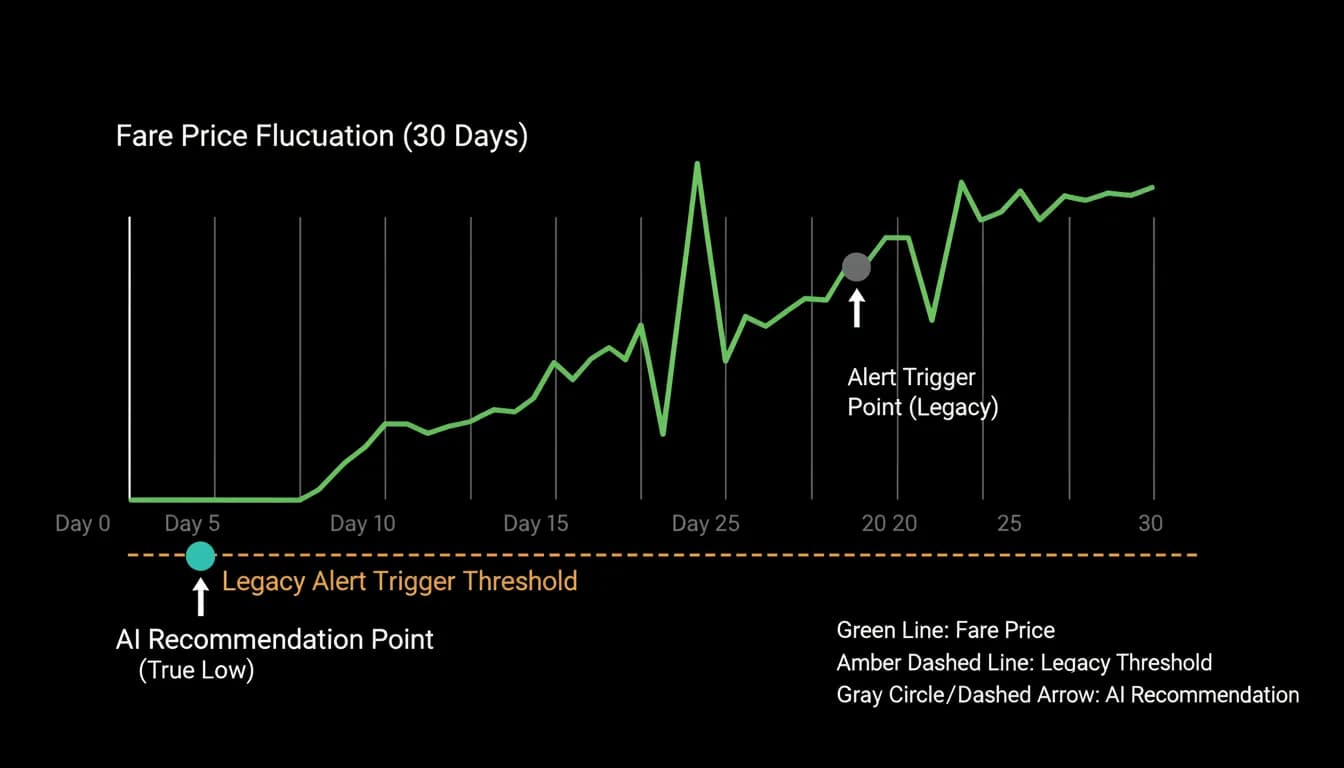
A price alert is a notification triggered by a threshold. "Tell me when flights to Barcelona go below $400." The alert system monitors the fare and pings you when it crosses the line. That is all it does.
The problems are numerous. The alert has no context about whether $340 is actually a good price for that route in that season. It does not know that you are flexible by 3 days and that Tuesday departure would save an additional $50. It does not consider that the $340 basic economy fare will cost you $75 in bags and $150 in change fees if your plans shift, making the $380 regular economy fare a better value. And it certainly does not know that fares on this route historically bottom out in 2 weeks, making $340 a decent price but not the floor.
AI price intelligence incorporates all of this. Instead of "price dropped to $340," you get: "Barcelona flights are at $340, which is 22 percent below the 90-day average for this route. However, fares historically reach their lowest point 6 to 8 weeks before departure, and you are currently 10 weeks out. Recommendation: wait 2 to 3 weeks. Current risk: 15 percent chance of price increase based on demand trends."
That is not an alert. That is advice.
Context-aware recommendations
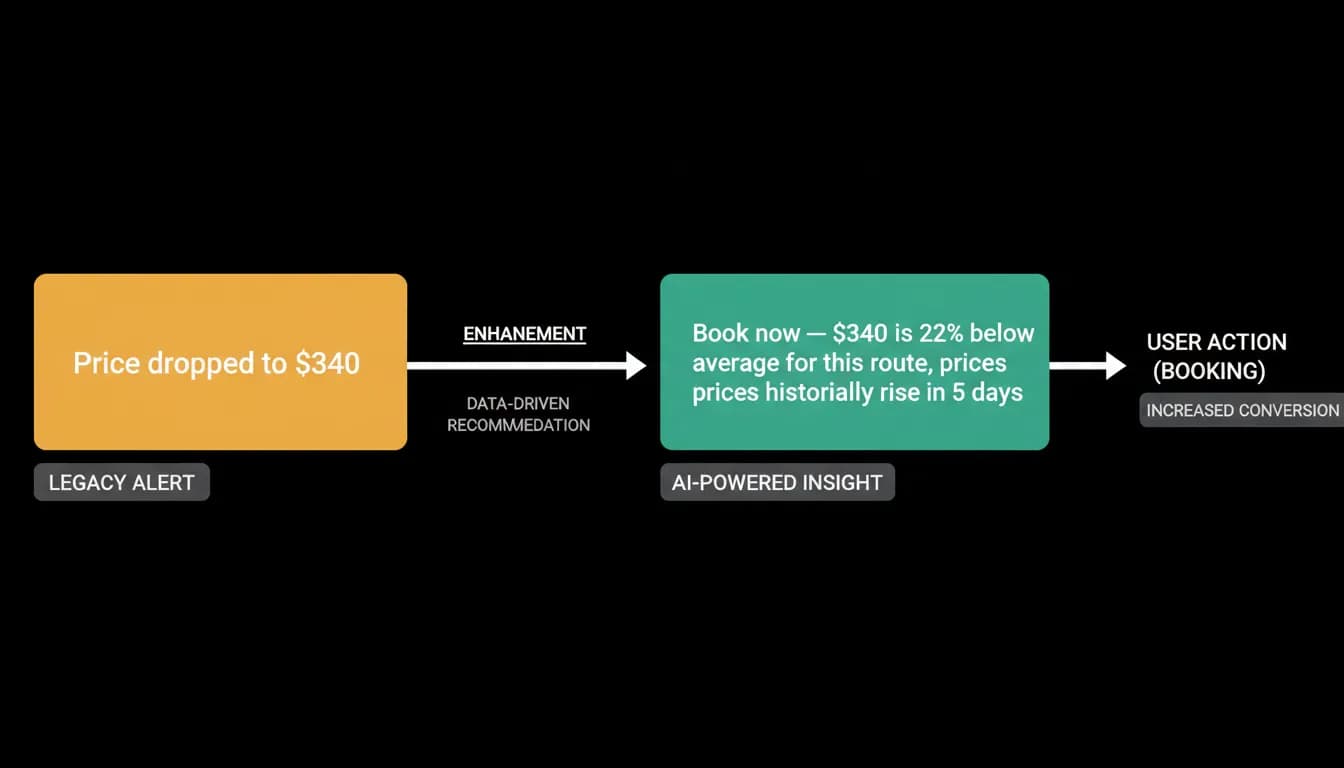
The most important word in AI price intelligence is "context." The same price can be a great deal or a terrible deal depending on context.
$400 to Barcelona in peak summer is excellent. $400 in January is above average. $400 on a nonstop is very different from $400 with a 6-hour layover. $400 on a fare with free changes has more value than $400 on a nonrefundable basic economy ticket.
AI agents evaluate fares in the context of your specific trip. They know your dates, your flexibility, your departure airport options, your preference for direct flights, and your historical price sensitivity. When they say "this is a good deal," it means "this is a good deal for you, on this route, at this time, given your preferences." Not "the number went down."
Proactive timing
Traditional alerts wait for a price to change and then tell you. AI agents predict price movements and tell you before the change happens.
"Fares to Barcelona are currently $380 for your dates. Based on historical patterns for this route, prices typically drop 10 to 15 percent about 45 days before departure. You are 60 days out. Recommendation: set a target of $340 and book if it hits that within the next 2 weeks. If it does not drop by then, book at market price because fares start rising at 40 days."
This is proactive timing intelligence. It accounts for route-specific pricing patterns, demand curves, and your specific booking window. Price alerts cannot do this because they have no model of price behavior — they simply watch a number.
The savings difference is meaningful. Proactive booking timing saves 15 to 25 percent compared to reactive alert-based booking across the average traveler's annual flights. On a household spending $3,000 to $5,000 per year on flights, that is $450 to $1,250 in savings.
Fare class awareness
This is the dimension that price alerts completely ignore and that represents some of the largest missed savings.
When a price alert triggers, it is usually for the cheapest visible fare. That fare is almost always basic economy — the most restrictive fare class with the least value. It looks cheap until you add a seat selection ($30), a checked bag ($35), and discover that changing the flight costs $150.
AI agents evaluate fare classes as part of the deal recommendation. The agent might tell you: "The basic economy fare is $340, but the regular economy fare at $380 includes seat selection and a checked bag you would pay $65 for anyway, plus change flexibility valued at $150. The $380 fare is the better deal by $25 in direct value plus insurance against plan changes."
This fare class intelligence catches money that alert-based booking leaves on the table.
Set up proactive price monitoring
The shift from alerts to intelligence requires one change: instead of setting static price thresholds, tell your AI agent about your trip and let it monitor the market intelligently.
"I want to go to Barcelona sometime in late March or early April. Two people. Budget is around $400 per person for flights. I'm flexible on dates. Tell me when it's the right time to book."
The agent monitors prices across your flexible window, evaluates fare classes, tracks historical patterns for the route, and sends you a recommendation when the data says it is time to act. Not when a number crosses an arbitrary threshold. When the market conditions align with your trip parameters for the best outcome.
That is the difference between watching a price ticker and having a financial advisor. Both involve the same underlying data. Only one of them is actually helping you make better decisions.
Nowah is an AI travel agent that searches and books real flights and hotels through conversation — no filters, no thirty open tabs. Plan your next trip.