Travel Booking Conversion Rates: Why Conversational Booking Converts Better
OTAs convert a low single-digit share of sessions. Conversational booking removes most of the drop-off points that cause it — here is where they actually occur.
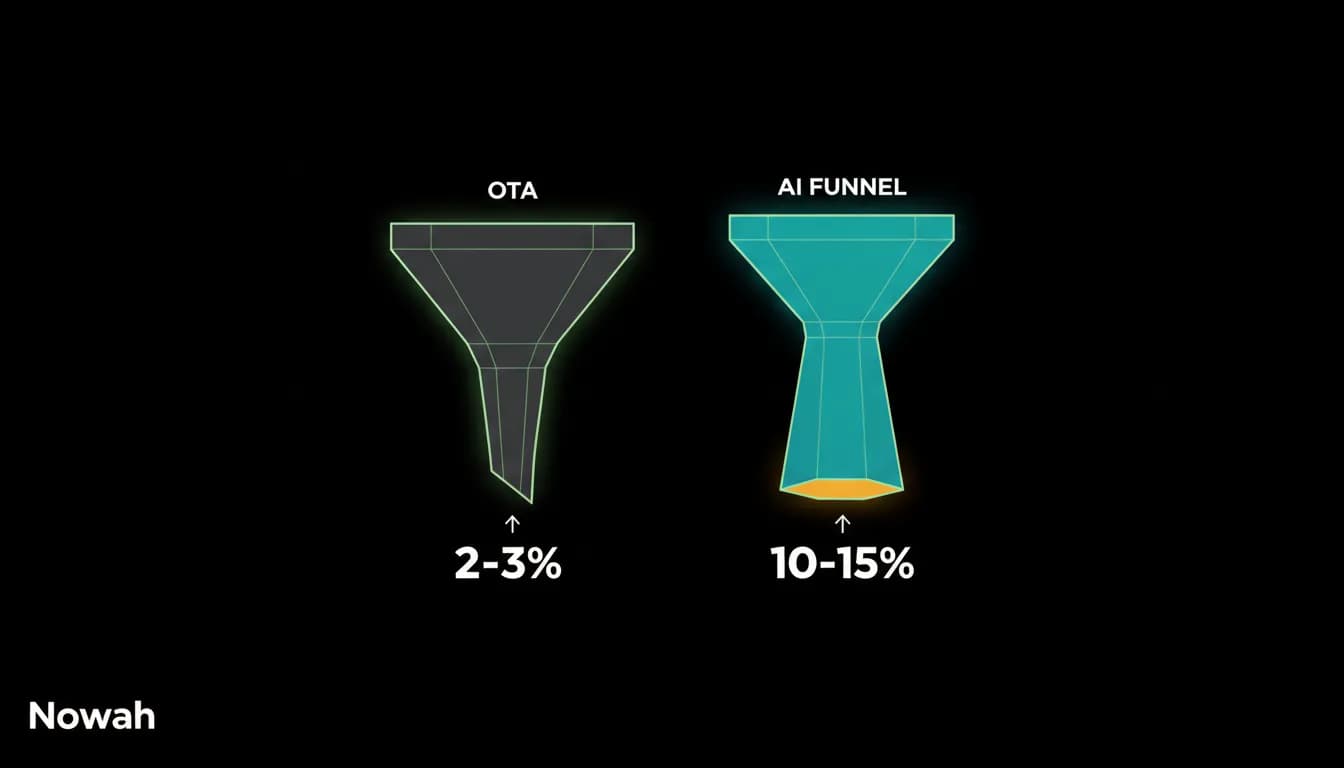
Ninety-seven out of every 100 OTA sessions end without a booking. That is not a typo. The industry-standard conversion rate for online travel agencies is 2 to 3 percent. Travel has the highest cart abandonment rate of any e-commerce category — 80 to 90 percent — and the gap between browsing and buying is wider than in any other online vertical.
Conversational booking converts markedly better on the same traffic — same travelers, same flights, same hotels. The difference is not better pricing or exclusive inventory. The difference is structural: fewer steps, less friction, more confidence, and guided decisions that move travelers from intent to purchase without the drop-off points that plague traditional booking flows.
Understanding why the conversion gap exists — and why it is structural rather than cosmetic — explains why AI agents are not just a better interface but a fundamentally different business model.
Why OTA conversion is structurally low
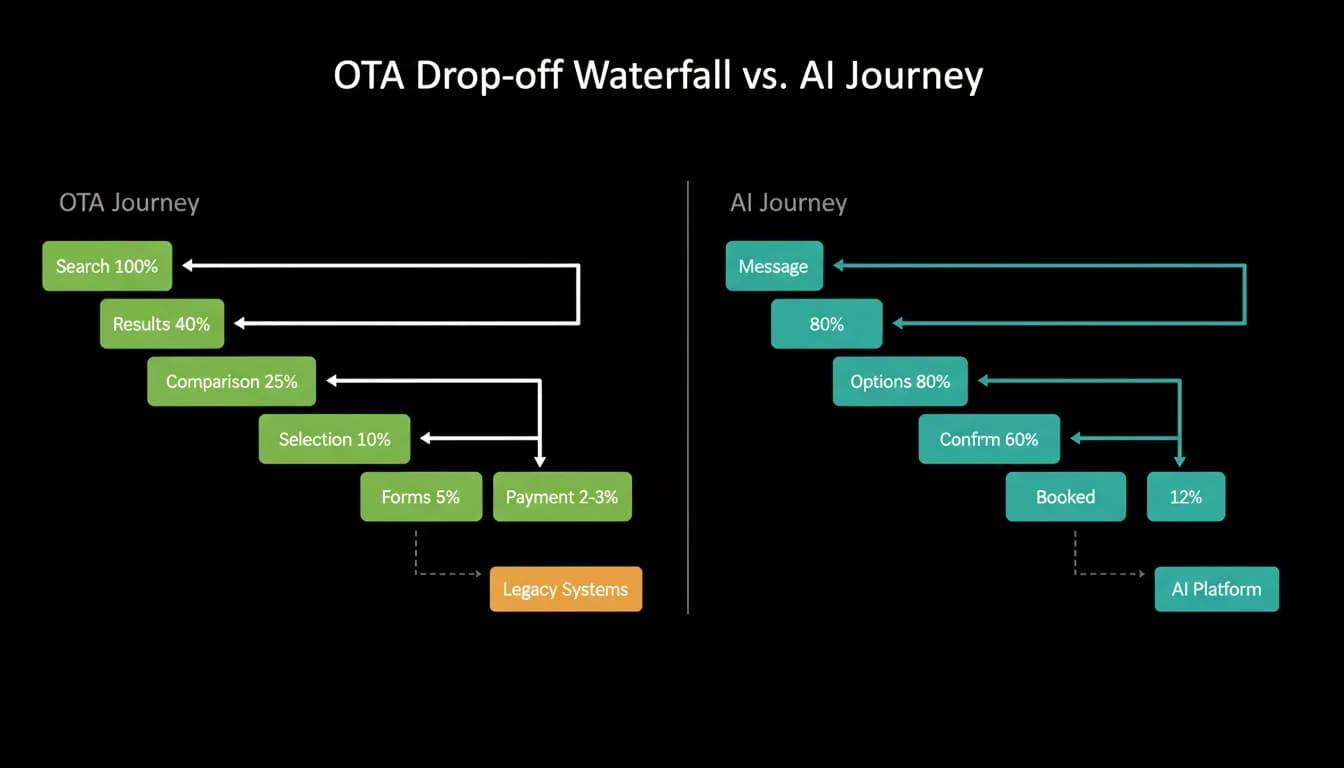
OTAs were designed to maximize the top of the funnel. Get as many eyeballs as possible to the search results page, then hope some percentage clicks through to booking. The business model works because the volume is enormous — billions of searches per year — so even a 2 to 3 percent conversion rate generates massive revenue.
But the low conversion is not an optimization problem waiting to be solved with better buttons or cleaner forms. It is a structural consequence of how OTAs work.
Too many options. A flight search returns 200 or more results. A hotel search returns hundreds. The traveler is expected to evaluate, compare, and decide among these options using filters and sort functions that cover 3 to 5 dimensions. Research consistently shows that satisfaction and decision quality decline after evaluating 6 or more options. OTAs present 30 to 100 times that number.
Too many steps. The OTA booking funnel averages 8 steps: search, filter, compare, select, ancillaries, passenger details, payment details, confirmation. Each step is a drop-off point. With 8 steps and a 15 to 25 percent drop-off rate at each step, the math produces 2 to 3 percent end-to-end conversion.
Too much friction. Form fields. Dropdown menus. Credit card entry. Passenger information. Seat selection screens. Baggage screens. Insurance upsell screens. Each screen is a friction point that slows the traveler and creates an opportunity to abandon. Mobile makes this worse — the same forms on a 6-inch screen are even more painful.
The comparison loop. The abundance of options creates a "what if there is something better" anxiety. Travelers search on one platform, check another, compare prices, return to the first, find prices changed, and ultimately book nowhere. The average traveler conducts 45 search sessions before completing a single flight booking. The OTA designed for comparison shopping inadvertently encourages comparison to the point of paralysis.
The AI conversion advantage
Conversational agents convert better because they address every structural problem that suppresses OTA conversion.
Fewer options. Instead of 200 results, the AI agent presents 2 to 4 curated recommendations. Each recommendation includes an explanation of why it was selected and how it compares to the alternatives. Curated options with stated reasoning leave travelers more confident in the choice than an unranked list does.
Fewer steps. The AI booking funnel has 3 steps: describe what you want, review the recommendation, confirm the booking. The conversation replaces search, filter, compare, and select. The agent handles ancillaries by asking conversational questions ("Do you want to check a bag?") rather than presenting multi-screen selection flows.
Less friction. Text input replaces form fields. Payment information stored in the profile replaces credit card entry. Traveler details from previous bookings auto-populate. The 8-step OTA funnel compresses to a conversation that feels like texting a knowledgeable friend.
No comparison loop. When the AI agent explains why a specific flight is recommended — "This is the cheapest direct option, it has your preferred seat available, and it departs at the morning time you consistently choose" — the traveler does not feel compelled to check other platforms. The recommendation came with reasoning, and the reasoning addresses the "what if" anxiety.
Friction mapping
Where exactly do travelers drop off on OTAs, and how do AI agents retain them at each point?
Search results page (40 percent drop-off on OTA). The traveler sees hundreds of results, feels overwhelmed, and either narrows with filters (losing options they might want) or scrolls until frustrated. AI agents skip this step entirely — the search happens behind the conversation.
Comparison phase (35 percent drop-off on OTA). The traveler opens multiple tabs, compares prices and times, and enters the "what if" loop. AI agents present 2 to 4 options with trade-off explanations, eliminating the need for manual comparison.
Form entry (18 percent drop-off on OTA). Entering passenger details, payment information, and ancillary selections on form-based screens. AI agents use stored profile data and conversational prompts.
Payment (10 percent drop-off on OTA). The final moment of commitment, where travelers second-guess the price. AI agents provide price context ("this is 12 percent below the 90-day average") that supports the purchase decision.
The cumulative effect is where it matters. A conversational flow has far fewer places to lose someone: no filter panel to abandon, no results page to bounce from, no comparison tab to leave open. Each removed step is a drop-off point that never happens.
Revenue per session
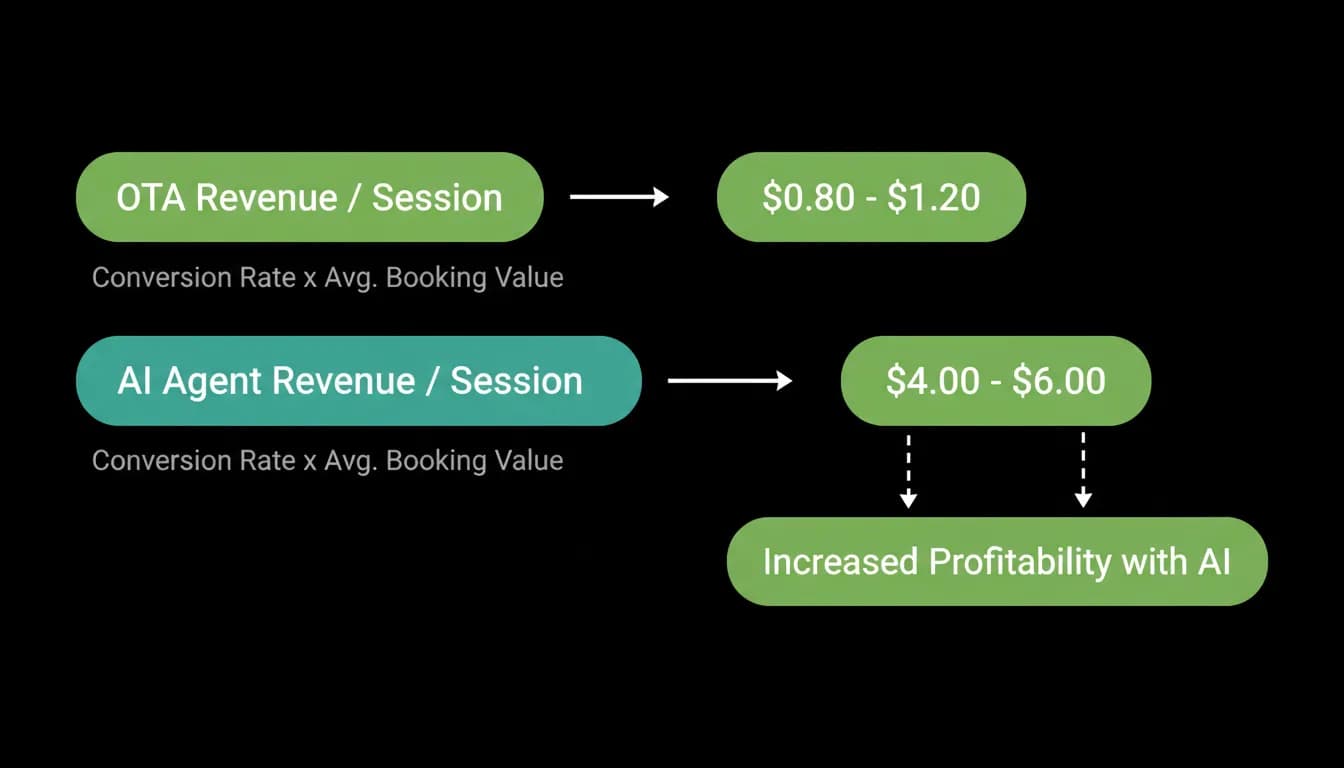
The conversion difference translates directly to revenue: the same session is worth considerably more when a materially larger share of sessions ends in a booking.
Work it through on any assumption you like: at a $500 average booking value, a couple of percentage points of conversion is a few dollars of gross booking value per session, while a double-digit conversion rate is an order of magnitude more.
This difference changes the unit economics of customer acquisition. A platform that converts a larger share of its traffic can pay more for that traffic than one that does not — or reach profitability at much lower marketing spend.
The conversion advantage is not just a user experience metric. It is the foundation of a superior business model.
The conversion cost calculation
For industry professionals evaluating booking platforms: calculate your true conversion cost. Take your total marketing and customer acquisition spend and divide by completed bookings — then ask how much of that cost is buying sessions that your funnel structurally cannot convert.
If you are spending $30 to $50 per completed booking in customer acquisition (typical for major OTAs), an AI agent conversion rate would reduce that to $6 to $10. The savings flow directly to either lower consumer prices or higher margins — or both.
The 5x conversion advantage of AI agents is not a temporary phenomenon that OTAs will close through better design. It is structural. Conversational interfaces produce fewer drop-off points than form-based interfaces. Curated recommendations produce higher decision confidence than open-ended search. Personalization produces higher relevance than generic results. These advantages are architectural, not cosmetic, and they persist because they are embedded in how the product works.
Nowah is an AI travel agent that searches and books real flights and hotels through conversation — no filters, no thirty open tabs. Plan your next trip.