First-hand travel reviews vs researched examples: create credible Nowah content
Create credible Nowah content by separating first-hand observations, supplier facts and fictional planning examples in a practical claim register.
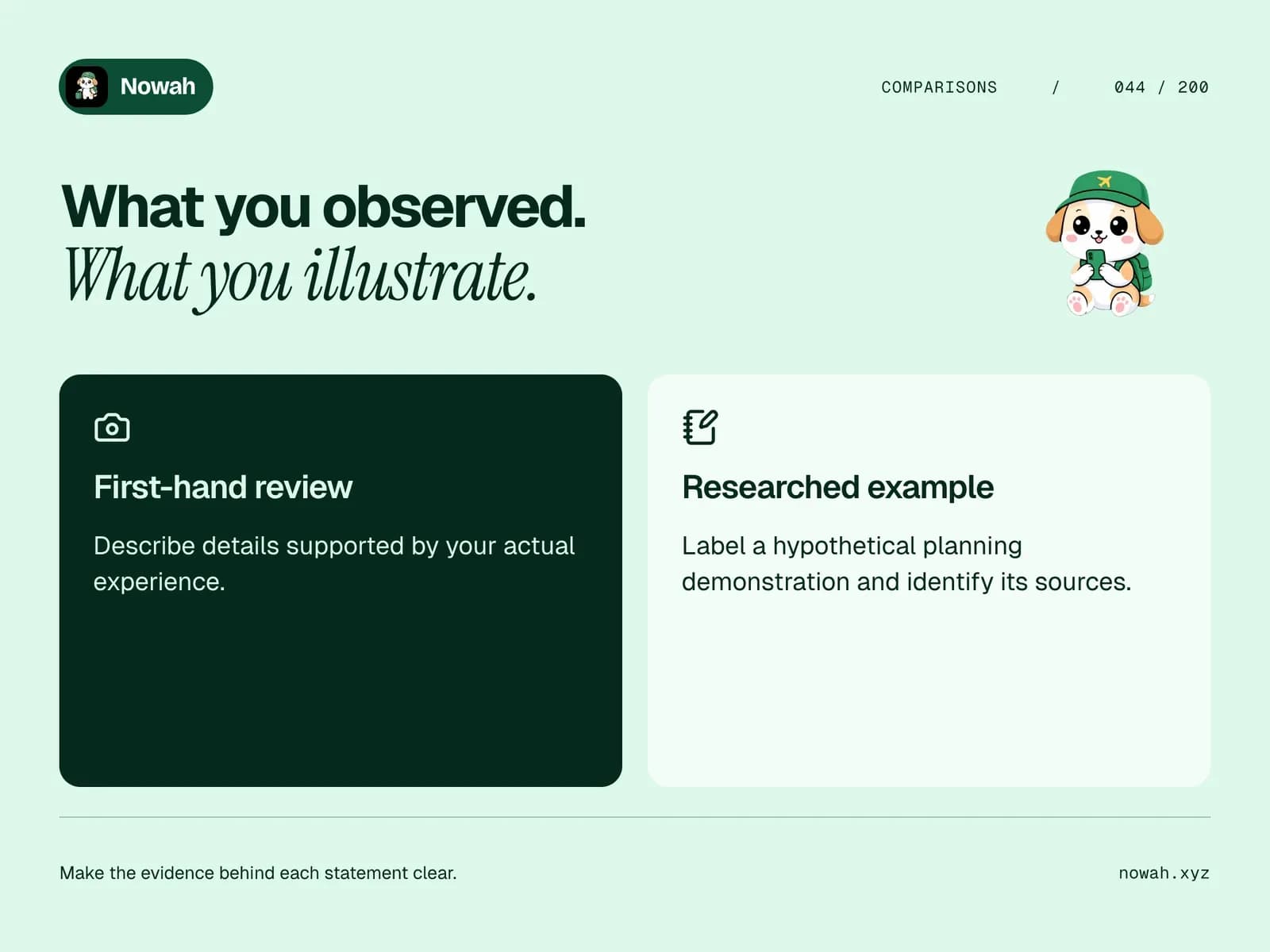
A creator can publish useful travel guidance from personal experience, current research or a clearly labelled planning example. The problem begins when those evidence types are presented as interchangeable. A generated itinerary is not proof of a real stay, and a supplier description is not a personal observation.
The Nowah Partner Program offers approved creators 35% of Nowah net revenue from qualifying bookings by eligible attributed accounts. Its continuing account attribution gives useful evergreen recommendations a meaningful commercial opportunity. That opportunity is stronger when the reader can understand what supports the advice.
This guide provides a claim register for combining first-hand observations, researched facts and fictional Nowah demonstrations. It does not require you to pretend you have travelled everywhere you discuss, or suggest that a commercial disclosure can replace evidence for a product claim.
Identify what you personally observed
A first-hand observation should be tied to the experience you actually had. Record the date, relevant room or product context and the limits of what you saw. One stay does not establish the condition of every room or the experience of every future guest.
Be precise about the wording. An observation about the room you used is narrower than a statement that an entire property always provides the same feature. A personal impression can be useful when it is clearly presented as an impression rather than a universal guarantee.
Keep your original notes and legitimate media appropriately organized. If the content was created under a separate commercial agreement, check the relevant usage permissions before reusing it in another recommendation.
The luxury room-tour evidence guide is useful when a visual review needs a careful distinction between what was filmed and what still requires current supplier information.
Separate supplier-stated facts
Room occupancy, rate inclusions, fees and cancellation conditions may depend on the actual offer and date. Use a current appropriate source and identify the scope of the information. A property-level description may not establish what applies to a particular room or rate.
Do not turn a supplier claim into a personal test result. If you have not used a product or stayed in a room, say that the information is researched rather than implying first-hand experience.
The FTC's influencer guidance cautions creators against claiming experience with products they have not tried. Review the applicable requirements for your actual content and audience, alongside the program and platform rules.
A researched guide can still be useful. Its value lies in selecting relevant evidence, explaining the decision and making the remaining questions clear, rather than inventing a visit to make the article sound authoritative.
Label the role of a Nowah planning example
A fictional demonstration can teach a useful process without reporting a real traveller's private details. State that the brief is hypothetical, explain why its inputs matter and identify what the example is intended to show.
For instance, a creator could demonstrate how two adults might organize a three-night city break with an evening arrival. The Nowah segment can explain a location priority and the next information to investigate. It does not certify current room availability, actual transport conditions or the suitability of a particular supplier offer.
A plan or map supports reasoning; it is not automatically evidence that the suggested trip has been completed or personally tested. Keep that distinction visible in the caption, narration and article text.
The one-question demonstration guide helps you choose a focused task so the hypothetical example adds practical value rather than decorative detail.
Work through a fictional review-editing exercise
Imagine a creator preparing a hotel-area article. In this teaching scenario, the creator has genuine footage from a past stay, current supplier information to investigate and a fictional Nowah brief for a different traveller situation. The scenario does not report a real creator's result.
The first draft mixes all three into one confident paragraph. The revised draft separates them: what was observed on the past visit, what the current source states and how the fictional brief helps a reader think about their own trip.
The Nowah recommendation becomes clearer because it has a defined role. It helps organize the reader's next question instead of appearing to confirm every fact in the original footage. Any commercial relationship relevant to the stay or partner link receives an appropriate explanation.
The exercise can improve clarity without claiming a measured increase in trust, clicks or bookings. Its output is a more accurate account of the evidence.
Build a claim register
Use one row per material statement. Record the claim, evidence type, source or observation date, relevant scope, remaining question and the wording you intend to publish.
An observed room detail belongs in the first-hand category, with its limits. A supplier condition belongs in the researched category, tied to the actual offer. A fictional trip input belongs in the hypothetical category and should not be promoted into a confirmed traveller requirement.
Add a separate field for generated media. The fact that an image looks plausible does not establish a property condition or travel experience. Keep its explanatory role visible.
The honest imagery guide provides a useful next check when an article combines actual photographs and generated diagrams. The register should make each image's evidential role easy to identify.
Review the transitions between evidence types
Many problems appear between sections rather than in an individual sentence. A real room photograph followed immediately by an illustrative booking discussion may imply that the example uses the exact room or current offer shown.
Write the transition explicitly. Explain when you move from a past observation to current research or a fictional planning lesson. The reader should not need to infer that a new traveller's dates and requirements may lead to a different option.
Then review the images separately from the full article. A shared extract should retain enough context that it does not turn generated material into apparent travel photography or a hypothetical result into a testimonial.
The AI illustration versus property photography comparison explores that visual distinction in more detail.
Make the Nowah earning explanation evidence-led too
The current partner terms define Nowah's commercial model. Approved partners earn 35% of Nowah net revenue from qualifying bookings by eligible attributed accounts. The traveller's retail price is not the base, and the permitted direct deductions exclude general overhead, salaries and general marketing.
For hypothetical arithmetic, a qualifying booking producing $60 of Nowah net revenue would generate a $21 partner share. That is not a real creator payout record, a fixed signup value or a prediction about the fictional city break.
If you later discuss actual outcomes, identify the period, currency and evidence status appropriately. A pending amount, a transfer and a bank receipt represent different stages. A well-labelled teaching example should not be reused as if it documented real performance.
The recording-assumptions guide helps keep those commercial examples honest.
Explain the account relationship precisely
A useful article can introduce a new traveller, but the program's actual conditions still apply. Eligibility requires the active partner route, successful tracking and a new account created within 30 days of the valid introduction. Existing accounts, self-referrals and artificial accounts do not qualify.
Once established, attribution continues for that traveller account's lifetime and can apply to later qualifying hotel, flight and paid eSIM bookings. This continuity is a meaningful reason to build a useful body of travel guidance.
It is not guaranteed repeat income. A person may learn from the article without creating an eligible account or making a qualifying purchase. Keep the editorial value and commercial outcome connected but supported by their own evidence.
Actual earnings also require completion, supplier settlement, the hold after the later event and the relevant payout conditions. Do not describe a useful demonstration as an immediate payment event.
Review the finished page as a reader
Open the rendered article on a phone. Can the reader identify what you observed, what you researched and what is fictional? Do the captions preserve those distinctions? Does the actual next destination match the promise surrounding the link?
The existing hotel review and star-rating discussion provides useful background for looking beyond an unqualified score. Your claim register should supply the context that a simple rating or attractive photograph cannot.
Check the commercial disclosure alongside the recommendation. A creator-facing guide can invite another influencer to learn about the program and apply, while an approved traveller recommendation needs the appropriate active partner route. Keep those audiences distinct.
Build useful recommendations from honest evidence
Nowah gives creators a compelling opportunity through a defined net-revenue share and continuing eligible account attribution. Your content does not need invented travel experience or unverified supplier claims to make that case.
Choose one reader question, complete the claim register and prepare a labelled Nowah demonstration. If the model fits the work you want to publish, apply to Nowah Partners. Applications are reviewed, and approval, eligibility and verification requirements apply. Let first-hand observations, researched facts and fictional examples each do the job they can genuinely support, then explain the earning model with the same care.




