Honest imagery for travel creators: check the public claim behind a Nowah visual
Check the public claim implied by a Nowah visual using an evidence card that separates actual results, supplier facts and explanatory concepts.
An image can create a public claim even when the caption never states it directly. A polished earnings chart may look like a real creator result. A planning diagram placed beside travel footage may appear to document a completed trip. For creators recommending Nowah, the useful question is what the audience is likely to believe the visual proves.
The Nowah Partner Program offers approved partners 35% of Nowah net revenue from qualifying bookings by eligible attributed accounts. Its defined earning model and continuing account attribution give creators a substantial opportunity to explain through clear diagrams, without inventing travel experience or performance evidence.
This guide provides a public-claim check for the image, caption and surrounding content together. It focuses on what the asset communicates, rather than choosing between illustration and photography or repeating a general room-review evidence checklist.
Write the claim a viewer could reasonably infer
Before publication, describe the likely takeaway in one sentence. Does the image appear to show a real hotel, an actual booking, a tested workflow, a measured audience result or only an explanatory concept?
The answer should come from the finished asset and its context, not from what you privately intended. A hypothetical label hidden outside a crop may not reach the person who sees the shared image. A testimonial-style layout can suggest a real speaker even if the text began as an invented example.
Do not treat visual polish as evidence. An image can look professional while still requiring a clearer explanation of its source, status and limits.
The recording-assumptions guide helps review the inputs behind a teaching graphic before it is presented publicly.
Match the evidence to that exact claim
A current program page can support a statement about the published earning model. It does not prove a particular creator's payout. A legitimate travel photograph can support an appropriately scoped observation, but it does not establish every condition of a future supplier offer.
A fictional planning example can teach a decision process without proving that an actual traveller followed it. A diagram of possible account and booking stages does not establish that those events occurred for your audience.
For endorsements affecting US consumers, the FTC's influencer guidance cautions against claiming personal product experience you have not had. Review the requirements relevant to the actual content and audience rather than using an image to imply evidence the words could not honestly state.
The evidence needs to support the specific claim, not merely be related to the same travel topic.
Work through a fictional earnings-graphic review
Imagine a creator preparing a Nowah educational graphic. It shows the 35% share and a $21 result. The creator intends to teach arithmetic, but the first layout resembles a personal earnings statement and does not identify the input clearly.
The revised version names $60 as hypothetical Nowah net revenue from a qualifying booking and shows the 35% calculation producing an illustrative $21 share. It does not include a fabricated creator name, payout date or statement reference.
The caption explains the formula and links to the current program evidence. The asset is now positioned as a teaching example, not a report of an actual earning result. This fictional review does not claim a measured improvement in engagement or conversions.
The commission-base communication guide provides a focused check for the words that need to remain visible beside the rate.
Review context, not only the individual image
A correctly labelled asset can become misleading when placed in a different context. A generic property illustration beside a first-person stay paragraph may imply that it shows the actual room. An illustrative earning figure beside a success-story headline may appear to document that result.
Read the image, title, caption and nearby sentences as one communication. Then inspect the image on its own, because it may be shared without the surrounding article. The essential evidence status should not depend on an explanation that disappears in the shorter format.
Do not assume a footer saying program terms apply resolves every mismatch. The reader still needs to understand whether the content describes a real event, current supplier fact or hypothetical concept.
The peer-review comparison guide is useful when a public visual includes competitor claims or several earning models.
Create a public-claim card
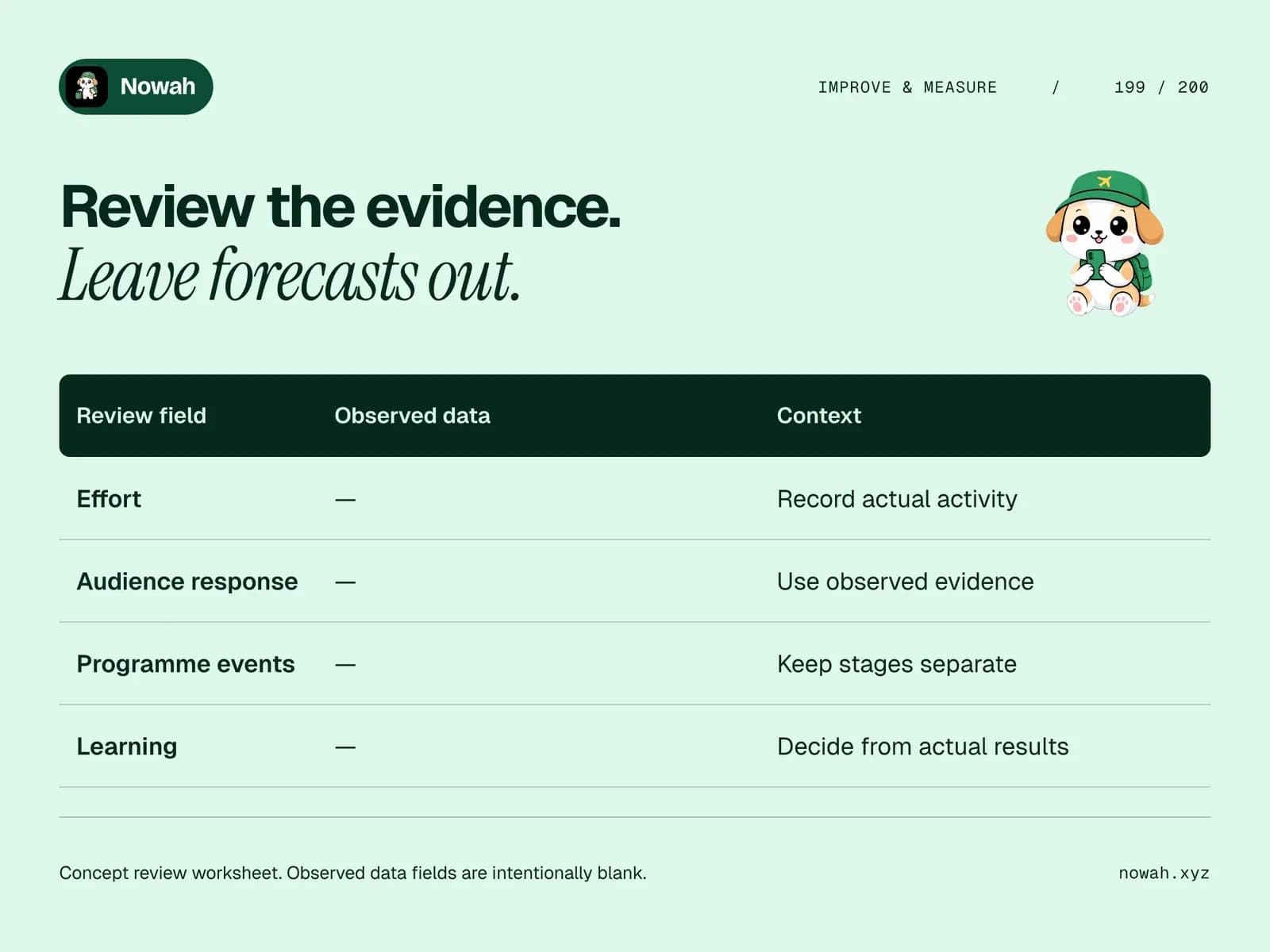
Give each asset five fields: likely audience takeaway, evidence supporting it, date and scope of that evidence, essential labels and the public context where the image will appear. Add an unresolved-question field when the source does not establish the intended claim.
For a program diagram, the evidence may be the current Nowah terms. For an actual performance claim, use the appropriate real record and describe its period, currency and status accurately. Do not invent private results to complete the design.
For public teaching material, fictional inputs should remain clearly labelled. A generated or designed image can add original explanatory value without pretending to be a photograph, statement or testimonial.
The card helps an editor identify the revision needed. It is not a guarantee of compliance or proof that the asset will perform commercially.
Keep the Nowah recommendation useful
An honest visual should help the reader understand a travel or program question. A labelled trip brief can explain how an arrival constraint affects the first night. A net-revenue diagram can clarify the earning base. An account timeline can distinguish signup from later qualifying travel.
Connect the image with a practical Nowah demonstration and identify the next information to investigate. Current supplier availability, room conditions and actual transport arrangements still need appropriate evidence. A plan or map is not a certificate that a trip has been completed or verified.
The one-question demonstration guide helps define that useful role. The recommendation becomes more persuasive when the viewer understands the task rather than being asked to infer a benefit from a logo or glamorous scene.
Explain the commercial model precisely
Approved Nowah partners earn 35% of Nowah net revenue from qualifying bookings by eligible attributed accounts. The current terms define permitted direct deductions and exclude general overhead, salaries and general marketing from that list. The traveller's full retail price is not the base.
The hypothetical $60-and-$21 example explains that formula only. It does not value a signup, predict earnings from a particular trip or prove a creator received a bank payment. Keep those limits visible wherever the example is reused.
Actual earning evidence also needs the appropriate status. Completion, supplier settlement, the hold after the later event and relevant payout conditions matter. A pending amount, a transfer and a bank receipt should not be presented as interchangeable proof.
The pending-versus-eligible earnings guide supports a more detailed explanation of those stages.
Keep account attribution separate from attention
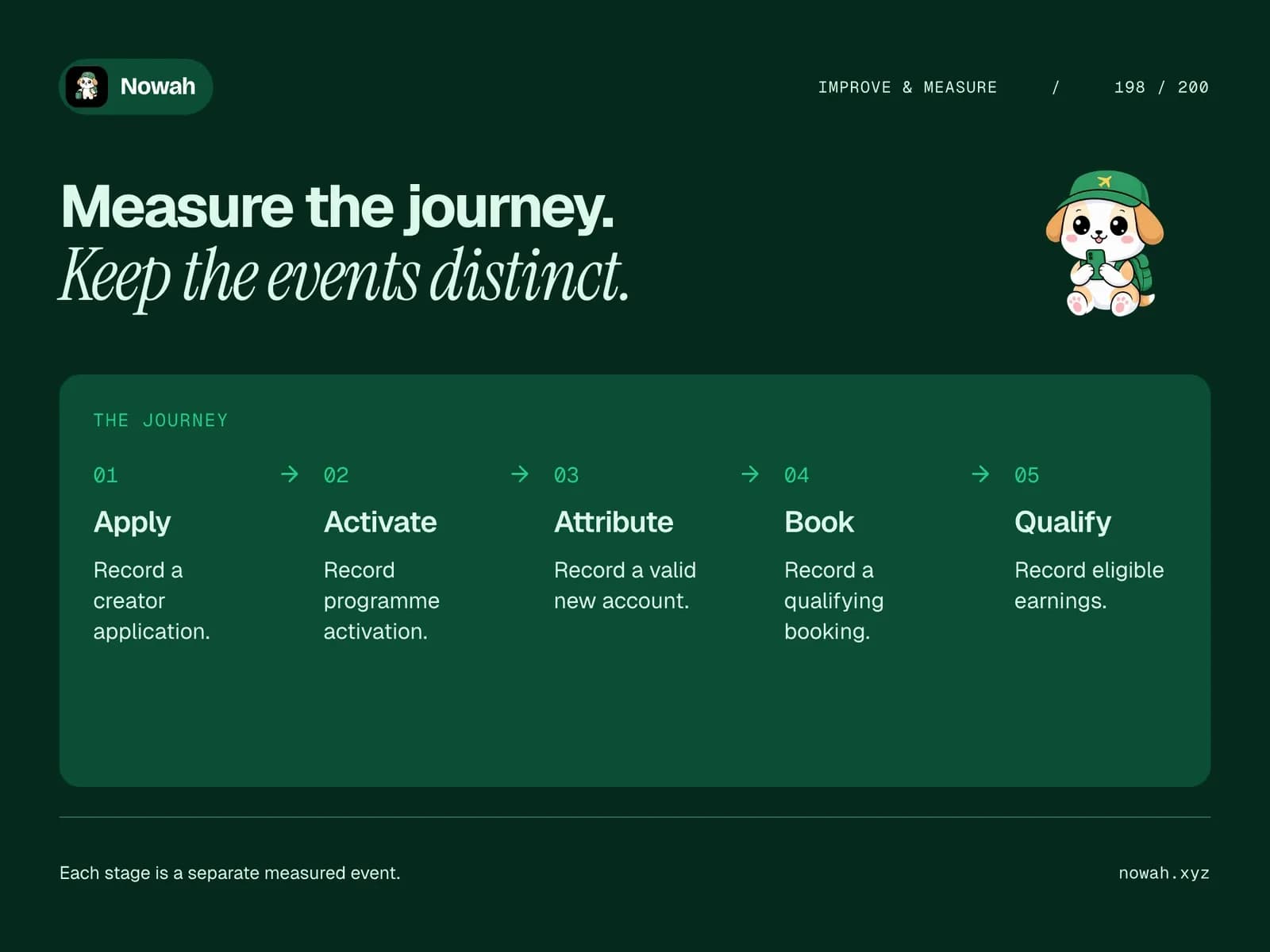
A shared image, view or link interaction does not by itself establish the Nowah relationship described in the terms. The eligible new traveller needs the active partner route, successful tracking and a new account created within 30 days of the valid introduction. Existing accounts, self-referrals and artificial accounts do not qualify.
Once established, attribution continues for that traveller account's lifetime and can apply to later qualifying hotel, flight and paid eSIM bookings. That continuity is a meaningful reason for useful evergreen content, without guaranteed repeat income.
Do not illustrate the sequence as if every viewer automatically completes each stage. A process diagram can show what would need to happen while leaving actual outcomes unmeasured.
Maintain the claim when facts change
Record which source supports a material figure or condition and when you checked it. If a program or supplier fact changes, review the static image, caption and linked article together. Updating only one can leave the public message inconsistent.
The refreshing-changing-facts guide provides a useful next resource. The existing article about what travel AI gets wrong offers broader context for evidence-led product explanations rather than unsupported certainty.
Check crops and alternative text as well. They should preserve the same key distinction between actual evidence and explanatory concept, rather than silently changing the image's meaning.
Publish a visual whose claim you can explain
Nowah gives creators a compelling opportunity through useful introductions, a defined net-revenue share and continuing eligible account attribution. Clear visuals can make that model easier to understand without manufacturing a travel story or earning result.
Choose one asset, complete the public-claim card and review it in the actual content context. Disclose the relevant partner relationship and make the next destination match the task. If the model fits your work, apply to Nowah Partners. Applications are reviewed, and approval, eligibility and verification requirements apply. Make the image useful, preserve what the evidence actually establishes and assess real outcomes through the events and records that exist.