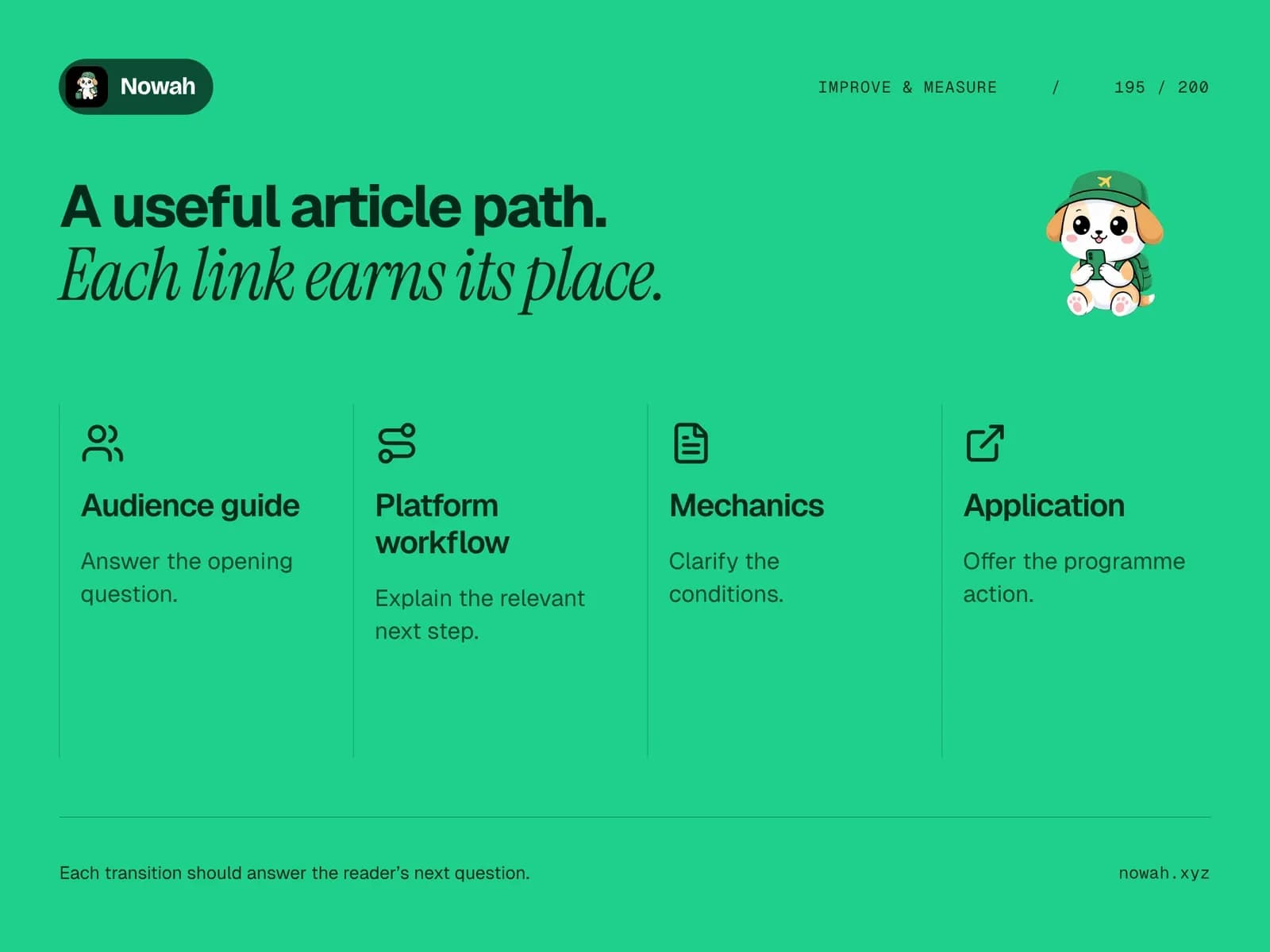
Measure the complete Nowah creator journey with the right evidence
Review Nowah creator applications, activation, attribution, qualifying bookings and earnings with defined events and appropriate evidence for each stage.
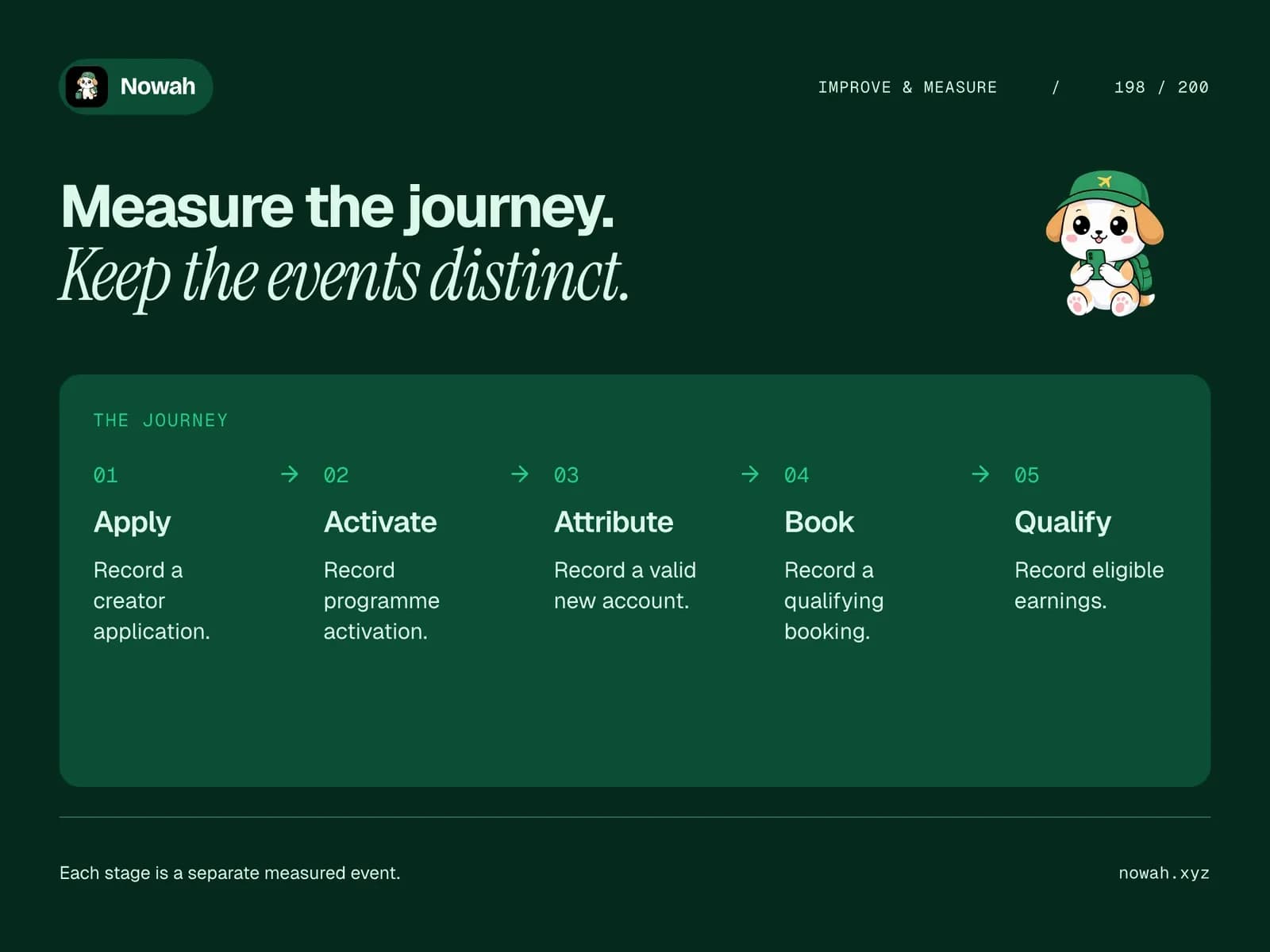
Travel content, partner applications, newly attributed accounts and qualifying bookings describe different parts of a creator business. A useful review keeps those events recognisable instead of presenting every encouraging number as the same conversion.
The Nowah Partner Program gives the commercial journey a defined basis: approved partners earn 35% of Nowah net revenue from qualifying bookings by eligible attributed accounts. A content view does not establish that earning, and an application is not a traveller referral. Measurement becomes more useful when each stage has an explicit definition and appropriate evidence.
This guide provides an evidence contract and a review memo for the whole journey. It does not assume access to private accounts, a particular Nowah analytics interface or a complete cross-domain reporting integration.
Keep the two journeys separate
Creator acquisition concerns someone learning about the program, applying, receiving a reviewed decision and becoming an active partner through the appropriate onboarding process. The audience journey concerns an approved partner's recommendation, a valid introduction, a new eligible traveller account and possible qualifying bookings.
Those journeys connect commercially, but they do not describe one interchangeable event. A resource explaining the program may attract prospective partners. A traveller-facing recommendation should explain a useful travel task and the appropriate disclosed active partner route.
The two-journey guide provides a dedicated explanation. For measurement, keep separate sections so an application total cannot quietly become a total of newly attributed travellers.
Define the unit before counting it
Write down what one entry represents. It might be an application, an approved partner, a traveller account, a booking or an earning entry. Those units are different, even when they belong to a related campaign.
One account may have possible later qualifying bookings after a valid initial attribution. Counting each booking as a new account would misstate acquisition. Similarly, a repeated view of a resource does not necessarily represent another person considering the program.
Use the unit and period supplied by the actual record. Avoid combining metrics merely because they appear beside each other in a presentation. A clear review can report several different observations without forcing them into one total.
Build an evidence contract for each stage
An evidence contract is a short note describing what would establish the event, what record is actually available and what remains unknown. Keep it in your own review document.
Stage | Evidence question |
|---|---|
Application | What establishes a submitted creator application? |
Approval and activation | What establishes the relevant reviewed/onboarding stage? |
New attribution | What establishes the valid eligible account relationship? |
Qualifying booking | What establishes the product and booking conditions? |
Eligible earning | What establishes completion, settlement and release conditions? |
Transfer or bank receipt | Which actual payment event does the record support? |
Name the owner or appropriate source of each record where that is relevant and permitted. If the evidence is unavailable to you, mark the stage unmeasured. A missing record should not be replaced by an assumption based on the stage immediately before it.
Record what the content itself can establish
Your own content review may establish that an article contains a useful demonstration, a working destination and a clear commercial disclosure. Available platform or website tools may provide particular interaction records. Learn their actual definitions before using them as evidence.
A reader question can identify a missing explanation. A configured outbound event can describe the action it records. Neither alone establishes application approval, valid account attribution or a completed booking.
Use the controlled CTA guide when the task concerns comparing two truthful invitations. Keep that experiment's observation separate from the later commercial stages you cannot directly observe.
A hypothetical review with deliberately blank stages
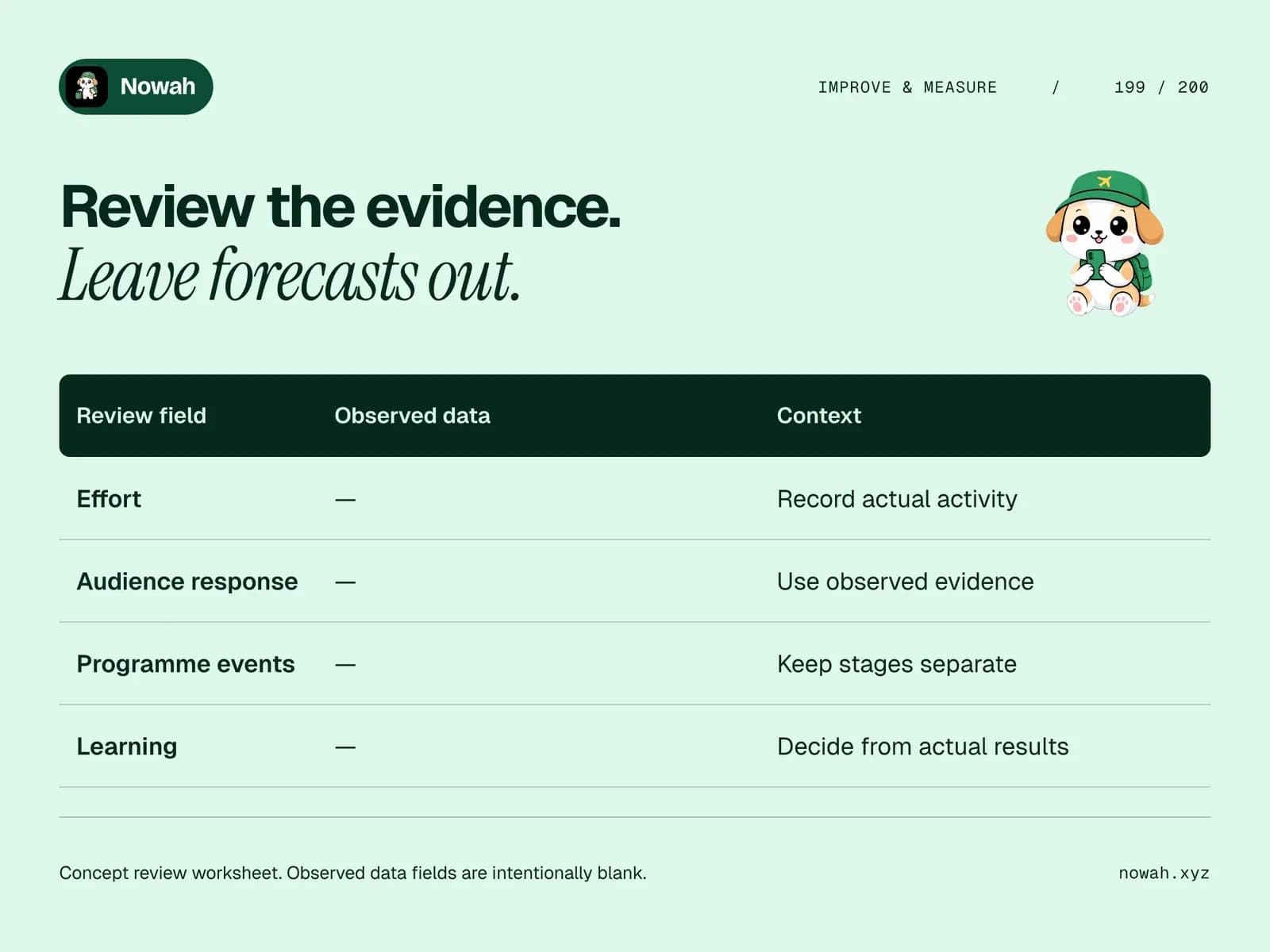
Imagine a fictional creator has published a hotel-area demonstration and has evidence that the resource is available with the intended link and disclosure. They also have a record relevant to their own partner onboarding. These are teaching conditions, not actual creator results.
Their review can describe the completed content task and the supported onboarding stage. It should leave traveller attribution and booking outcomes blank unless appropriate records establish them. The existence of a useful article and an active partner does not prove that an audience member completed the earning journey.
If a later record establishes an eligible new account relationship, that supports an additional event. It still does not establish a qualifying booking or a bank receipt. Each added observation needs its own evidence rather than inheriting certainty from the previous row.
The blank stages make the review more honest and useful. They identify the question that remains unresolved instead of producing a complete-looking funnel from unrelated observations.
Interpret attribution using the program rule
The Nowah terms require a new eligible account within 30 days of the valid introduction, with tracking successfully reaching Nowah. Existing accounts and self-referrals do not establish eligible new attributions.
After valid account attribution exists, possible later qualifying bookings can also generate earnings for that account's lifetime. Keep that continuing relationship distinct from a fresh account introduction each time the traveller encounters another recommendation.
This gives Nowah a meaningful commercial story for creators making useful first recommendations. It does not guarantee repeat bookings or recurring income. The eligibility-event worksheet helps review excluded and unresolved cases without inferring private account information from comments.
Review the booking and earning stages independently
The listed eligible products include hotels, flights and paid eSIMs under the program conditions. A travel story mentioning restaurants, rail or an event does not make those purchases commissionable. Check the actual product scope before including a transaction in an earning explanation.
Completion and verified supplier settlement are both required. The applicable hold begins after the later event, with currency thresholds, verification and other payout conditions still relevant. A pending booking is therefore not interchangeable with an eligible earning.
The partner share applies to Nowah net revenue rather than the traveller's booking total. If you use a calculation example, label the inputs as hypothetical and keep it separate from any actual campaign result. A formula can explain the model without measuring what your content produced.
Preserve currency and payment-event boundaries
Keep settlement currencies separate in the review. A USD amount and a EUR amount do not become a valid single-currency total when added together. Use the appropriate records and threshold assessments for each currency.
A transfer to a connected Stripe account is also separate from a bank payout. Use the actual event and available evidence when describing money received. Avoid converting an earlier program stage into a guaranteed arrival date.
The earning-status guide covers the labels, while the separate-currency guide provides a different reporting sheet. Those distinctions preserve the meaning of the values in the overall review.
Write a four-part review memo
Summarise the period with four sections: task completed, evidence observed, stages unmeasured and next useful action. Keep the memo short enough that you can explain why each statement belongs there.
The task might concern producing a relevant Nowah demonstration or correcting a confusing destination. The evidence section should describe the actual records or observations. The unmeasured section preserves the boundaries. The next action should address the most useful unresolved question rather than assume a commercial outcome.
Compare periods only when the units, definitions and evidence are sufficiently consistent. If a measurement method changes, record that change. A more detailed report is not automatically evidence that the underlying creator business performed better.
Use the review to improve a real recommendation
Nowah should remain connected to the audience's travel decision. Explain the relevant brief, show a meaningful planning constraint and provide a useful disclosed next action. The commercial review can then assess the stages appropriate to that recommendation.
Keep content improvements and earning outcomes separate. A clearer itinerary demonstration may be worth preserving because it explains the task better, even before any financial outcome is established. Use genuine questions and available records to decide what to improve next.
This approach avoids treating the review as a contest to produce the largest number. It gives the creator a clearer account of the work completed, the evidence available and the part of the journey still requiring attention.
Build a measured creator practice
If this model fits your travel content, apply to Nowah Partners. Prepare a useful first recommendation and define the evidence you would need to assess it. Keep application, activation, attribution, qualifying travel and payment events recognisable throughout the review.
Nowah's defined net-revenue share and continuing attribution offer creators a substantive opportunity to explain. A complete measurement approach respects that opportunity by distinguishing the promise of the model from outcomes that actual records have established.