Match Pinterest Travel Pins to the Right Nowah Next Step
Match Pinterest travel Pins to useful Nowah destination pages, keeping the visual promise, article answer and partner next action aligned.
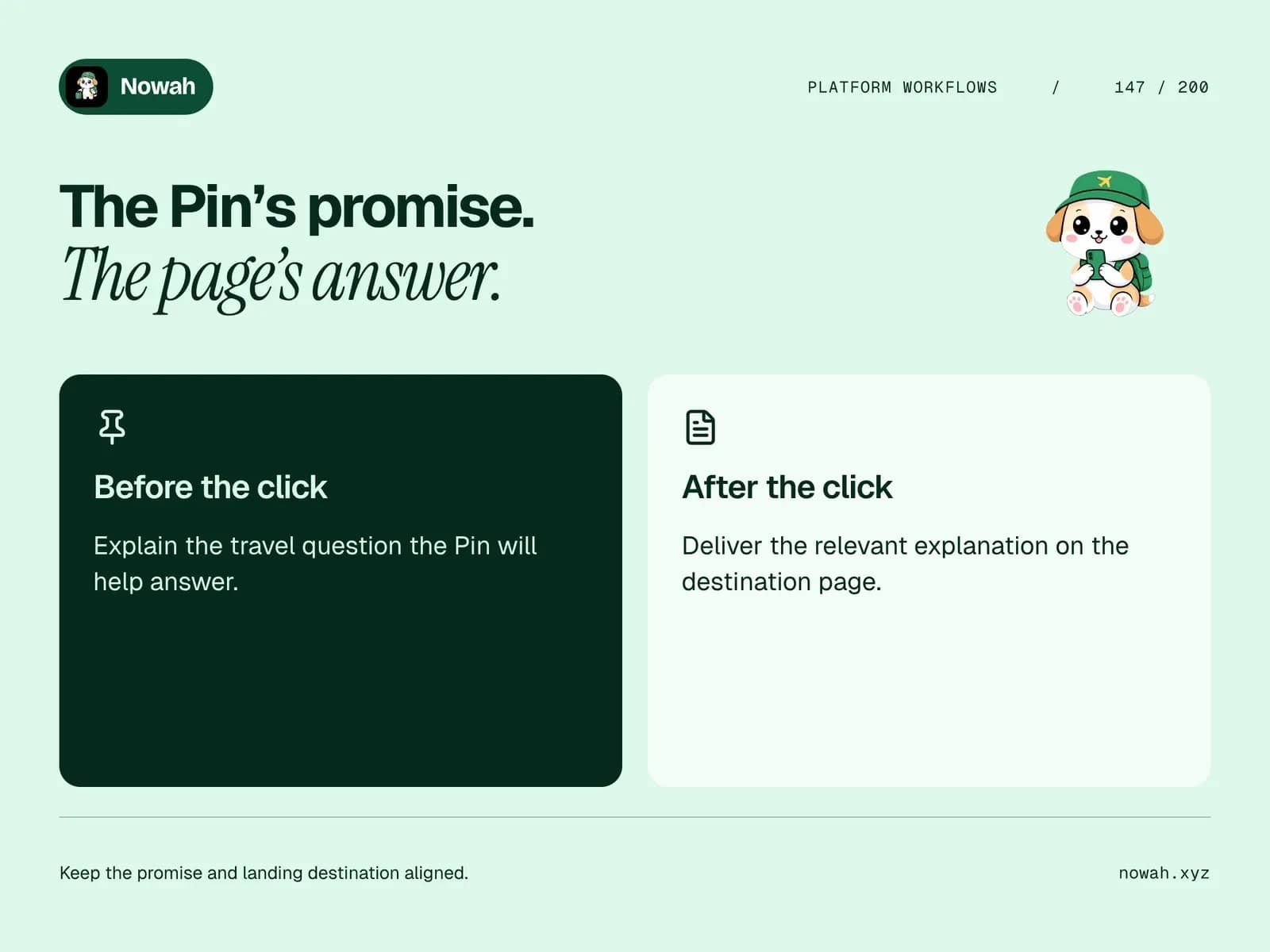
A travel Pin makes a promise before anyone opens its destination. It may offer a checklist, explain a comparison or introduce a planning question. The page reached should fulfil that promise before asking the reader to take another action.
For a creator recommending Nowah, a good destination match makes the commercial connection more useful. The reader can see how a practical travel brief leads into a relevant planning task. Approved Nowah partners can earn 35% of Nowah net revenue from qualifying bookings by eligible newly attributed accounts.
The goal is a coherent reader journey, not a claim that a particular Pin design guarantees traffic or earnings. Start by making the visual promise and the destination's answer agree.
Write the promise in one sentence
Describe what the Pin offers without using a vague phrase such as “travel smarter.” A specific promise gives you something to check.
The offer might be a rooming-question checklist, a hotel-move comparison or a way to organise an early departure. Each is a different resource with its own useful output.
Avoid claims the destination cannot establish. A page explaining a planning tradeoff does not necessarily prove the cheapest price, guarantee a hotel benefit or confirm a traveller's booking.
Use the sentence as a design constraint. The headline, illustration and supporting words should describe the same task rather than making several competing promises.
The original Pinterest resource guide helps choose a useful output before you decide how to present it visually.
Define the answer the page must provide
Open the destination and identify where it answers the Pin's question. A relevant page should not require readers to search through an unrelated introduction before discovering whether the promised resource exists.
The answer needs enough context to be useful. A hotel-move comparison should explain the shared brief and the consequences of each direction. A checklist should say which decision it supports and what remains dependent on current evidence.
Do not treat a generic product page as an automatic substitute for the specific resource promised by the Pin. A Nowah overview can be relevant when the Pin offers program information, but it may not fulfil a promise about a particular traveller worksheet.
The page should make the next action intelligible after delivering the answer. That is where a relevant Nowah demonstration or partner route can become useful.
Create a Pin-to-page promise contract
Write a short contract in your editorial notes. It should identify:
- The exact question shown on the Pin.
- The useful answer or resource the destination supplies.
- The assumptions behind any example.
- The evidence needed for changeable factual claims.
- The point where Nowah becomes relevant.
- The next action and its intended audience.
- The commercial relationship to explain.
This is a production tool you maintain, not a claimed feature of Nowah or Pinterest. Its purpose is to expose gaps before you publish.
Read the contract without the artwork. If the destination's job is unclear in words, a polished image will not solve it.
Use it again during updates. A page can keep the same address while changing its content or commercial purpose. The old Pin may then need a revised destination or a different promise.
A fictional early-departure resource
Imagine a creator making a Pin about how an early departure affects the final hotel night of a short break. This is an illustrative publishing example, not a real traveller story or a reported campaign result.
The Pin promises a small planning checklist. The destination explains which information matters: the actual departure requirements, the accommodation arrangement and the traveller's priorities for the final evening.
A fictional Nowah brief investigates a lighter final-day structure. The creator explains the reasoning while leaving real transport and supplier conditions for current verification. No journey time, room benefit or rate is invented.
The page's useful output is a list of questions to check, not a universal instruction to choose one hotel. A relevant, disclosed partner recommendation follows for readers investigating their own trip.
The Pin and page agree because both address the same planning decision. The recommendation becomes a continuation of the answer rather than a surprise change of subject.
Keep the Nowah demonstration specific
Show why the product belongs in the destination. A fictional brief can help explain how a timing constraint changes the planning question or why the traveller needs to clarify a priority.
Verify the product behaviour you describe. Do not invent an automatic Pinterest import, a creator dashboard or a special offer to make the page feel complete.
A planning output remains different from a confirmed booking. It cannot establish availability, cancellation conditions or the suitability of a specific arrangement without the relevant evidence.
Nowah's article about how events move flight prices offers background when a resource discusses fixed-date travel. The page still needs its own evidence for any specific travel claim.
If the demonstration is not relevant to the Pin's question, reconsider the connection. Adding a general promotional paragraph does not repair a destination mismatch.
Choose the appropriate commercial action
A traveller exploring a brief needs a different route from a creator evaluating a partner program.
For travellers, an approved creator should use the active partner route supplied through approval and onboarding. Do not invent a referral address or assume that a general application page establishes traveller attribution.
For prospective creators, the official program overview and partner portal are relevant destinations. The page should explain the reviewed application and the actual offer.
Label each route according to its purpose. A vague invitation to “get started” may leave the reader unsure whether they are planning a holiday, applying to a program or signing into an existing account.
The creator-versus-traveller journey guide helps separate those two goals when a resource library serves both audiences.
Make the commercial relationship visible
Tell readers that you are a Nowah partner and may earn commission from qualifying referrals. Keep the explanation understandable with the recommendation rather than relying on unrelated account history.
Pinterest's commercial guidance emphasises relevant, useful content and transparent commercial links. Treat that as part of the resource's quality, not an optional decoration after the design is finished.
Do not let a clear disclosure sit beside an unsupported promise. A fictional example cannot prove guaranteed savings or real creator earnings simply because its commercial purpose is acknowledged.
The Pinterest partner-link disclosure guide examines that relationship and destination behaviour in more detail.
Review the page as someone encountering the recommendation for the first time. They should understand both the practical task and the way you may benefit.
Test the actual reader journey
Inspect the Pin's text, the destination and the next action in order. Check that the page opens, contains the promised answer and uses labels that accurately describe the destinations.
Record what the test establishes. A successful page visit demonstrates the navigation behaviour you observed. It does not prove recorded attribution, a qualifying account or eventual partner income.
Check source destinations as well. An important supplier claim may lose its support if the original page changes or redirects, even while the resource itself still opens.
Look for unnecessary detours. If an intermediate page contains several choices, each should have a clear purpose. More destinations are not automatically more useful.
Keep the checked date and the reason for any revision with the promise contract. That gives future maintenance a specific starting point.
Explain the earning conditions accurately
The Nowah terms require a traveller to follow an active partner link and create an eligible new account within 30 days of introduction. Tracking must reach Nowah successfully. Existing accounts and self-referrals do not qualify.
Once valid attribution is established, later qualifying hotel, flight and paid eSIM bookings may generate earnings for the account's lifetime. This does not guarantee future travel or a fixed income.
The share is 35% of Nowah net revenue, rather than the traveller's total booking spend. Completion, supplier settlement and the applicable hold and payout conditions remain part of the process.
A Pin interaction or a visit to the resource page is not evidence that those later conditions have been met. Keep your commercial explanation accurate even when the resource's main subject is a travel question.
Keep the promise aligned over time
Review the contract when you change the article, replace the destination or reuse the Pin in another context. A resource can become misleading through a mismatch even when each individual sentence appears reasonable.
If the answer has changed, revise the visual promise or the destination so they agree again. Remove claims that no longer have current support.
For the next resource, choose a distinct planning decision rather than repeatedly distributing the same affiliate message with different artwork.
If this style of useful travel publishing fits your audience, apply to Nowah Partners. Build a recommendation around a clear question, a page that answers it and a next action that honestly continues the task. That gives the Nowah link a purpose readers can understand.




