Build a YouTube Hotel Review Chapter Map That Makes Nowah Relevant
Structure a YouTube hotel review around evidence, traveller tradeoffs and a useful Nowah planning example, with a clear chapter map.
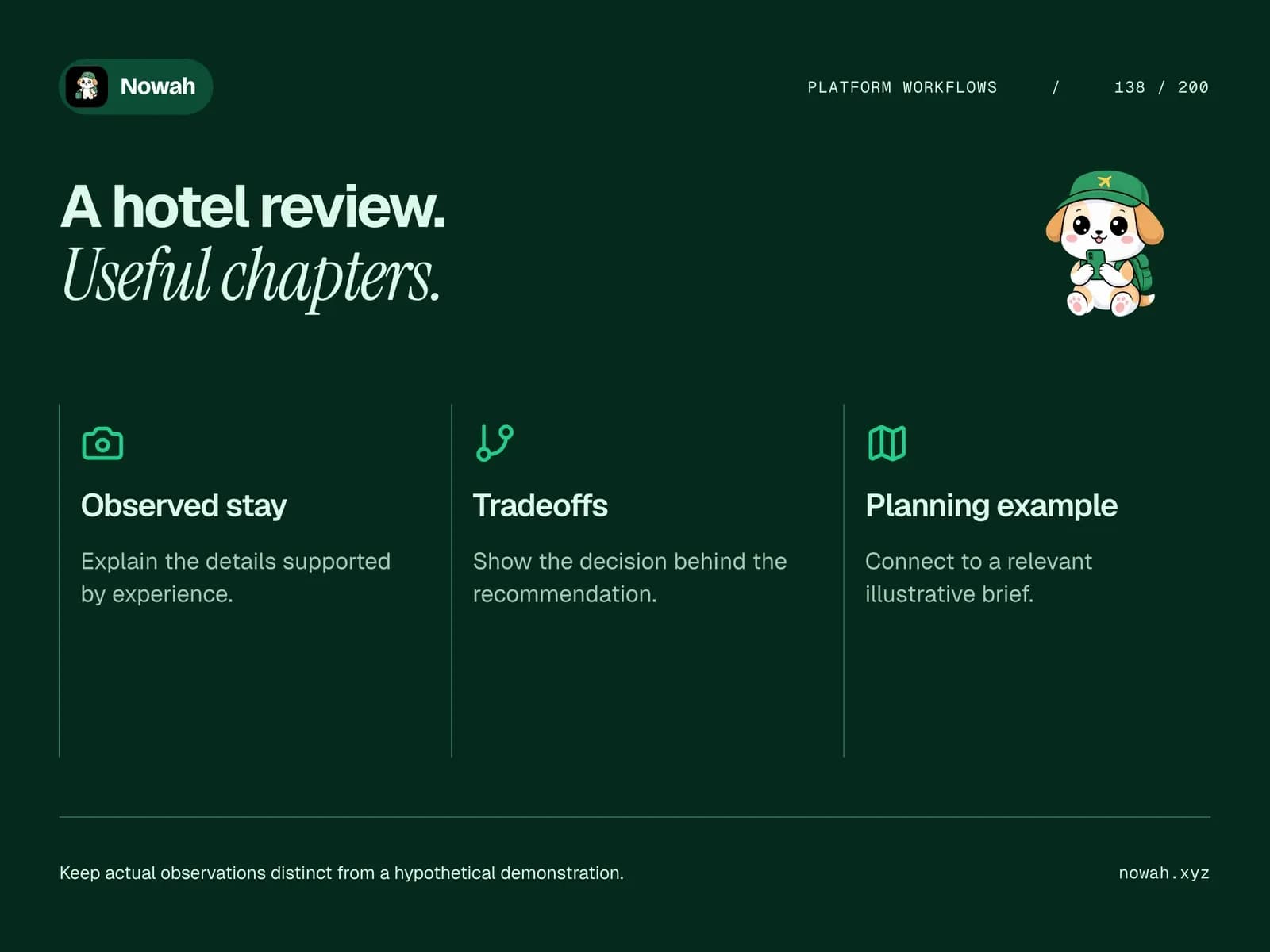
A long hotel review can contain beautiful footage and useful observations while still leaving viewers unsure how the property relates to their own trip. A clear chapter map helps organise the evidence and the decisions it can inform.
Nowah can play a practical role in the planning part of that review. You can move from an observed detail to a labelled fictional brief, show the relevant planning task and explain which hotel or supplier questions still need checking. Approved Nowah partners can earn 35% of Nowah net revenue from qualifying bookings by eligible new accounts they introduce.
The product recommendation should arise from that useful explanation. It should not depend on presenting every hotel as ideal, inventing a stay or treating an attractive room as proof of partner earnings.
Define the review's central question
Choose the decision your review helps a viewer investigate. It might concern a hotel's location, the room category you observed or the relationship between the property and the surrounding trip.
A broad promise to cover everything can make the video difficult to organise. A clearer question lets you decide which footage matters and which material belongs in a separate piece.
State the scope of your observation. If you stayed, describe the specific room and circumstances your evidence supports. If the review is researched rather than first-hand, say so and identify the source roles honestly.
Do not imply that one recorded experience establishes every guest's future stay. A filmed room can support observations about that room, while current booking conditions require their own evidence.
The luxury review evidence guide offers a related way to distinguish source types, even when your main format is video.
Build an evidence index before the chapter list
List the claims you might make and the evidence supporting each. Include the footage, source, checked date where relevant and the limits of what it establishes.
An observed room layout may be supported by your actual footage. A property-wide service claim may depend on current supplier information. A hypothetical planning example illustrates reasoning rather than proving a real traveller outcome.
Give unresolved questions their own place in the index. This prevents the edit from quietly converting uncertainty into a confident statement.
If a detail is room-specific, note that limitation. If a fact can vary by rate, dates or occupancy, record those conditions rather than presenting it as universal.
This index is an editorial tool you maintain. Do not suggest that Nowah automatically verifies every statement in a hotel review or supplies a special creator evidence dashboard.
Organise chapters around reader decisions
Create a chapter map in which each section has a clear job. An opening scope statement can explain what you observed. Later sections can examine the relevant room or location detail, the traveller tradeoff, the planning example and the remaining checks.
Use the map as an editing structure. If you intend to publish navigable chapters through YouTube's current tools, check the applicable setup separately rather than assuming that a written outline alone configures them.
Give each chapter a useful question. “What does the location change about this trip?” provides a stronger organising principle than a collection of unrelated shots.
Avoid repeating the same recommendation in every section. The review can build toward a relevant Nowah action while allowing evidence, reasoning and qualifications to have their own space.
The long-form Nowah demonstration outline helps develop the planning chapter when it needs more than a brief product mention.
Keep observation and planning visibly separate
A viewer should understand when the video moves from describing a hotel to investigating a fictional trip.
Introduce the illustrative brief clearly. State the relevant party, timing constraints and priorities without borrowing another person's private details or presenting the scenario as a real follower's holiday.
Then explain why the observed hotel detail matters to that brief. A workspace may prompt questions about a working morning. A location may affect how you investigate arrival or event logistics. A room arrangement may raise occupancy questions.
Show only Nowah behaviour you can verify in the current product. A planning output should not be presented as a booking confirmation, an availability guarantee or proof that the hotel meets a particular requirement.
Keep supplier-dependent questions visible after the demonstration. A useful plan can help organise research while still leaving actual room conditions or transport arrangements to confirm.
A fictional chapter map for a short break
Imagine a creator preparing a long-form review that includes genuine observed accommodation footage. The planning segment below is hypothetical and describes no real referral or booking result.
The first section explains the review's scope and the evidence behind the footage. The next examines the specific room or location detail relevant to the video's main question.
A tradeoff section introduces a fictional short-break brief with a fixed event and an early departure. The creator explains why a hotel-area choice needs to be considered alongside the day structure.
The Nowah chapter investigates that brief and shows a relevant revision. The creator identifies what changed and why, then separates the illustrative planning conclusion from supplier facts still needing current evidence.
A closing research section lists those remaining questions and explains the appropriate next action. The Nowah partner relationship is clear with the recommendation.
This structure gives each type of evidence a role. It does not claim that a map, room clip or fictional plan establishes universal suitability.
Create a chapter-evidence worksheet
For each planned section, record:
- The viewer question it answers.
- The important claim or observation.
- The footage or source supporting that statement.
- The qualification that needs to remain visible.
- The practical conclusion the viewer can use.
- The connection to the next section.
Read the worksheet as a sequence. Does the reasoning develop, or does the video jump between attractive details without explaining their relevance?
Use the connection field to identify where Nowah genuinely helps. If the product appears only as an unrelated promotion after the review, consider whether the planning question needs a clearer role.
Nowah's article on the anatomy of a hotel recommendation provides background for connecting facts to requirements. Your own review still needs evidence for the property statements it makes.
The worksheet can also help another editor understand why a qualification should not be cut merely to shorten a section.
Make comparison and independence clear
A hotel review can recommend further research without declaring the property best for every traveller. Explain the priorities under which an observed feature is relevant and the circumstances in which it may matter less.
Do not rank suitability by the commission you might earn. A more expensive-looking room does not establish Nowah net revenue or the partner share from a future qualifying booking.
If you compare actual offers, match the important conditions and use current evidence. Different dates, occupancy, inclusions or cancellation rules can make a headline comparison misleading.
Disclose relevant commercial relationships independently. A hosted-stay agreement with a hotel is separate from a Nowah referral relationship. Do not imply that Nowah supplied a complimentary stay, upgrade or special benefit without evidence.
The independent judgement guide explores that separation between commercial interest and the traveller's requirements.
Offer the right next action
Tell viewers that you are a Nowah partner and may earn commission from qualifying referrals. Use applicable current platform disclosure tools, and make the relationship understandable where the recommendation occurs.
Check the actual external-link route on your channel and the destination it reaches. A traveller researching a trip needs a different explanation from another creator applying to the program.
Approved partners should use the active traveller route supplied through onboarding. Do not invent a referral address or assume that a general application page creates account attribution.
For creators interested in joining, the official partner portal is the appropriate application destination. Explain why useful, evidence-led travel content fits the offer instead of promising an automatic income.
The final invitation should continue the review's practical question. If the video explored a hotel-area tradeoff, the next destination should help the viewer understand that kind of research task.
Keep the earning conditions accurate
The Nowah program terms require an eligible traveller to follow an active partner link and create a new account within 30 days of introduction. Successful tracking is necessary, while existing accounts and self-referrals are excluded.
Later qualifying hotel, flight and paid eSIM bookings may produce earnings for an attributed account's lifetime. That continuing attribution does not guarantee repeat travel.
The 35% share applies to Nowah net revenue, not the traveller's full hotel bill. Completion, supplier settlement, the relevant hold and payout conditions remain part of the process.
A review view or a question about a room is not evidence that those stages have occurred. Keep the commercial opportunity tied to a valid, useful introduction rather than a fabricated result.
Before publishing, compare the edit with the chapter-evidence worksheet. Check scope, source-dependent claims, qualifications and the destination. If useful hotel explanations fit your audience, apply to Nowah Partners with a clear account of the decisions your content helps travellers investigate.




