The DX Audit: How to Evaluate Your API's Developer Experience
A structured framework for auditing DX quality — onboarding time, error clarity, documentation coverage, tooling completeness. Score your API across 10 dimensions with our rubric.
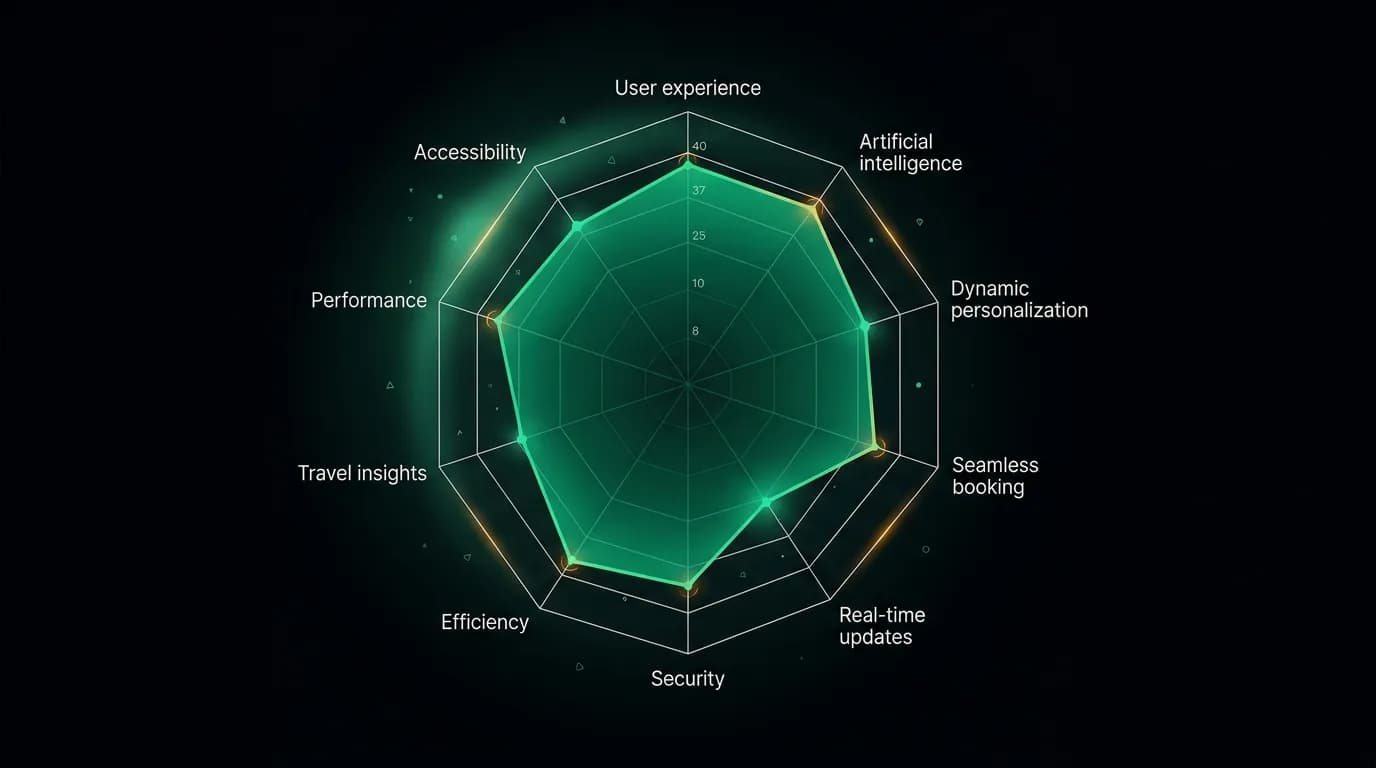
We audited our own developer experience eighteen months ago. We thought it was "pretty good." The audit revealed four gaps we had been blind to: our sandbox required authentication (defeating its purpose), our error messages lacked resolution steps, our CLI had no offline mode, and our documentation search returned irrelevant results for the most common queries.
Every API team thinks their DX is fine. An audit replaces that assumption with data. Here is the framework we use, both internally and as a lens for evaluating the broader travel API landscape.
The 10 dimensions

We score DX across ten dimensions, each rated 1 (poor) to 5 (excellent). The dimensions cover the full developer journey from first discovery to production at scale.
1. Onboarding speed. How long from sign-up to first successful API call? Score 1: over a week. Score 3: one day. Score 5: under five minutes with self-serve tools.
2. Documentation quality. Are docs comprehensive, accurate, and searchable? Score 1: incomplete or stale. Score 3: complete but hard to navigate. Score 5: tested in CI, searchable, with feedback loops.
3. SDK quality. Are SDKs type-safe, well-documented, and idiomatic? Score 1: no SDK, raw HTTP only. Score 3: SDKs exist but are auto-generated with minimal polish. Score 5: SDKs in 3+ languages with convenience methods and comprehensive error types.
4. CLI tooling. Does a CLI exist? Is it useful for daily workflows? Score 1: no CLI. Score 3: basic CLI with limited commands. Score 5: full-featured CLI with interactive modes, scripting support, and integration with developer workflows.
5. Sandbox. Can developers experiment without consequences? Score 1: no sandbox. Score 3: sandbox exists but requires setup. Score 5: zero-setup sandbox with pre-filled examples and deterministic test data.
6. Error messages. Do errors explain what went wrong and how to fix it? Score 1: generic HTTP status codes only. Score 3: error codes with descriptions. Score 5: specific codes, resolution steps, documentation links, and request IDs.
7. AI agent readiness. Can an AI agent use the API effectively? Score 1: no structured schemas. Score 3: OpenAPI spec exists but is incomplete. Score 5: comprehensive tool schemas, deterministic responses, and agent-optimized documentation.
8. Webhook DX. How easy is it to integrate and debug webhooks? Score 1: no webhooks. Score 3: webhooks exist but no debugging tools. Score 5: delivery logs, replay, signature helpers, and local forwarding.
9. Dashboard. Does a management interface exist? Is it useful? Score 1: no dashboard. Score 3: basic dashboard with key management. Score 5: real-time metrics, log viewer, analytics, team management, and billing.
10. Community. Is there a developer community around the platform? Score 1: no community presence. Score 3: documentation-only support. Score 5: active forum, regular content, developer spotlights, and responsive team engagement.
Scoring rubric: what each level looks like
The difference between a 3 and a 5 is the difference between "it works" and "it is a pleasure to use." Specific criteria at each level prevent subjective inflation.
For documentation (as an example), score 3 requires: all endpoints documented, parameter descriptions present, at least one example per endpoint. Score 4 adds: error documentation, tested examples, and search functionality. Score 5 adds: examples tested in CI, "was this helpful?" feedback, and quarterly review process.
The rubric forces honesty. When you have to justify why you gave yourself a 4 instead of a 3 based on specific criteria, the score becomes meaningful rather than aspirational.
Competitive benchmarks
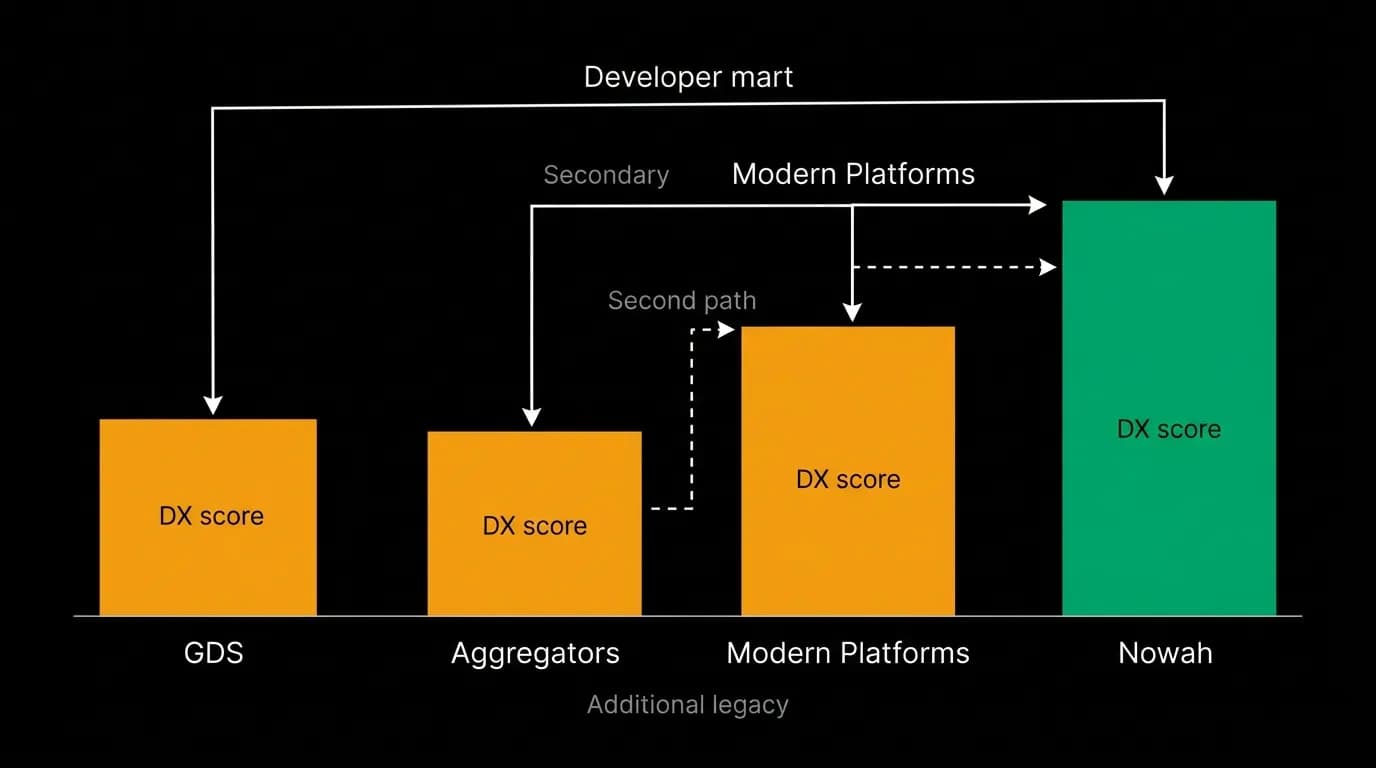
We benchmark across four categories of travel API provider.
Legacy GDS systems (global distribution systems from the 1980s-90s) typically score 1-2 across all dimensions. Their APIs expose ancient message formats. Documentation is dense and legalistic. No SDKs. No sandbox. No dashboard.
Aggregators score 1-3. Better documentation than GDS. Some have basic SDKs. Sandboxes are rare or require manual setup. Error messages are often opaque.
Modern platforms score 2-4. Good documentation. SDKs in multiple languages. Some have dashboards and CLIs. Error messages are generally clear. Webhooks are usually available.
Nowah targets 4-5 across all dimensions. Our weakest dimension today is Community (we are still early), and our strongest are Error Messages and Sandbox.
The biggest gap in the entire travel API market is AI Agent Readiness. No provider currently scores above 4 on this dimension. Most score 1-2. This is the opportunity we are pursuing most aggressively.
Prioritization: what to fix first
Not all dimensions are equally important, and improving them is not equally difficult. We use an impact-effort matrix to prioritize.
High impact, low effort: Error messages. Improving error messages requires changing string literals and adding documentation pages. The impact on support ticket volume and developer satisfaction is immediate and measurable.
High impact, high effort: SDK quality. A good SDK takes months to build and maintain. But it defines the day-to-day developer experience and drives adoption.
Low impact, high effort: Community building. Community compounds over time but takes months to years to show measurable ROI. Start early but do not prioritize over more immediate wins.
The typical audit produces a prioritized roadmap of improvements. We recommend fixing the lowest-scoring dimensions first, weighted by impact. A dimension scored at 1 with high developer impact should be the top priority regardless of effort.
Running the audit
A thorough DX audit takes two to three weeks and involves four activities.
Developer interviews. Talk to five to ten developers at different stages (new, active, churned). Ask open-ended questions about their experience. Do not prompt with your dimensions list -- let pain points emerge naturally.
Metric collection. Pull data for time-to-first-call, support ticket volume, documentation page views, error rates, and SDK adoption. Numbers do not lie, even when perceptions are positive.
Scoring sessions. Gather your team, review the rubric, and score each dimension. Disagree productively. If two people score the same dimension differently, the discussion about why is the most valuable part of the audit.
Report and roadmap. Summarize scores, highlight gaps, and map improvements to a quarterly roadmap. Share the report with the broader team -- transparency about DX quality creates motivation to improve it.
We run this audit internally every six months. Each audit produces a handful of high-priority improvements that go directly into the next quarter's engineering plan. The scores trend upward over time, which is the point. A DX audit is not a one-time activity. It is a recurring investment in self-awareness.
Nowah is an AI travel agent that searches and books real flights and hotels through conversation — no filters, no thirty open tabs. Plan your next trip.