The Great Unbundling of Travel: AI Recomposes Booking
Travel was bundled into OTAs. AI is unbundling it into personalized, agent-driven experiences. Here is the history and where it is heading.

Travel booking has gone through two major structural shifts. The first was bundling: travel agencies packaged flights, hotels, and activities into coherent trips. The second was unbundling: online travel agencies broke those packages apart and let consumers assemble their own trips from individual components. We are now in the third shift: AI is rebundling everything, but in a fundamentally different way than travel agencies ever could.
Understanding this cycle explains why AI-native travel platforms are not just incremental improvements over OTAs. They are a different category of product.
The bundled era: human travel agents
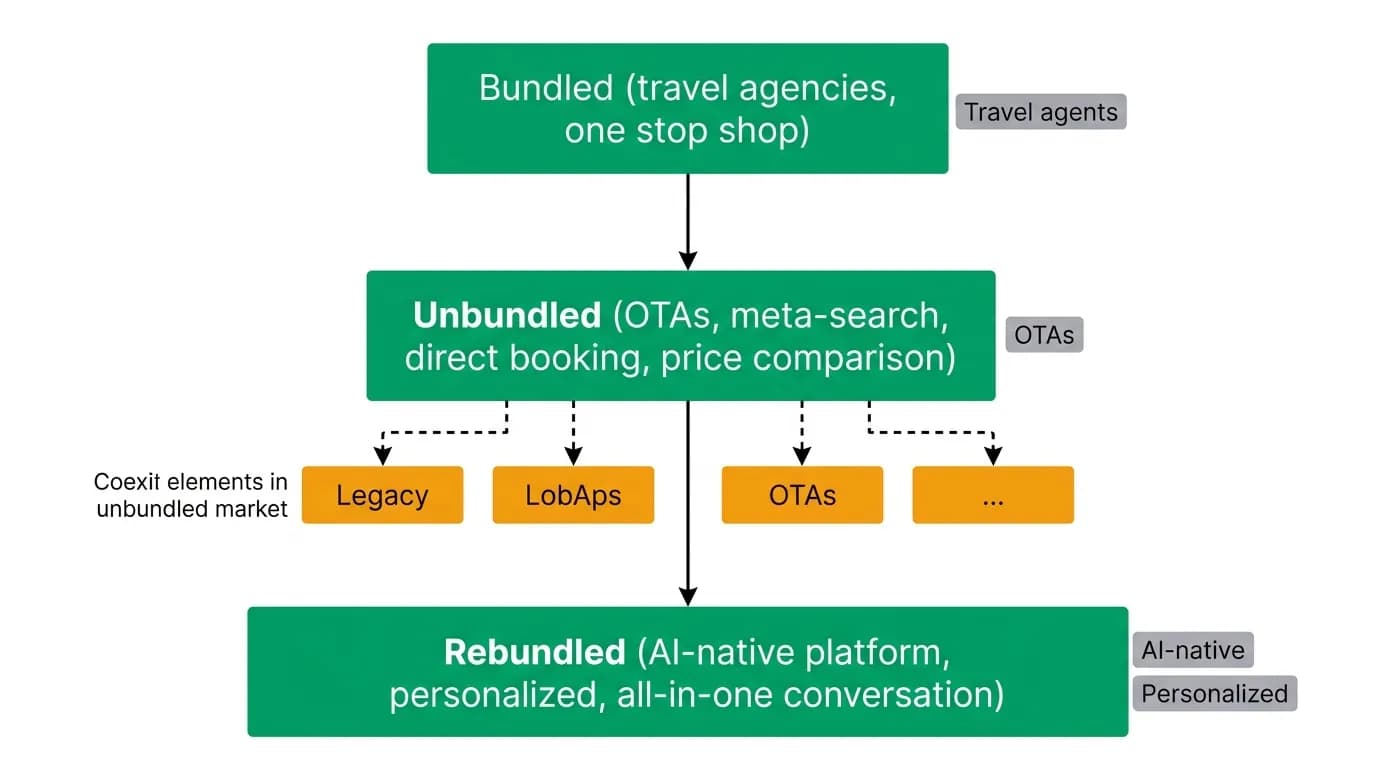
Before the internet, booking travel meant visiting a travel agent or calling one on the phone. The agent knew the inventory. They knew which airlines flew which routes. They had relationships with hotels. They understood visa requirements and connection times and which airports were nightmares.
The service was personalized because it was human. Your travel agent remembered that you hated red-eye flights. They knew you preferred window seats. They knew your budget range without asking because they had booked your last five trips.
The trade-off was access and cost. You could only work with agents during business hours. The selection was limited to what your agent knew about and had access to. The service was expensive because human expertise does not scale.
The unbundled era: OTAs and meta-search
The internet unbundled travel. Suddenly consumers could access airline inventory directly. Hotel booking sites aggregated thousands of properties. Meta-search engines compared prices across OTAs. The access problem was solved. Anyone with a browser could search every airline and hotel on the planet at 2 AM in their pajamas.
But unbundling created new problems. The personalization disappeared. OTAs treat every user the same. You fill out the same search form whether you are a frequent business traveler or a first-time vacationer. The results page shows the same 500 options regardless of your preferences. You became your own travel agent, and it turns out that most people are bad at it.
The global online travel market is worth over $800 billion annually, and OTAs capture roughly 40% of that. That market share was earned by solving the access problem. The question is whether solving the personalization problem can capture even more.
The rebundled era: AI agents
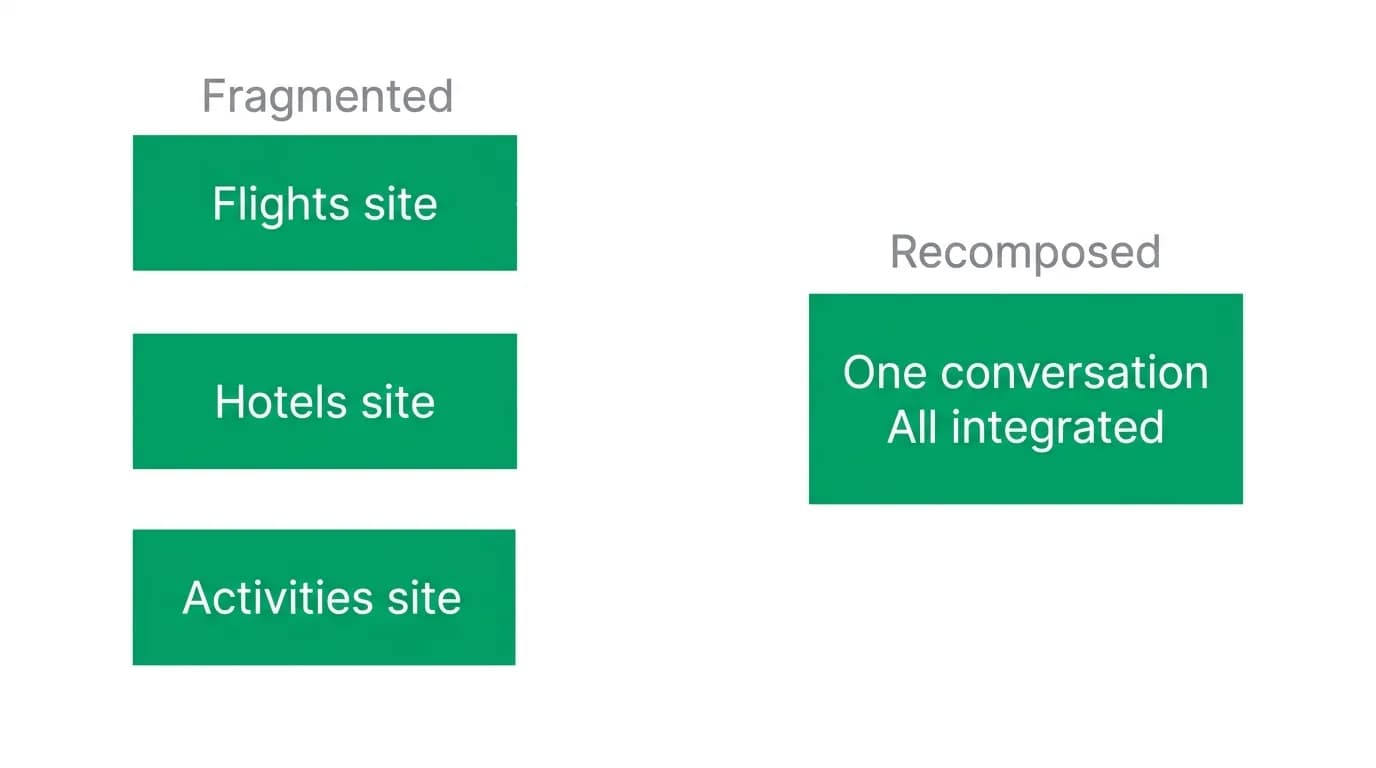
AI enables something that was never possible before: personalized service at digital scale. A human travel agent could serve maybe 50 clients well. An AI agent can serve millions, and it can remember every preference, every past trip, and every conversation with each one.
This is the rebundling opportunity. Not packaging pre-built bundles like the old travel agencies did. Building custom bundles for each user based on their specific preferences, constraints, and history.
When you tell an AI travel agent "plan me a trip like the one I took to Italy last year but somewhere new," that request draws on memory of your past trip (dates, budget, accommodation style, activities), your stated preferences (you like walking cities, you hate tourist traps), and your constraints (you have a week off work, you need a direct flight from your home airport). The agent synthesizes all of this into a personalized recommendation that no OTA search form could produce and no human travel agent could deliver at scale.
Personalization as competitive advantage
The OTAs' competitive advantage was inventory breadth. They won by showing you the most options. But showing more options stopped being an advantage when every OTA had access to the same inventory through the same APIs. Today, searching for flights on any major OTA returns essentially the same results. The differentiation collapsed to price, and price wars erode margins for everyone.
AI-native platforms compete on a different axis: understanding the user. The platform that knows you best makes the best recommendations. The platform that makes the best recommendations earns the most bookings. The platform that earns the most bookings learns the most about you. This is a flywheel that OTAs cannot replicate because their architecture does not support persistent user understanding.
Over 70% of travelers say they are open to AI-assisted trip planning. The appetite is there. The question is which platforms can deliver on the promise.
Trust in AI-mediated transactions
The rebundling thesis only works if users trust the AI agent as much as they trusted their human travel agent. That trust has to be earned incrementally.
Human travel agents earned trust through repeated interactions. You started with a simple domestic flight. When that went well, you booked a vacation. When that went well, you trusted them with your honeymoon. Each successful interaction built confidence.
AI agents need to follow the same pattern. Start by proving that the search results are good. Then prove that the recommendations match preferences. Then prove that the booking process is reliable. Then prove that problems are handled gracefully. Trust is not a feature you ship. It is a metric that grows over time.
The technology to deliver trustworthy AI travel agents exists today. The language models are good enough. The travel data APIs are comprehensive enough. The payment infrastructure is robust enough. What is still being built is the track record. And track records take time.
Market predictions
Travel is projected to be a top-three industry for AI agent adoption by 2027. I believe this is accurate, and I think the shift will happen faster than most people expect.
The window of opportunity for AI-native challengers is open right now. Incumbents are constrained by legacy architecture, existing revenue models, and organizational inertia. They will adapt eventually. But "eventually" in enterprise technology means years, and years is enough time for AI-native platforms to build the user base and trust that incumbents will struggle to compete with.
The companies that win this transition will be the ones that understand it is not about adding AI to travel booking. It is about rebuilding travel booking around AI. Those are different projects with different architectures, different business models, and different outcomes.
The unbundling-rebundling cycle has happened in industry after industry. Media. Finance. Retail. Each time, the rebundlers built something that looked nothing like the original bundled product, but served the same fundamental need better. Travel's version of this cycle is starting now.
Nowah is an AI travel agent that searches and books real flights and hotels through conversation — no filters, no thirty open tabs. Plan your next trip.