Hotel Recommendations Are Broken — AI Can Fix Them
Star ratings and review scores tell you nothing about whether YOU will like a hotel. AI matching based on your actual preferences does.

An 8.5 out of 10 hotel review score tells you almost nothing useful. It tells you that the average of all guests, across all trip types, all seasons, all room categories, rated this hotel 8.5. It does not tell you whether you will like it.
A business traveler who needs fast wifi and a quiet room rates the same hotel differently than a couple looking for a romantic atmosphere and rooftop bar. A family with young children cares about different things than a solo backpacker. The review score averages all of these perspectives into a single number that is relevant to none of them.
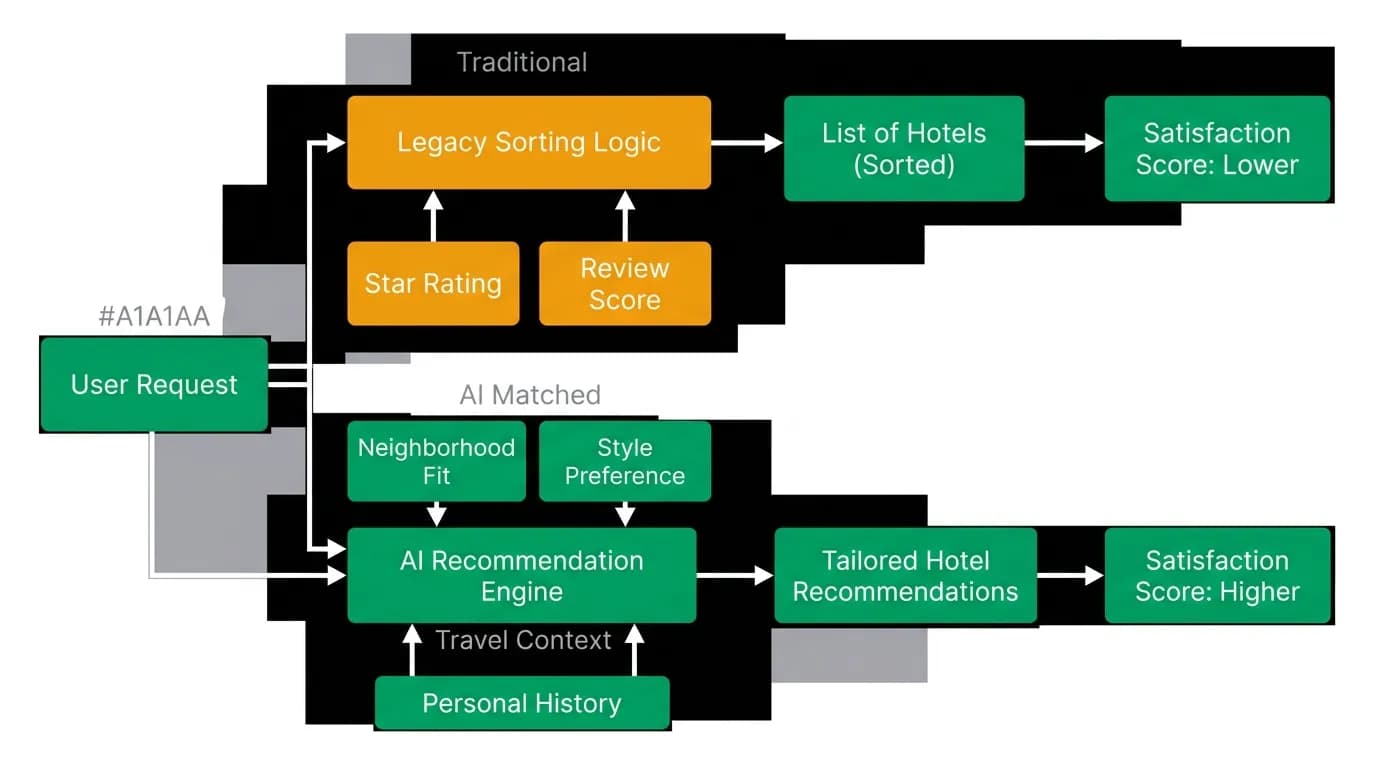
Hotel recommendations on traditional platforms are broken because they rely on these meaningless aggregates. Star ratings, review scores, and sort-by-price. None of these tell you whether a specific hotel matches your specific preferences on your specific trip. AI can do what star ratings cannot: match the hotel to the traveler.
The review score illusion
Consider two hotels in Rome, both rated 8.5/10 on a major platform.
Hotel A is a large business hotel near the train station. Efficient check-in. Good gym. Fast wifi. Soundproofed rooms. Functional decor. The 8.5 comes from business travelers who appreciate reliability and convenience.
Hotel B is a small boutique hotel in Trastevere. Charming courtyard. Unique room layouts. Amazing location for restaurants and nightlife. Thin walls. Slow elevator. The 8.5 comes from leisure travelers who love the character despite the quirks.
If you are a couple on a food-focused holiday, Hotel B is perfect and Hotel A would be disappointing. If you are on a business trip, Hotel A is perfect and Hotel B would frustrate you. The review score is identical. The actual fit is completely different.
Forty percent of travelers report post-booking regret. Mismatched hotel expectations are one of the primary causes. They chose based on the number, not the nuance.
Neighborhood trumps amenities
For most leisure travelers, hotel location matters more than hotel amenities. A mediocre hotel in a great neighborhood beats a great hotel in a bad neighborhood.
But traditional platforms rank by amenities and reviews, not by neighborhood fit. They might let you filter by area on a map, but the map does not know what you care about. It does not know that you want to be near interesting restaurants, or near the art district, or within walking distance of the beach.
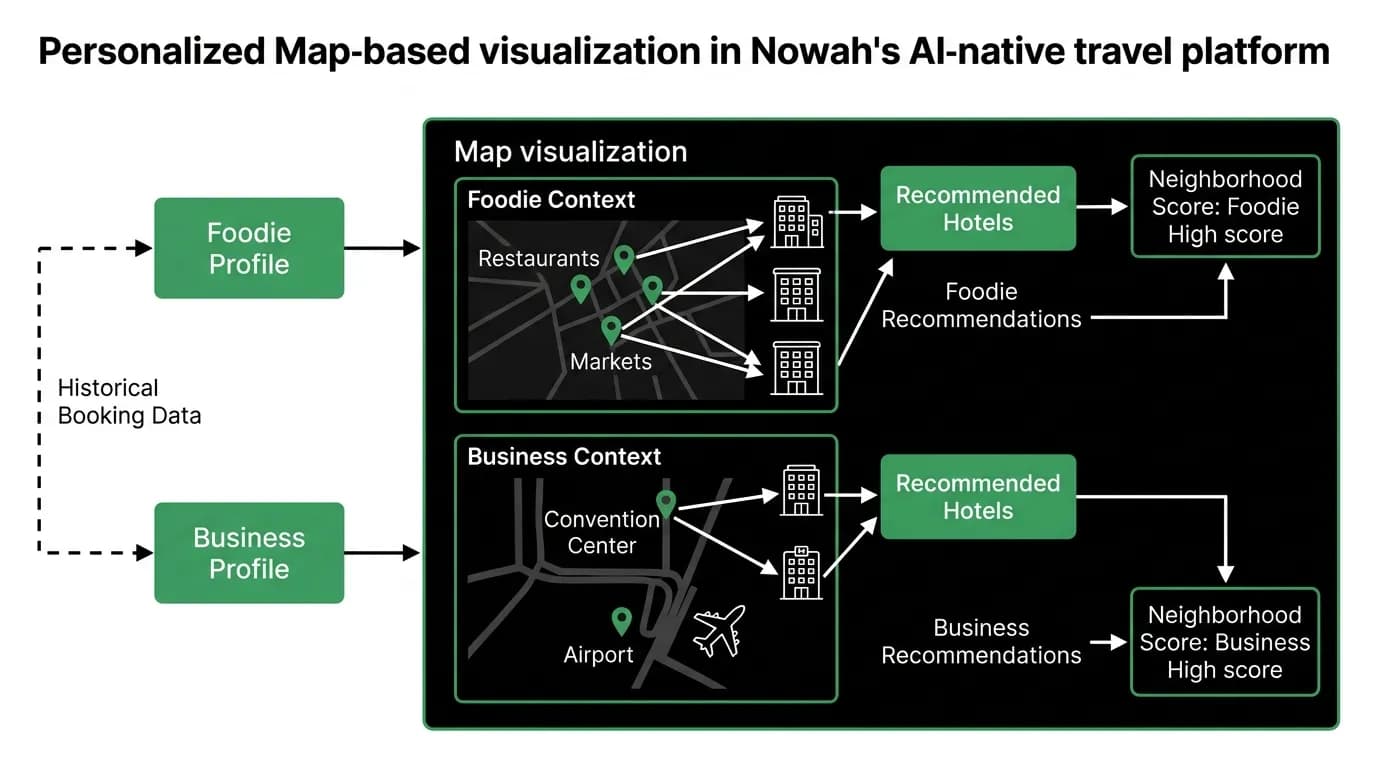
AI hotel recommendations incorporate neighborhood intelligence. For a user who loves food (known from their preference profile or stated in conversation), the agent evaluates each hotel's proximity to restaurants, markets, and food streets. For a user who values walkability, it scores pedestrian access, distance to public transit, and neighborhood safety.
The same city produces different hotel recommendations for different travelers. A food-focused visitor to Rome gets hotels in Trastevere and Testaccio. A history-focused visitor gets hotels near the Forum and Pantheon. A family gets hotels in quieter residential areas with parks nearby.
Hotel personality matching
Hotels have personalities. Some are slick and modern. Some are historic and ornate. Some are minimalist and design-forward. Some are warm and eclectic. Some are anonymous and functional.
Traditional platforms describe hotels through amenity lists: pool, gym, restaurant, spa. These lists miss the personality entirely. Two hotels can have identical amenity lists but feel completely different to stay in.
AI agents learn hotel personality preferences from your history. If your last three hotels were independent boutiques with character, the agent knows not to recommend a generic international chain, even if the chain scores higher on reviews.
Context matters too. The same traveler might want a boutique hotel for a vacation and a reliable chain for a business trip. The agent considers trip context, not just general preference.
Context-aware recommendations
The same traveler needs different hotels for different trips. This is obvious but traditional platforms cannot handle it because they have no concept of trip context.
On a business trip: you want proximity to the meeting venue, reliable wifi, a desk in the room, and easy airport access. Aesthetic charm is secondary.
On an anniversary trip: you want atmosphere, a great neighborhood for evening walks, restaurant proximity, and maybe a room with a view. Wifi speed is irrelevant.
On a family trip: you want space (suites or connecting rooms), kid-friendly facilities, safe neighborhood, breakfast included, and proximity to family attractions.
An AI agent that knows the trip purpose, from the conversation context, adjusts its ranking criteria automatically. "I'm traveling for work next Tuesday" triggers business-optimized hotel search. "Planning our anniversary trip" triggers romance-optimized search. No filter toggles needed.
Beyond star ratings
The signals AI uses that traditional platforms ignore:
Review text analysis. Not the score, the content. What do people actually say? "The neighborhood was loud at night" is useful information for a light sleeper. "Amazing breakfast spread" matters to some travelers and not others. AI can parse thousands of reviews and extract the signals relevant to your preferences.
Photo analysis. The gap between marketing photos and reality is significant. AI can analyze guest-uploaded photos to assess actual room quality, view accuracy, and condition.
Repeat guest patterns. Hotels where guests return are different from hotels where guests visit once. Repeat booking data is a strong quality signal.
Price-quality ratio. A $150/night hotel that delivers a $200 experience is a better recommendation than a $200/night hotel that delivers $200 of value. AI can identify these value outliers.
Users shown AI-curated hotel results report higher satisfaction than users who browse and select from 50+ options. The best hotel booking experience is not the one that shows you the most hotels. It is the one that shows you the right hotel.
OTA hotel commission rates of 15-25% create an incentive misalignment between platforms and travelers. Platforms are incentivized to promote high-commission properties. An AI agent working for the traveler has no such conflict. The hotel it recommends is the one that best matches your preferences, regardless of commission structure.
Average booking value for AI-assisted hotel bookings is 15-20% higher. Travelers book better hotels, not just cheaper ones, when the recommendations actually match what they want. That is the entire point. Hotel recommendations should help you find the hotel you will love, not the hotel with the highest review average. AI makes that possible.
Nowah is an AI travel agent that searches and books real flights and hotels through conversation — no filters, no thirty open tabs. Plan your next trip.